James Burke died in a Buffalo hospital room in the spring of 1996, a dying man under prison guard whose story millions of people already knew from a movie. Robert De Niro had played a version of him in "Goodfellas." The newspapers called him Jimmy the Gent, and investigators called him the mastermind of the largest cash robbery the country had ever seen.
The law never charged him for it. Not that year, not ever.
His answer to the law was always silence, and that silence started early. At 18, arrested for passing bad checks, Burke was offered the oldest deal in the book: name the man you work for and walk free. By the account his world carried, he refused and took the prison term instead.
He was a teenager with a borrowed name, and he chose the wall. Then he kept choosing it.
Through every arrest that followed, through the investigations that circled Kennedy Airport for years, through the convictions the law did manage to win, the record shows no deal, no testimony, no cooperation. The men who hunted him never doubted what he had done, and some said so in plain words. What they could never do was prove it in a courtroom.
The silence had a beginning older than any police station. It starts with a boy passed from home to home.
By the account his biographers assembled, his mother surrendered him to the foster system as a toddler, and the system passed him along through a string of foster homes. The record those biographers kept speaks plainly about what some of those houses held, violence among the gentler parts of it.
He was still a boy when the worst of it arrived. During an argument in a moving car with the boy inside, his foster father lost control of the wheel. The crash killed the man. By the tellings that survived, some in the house blamed the boy, and the beatings that followed made the point.
One family finally kept him. The Burkes took him in, and he took their name and carried it for the rest of his life. By the account his world told later, he never forgot the people who had been kind to him in those years, and he paid those debts for decades, quietly and in person.
The rest of his education came from the street, and the street taught fast. Small crimes came first, then organized ones. By his late teens he was running errands at the edge of a world that had rules of its own.
In 1949, that world tested him. Arrested for passing counterfeit checks, he was offered the name of the man he worked for, a man connected to the outfit later called the Colombo family, in exchange for the door. By the account that outlived everyone involved, he said no.
He took the prison term instead. The length of that term is one of the details the tellings disagree on, so it cannot be stated with confidence. What matters is what the choice bought.
In the world he was entering, a man who held his tongue under that kind of weight became something rare and valuable, and word of it traveled. References in that world moved by word of mouth, boss to boss. The Irish kid with the borrowed name could not be made, not with his blood, and the Italians who ran the rackets did not care.
A man who would do the work and never talk about it afterward was worth more than most men who could sit at the table. When he came out of prison, the reputation came out with him.
He put it to work at the one place in New York where everything valuable eventually sat still on a loading dock, waiting. The airport out on the edge of Queens was growing into one of the busiest cargo gateways in the country.
Out past the last subway stop, the runways of what was then called Idlewild sat behind fences guarding some of the richest freight in America. The freight had to travel by truck to reach the city that bought it, and a man with the right friends could learn the exact hour a load worth stealing would be rolling slow toward a light.
Burke made himself the man with the right friends. By the accounts of the era, he built his trade on information first and muscle second, buying schedules from freight handlers and dispatchers the way other men bought stock. The trucks began to disappear.
The nickname came out of those years, and it came with a story attached. By the tellings his own world spread, Burke would press folded bills into the hands of drivers he had just robbed, a tip for the inconvenience. The drivers learned there were worse men to be stopped by.
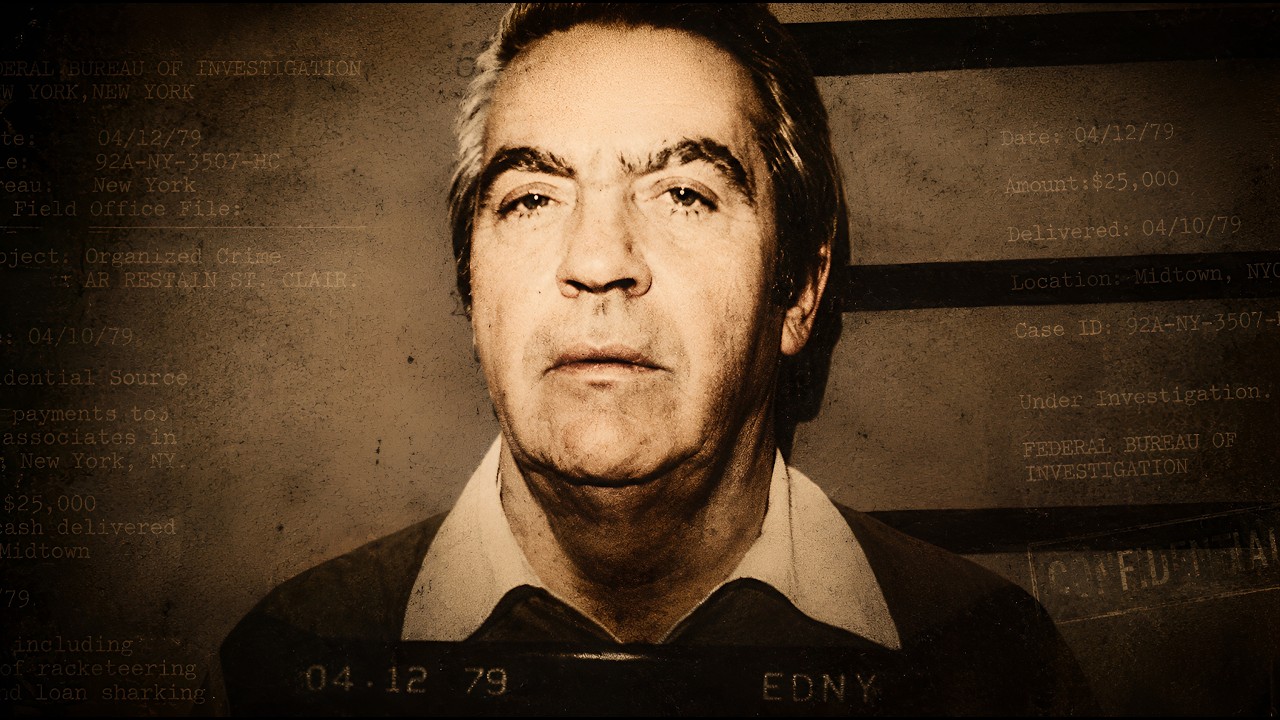
The stories called him Jimmy the Gent, and the name stuck for the rest of his life. The stories were carried mostly by men with reasons to polish them.
What the record carries flat is simpler. The hijackings around that airport became an industry, and the name that traveled with that industry was a borrowed one.
He could rise, and he did, but there was a ceiling over him and everyone knew where it hung. The families who licensed that world took members only from their own blood. Burke was an associate of the Lucchese crime family, never a made man, because the Irish kid could not be made at all.
It did not matter. An associate who produced the way Burke produced was worth a seat no ceremony could give, and the Lucchese men above him treated his operation as one of the borough's reliable engines. The families kept a buffer between themselves and the trucks, and Burke kept a franchise no made man could take from him without losing what he earned.
He paid up the chain. He kept his crews quiet, and he kept himself exactly where a man who never talked belonged: close to everything, signed to nothing.
In 1967, the method showed what it could do at full size. A cargo robbery at the Air France terminal emptied a holding room of one of the biggest cash scores the airport had ever surrendered, by the accounts of the era and by the account Henry Hill told for the rest of his life. The job ran through Burke's world and made reputations inside it.
Hill is a source quoted with caution, and the claim rides as his. What nobody disputes is what the era's record shows around it. By the close of the 1960s, cargo crime at that airport had grown into a problem drawing federal attention, and the name investigators kept hearing at the center of it belonged to Jimmy the Gent.
The money needed somewhere to land, and the men who made it needed somewhere to drink. He bought a bar.
The bar was called Robert's Lounge, and it sat in South Ozone Park, close enough to the airport that the planes crossed low over the roof. On paper it was a tavern Burke owned. In practice, by the accounts of the men who drank there, it was a courthouse for a jurisdiction the law did not recognize.
It was the room where scores were planned, shares were argued, debts were called in, and the airport's stolen cargo found its buyers. The accounts describing those rooms come mostly from men who later traded their memories for leniency, and that should be remembered.
What sits outside dispute is the address, the owner, and the traffic. The bar also held a crew, and the crew explains the years that followed.
Above Burke stood Paul Vario, the Lucchese captain whose blessing licensed everything the lounge produced. A heavy-set man who by the accounts of the era ran his piece of Brooklyn and Queens from cabstands and junkyard offices, Vario let Burke run the airport. His blessing made the blood ceiling academic, because the license mattered more than the membership.
Below Burke came the young men. Henry Hill was half-Irish like Burke, half-Sicilian, useful and talkative in equal measure. Tommy DeSimone was the volatile young gunman whose short and violent story has been told separately.
The lounge made them a unit long before the movie made them famous, and the movie, when it came, rearranged them. One rearrangement matters here. In the film, the De Niro character delivers a young man a lesson in two rules: never rat on your friends, and always keep your mouth shut.
Whether James Burke ever gave that speech, the record cannot say. What it holds instead is this: by every account it kept, the man himself lived both rules to the end, which is more than can be said for some of the men around him.
The law kept trying to find a charge that would hold. In 1972, it found one, and the conviction shows what the big cases kept missing. Burke and Hill went to prison over a violent debt collection, an extortion case built on a beating, and the sentence took Burke off the street for the middle of the decade.
It was the second time the system had held him, and the second time it had held him for something small. The hijackings, the fences, the airport itself, the whole industry investigators kept attaching to his name stayed exactly where charges could not reach it. He served his time quietly, and the lounge was waiting when he came back.
So was the airport, and it had grown richer while he was away. By the accounts of the era, the cargo moving through Kennedy by the late 1970s had made the airport one of the most valuable robbery targets in the country. The man who knew its schedules best had spent his whole career proving that nothing he knew would ever reach a courtroom through him.

That combination was about to be tested at a scale no one in the lounge had imagined. The biggest tip of his life was already moving toward that bar, and the strangest winter of his life was moving with it.
The tip came from inside the airline. A cargo supervisor at Lufthansa, buried under gambling debts to the wrong lenders, knew that the value moving through his building on certain nights was, by the accounts of the era, beyond anything the airport had ever held. His debt found its way to the men who could use what he knew.
The court record would later fix his name and his role precisely, because he became the one man the courtroom ever reached. The chain that carried his information to South Ozone Park was mapped by investigators and told by informants, and every version of the map ended at the same bar.
On December 11, 1978, in the early morning dark, a van rolled through the gates of the Lufthansa cargo terminal. By the accounts of the investigation, the men inside moved like a crew that had rehearsed on the building's own schedule. The night workers were rounded up in the first minutes.
The vault was opened the way vaults are always opened, by the people who knew it, doing what armed men told them to do. The cash and the jewels left in the same van before the morning shift arrived, and most of what they carried out was never seen again. The number the newspapers printed that week made the robbery exactly what it has always been called.
The belief arrived almost immediately. Agents, by those same accounts, were watching the lounge within days and watching Burke within weeks, and the working theory of the case never seriously pointed anywhere else. The bureau put years into the file, wiretaps and surveillance and informants circling the lounge, and the file grew without ever growing into an indictment.
The men who ran that investigation did not treat the question of authorship as open. In the years that followed, some of them said so in public, in language no prosecutor uses about a man he doubts. The case had certainty to spare. It needed proof, and proof needed witnesses.
The witnesses who might have carried the case into a courtroom stopped being available. The ones who stayed available had the example of the man they would have been describing in front of them. Physical evidence was thin and cooperation was thinner.
What the law could reach, it reached. The cargo supervisor with the debts was tried and convicted, the only person ever prosecuted for the theft, and the only money the record ever recovered was seized from him. The man the investigation had built itself around watched the trial from the outside, uncharged.
Decades later, prosecutors finally brought a Bonanno captain into a Brooklyn courtroom over the heist. He was the only man ever put on trial for the robbery itself, and the jury acquitted him. He was not Burke.
The only trial the robbery itself ever produced ended in a walk, and the man at the center of every version of the story never sat at a defense table for it at all. The robbery that made James Burke famous produced exactly one conviction, and it was not his. No indictment for that night was ever brought against him, and none ever would be.
The silence he chose in a station house as a teenager had grown into something the federal government could document, surveil, describe, and never once penetrate.
The break, when it finally came, arrived not through Burke but through the man beside him. While the Lufthansa file was still growing, Henry Hill was arrested, and the charge had nothing to do with the airport. It was narcotics, a drug operation Hill had been running on the side, and it carried enough weight to bury him.
What happened next is the part Hill told for the rest of his life, and it rides as his account. Sitting in custody, he became convinced that the men he had worked beside since he was a boy would kill him before they would trust him, and that the purge that followed the heist had a place reserved for his name. No court ever tested the fear. The record only shows what he did with it.
He agreed to cooperate, and once he began, he never stopped. The government wanted Lufthansa first, and by the accounts of the investigation, Hill gave them everything he had on it. It was not enough. The witnesses who could have stood beside his testimony were gone, and the word of one admitted criminal testifying to save himself could not carry a heist indictment on its own.
What his word could carry was a smaller case, one that never needed to touch the airport: a season of college basketball. By the case, the government went on to prove that gamblers had reached a player inside the Boston College team during the 1978-79 season. The arrangement was the oldest crooked bargain in sport. The team did not have to lose. It only had to win by less than the number the bookmakers set.
Burke, by the account Hill told and a jury accepted, was the discipline behind the scheme, the man whose money backed the bribes and whose reputation guaranteed that nobody involved would think of walking away. The calendar is the strangest part of the record. That season straddled the heist. In the same winter, the Lufthansa vault was emptied and the bureau began circling the lounge. The man the bureau was watching was also fixing college basketball games.
In 1982, a federal jury convicted James Burke of conspiring to fix those games, and the sentence was 12 years. The witness who put him there was Henry Hill, the half-Irish kid from the lounge, testifying against the man whose world had raised him.

The accounts of that trial keep no record of what crossed Burke's face while he listened, and that absence is the most Burke-like fact in the record. He gave the courtroom nothing. He did not testify, and he named no one. The conviction changed his address and nothing else.
The two convictions the record already held were small ones: a term for bad checks and a term for a beating over a debt. The investigations that circled him for most of his life had chased trucks, cargo, and a vault emptied in the dark. The verdict that finally took him off the street for the last time was about basketball games won by less than they should have been.
He went inside, still uncharged for that December night. The law was not finished with him. The next case it built would not be about money at all.
The case was murder, and the victim was a man history would barely remember on his own. Richard Eaton was a con man who moved along the edges of Burke's world, a hustler who ran schemes out of Florida and talked his way into money that was not his to keep. By the account the trial later carried, the money he took belonged to a drug operation Burke had an interest in, and Eaton made the theft worse by lying to Burke about where it had gone.
He was, by those same accounts, a man who lied easily and widely, and the last lie of his life was told to the wrong listener. In the world this story describes, either offense alone carried a price.
In 1979, Eaton's body was found in Brooklyn in the back of a truck, and the reports of the discovery agree on the one detail that would follow the case ever after. The body was bound, and it was frozen.
The investigation that followed worked its way, by the accounts of the era, from the dead man's known associates to the bar in South Ozone Park, and the name it settled on was the name every investigation in this story eventually settled on. For once, the file would not stop there. The difference was the witness.
By the time the murder case was ready, Henry Hill was the government's man in full, and by the account he gave from the stand, Burke had spoken to him about Eaton in words a jury was allowed to hear. The word of an admitted criminal could not carry the heist on its own. The murder case did not ask it to stand alone. This was a state case, not a federal one, tried on a body and a killing rather than on the architecture of a heist, and it asked a smaller question a jury could answer.
In 1985, a jury convicted James Burke of the murder of Richard Eaton, and the sentence was 20 years to life. He was already in prison when the verdict came, still serving the basketball sentence, and the new term ran past any horizon his health would ever reach. At the last trial he would ever sit through, he did as he had always done. He did not take the stand.
Millions of people have seen a version of that truck. In the film, the camera finds a body hanging frozen inside a refrigerated trailer, and the scene became one of the most famous images the movie owns, attached to a name the screenwriters invented. The real version is colder and smaller. The movie showed the frozen body and never gave it his name. His name was Richard Eaton.
The convictions of James Burke's life now sat complete in the record: bad checks, a beating over a debt, a season of basketball, and a murder. Nothing on that list is the crime the world knows him for. The robbery stayed uncharged to the end.
What was left of his life would be lived in custody, and what was left of his story belonged to other people to tell. The next time the federal government went looking for what Jimmy Burke knew, he would be dead, and it would bring shovels.
The state sent him to Wende Correctional Facility east of Buffalo, and the record of his last years is thin by his own design. The murder sentence ran on top of the basketball sentence, and together, at his age, they closed the door for good. Other men from the lounge were gone by then, dead or living under new names in the government's care, and the world that had made him survived mostly as a memory with a case number.
The prosecutions were finished, and the strangest part of his fame had not even arrived yet. While he was inside, the movie came out. The story of his crew, filtered through Henry Hill's telling and a screenwriter's shaping, became one of the most celebrated crime films ever made, and audiences met a version of him with another man's name and Robert De Niro's face.
Millions of people learned his story as entertainment while the man himself sat in a cell in upstate New York. By every account of those years, he never said one public word about it. The fame did not change a line of his record. It also did something no investigation had managed: it fixed him permanently at the center of the Lufthansa story in front of an audience no courtroom could ever seat.
The illness, by the accounts written at his death, was cancer. Near the end it moved him from the prison to a hospital room in Buffalo. A dying man with a lifetime of questions stacked against his name has every reason to trade answers for comfort, for visits, for a softer bed. By every account written at his death, he traded nothing.
There was no confession to print and no memoir to sell, and the silence he had kept since a check arrest made him choose sides was buried with him. He died in that room in the spring of 1996. The obituaries led with the movie and the robbery, and by the accounts written at his death he had never cooperated with the government in any form. The crime that made him famous ran through every one of them, and so did the fact that no court ever made him answer for it.
The story refused to close with him. In 2013, federal agents returned to a house he had owned in Queens and dug beneath it. What they carried out became, by the accounts of the case, part of the evidence behind the one heist trial that ended in an acquittal that was not his. The law of his world had always said things were buried where he lived and drank, and the digging sits on the record under his house years after he was gone.
More than 47 years have now passed since the vault at Kennedy was emptied, and the robbery has never produced another conviction. The investigators who circled him grew old with the case, and the questions they carried are still open. The man they built them around answered none of them.
James Burke died famous for a robbery no court ever tried him for because every road a prosecutor could take ran through witnesses, and the witnesses either vanished, or flipped and could not carry the case alone, or looked at the man across the room and remembered what silence had done for him. He chose the wall as a teenager, and he never once stepped out from behind it.
The movie gave him a verdict. The law never did.