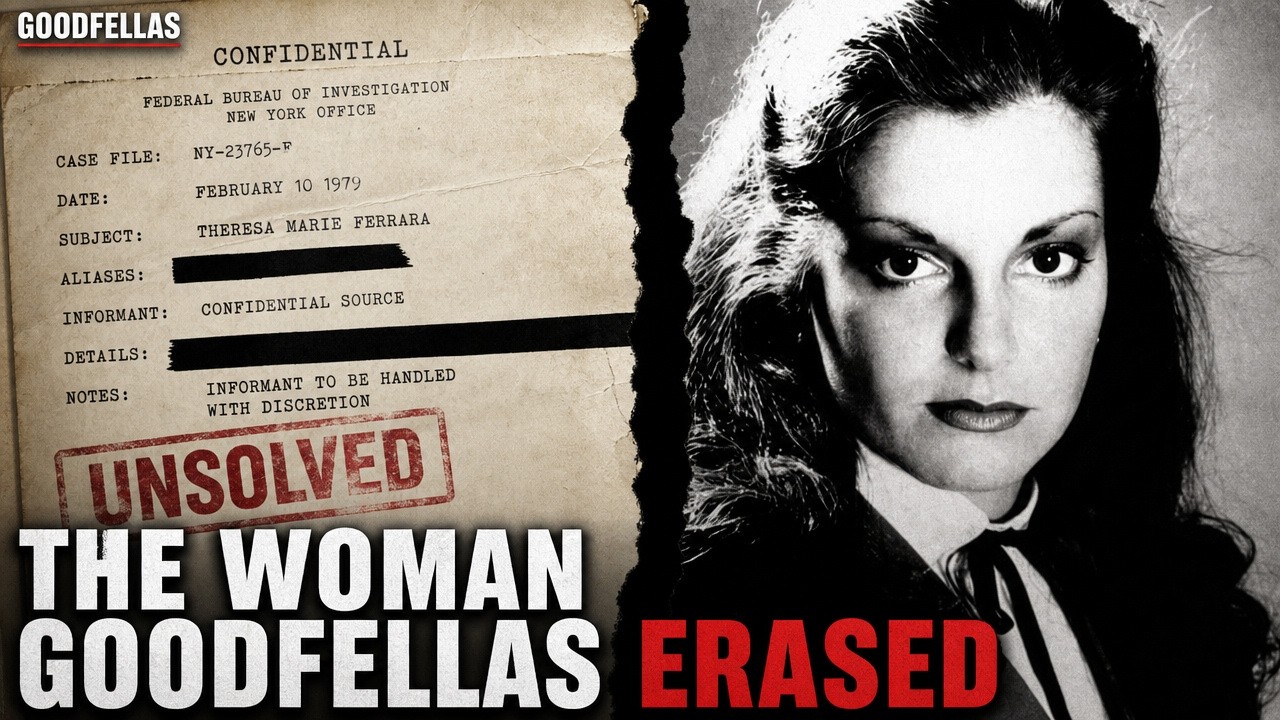
On February 10, 1979, at 5:30 in the afternoon, a 27-year-old woman walked into the Apple Haircutters Salon on Sunrise Highway in Bellmore, Long Island. Her name was Teresa Ferrara. She was dark-haired and well-dressed, and she sat down in her niece's chair. Everything about the moment looked ordinary.
Then the phone rang. It was for her.
She took the call and came back to the chair. She told her niece, 19-year-old Maria Sanor, that she had a chance to make $10,000. She said she would be back in 15 minutes. She set down her mink coat and her handbag. She left the keys to her 1979 Corvette on the counter. She walked out the door.
She was never seen alive again.
Ninety-seven days later, on May 18, 1979, a dismembered female torso washed ashore at Barnegat Inlet in Tom's River, New Jersey. The head was missing. Both hands were missing. The rest of the body was never recovered.
Medical examiners at St. Barnabas Medical Center had no fingerprints to run, no face to photograph, and no dental records that matched. What they had were two silicone breast implants. Each one carried a serial number. Those numbers traced back to a clinic in Manhattan, and the clinic traced back to one patient: Teresa Ferrara.
Hollywood made a movie about the world she lived in. It hired Ray Liotta, Robert De Niro, and Joe Pesci. It was called Goodfellas. It spent two hours and 26 minutes inside the Lucchese crew's world, showing the hijackings, the beatings, the Lufthansa heist, and the bodies. It never said her name, not once.
The only trace of her in the final cut is a nameless girlfriend on Tommy's arm at the Copacabana. No name, no story, no ending. The famous Liotta montage runs through the major victims of the post-Lufthansa cleanup. It skips her, a woman at the center of the cleanup's logic, and her murder does not make the film.
Hollywood gave audiences the story. The real record gives the part that was buried.
Teresa Ferrara was born on September 5, 1951, in South Ozone Park, Queens. She grew up on Long Island's South Shore in the Five Towns, in the kind of streets where you knew who the connected men were because their cars were better than everyone else's and nobody asked where the money came from.
Her family had distant ties to Carlos Marcello, the New Orleans boss who ran Louisiana and half of Texas and whom federal investigators spent two decades trying to indict. That connection was not operational. It was bloodline. But in the world Ferrara was moving toward, bloodline opened doors.
By the early 1970s, she had relocated back to Ozone Park. She had found Robert's Lounge on Lefferts Boulevard in South Ozone Park, a bar that looked like nothing from the outside. Inside, it was the operational center of Paul Vario's Lucchese crew.
Jimmy Burke drank there. Tommy DeSimone drank there. Henry Hill drank there. The jobs got planned there. The money got counted there. Years later, the NYPD would excavate the basement and find human remains.
Ferrara became a fixture. Not a wife, not a girlfriend kept at arm's length. A fixture. She was in the room for conversations about hijackings, drug shipments, and cash runs. She heard names. She heard numbers. She heard things that no civilian was supposed to hear.
In 1972, she became Tommy DeSimone's mistress. Here is what the movie got wrong about DeSimone. Joe Pesci played him at 5-foot-4, volatile, explosive, small. The real Tommy DeSimone stood over six feet tall. He had a linebacker's build. He carried two pearl-handled revolvers. He was not a small man who overcompensated with rage. He was a large, physically dominating man who killed because he wanted to and because nobody stopped him.
By 1972, he was already being held responsible for the murder of Billy Batts, a made man in the Gambino family. That killing would eventually cost him his life. But in 1972, he was still untouchable, still dangerous, still the man Ferrara chose.
DeSimone was married. His wife was Angelica Spione, known as Cookie. Ferrara knew that and stayed anyway. She was present. She was trusted. Over the next five years, she built a position inside the crew that no woman had built before.
Then she got arrested. In the summer of 1977, a DEA undercover operation put an agent posing as a cocaine buyer in her path. Ferrara met him. The deal moved forward. The agents closed in. She was facing a maximum of 15 years on federal drug trafficking charges.
The FBI New York field office made her an offer. She took it. They assigned her a confidential informant number and paid her in cash and money orders under a coded alias. The payments ran between $200 and $400 per report.
She filed reports. She kept attending Robert's Lounge. She kept sitting across from Jimmy Burke and Paul Vario. She kept listening. Henry Hill, in his post-arrest debriefings, confirmed her informant status. He knew. Whether anyone else in the crew knew in 1977 is the question that would eventually get her killed.
Here is where the timeline gets dangerous. On November 11, 1978, at the Flushing waterfront, DEA, FBI, and Coast Guard units moved simultaneously. The bust seized nearly 30 tons of cocaine. Internal crew records put the loss at $250,000. It was one of the largest single-operation seizures the Lucchese crew had ever suffered.
Within days, the question circulating through Ozone Park was simple: who knew? The operation had been tightly compartmentalized. The people with full operational knowledge were a short list. Ferrara was on it.
She had been feeding intelligence to the FBI for over a year by November 1978. She had a handler. She had a payment trail. And now $250,000 worth of product was sitting in a federal evidence locker. Suspicion moved toward her. It did not arrive all at once. It gathered.
But Ferrara did not wait to see what happened next. She made a second move. In late 1978, she partnered with a man named Richard Eaton. Eaton was connected to Jimmy Burke. He had ties to the Florida underworld, Fort Lauderdale, shell companies, and a restaurant that served as a front for moving money.
Together, Ferrara and Eaton developed a plan to intercept and reroute a Lucchese cocaine shipment before it reached its destination. Bank records show six-figure transfers moving through shadow accounts. Some were tied to Eaton's Fort Lauderdale operation. Others were tied to shell companies registered in Nassau County, Long Island.
The money trail ends at North Shore Towers, a luxury high-rise in Great Neck, Long Island. In early 1979, Ferrara signed a lease there for $1,000 a month. She also registered a new Corvette. She was 27 years old. She was living in a luxury apartment. She was driving a new car. She was stealing from Paul Vario.
And Paul Vario trusted her. That is the detail that makes the whole story work. Vario had used Ferrara as a courier, not for small amounts. He had trusted her to move up to $3 million in Lufthansa cash to Florida.
The Lufthansa heist had taken place at JFK Airport on December 11, 1978. Six million dollars gone in 90 minutes. The money needed to move fast, and it needed to move clean. Vario chose Ferrara for that run.
Consider what that means. The man who ran one of the most disciplined Lucchese operations in New York trusted a 27-year-old woman to physically transport millions in stolen cash across state lines. That was not casual trust. That was operational trust, the kind you extend to someone who has never given you a reason to doubt them.
By early 1979, Vario had three reasons to doubt her: the Flushing bust, the Florida theft, and a growing suspicion, fed by sources inside the FBI itself, that she had an informant number. She was a liability to the crew. She was also becoming a liability to the FBI.
Her handlers knew she was still inside the operation. They knew she had been used to move Lufthansa money. They knew she had stolen from the people she was supposed to be reporting on. A confidential informant who steals from her targets and enriches herself in the process is a legal problem, a trial problem, a problem that gets defense attorneys very interested. The FBI did not move to protect her.
On February 10, 1979, Teresa Ferrara walked into Apple Haircutters in Bellmore at 5:30 p.m. She took a phone call. She was told she could make $10,000 in 15 minutes. She left her coat. She left her bag. She left her keys.
The $10,000 was bait. She knew the world she was in. She had been in it for seven years. She must have known what a phone call like that could mean. But $10,000 was a number. And she walked toward it.
The forensic report from St. Barnabas Medical Center is specific about what was done to her. The cuts were made with clean industrial tools, not a knife, not a saw wielded in panic. They were precise, practiced cuts. There were no bullet wounds and no ligature marks around the neck or wrists. The cause of death could not be established.
The head and hands were removed deliberately. No fingerprints, no dental records, no face. The crew had done this before. After the Lufthansa heist, bodies connected to the operation began disappearing. Some were never found. Some were found in pieces. The NYPD later recovered remains in the basement of Robert's Lounge.
The pattern was known, but Ferrara was different. She was the only woman. And the method sent a message that went beyond her. It said: we know you talked. We know what you are, and we will not just kill you. We will make you disappear so completely that the government you talked to cannot even prove you are dead. We will take your hands so they cannot print you. We will take your head so they cannot identify you. We will put what is left in the ocean and let the current carry it to New Jersey.
The FBI got the torso report in May 1979. They traced the implant serial numbers. They confirmed the identification. They closed the file. No arrest was ever made. The complaint number is sealed. The case remains officially unsolved.
Now look at what Goodfellas does with this. The film is based on Nicholas Pileggi's source material and Henry Hill's firsthand account. Hill knew about Ferrara. He confirmed her informant status in his debriefings. He knew she had been killed. He knew why. That information was available to the filmmakers. They chose not to use it.
The Liotta montage runs for four minutes and 10 seconds. It covers the post-Lufthansa victims one by one, body after body, each one shown in the specific grotesque detail the film is famous for. Ferrara is not in it.
The woman who had moved as much as $3 million in Lufthansa cash, who had been feeding intelligence to the FBI for two years, who was dismembered and deposited in the Atlantic Ocean as a direct consequence of that heist, does not appear. What survives of her in the finished film is that nameless girlfriend in the Copacabana scene. A few seconds of screen time. Her story, her file, and her death never made it in.

This was not an oversight. The Liotta montage was meticulously constructed. Pileggi and Scorsese knew the record. The choice to omit Ferrara was a choice. The film kept the victims who fit the story it wanted to tell, a story about men, about loyalty between men, about betrayal between men. A woman who had operated at the same level, made the same choices, and died the same way did not fit that frame.
The crew erased her with industrial tools and the Atlantic Ocean. The film erased her with a script revision.
In the legend, Goodfellas tells you everything about the Lucchese crew's world. The truth is, it tells you the version that was easiest to sell. Ferrara's story was harder. She was an informant who was also a thief. She was a mistress who was also a courier. She was trusted by Paul Vario and paid by the FBI. And she stole from both of them.
She does not fit the clean narrative of loyalty and betrayal that the film runs on. She is something more complicated: a woman who played every side simultaneously and ran out of room.
Three things killed her. Not one. Three. The Flushing bust in November 1978 put suspicion on her inside the crew. The Florida theft with Richard Eaton put a dollar figure on her betrayal. And her FBI informant status, confirmed by Hill and suspected by Vario, closed the last exit. Any one of those three things might have been survivable. All three converging in the same three-month window were not.
Maria Sanor, Ferrara's niece, was 19 years old when she watched her aunt walk out of that salon. She later documented what she saw in a memoir. The mink coat left on the chair. The handbag on the counter. The Corvette keys. The 15 minutes that became 97 days. She was the last person to see Teresa Ferrara alive.
The case has never been solved. No indictment, no trial, no named suspect. The people most likely responsible are dead. Paul Vario died in federal custody in May 1988. Tommy DeSimone disappeared in January 1979, one month before Ferrara vanished, almost certainly killed by the Gambino family over the Billy Batts murder. Jimmy Burke died in federal custody in April 1996.
The ocean kept its part of the deal. What remains is a sealed complaint number, a forensic report from a New Jersey medical center, and a woman who moved as much as $3 million in stolen cash, filed reports for the FBI, stole from one of the most dangerous crews in New York, and was erased so thoroughly that the most famous movie ever made about her world acted as if she had never existed.
That is not just an omission. In organized crime, the only thing more final than a bullet is being written out of the record entirely. The crew did it with a hacksaw. Hollywood did it with a screenplay. The method was different. The result was the same.
The FBI knew what had happened to Ferrara within weeks of the torso washing ashore. They had her informant file. They had her payment records. They had Hill's debriefings. They had the implant identification from St. Barnabas. They had enough to build a narrative even without a cause of death.
What they did not have was a body they could put in front of a jury. No head, no hands, no cause of death established, no weapon, no witness willing to testify. The crew had understood something that the FBI's own procedures could not easily counter. If you remove the evidence of how someone died, you make prosecution almost impossible.
The torso proves a person is dead. It does not prove who killed her, how, or where. That gap is not accidental. It is engineered. The Lucchese crew had been operating in and around JFK Airport for over a decade by 1979. They understood logistics. They understood how evidence moved and how it disappeared.
The same operational thinking that planned the Lufthansa heist, the biggest cash haul in American history at the time, was applied to the problem of Teresa Ferrara. Move the parts, separate them, let geography do the rest. The head and hands went somewhere. Investigators never found them. The working theory in the case files is water. The same water that carried the torso to Barnegat Inlet likely carried everything else further out or deeper down. The Atlantic is a large place. The crew knew that.
Here is what the record does not resolve: who made the call? Tommy DeSimone was the obvious candidate. He was her lover. He knew her movements. He had the temperament and the history. But DeSimone himself disappeared on January 14, 1979, almost four weeks before Ferrara walked out of the Bellmore salon.
He was called to a meeting, almost certainly believing he was about to be made, inducted into the Gambino family as a reward for years of work. Instead, the Gambinos killed him, retribution for Billy Batts, seven years delayed. No trace of him was ever found either. So DeSimone was already dead when Ferrara vanished. That leaves the question open.
Vario had the motive and the authority. Burke had the operational capacity and the Florida connection through Eaton. Someone made the decision. Someone arranged the phone call that brought her out of that salon. Someone told her there was $10,000 waiting.
She believed it because she had been in this world long enough to know that $10,000 was a real number, that people in this crew moved that kind of cash casually, and that a quick job was not unusual. Or she believed it because she had no choice but to believe it. Because the alternative, that the call was a trap, meant the crew already knew everything. And if they already knew everything, there was nowhere to run. Either way, she walked out.
The FBI, for their part, had a problem they were not eager to advertise. They had run a confidential informant inside the Lucchese crew during one of the most active periods in that crew's history. The Lufthansa heist happened on their watch with their informant in place. The Flushing bust happened, and then their informant turned up in pieces in New Jersey.
A dead informant is a failure of the program. It raises questions about whether the handler moved fast enough, whether the informant was adequately protected, whether the bureau prioritized the intelligence over the person providing it. Those are uncomfortable questions. Sealing the complaint number and keeping the case officially unsolved is one way to avoid answering them.
Henry Hill entered the witness protection program in 1980. He talked about almost everything: the Lufthansa heist, the murders, the drug operation, the internal structure of the crew. His testimony put Paul Vario and Jimmy Burke in federal prison. He confirmed Ferrara's informant status. He confirmed she had been killed. He did not name the person who ordered it.

Whether that was because he genuinely did not know or because even inside witness protection there were lines he would not cross is not documented. What is documented is the shape of her life in the months before she died.
The North Shore Towers apartment at $1,000 a month. The new Corvette. The six-figure transfers moving through Eaton's shell accounts. She was spending money she had taken from the crew. She was living well. She was 27 years old and spending Lucchese money in a luxury apartment in Great Neck while simultaneously filing reports for the FBI New York field office. That is an extraordinary position to hold and an extraordinarily short-lived one.
The timeline from the Flushing bust in November 1978 to her disappearance on February 10, 1979, is 91 days. Ninety-one days between the moment the crew had its clearest reason to suspect her and the moment she walked out of that salon. In crew terms, that is not a long deliberation. That is a measured one. Someone gathered the evidence. Someone confirmed the informant status. Someone traced the Florida money. And then someone made the call.
The forensic detail that stays with you is not the dismemberment itself. It is the cause of death listed as undetermined. The medical examiners at St. Barnabas had the torso. They had the tools to work with. And they could not establish how she died.
That means whatever was done to her before the cutting began left no trace on the parts that were recovered. No bullet, no broken bone, no bruising pattern consistent with strangulation or blunt force. The torso told them she was dead. It told them nothing else.
That absence is its own kind of statement. In the world Ferrara occupied, the manner of death was often the message. A body left on a street corner said one thing. A body found in a car trunk said another. A body that washed ashore in pieces, head and hands removed, cause of death unestablishable, said something specific: we are not afraid of the investigation that follows. We have already accounted for it.
Teresa Ferrara was born in Queens. She grew up on Long Island. She found her way into one of the most dangerous criminal organizations in New York at a time when that organization was at the peak of its power and its violence. She built a position inside it that took years and genuine trust to construct.
She played that position against the FBI for money. She played it against the crew for more money. She moved millions of dollars across state lines. She survived in that role for two years after her arrest, which is longer than most people would have lasted for one day.
She was not naive. She was not a victim of circumstance who stumbled into the wrong room. She made calculated decisions at every stage. The FBI recruitment was a calculation. The Florida theft was a calculation. The North Shore Towers apartment was a calculation. She was building a life with money she had extracted from people who killed for less.
The calculation that failed her was the one she made at 5:30 p.m. on February 10, 1979: that $10,000 was reachable in 15 minutes, that she could still make a move in a game where all the other players had already decided the game was over.
Maria Sanor waited. Fifteen minutes became an hour. The mink coat stayed on the chair. The Corvette keys stayed on the counter. The salon closed. Sanor took the coat and the keys home. She documented all of it years later, the specific weight of that wait, the moment ordinary time stopped and something else began.
Nobody reported Ferrara missing that night. Not immediately. In this world, people disappeared for reasons that were not always sinister. Or at least that was what you told yourself while you waited. You did not call the police the first night. You waited. You asked around. You listened for word moving through the usual channels.
No word came. The official missing person's report came later. The investigation moved slowly. There was no crime scene. There was no witness beyond a 19-year-old girl in a hair salon who had watched her aunt take a phone call. There was a coat, a bag, and a set of car keys.
Ninety-seven days after she walked out of that salon, the ocean returned what it chose to return. The sealed complaint number means the full investigative file is not publicly accessible. What exists in the record comes from FBI documents released through other proceedings, from court filings in related cases, from Hill's debriefings, and from Sanor's memoir.
The picture those sources build is detailed enough to understand what happened and why. It is not detailed enough to put a name on a charge sheet. That may never change. The men most responsible for the decision are dead. The crew they served is fractured and diminished. The FBI file stays sealed.
Teresa Ferrara moved as much as $3 million in stolen cash. She filed intelligence reports on one of the most active criminal operations in New York. She stole from Paul Vario and spent the money on a luxury apartment. She did all of this simultaneously in the same 90-day window. She was 27 years old.
Goodfellas has been watched by tens of millions of people. It is considered one of the most accurate portrayals of organized crime ever put on screen. It is taught in film schools. It is quoted at dinner tables. It runs on cable television several times a week. It does not contain her name.
The crew took her head and her hands so that the ocean could not give her back whole. The film took her name so that the story could be told clean. Both acts served the same purpose: to make her disappear from a record that her presence complicated.
The difference is that the ocean eventually returned something. A torso, a serial number, a confirmation that she had existed and that she had been destroyed. The film has never offered that much.
Teresa Ferrara's case is officially unsolved.