By the end of October 1904, the Petri family had vanished from the small mining town of Shadow Creek, West Virginia, in a way that left authorities with more questions than answers. One man had disappeared without a trace, and the other two were institutionalized, never to return. For one October night, every door in their home was locked from the outside, reportedly to keep something in rather than to keep others out. The events that would define the family began months earlier, on April 12, 1904, when Edward Petri was trapped for nearly six hours after a partial collapse in the eastern section of the Blue Ridge Coal Company mine.
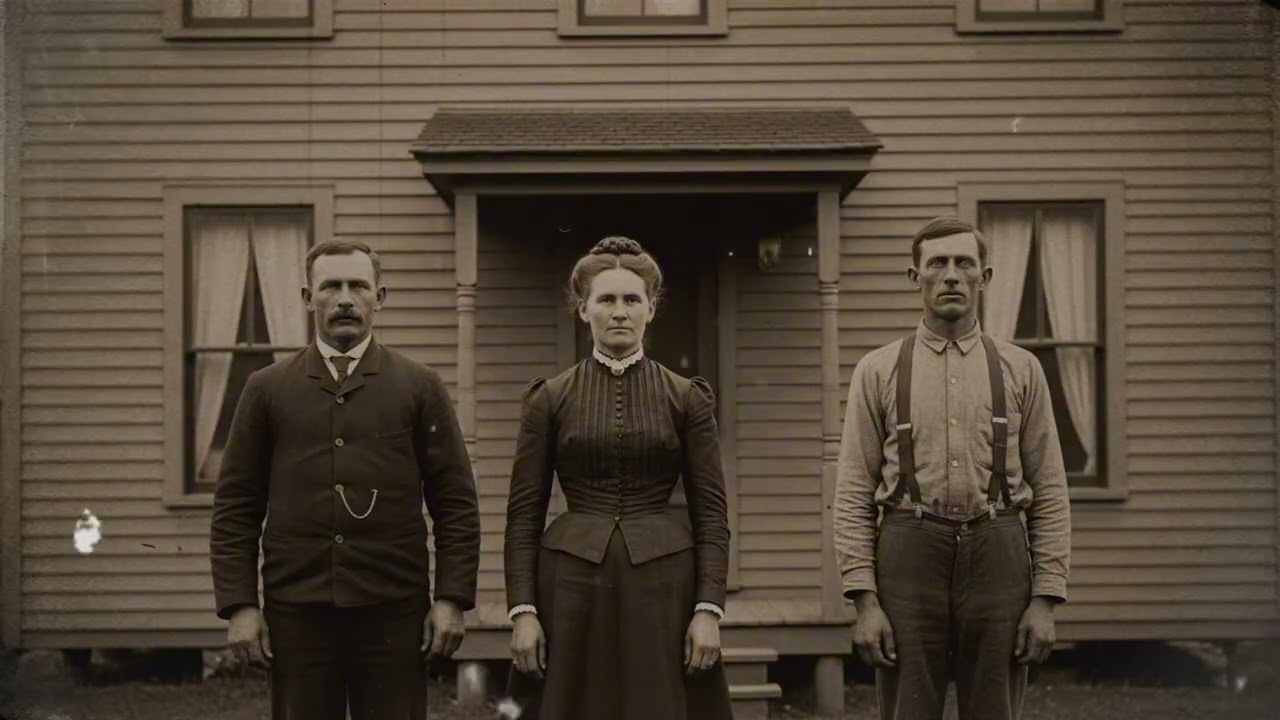
When rescue workers reached him, he was conscious but eerily calm. The company doctor, Dr. Thomas Harrington, noted in his journal that Edward responded to questions about his ordeal with vague statements that “it was peaceful down there and that the darkness spoke to him. ”
Edward, who had sustained a significant back injury, moved into the home of his brother Samuel, the mine foreman, and Samuel’s wife Martha to recover.
For weeks, the arrangement seemed beneficial. Neighbors later recalled that Martha was a devoted caregiver, preparing poultices from her garden for Edward’s wounds. But by June, something had shifted. Church attendance records show Martha, previously a regular at Sunday services, began to disappear from the congregation.
By July, she had stopped attending altogether. A visit from the pastor’s wife, Harriet Wilson, captured the changing atmosphere of the household. Wilson described a home with drawn curtains, a peculiar odor of damp earth and chemical preservatives, and a “nervousness” in Martha’s movements. Martha, visibly agitated, insisted that Edward could not be disturbed and that visitors should leave before sundown, saying, “He’s not himself after dark.
None of us are anymore. ”
Dr. Harrington first noted a visit to the Petri residence in late August, called to treat Martha for recurring headaches and episodes of disorientation. Samuel reported she had difficulty sleeping and complained of hearing “voices in the walls.
” A week later, Samuel returned to the doctor’s office requesting additional laudanum, admitting that Edward had developed unusual nighttime habits, including standing motionless in doorways for hours and wandering the root cellar at dawn surrounded by collections of unknown materials in glass jars. By September, Samuel had asked about the possibility of committing his brother to an asylum, though he seemed hesitant. He described finding Edward in the cellar surrounded by his collections, and he asked the doctor a haunting question: “Have you ever looked at someone you’ve known your whole life and suddenly felt you were looking at a stranger? ”
A private ledger kept by a former employee of the company store revealed unusual purchasing patterns by Samuel throughout the summer and fall.
He bought excessive quantities of salt, lye soap, multiple locks and chains, heavy canvas tarpaulin, and, just weeks before the incident, six new padlocks, twenty pounds of nails, and enough laudanum “to put a horse to sleep. ”
The most telling account of Edward’s behavior came from a fellow miner, George Miller, who shared a final Sunday dinner with the family in early September. Miller recalled that Edward barely touched his food but stared with “an intensity that made my skin crawl. ” At one point, Edward leaned across the table and asked, “George, have you ever felt the mountain breathing when you’re deep in the tunnels?
” As Miller was leaving, Edward grabbed his arm with surprising strength and whispered, “It wants to come up, George. It’s found a way out. ”
Dr. Harrington’s journal entry from October 10 describes being summoned to the Petri home past midnight.
Martha, feverish and distressed, refused to reenter the house, claiming something was moving between the walls. Samuel explained that she had tied herself to the bedpost to prevent sleepwalking, leaving visible rope marks on her wrists. Most concerning was Martha’s whispered assertion that Edward was no longer Edward. In a private conversation that same day, Samuel told the doctor that Edward spoke to Martha “not as a brother should speak to his sister-in-law, but as something else, something that’s wearing Edward like an ill-fitting suit.
” He claimed there were things in the root cellar that proved they were not crazy, saying Edward had been collecting them since being pulled from the mine collapse. The day of October 17 began unremarkably. Samuel reported to work at his usual time but requested permission to leave around noon, citing a household emergency. His supervisor described him as distracted and detached, with “a kind of desperate determination” in his eyes, like “a man who had come to some terrible decision and was now resolved to carry it through.
”
A neighbor, Eliza Jenkins, reported hearing a terrible commotion from the Petri home around 3:00 p. m. , including the sound of furniture being dragged and urgent hammering. She also heard shouting from both Samuel and Martha, as well as a third voice she did not recognize, speaking in a strange cadence that sounded more like chanting than ordinary conversation.
The hammering continued for at least an hour before everything went quiet “all at once. ”
By 6:00 p. m. , returning miners saw smoke coming from the chimney, an unusual sight for a warm October evening, and noticed that every window had been covered with blankets or heavy fabric.
Around 9:00 p. m. , a night-shift worker named Jacob Moore passed the house and heard the sound of something heavy being dragged downstairs. He noticed that every door to the home had been secured with brand-new padlocks on the outside.
When he called out, a low, rough voice from inside said just one thing: “The doors stay closed today. ”
The night watchman, Frederick Collins, later reported seeing Samuel sitting alone on the front porch at 2:00 a. m. , staring fixedly toward the mine, holding a mining pick in his lap with a shotgun propped against the railing.
Collins chose not to approach. As he passed the side of the house near the root cellar entrance, he reported hearing “a persistent scratching sound like something trying to claw its way out. ”
Dr. Harrington was called to the home the following morning.
Samuel was still sitting in the same position, unresponsive and severely dehydrated, with self-inflicted lacerations on both palms. The interior of the house showed signs of a struggle. Pages torn from the family Bible had been fastened to the walls of the entryway and parlor with a mixture of coal dust and blood. The kitchen contained a large pot of boiled-down laudanum mixed with other substances, creating a potent sedative.
The root cellar door showed extensive scratch marks on the inside and had been reinforced with wooden planks nailed across its frame. Martha Petri was found unconscious in the master bedroom, heavily sedated, with ligature marks on her wrists and ankles. Edward Petri was nowhere to be found. His bedroom contained no personal belongings, as if he had never occupied the space.
The walls had been freshly whitewashed, and the floorboards showed evidence of vigorous scrubbing with lye. In the attic above Edward’s room, investigators found his mining boots filled with soil, a disassembled pocket watch arranged in a circular pattern, and a journal written in his handwriting but filled with indecipherable symbols and drawings. Among the strange symbols were detailed anatomical drawings of human organs with a precision that puzzled the doctor, as well as sketches of a humanoid form with limbs too long and joints bending in impossible directions. The most disturbing pages contained what appeared to be methodical observations of Samuel and Martha, documenting their sleep patterns and habits with clinical detachment.
The final dated entry from October 16 contained only one English phrase: “The host is becoming inadequate. ”
When Samuel finally became responsive, he would only say that Edward “has gone back to where he came from” and that the doors “had to stay closed to keep us all safe. ” When pressed, he became agitated, repeating, “Edward is in the walls now. Edward is in the walls.
”
Sheriff Collins’ personal notes, discovered after his death in 1919, recorded a far more elaborate account. Samuel maintained that after the accident, Edward’s behavior had changed gradually, becoming increasingly nocturnal and speaking in a voice that was not his own. He claimed that upon returning from work on October 16, he found Martha barricaded in her bedroom, having allegedly witnessed Edward shedding his skin in the root cellar. Samuel described confronting his brother, who reportedly spoke in an echoing voice, claiming to have existed “in the deep places since before your kind crawled from the high sea” and stating that Edward’s form “has grown insufficient.
”
Samuel claimed he subdued his brother with a blow to the head, bound him, and locked him in the root cellar. He then sedated Martha and began securing the house, covering the walls with Bible passages he believed might contain whatever was using Edward’s form. At times, he claimed Edward escaped into the walls “like smoke seeping through cracks,” while at other times he suggested his brother had returned to the mine. Most disturbing was his occasional insistence that Edward was still in the root cellar, “just not in a form you would recognize.
”
The case disappeared from public record with surprising speed. By November 1904, the local newspaper had ceased all mention of the incident. Samuel was never formally charged with any crime. Instead, he was committed to the same asylum as his wife in early November.
The Petri house was demolished in 1911. The case resurfaced decades later through two discoveries. In 1947, workers expanding the mine shaft broke through into a previously unknown cavity in the mountain. Company records noted the discovery of Edward Petri’s personal effects, including a pocket watch, wire-rimmed spectacles, and a wallet containing his mine worker’s identification card.
No human remains were found, and the location had been sealed and inaccessible from the outside. Personal correspondence from the mine supervisor at the time, preserved by his family, described findings deliberately excluded from the official report. The items inside the cavity were arranged in a perfect circle on the floor. The leather of the wallet showed no signs of decay after over forty years in a damp environment, and the metal of the pocket watch was untarnished.
The inside surface of the spectacles’ glass was covered with a thin film of what appeared to be material from the deepest coal seams. Most disturbing was the discovery of dozens of handprints pressed into the solid rock, as if the stone had been soft at the time of contact. The impressions were too large to be human, with elongated fingers that tapered to points. Two of the men who discovered the cavity fell ill with an unusual respiratory ailment.
Both reported vivid, disturbing dreams. One man’s condition worsened until he began claiming something was growing inside him. He died three weeks later, with the company doctor attributing his death to pneumonia. The cavity was sealed with concrete, and the men were instructed never to speak of what they had seen.
The second discovery came in 1962 during a renovation of the Shadow Creek Medical Clinic, when a sealed metal box was found hidden within a wall cavity. In addition to Dr. Harrington’s journal, the box contained a letter dated November 30, 1904, addressed to future residents of the town. In the letter, the doctor described his growing conviction that what had occurred in the Petri home could not be explained by conventional medicine.
He described his examination of Martha Petri, noting marks on her wrists that showed “a progressive hardening, almost a calcification,” and blood work revealing dark, crystalline structures suspended in the plasma. The letter also described Samuel’s account of Martha’s disturbing nocturnal behavior, including sleepwalking to Edward’s room and the root cellar, and speaking in a language “that shouldn’t come from a human throat. ” On the night of October 16, Samuel claimed he had interrupted Edward making an incision in Martha’s flesh with a mining tool while she willingly extended her arm toward him. Most alarming to the doctor was his discovery of preserved skin samples in jars hidden beneath the floorboards of Edward’s room.
The skin had remained unchanged since its discovery. It did not decompose, and under certain lighting conditions, it “appeared to exhibit subtle movements even when completely undisturbed. ”
Upon the letter’s discovery in 1962, local physician Dr. Robert Campbell reportedly opened the sealed containers mentioned by Harrington, only to find them empty.
The jars contained only a fine, dark residue that dispersed when opened, like soot or extremely fine coal dust. Approximately three weeks later, Campbell abruptly resigned his position and left town without explanation. His resignation letter consisted of a single sentence: “I can no longer in good conscience practice medicine in this community. ”
Martha Petri remained institutionalized until her death in 1907, never having spoken another word.
Her medical file characterized her condition as catatonic periods interspersed with episodes of extreme agitation, during which she attempted to remove her own skin using any available implement. The file noted that such episodes occurred exclusively between sunset and sunrise. Samuel’s fate remained more ambiguous. Asylum records indicate he was transferred to a state facility in 1906, but no admission record exists there.
His death certificate, filed in 1911, lists his place of death as “unknown” and the cause as “presumed deceased. ”
Local folklore has offered alternative explanations for what happened to Edward Petri. Retired miners interviewed decades later described an unwritten rule among those who worked in the mine: never work alone in the east tunnels, and never acknowledge a solitary figure with a lamp that cast no light on the walls around it. Some claimed the sightings were not really Petri, but “something else wearing his shape like an old coat.
” Miners also maintained a tradition of leaving small offerings of tobacco or whiskey at the entrance to the eastern tunnels as a form of insurance, a way of respecting a boundary. In 1967, a geological survey team from West Virginia University found unusually high concentrations of unidentified organic compounds in the soil at the former Petri home site. The foundation outline remained conspicuously barren of vegetation more than sixty years after the house was demolished. The lead geologist’s private notes, later acquired by the university, described carbon compounds with molecular structures inconsistent with any known form of life in the region and noted that samples maintained in dark, damp conditions exhibited measurable growth over time despite lacking any apparent means of sustaining themselves.
His funding request for a follow-up study was denied, and he subsequently left the university, never publishing on the subject again. The final documented connection to the case emerged in 1969, when construction workers breaking ground for a new highway discovered a tunnel not connected to the known mine workings. Inside a small chamber, they found a collection of glass jars arranged in a circle around a wooden chair, along with hundreds of pages of notes written in a combination of conventional English and the same symbolic language found in Edward Petri’s journal. Before experts could be called, an unexplained collapse sealed the tunnel and its contents.
Sitting on the chair was a pair of wire-rimmed spectacles identical to those described on Edward Petri’s identification card. One worker who attempted to force a jar free described the glass as fused with the wooden shelf it sat upon. When it shattered, it released a fine, dark powder. The man who inhaled it complained of a metallic taste and a sensation he described as “movement under my skin.
” He returned to the site alone the next morning and was found sitting in the wooden chair, unresponsive. By the time the medical team arrived, the tunnel had collapsed. Five of the eight workers who had entered the chamber later reported vivid, disturbing dreams of following a figure deeper into the mountain. Three of them subsequently relocated or were admitted to psychiatric facilities.
The incident report and photographs filed with the state transportation department were later reported missing. In the decades since, the story of the Petri family has occasionally resurfaced in paranormal literature, often embellished with supernatural elements absent from the historical record. What remains factually verifiable is this: three people lived in a house in Shadow Creek in the autumn of 1904. By the end of October, one had vanished without a trace, and the other two were institutionalized, never to return.
The abandoned mining town was finally removed from West Virginia maps in 1972. The site has been reclaimed by the forest, but local residents of neighboring communities still share a common piece of folk wisdom: avoid the eastern slopes of that particular mountain after sundown, for the ground there sometimes moves in ways that ground should not move. Whether Samuel Petri’s desperate act of sealing his home was an expression of mental illness or an attempt to contain something that defied conventional understanding remains an open question. Dr.
Harrington’s final journal entry, written the day before his departure from Shadow Creek, offered one troubling observation. The padlocks Samuel had placed on the doors, all facing outward, showed peculiar damage. The metal was deformed not from external force, but as if it had been altered from within, as if something inside the house had exerted pressure against the barriers.
He left with the hope that whatever was contained within those walls remained “deep in the foundation soil,” never to emerge again.