The men who served Prince Philip for nearly seven decades were the only people who truly knew him, and they never told the world what they saw. Household staff, pages, equerries, and private secretaries stood within a few feet of him during his most private moments, yet none of them ever broke the silence. What remains is a difficult portrait of a man whose household learned to brace itself before opening a door. Experienced staff were reduced to silence by his sharp temper, and the household walked on eggshells for decades.
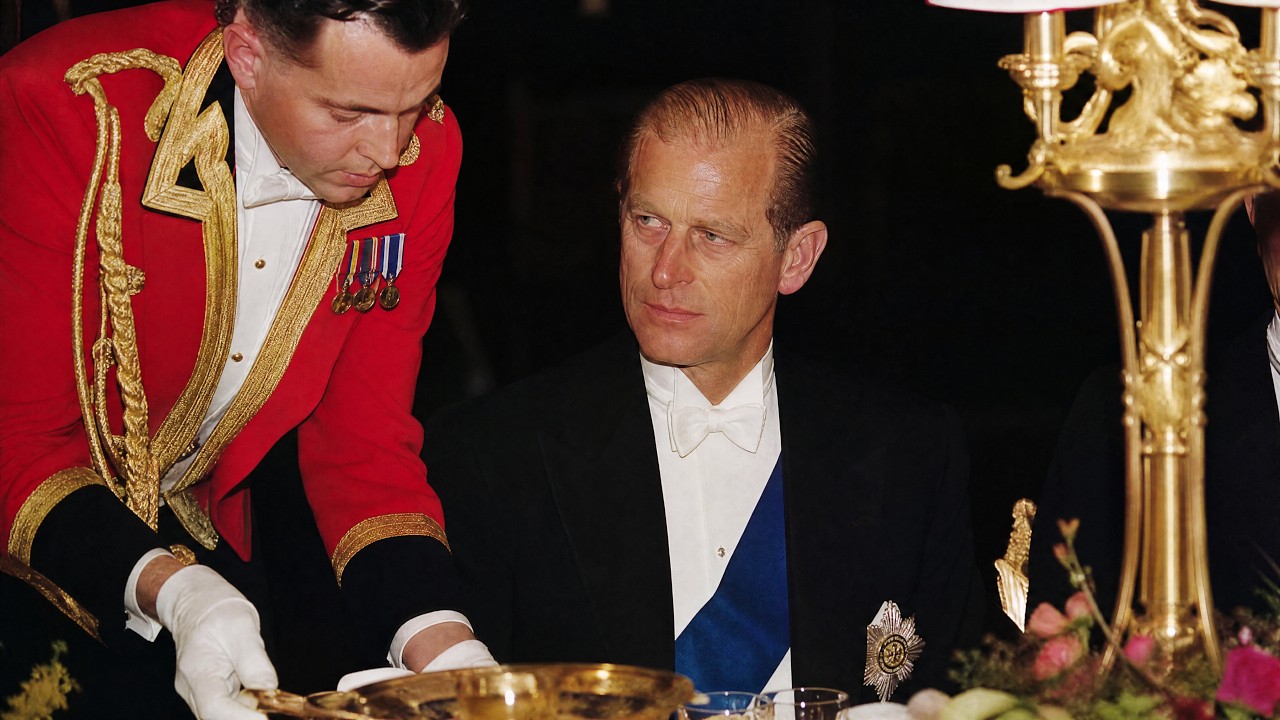
Yet almost none of them left carrying a grudge. When he died, three of them were remembered by name in his will. This is what his men saw and what they could not fully explain. Born Prince Philip of Greece and Denmark on June 10, 1921, he was the only son and youngest of five children.
The family claimed he was born on a dining table at a villa called Mon Repos on the island of Corfu. Within a year of his birth, the Greek monarchy collapsed in the aftermath of a lost war against Turkey. His father, Prince Andrew, was arrested and tried, and in December 1922 the family was exiled for life. The story passed down is that the infant Philip made the journey on a British warship in a makeshift cot made from a fruit crate.
Whether fact or legend, the exile was real. He began life as a prince of Greece and lost his homeland before he learned to walk. The family settled in a borrowed house outside Paris, quietly poor and dependent on wealthier relatives. What followed was a slow dismantling of everything that could contain a childhood.
His mother, Princess Alice, who was born deaf, suffered a nervous breakdown in 1930 and was committed to a sanatorium. For nearly five years, Philip had no contact with her at all. His father moved to the south of France to live a life of hotels and card games with a woman who was not his wife. His four beloved sisters married German princes, one after another, and moved to a country that would soon become an enemy of Britain.
By the age of nine, the boy had lost his country, his mother, his father’s daily presence, and every one of his sisters. He was handed to his mother’s English relatives and passed between the houses of the great. He was sent north to Gordonstoun in Scotland, founded by German educator Kurt Hahn on the principle that cold water, hard running, and a simple life build character. Philip did not merely endure Gordonstoun; he thrived there.
His own account of those years was characteristically spare. His family broke up, he said decades later. His mother was ill, his sisters were married, his father was in the south of France. He simply had to get on with it.
Seven plain sentences describing the demolition of a childhood. The lesson he took was that attachment was dangerous and self-reliance was the only safe ground. That psychology governed everything that followed. The temper his staff braced for was not mere rudeness; it was the outer edge of a discipline built from childhood to survive a world that kept disappearing.
He ran his household with strict precision because control was the one thing he never had as a child and could not now bear to lose. For a few short years, Philip was the most admired young man in Britain, and he had earned it. He trained at the Royal Naval College in Dartmouth and graduated top of his class. In March 1941, during the Battle of Cape Matapan in the Mediterranean, he was in charge of the searchlights on the battleship HMS Valiant.
In the darkness, he directed the lights precisely onto enemy ships and held them there, illuminating targets for his fleet’s guns. He was mentioned in despatches. Off the coast of Sicily in 1943, serving as second-in-command of the destroyer HMS Wallace, he improvised a raft carrying a smoke bomb and launched it into the water to look like burning wreckage. The German bomber went for the decoy instead of the ship, and the ruse very likely saved the Wallace and everyone aboard.
The war mattered because it was the only field where his hardness was not a liability but the very thing that saved lives, including his own. He found a world that suited him perfectly, one of clear orders and real competence. He loved the navy, and he was forced to give it up for marriage. When Elizabeth became queen, his career quietly ended, because a consort cannot continue as a serving officer.
The only career that was entirely his own was taken from him. In the late 1940s, he stood on the threshold of the very thing he had wanted since Corfu: a household of his own to run. He threw himself into it, managing estates, finances, and the modernization of a court unchanged since Victoria. He gathered a small circle of loyal men, most notably an Australian naval friend named Michael Parker, who became his private secretary and companion.
On February 6, 1952, King George VI died in his sleep at Sandringham. All of Philip’s assumptions about his future quietly collapsed in a single morning. His wife was now the sovereign, and he became the husband of the sovereign, a position with no defined authority. He had married to gain a household he could command, and instead he had married the one woman in the country he could never outrank, in the one house in the country he would never be allowed to run.
The first blow of the new reign was aimed at something smaller and more personal than a throne. When Elizabeth became queen, Philip assumed his children and household would carry his name. He had given up his foreign titles and taken the name Mountbatten specifically to have a British name to pass on. The old guard of the establishment, led by the formidable Queen Mary and supported by Prime Minister Winston Churchill, refused outright.
The royal house would remain Windsor. The queen, advised on every side that the matter was constitutional and not personal, allowed the decision to stand. Philip’s famous response was one of the most revealing sentences of his life. He said he was nothing but a bloody amoeba, the only man in the country not allowed to give his name to his own children.
A compromise was finally reached in February 1960, just days before the birth of his third child, Prince Andrew, when the surname Mountbatten-Windsor was created for descendants without royal titles. It was a partial victory, arriving eight years after a deep wound. The household needed somewhere to be master. The palace, having barred him from public power, handed him the management of the private apparatus.
He restructured the management of the royal residences, breaking up inherited habits that had barely changed since Queen Victoria. He ran Sandringham and Balmoral as working farms and shoots, scrutinized accounts, and questioned every inherited expense. He had a real talent for organization and a sharp eye for waste, and he had no patience whatsoever for a servant who could not answer a direct question, performed a job badly, or defended an old way of working merely because it was old. Very few of those allowed to describe him did so fully.
Grant Harrold, who worked as a royal butler for seven years and published his memoirs in 2025, recorded that other servants feared the duke and warned him not to go near him. Harrold describes a man who would make what he called his classic remarks, blunt and unexpected, and then follow them with a swear word. In one of the most telling observations anyone made about him, Harrold suggested that if the duke swore at you, it meant you were seeing the real Prince Philip, and it was something a lot of people loved. A bollocking, by this account, was a kind of familiarity.
Being sworn at meant you had become close. Other testimony was blunter. Royal photographer Eamonn Bellamy Turner described Philip as sometimes dangerous and called him the least popular royal he ever worked with. Broadcaster and royal photographer Helena Attard said there was never a boring moment around the duke and that he was always getting into trouble for his unguarded comments, yet he was enjoyable to be with.
Taken together, a consistent character emerges. He was sharp enough to frighten seasoned professionals, blunt to the point of danger, and, for some of the very people who braced themselves, oddly and genuinely beloved. The clearest documented evidence of his private harshness was not told by a servant at all; it was the relationship between the duke and his eldest son, Charles. In 1994, writer Jonathan Dimbleby published an authorized biography of the Prince of Wales, written with Charles’s cooperation and access to his papers and recollections.
The biography records that Philip often seemed determined not just to correct his son but to mock him. One close relative, quoted in the book, described the duke’s manner as intensely bullying and said its effect was to push Charles further and further into his shell. Philip genuinely believed that the hardness that had saved him was a gift, and he set out to give that same gift to his son. He was preparing a gentle, dreamy boy for the harsh task of becoming king.
The problem was that what made Philip strong only frightened Charles. The cold water that made one boy sturdy made the other shrink. Philip had flourished at Gordonstoun; he sent Charles there expecting the same result. For Charles it was a nightmare, a harsh institution without friends that left him miserable and desperately homesick.
The staff saw all of it. They were present at breakfasts and in corridors and on the edge of family scenes, watching a father who could not find a way to be gentle with a son who needed gentleness more than most. They carried the knowledge silently for decades. Charles’s wound is the only place where Philip’s private harshness leaked out, because Charles himself chose to have it documented.
In the autumn of 1956, Philip left Britain on a long solo tour aboard the royal yacht Britannia, his absence stretching to about four and a half months. In the 1950s, such a separation was unusual enough to be noticed. What turned quiet questioning into public speculation was an event in London. Michael Parker, Philip’s private secretary and close friend, was named that winter in divorce proceedings brought by his wife, Eileen.
Parker resigned rather than allow the scandal to touch the duke he served. The tabloids drew the line, unstated and unproven, from a friend’s messy divorce to a lonely prince on a yacht, and for the first time public speculation about a rift in the royal marriage reached the newspapers. Then the palace did something it rarely did. It answered.
The queen’s press secretary, Commander Richard Colville, issued a flat public denial, stating that it was quite untrue that there was any rift between the queen and the duke. The fact that the palace felt compelled to break its silence at all was the true measure of how close the matter had come to the surface. No relationship involving Prince Philip was ever proven. Every specific claim over 70 years was denied, and no evidence for any of them ever emerged.
The documented facts of that winter are these and only these: a long separation, a friend’s divorce, a press that overstepped, and a palace forced against every instinct to issue a public denial. The scandal was about pressure and machinery, not infidelity. The staff who could have written a tell-all never did. By the time of Philip’s death, the old code of royal service was cracking.
Former staff from other households had published memoirs and profited. The public appetite for royal secrets was enormous, and a frank account from someone genuinely in the room would have sold hundreds of thousands of copies. Yet no equivalent book about Philip was ever written. Not one member of his staff ever published an account claiming he was hated.
This silence is the strongest evidence in the entire story. The pattern of long service tells the same story. Michael Parker served Philip for a decade and left not with bitterness but with loyalty, speaking affectionately of the duke as very supportive during the worst period of his life. Miles Hunt-Davis became Philip’s private secretary in 1993 and remained until 2010, seventeen years as the right-hand man of someone described as impossible to work with.
At a senior level, nobody is forced to stay that long; it has to be voluntary. You do not keep a private secretary for seventeen years if you cannot stand him, and a private secretary does not stay seventeen years with a man he hates. The most remarkable example of loyalty was the valet. David Barwick joined the duke’s household in 1975 and remained for decades, until the end of Philip’s life, a total of 46 years.
He dressed him, packed his bags, and stood beside him through every shift of mood. In 2021 he was appointed a Member of the Royal Victorian Order, the honor the sovereign gives for personal service to the Crown. Nobody endures the daily intimate service of a man they hate for 46 years. The numbers that measure his private life are 10 years from Parker, 17 from Hunt-Davis, 30 from McGrath, and 46 from Barwick.
The kindness real evidence has survived. In 1992, as Charles and Diana’s marriage was collapsing publicly, Philip sat down and wrote to his daughter-in-law. They were not one letter but a series, private correspondence between the blunt old duke and the young woman at the center of the storm. Years after Diana’s death, the letters were read aloud at the inquest into how she died.
They were kind. Philip offered to do everything in his power to help Diana and Charles through the crisis, promising that if he was asked, he would always do his utmost to help. Diana addressed him warmly as “Dearest Pa. ” He signed his letters to her “with much love, Pa.
”
At a 1997 dinner marking their golden wedding anniversary, the queen rose and praised her husband. She said he was not a man who took easily to compliments, but he had quite simply been her strength and stay all those years, and she owed him a debt greater than he would ever claim or she would ever know. The staff in the lower floors would have understood exactly what she meant, because they had spent their careers learning the same lesson she had. On August 2, 2017, at the age of 96, Philip carried out his final public engagement.
The last entry in the longest working diary in royal history was a meeting with the Royal Marines in the forecourt of Buckingham Palace, standing in the rain without a coat. Since 1952 he had completed 22,219 solo engagements, delivered 5,493 speeches, made 637 solo visits abroad, and given his name to more than 780 organizations. In 1956, the same energy had produced the Duke of Edinburgh’s Award, the youth program he founded with Kurt Hahn, which has since put millions of young people to the test around the world. He did not remain at the heart of events.
He withdrew quietly to a modest farmhouse called Wood Farm on the Sandringham estate in Norfolk. There he spent most of his retirement living simply, reading, painting, and seeing old friends, cared for by a small circle of trusted staff. The temper that had frightened a great palace had softened with age, becoming in the accounts of those who were there something closer to gruff familiarity. He had wanted, since he was a boy in exile, a home and a household that were unambiguously his own, and in the simple rooms of Wood Farm he finally had that in his final years.
He died at Windsor Castle on April 9, 2021, two months short of his hundredth birthday. His daughter-in-law Sophie described his death as being very gentle, as if someone reached out and took his hand. After a life that began with violent upheaval on a Mediterranean island, he went out quietly. The will was not made public.
By a High Court decision and long royal custom, it was sealed for 90 years to protect the dignity of the Crown. The exact contents, the precise amounts, and the full list of beneficiaries remain locked away. But one detail emerged and was reported in the aftermath of his death. Philip left money in his will to three members of his household staff.
Consider what that fact means. In the last document of his life, a man remembers the people who mattered to him. He chose, as one of his final acts, in a will he knew would be sealed and private, to provide for three of his servants. This is not the act of a man who despised his staff, and it is not the act of staff who despised him.
A gift written in a document that no living person would read is the opposite of a display. It had no audience and could buy him nothing. It is as close as the records can bring us to what the man actually felt about the people who served him. After seventy years of the household learning to ready themselves before the door opened, they stayed.
That is the complete truth. What the household felt for Prince Philip was not hatred. It was fear, and beneath the fear, a loyalty that never broke. The household that hates a master flees from him or exposes him.
Philip’s household did none of those things. They gave him a lifetime of silence, and he in turn gave them a place in his will. To understand how fear and loyalty could live so long in the same house, return once more to the boy taken from Greece in a fruit crate. The child who learned that his country, his mother, his father, and his sisters could all be taken from him without warning learned a lesson he never forgot.
He grew into a man determined never to be that helpless again. The armor that frightened his servants was the same armor that allowed a half-orphaned refugee to survive, to rebuild himself as a decorated naval officer, and to stand for seventy years two steps behind his wife without ever laying the burden down in public. The tragedy and the strange triumph lie in the fact that a handful of people came close anyway, and then refused to leave. The butler Grant Harrold, who spent seven years learning to ready himself before that door opened, looked back and chose the word “loved.
” He said Philip was straightforward and not to everyone’s taste. Then, without retreating from any of it, he stated plainly that he loved him. No one who truly hated Prince Philip could say that. The people who knew him best did.
كل الأسماء والحقائق والتواريخ والاقتباسات مأخوذة من النص المصدر بدون أي تلفيق أو إضافة.