In the early 1940s, the British Army was an institution defined by rigid social hierarchy. An officer was a gentleman, and a soldier was a subordinate. Discipline was measured in the crispness of a salute and the absolute distance maintained between ranks.
When the men of the Second Australian Imperial Force arrived in the Middle East, they did not simply join the war. They ignited a cultural firestorm.
To British officers, the diggers were an undisciplined rabble. They rarely saluted and dressed with a casual disregard for King's Regulations. They spoke to their own commanders with a level of familiarity that bordered on insurrection.
British generals looked at these bronzed, loud-mouthed men from the Outback and saw a liability. They expected a force that would crumble the moment the German professionals applied pressure.
The British were about to receive a brutal education. They were about to learn that while the Australians lacked the polish of the parade ground, they possessed a tactical brilliance that would save the British Empire from its own traditionalism.
To understand the friction, one has to understand the Australian psyche. The AIF was a volunteer force, and the Australian culture of mateship was more powerful than any military manual.
In the Australian mind, respect was earned through competence, not granted by a piece of brass on a shoulder. British officers were horrified to see Australian privates arguing with their sergeants about the best way to flank a machine gun nest.
In the British Army, a soldier followed orders until he was dead. In the Australian Army, every man felt he had a vote in the tactical outcome.
What the British saw as insolence was actually a decentralized command structure. Australian officers had often been civilians alongside their men, farmers leading farmers and lawyers leading clerks, which created a shared intelligence.
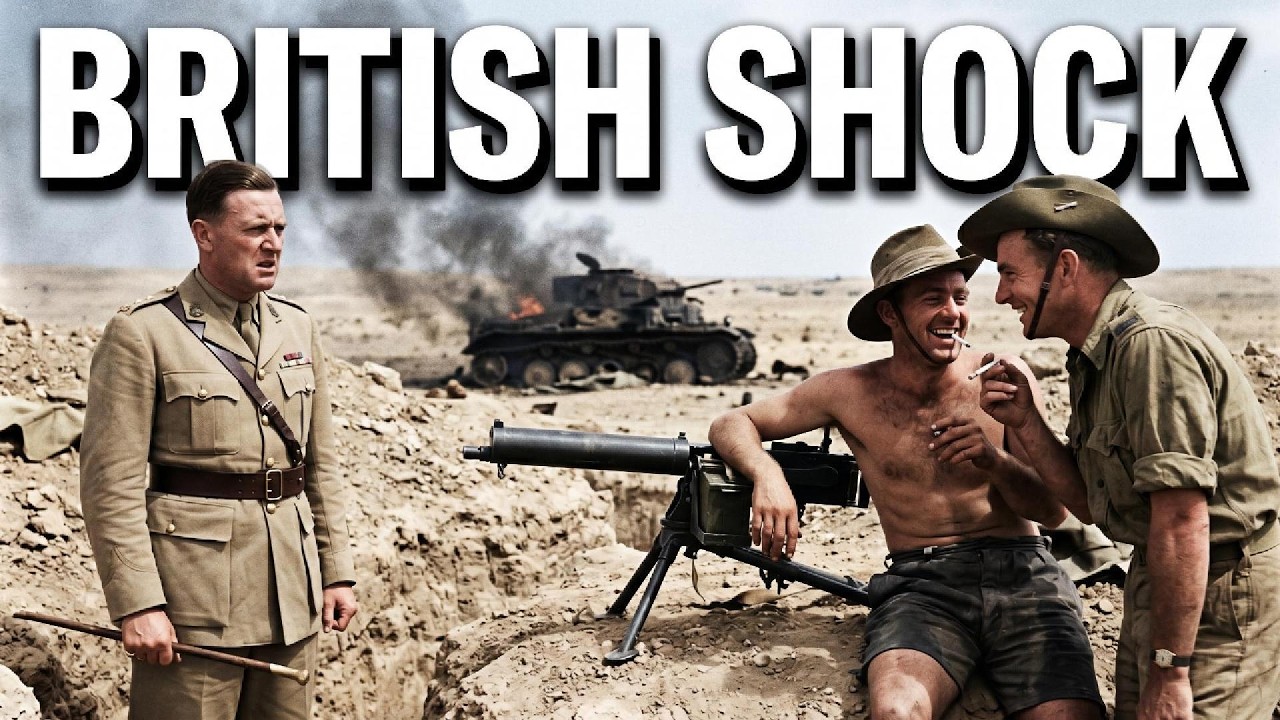
If an Australian officer fell in battle, the squad did not paralyze. Every man knew the plan, and every man was capable of leading. This egalitarian engine made the AIF a fluid force that could adapt while rigid British structures were still waiting for orders from headquarters.
The ultimate test came in 1941 at a desolate, sun-bleached port in Libya called Tobruk. Erwin Rommel, the Desert Fox, was sweeping across North Africa with his seemingly invincible Panzers.
The British had been driven into a full-scale retreat, and Tobruk was the only thing standing between Rommel and the Suez Canal. The defense was handed to the Australian 9th Division, led by the legendary Leslie Morshead, a man the Germans would eventually call Ali Baba and his 20,000 thieves.
The German propaganda machine mocked them as rats scurrying in the dirt. The Australians took the name and turned it into a legend.
British officers expected the Australians to be crushed by the Blitzkrieg, but Morshead and his diggers did something radical. They realized that the German tanks were not the problem. The infantry following them was.
They developed the pass-through tactic. When the Panzers attacked, the Australians stayed in their deep, narrow trenches, letting the tanks roll right over them.
Once the tanks had passed, most of the Australians popped up like ghosts and massacred the German infantry with bayonets and Bren guns. The tanks, now isolated without their supporting troops, were easy prey for anti-tank guns.
For 242 days, the rats held out, dealing Rommel his first decisive defeat of the war. The British officers who had mocked the Australians' ragged appearance were now desperately studying their maps.
As the war in the desert evolved, the Australians introduced a predatory style of warfare that chilled the blood of the Axis forces. They became masters of the deep patrol.

While British doctrine favored large-scale coordinated movements supported by heavy artillery, the Australians preferred the shadows. Small groups of diggers would vanish into the desert night for 48 or 72 hours at a time.
They did not just scout. They hunted. They would crawl miles through the sand, bypass sentries, and enter German or Italian trenches in total silence.
They would sabotage fuel dumps, steal maps, and kidnap officers from their beds before a single shot was fired. This aggressive patrol spirit gave the Australians total psychological dominance.
German diaries from the period are filled with the terror of the men in the slouch hats, whom they described as inhumanly quiet and utterly ruthless. British officers, initially skeptical of these unauthorized raids, soon realized the Australians were providing better intelligence than the entire British reconnaissance wing.
By the time of the Second Battle of El Alamein in 1942, the British High Command's opinion had shifted from disdain to desperation. Field Marshal Bernard Montgomery, a man known for his extreme discipline and ego, placed the Australian 9th Division at the most critical point of the line.
The Australians were given the crumbling mission, the most violent, grinding part of the offensive designed to wear down the German reserves. For 10 days, the Australians fought a battle of pure attrition.
They took 20 percent casualties but never gave an inch of ground. Montgomery, watching through his binoculars, was forced to admit that the Australians were the most lethal infantry he had ever seen.
He famously remarked that he wished he had more divisions like them. Not because they were well-behaved, but because they were unbreakable.
The British officers who had once complained about Australians not saluting were now saluting the Australians as they marched past, bloodied but triumphant.

If the desert was a shock, the jungle was a revelation. When the AIF was recalled to defend Australia against the Japanese, they were sent into the vertical, muddy hell of the Kokoda Track in New Guinea.
The British military establishment at the time believed the Japanese were masters of the jungle and that Western soldiers could not survive in the tropics. They had seen the fall of Singapore and assumed the Japanese were invincible in the brush.
The Australians shattered this myth as well. They traded their desert tans for jungle greens and evolved with a speed that left British observers breathless. They developed jungle craft, learning to move in absolute silence and using the terrain to ambush the ambushers.
In New Guinea, the digger ethos reached its peak. Fighting in mud that reached their knees and carrying wounded mates over mountain ranges in torrential rain, they broke the back of the Imperial Japanese Army.
They proved that the Japanese were not masters. They were just soldiers who had not met the Australians yet. British officers realized that while they were still trying to figure out how to supply a jungle camp, the Australians were already living in it, hunting the enemy like predators.
By 1945, the great divide had been bridged, not by regulations, but by blood. The British officer corps had learned a humbling lesson: discipline on the parade ground means very little if it does not translate to initiative on the battlefield.
The Australians did not change for the British. They did not start saluting more, and they did not stop calling their officers by their first names. Instead, the British changed their perception.
They realized that the rowdy colonial was actually a highly sophisticated, innovative, and deeply committed warrior. The AIF did not just fight for the British Empire. They forced the empire to grow up.
They showed that the strongest army is not the one with the shiniest boots, but the one where every man, from the private to the general, is a mate who would die for the man next to him. The British officers did not expect the Australians to be the best soldiers in the world.