In 1928, Nikolai Bukharin sat across from a political enemy and made a prediction that proved devastatingly accurate. He called Joseph Stalin the new Genghis Khan, warned that Stalin would slaughter them all, and described him as a man without real ideology who changed his theories whenever he needed to destroy someone. Every word of it would come true. Every prediction he made about what was coming was borne out by history.
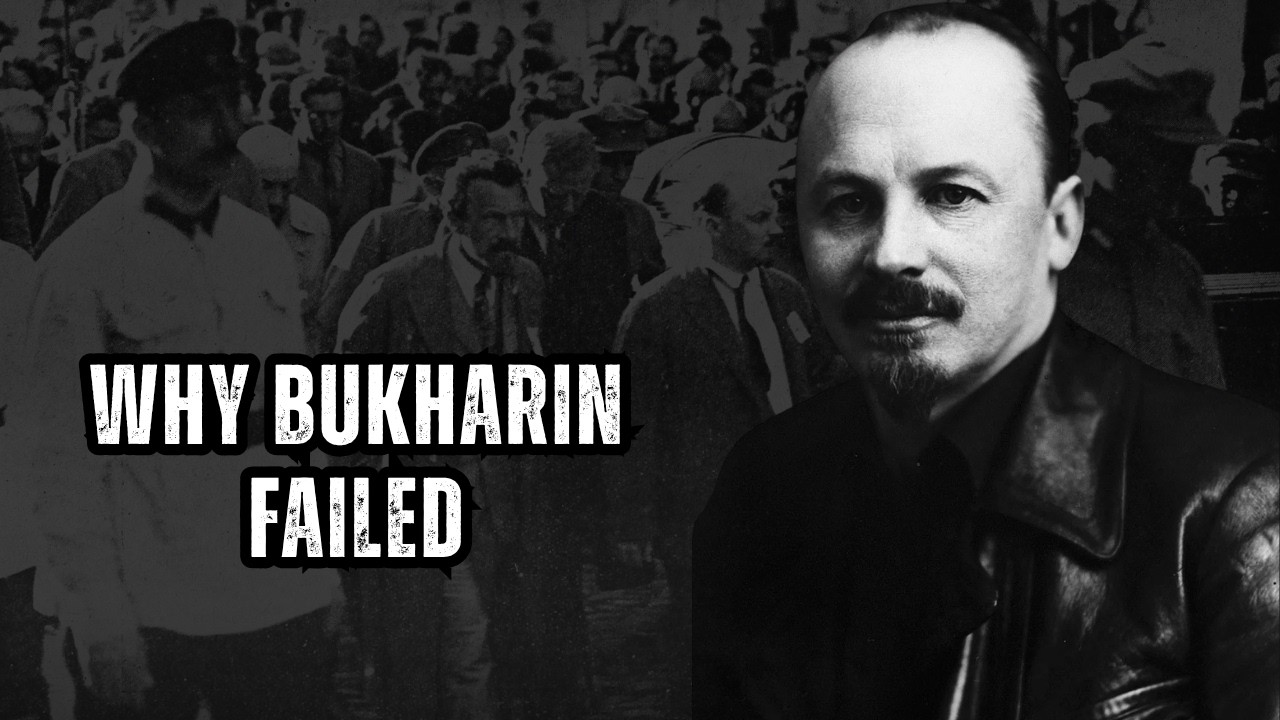
And then Nikolai Bukharin went home, wrote letters of submission, and waited. This is not a story about a man who failed to see the danger. It is a story about a man who saw it perfectly clearly and still could not stop it. Born in Moscow in 1888 to two schoolteachers, Bukharin was an unlikely product of the revolutionary underground.
He was curious, widely read, and genuinely warm in a movement that prized hardness. He loved natural science, painting, and world literature. The artist Konstantin Yuon once told him to abandon politics entirely, insisting that painting was his true calling. Bukharin did not listen.
By 17, he was in the Bolshevik Party. By 20, he was organizing worker protests and sitting on the Moscow Soviet. Arrested and exiled in 1910, he escaped abroad and met Lenin in Krakow in 1912. Over the following years, he produced theoretical work serious enough to be debated across the entire European revolutionary movement.
By 1917, when the revolution arrived, Bukharin was regarded within the party as second only to Lenin as a Marxist thinker. After the October Revolution, he became editor of Pravda and was elected to the Politburo. By 1926, he headed the Communist International. He co-wrote The ABC of Communism, the party’s defining textbook, which was read worldwide and shaped an entire generation’s understanding of Bolshevism.
Lenin, in his testament dictated in December 1922 as he lay dying, said something about Bukharin that he said about no one else. He called him not only the most valuable theorist in the party but “rightly considered the favorite of the whole party. ” In a testament full of reservations, in which Lenin questioned Trotsky’s arrogance, Stalin’s rudeness, and Zinoviev and Kamenev’s reliability, Bukharin alone received genuine warmth. This matters because Bukharin’s judgment was not that of an outsider or a lightweight.
It was the judgment of the man Lenin trusted most intellectually. When Bukharin studied a situation and drew a conclusion, there was every reason to take that conclusion seriously. After Lenin died in January 1924, Bukharin became the Soviet Union’s most powerful economic voice. He was the chief architect and defender of Lenin’s New Economic Policy, the NEP.
Introduced in 1921, the NEP allowed limited free market activity. Farmers could sell their produce. Small private enterprises could operate. The state retained control of heavy industry but did not attempt to control everything at once.
Bukharin believed this was the correct path: a gradual, patient transition to socialism that worked with the peasantry rather than against it. If peasants were allowed to prosper, he argued, they would produce more, generating the surplus needed to fund industrial development over time. He called it building socialism at a snail’s pace and told peasants they should feel free to enrich themselves. It was not a glamorous message, but Bukharin was convinced it was the honest one.
Stalin, in the mid-1920s, agreed, or appeared to. He positioned himself as the defender of the NEP against the left, against Trotsky’s calls for rapid industrialization and global revolution. The two men became the dominant alliance in Soviet politics. Together, they went to work on their opponents.
Trotsky was expelled from the party in 1927. Zinoviev and Kamenev followed. The left opposition, every significant political voice that might have served as an alternative power base, was systematically destroyed. By 1926, Bukharin was at the height of his influence, the second most powerful man in the Soviet Union.
His economic vision appeared to be the country’s settled direction. His alliance with Stalin appeared unbreakable. What Bukharin did not see, or would not see, was that he had spent three years eliminating every person who might one day stand beside him. He had helped build a machine with no opposition left inside it.
And Stalin was the only one who knew what that machine was really for. In 1928, a grain shortage exposed everything. Grain was not reaching the cities. The NEP, which depended on peasants choosing to sell their surplus, was not producing enough to feed the growing urban workforce or fund the industrial expansion Stalin wanted.
Stalin reversed himself completely. The NEP was out. Rapid industrialization was in. Forced collectivization, seizing land from individual farmers and consolidating it into state-controlled collective farms, was the new direction.
It was precisely what Trotsky had proposed, the very man they had just expelled from the Soviet Union for suggesting it. Bukharin fought back throughout 1928 in Politburo meetings, at party congresses, and in every available forum. He warned that coercive grain seizures would backfire, as war communism had a decade earlier. He predicted collectivization would produce what he called “military-feudal exploitation of the countryside” and said it would cause famine.
He was right about all of it. The famine came. Between five and a half and nearly nine million people died. But in 1928, he was losing the argument.
And losing the argument meant losing everything else. Desperate, Bukharin went secretly to meet Lev Kamenev, one of the men he had helped destroy, to try to build a coalition against Stalin. At that meeting, Bukharin said things that were true, dangerous, and fatally unguarded. He said Stalin changes his theories to meet his need to get rid of someone at that moment.
He called Stalin the new Genghis Khan. He said, “He will slaughter us all. ”
Those words were leaked to the Trotskyist press. The same charge used to destroy Trotsky, factionalism, secret meetings, conspiring against the party, was now available to use against Bukharin.
The weapon he had helped build was now pointed at him. By April 1929, Bukharin had lost the editorship of Pravda and his position in the Comintern. By November, he was expelled from the Politburo. But here is what the timeline obscures.
Bukharin saw Stalin with complete accuracy. He described him precisely: a man without fixed ideology who destroyed people tactically and called it principle. He understood the danger. He knew where it was going.
And then he kept looking for a way to survive within it. This is the center of the story. Bukharin saw Stalin for what he was, but that clarity kept running into something he could not overcome. His belief that the system he had helped build was still, at some level, redeemable.
His conviction that compliance might buy survival. His hope that if he submitted and waited, something would change. It never did. When Stalin reversed himself on collectivization in 1928, Bukharin’s instinct was not to break with him publicly while he still had a platform.
It was to argue through party channels, to reason, to persuade. He was fighting a policy debate in what had already become something else entirely. When the Kamenev meeting was leaked, Bukharin recanted. He publicly renounced his views.
He wrote letters of submission. He tried to demonstrate loyalty to a man who had already decided what to do with him. Every capitulation was a rational response to an immediate threat. The problem was that every capitulation also confirmed to Stalin that Bukharin had nothing left to fight with.
Then there was the irreversible mistake made years earlier. When Bukharin helped Stalin dismantle Trotsky, Zinoviev, and Kamenev, he genuinely believed it was necessary, that the left opposition was wrong, divisive, and dangerous. But those men, however much he had disagreed with them, were the only political forces in the Soviet Union capable of challenging Stalin. By 1928, they were gone, exiled, imprisoned, stripped of everything.
When Bukharin finally needed allies, there were none. He had spent the previous three years making sure of it. He understood this. He told Kamenev directly that the differences between himself and Stalin were infinitely more serious than any differences he had ever had with the left opposition.
He was saying out loud that he had destroyed the wrong people. Understanding it in 1928 was not the same as being able to undo it. In February 1936, Stalin sent Bukharin to Paris. The stated purpose was to negotiate the purchase of the Marx and Engels archives held by the German Social Democratic Party before its dissolution by Hitler.
Bukharin went with his wife, Anna Larina. They were abroad. Exile was a genuine option. Bukharin refused it.
He said he could not live outside the Soviet Union. That decision is the clearest window into everything that had driven his choices throughout the previous decade. Bukharin was not simply afraid. He was, at some fundamental level, unable to separate himself from the project he had spent his life building.
Even as that project was consuming the people around him. Even as he had told Kamenev that Stalin would slaughter them all, he could not step outside it. He came home. Within a year, he was arrested.
The arrest came on February 27, 1937. From his cell, Bukharin wrote 34 letters to Stalin. Not one was answered. He was tried in March 1938, accused of crimes that were entirely fabricated: conspiring with foreign powers, plotting to assassinate Lenin and Stalin, planning to partition the Soviet Union.
He confessed under duress, under threat to his wife and infant son. His final courtroom statement on the night before his death sentence was pronounced was more complex than a simple submission. Historians have argued he used it to embed a veiled indictment of the proceedings, a last act of resistance when no other kind remained. He was executed on March 15, 1938.
He was 49 years old. What followed that decision took everything from him. His wife, Anna Larina, spent nearly 20 years in the Gulag. Their son, Yuri, taken from her when he was less than a year old, grew up in Soviet orphanages.
He did not see his mother again for 18 years. Before his arrest, Bukharin had dictated a farewell testament to Anna, a letter to future party leaders declaring his innocence. It was too dangerous to write down, so she memorized it. All 800 words.
She carried it through labor camps, through Siberian exile, through decades of silence, waiting for the day she could deliver it. She lived to see it happen. Nikolai Bukharin was posthumously exonerated on February 4, 1988, fifty years after his execution. Anna Larina died in 1996.
The note Bukharin wrote to Stalin on the eve of his execution, asking simply, “Koba, why do you need me to die? ” was found still in Stalin’s desk after Stalin’s own death in 1953. He had kept it. He never replied.
Here is what history did with Nikolai Bukharin’s ideas. The forced collectivization he warned against produced the famine he said it would, a famine that killed somewhere between five and a half and nearly nine million people. The coercive state he feared is exactly what emerged. When Gorbachev came to power in 1985 and tried to reform the Soviet system, it was Bukharin’s policies from the 1920s that reformers looked back to as the model.
Half a century after his death, he became the symbol of the road not taken. He was right. He warned them, and it made no difference. Bukharin was right about everything, except the one thing that mattered most.
He believed the Soviet project was still worth saving from within. Every position he ever took, every argument he ever made, was an argument made from inside the system. Work with the peasantry. Build gradually.
Don’t destroy what you’re trying to create. He was never arguing against Soviet power. He was arguing for a better version of it. That distinction destroyed him.
Because it meant that when the system turned against him, he had no ground to stand on outside it. He could not leave. He could not fight from a position that did not depend on the party’s approval. Every act of resistance, the Kamenev meeting, the Politburo arguments, the courtroom statement, was still conducted within a framework he refused to abandon.
Stalin understood this completely. A man who believes in the system, who needs the system to validate his correctness, who will always come back because he cannot imagine being anywhere else. That man is not a threat. That man will write 34 letters and wait for a reply.
Trotsky’s arrogance made him blind to Stalin. Bukharin’s idealism made him unable to act against him. Being right in the end was not enough. Because Bukharin’s rightness was always conditional on the system he was right about still being worth fighting for.
Stalin made sure it wasn’t. And Bukharin went home from Paris anyway. He was the favorite of the whole party, and the party killed him.