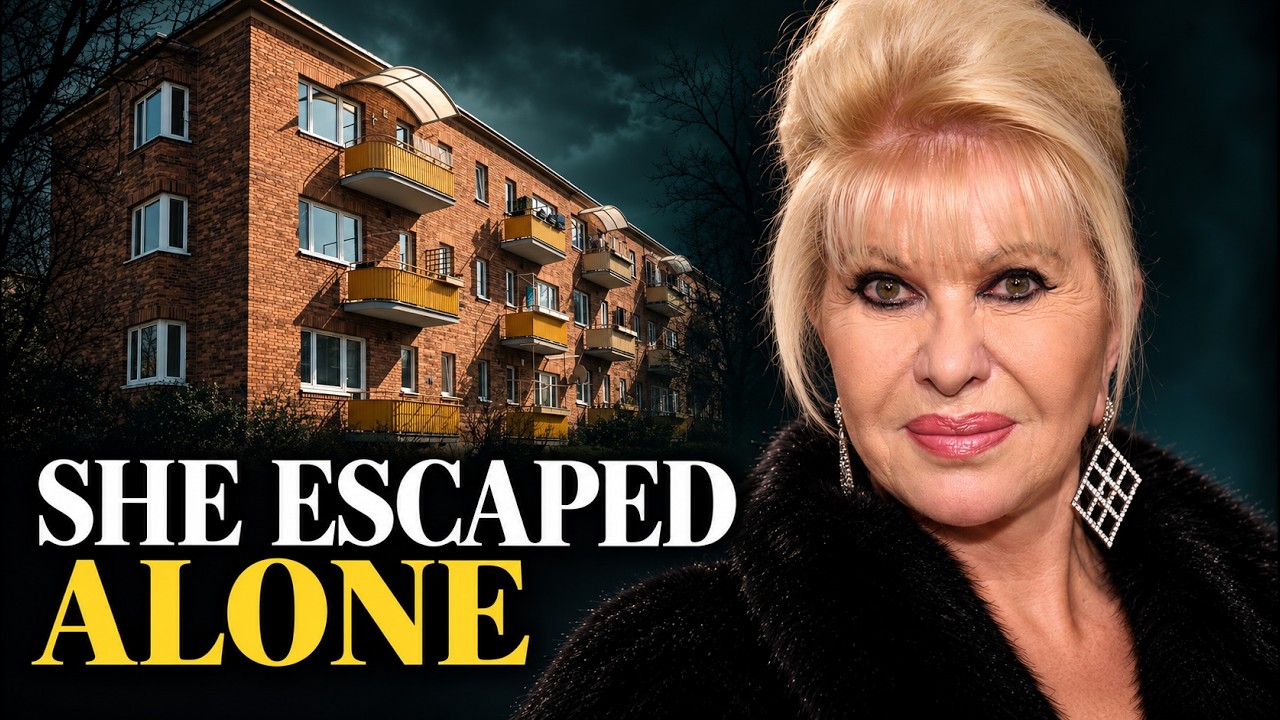
For more than half a century, the apartment remained unseen. No photograph of its interior was ever published. No address was ever printed. It was the place Ivana Trump grew up in, yet the world only knew it as a vague image of life behind the Iron Curtain: cold rooms, queues, empty shelves.
The real story is more complicated, and it begins with a file number. Six months after Ivana married Donald Trump in April 1977, the Czechoslovak secret police registered her father as an informant. His code name was Miloš. His registration number was 28,933.
For the next twelve years, he reportedly met with his handler after nearly every trip he made to visit his daughter in America. But the apartment itself was not a cold room behind a queue. It was in the town of Zlín, in Moravia. It had three rooms, around 68 square meters, with central heating and a fitted kitchen.
When the first units were completed in the summer of 1947, they were promoted as the first new housing built in Czechoslovakia after the war. Ivana Zelníčková was born on February 20, 1949, seven weeks after the town lost its name. Zlín had been renamed Gottwaldov after Klement Gottwald, the communist leader who had seized control of the country in February 1948. Her birth certificate did not say Zlín.
It carried the name of a man who had come to power a year before her mother became pregnant with her. Then the renaming came closer. On March 28, 1951, the housing estate where the family lived was renamed the Julius Fučík Quarter, after a communist journalist executed by the Nazis in 1943 and later turned into the state’s official martyr. Ivana was two years old.
She went to the elementary school on Bartošova čtvrť for nine years. A former classmate, Jarmila Travníčková, later told the Czech News Agency that other children envied Ivana her father. Not her clothes and not her apartment, but her father. He was, according to the classmate, a great sportsman who accompanied them on every school trip.
He owned a cottage in the Javorníky mountains and took her there. A generation later, he took her children there too. Her mother described him differently to an American magazine, saying he treated Ivana like a boy. He put her on skis before she was four, and he never really stopped.
Her mother, Marie Zelníčková, worked for 21 years at a telephone switchboard in Malenovice, on the edge of the same town, in the same state institution where her husband worked. In 2022, she described those years to a local newspaper reporter in a single sentence: “I spent 21 years here, it was a wasted life. ” She did not describe hunger, fear, or a camp. She described a keyboard, a chair, and a building she could see from her window.
She also said something else in the same period that explains the apartment: “My husband and I had to work two shifts so that Ivana could study. ” Two people working full-time in a state that guaranteed permanent employment were doubling their hours to educate one child. It was not poverty. It was a ceiling.
The state fed them and housed them, but it also decided how far the daughter could go, and the answer was that one shift’s income was not enough. The family lived in the Obiliny area of Zlín, according to the classmate who sat next to Ivana for nine years and said so explicitly. There is a competing account. An American magazine reported in 2017, in an interview with the mother, that the family lived in one of the small Bata worker houses.
The two are different buildings, and they cannot both be true. The magazine article also gave Ivana’s birth year as 1947 and dated her marriage to Trump to 1979, both wrong by two years, so the classmate’s account carries more weight. The Obiliny apartments were three-story brick buildings, begun in 1946 on the eastern edge of the town. Nineteen residential complexes existed by the time Ivana grew up.
The architect was Vladimír Karfík, who had worked in the offices of Frank Lloyd Wright and Le Corbusier before the war, then returned home to design workers’ apartments. The flats were mostly three rooms, 59 to 68 square meters, with an entrance hall, living room, two bedrooms, a bathroom, a fitted kitchen, brick walls, concrete floors, central heating, a cellar for each flat, and a shared laundry and drying room. There was a basement room for prams and handcarts, a refuse chute in the kitchen, and a relief by students of the Prague Academy of Applied Arts above every entrance. Bees, flowers, a spider, small images of nature and crafts set into the brick.
When the first units were completed in the summer of 1947, they were promoted as the first new apartments built in Czechoslovakia after the war. Not the worst housing in the country, but the newest. Ivana’s father, Miloš Zelníček, was born on September 17, 1927, in Třebíč. He was an electrical design engineer at a state construction enterprise called Pozemní stavby.
He did not work for the Bata shoe company, although almost everything written about him in English gets his job wrong. The company was the reason the town of Zlín existed at all. Tomáš Baťa had built the town around his shoe factory between the wars. The parents met as teenagers in the halls of the Baťa dormitories.
But Miloš was not a shoe man. He worked for the state, not the factory. The company appears in the family story, but not in the address. The cruelty of this childhood is not obvious.
There are five easy answers, and each has been published, and each fails against the facts. Poverty fails: the apartment had central heating, a fitted kitchen, and a bathroom in a country where many lacked all three. A strict father fails: the children in her class envied her that father. He trained her, drove her, took her to the mountains.
Lack of opportunity fails: she trained abroad as a teenager in Italy and Austria, studied at university in Prague, and earned a master’s degree. Persecution fails: a local report suggests her father was a department head, the family owned a country house, perhaps two, and nobody was imprisoned, fired, or expelled from their home. And hatred of the place fails: she returned about twice a year for the rest of her life and sent her three American children to spend summers there. The cruelty is not something done to the apartment.
It is something done to the apartment because of her. Ivana married Donald Trump on April 9, 1977. On October 21, 1977, the Czechoslovak secret police registered her father. Six months and twelve days separated a Manhattan wedding and a registration card in a Moravian police office.
The category was their lowest, “informant. ” His code name was Miloš. His registration number was 28,933. The following spring, they opened a file on her.
The code name was Ivana. The number was 29,834. The category was “person under investigation. ” It was opened on April 6, 1978, by the Gottwaldov office.
Almost a year later, on April 27, 1979, the file was upgraded and transferred to the directorate responsible for counterintelligence. A woman from an apartment in Moravia had become a national file. The meetings followed a pattern. After almost every trip to visit his daughter and son-in-law in America, the handler’s name appears in the reports in Zlín, as does the name of the local chief.
This continued from the late 1970s until 1989. Twelve years for a man who returned home from his daughter and grandchildren and was questioned about it. What did he tell them? Business, real estate, money.
Things a proud father-in-law might repeat at a dinner table. In 1988, he reported that Donald Trump had given $10,000 to Bush and $10,000 to Dukakis, both parties, in the same election. A father-in-law repeating a boast about hedging an election, and an officer in Moravia typing it up. That same autumn, he reported something else that made the file famous.
He told them Trump intended to run for president of the United States in 1996, that both parties were trying to recruit him, and that he had refused for the time being on the grounds that he was too young. The file gives his age as 41, but he had turned 42 that June. There is also a line in the file about the grandchildren. The text says it is nice for these children, in a romantic framework, to be taken by their grandfather into the Javorníky forests, where he owns a cottage.
A secret policeman recording the details of a summer holiday. It is the most ordinary thing in the entire archive, and it tells you what the archive was for. There is no signature anywhere in the file. The category into which her father was placed did not require one.
One source that read the file said the service made him an informant without his knowledge. A historian who works on these archives assessed that the cooperation probably remained within acceptable limits, with no offensive missions. Nothing harmful was said about his daughter or about Trump in any of the records. After twelve years of this, no damaging material on Trump was found in the file at all.
This is not a story of a father selling his daughter. The archive does not give you that either. Did she know? Reports ask the question directly and answer it in three words: “cannot be ruled out.
” That is not an answer. It is a printed shrug. Ivana Trump never made any public statement about her father’s file, and the story spread while she was still alive. The American side of the story is weaker than people assume.
The FBI opened a preliminary investigation into her on March 7, 1989, and closed it in 1991. The investigation looked at how she got from Czechoslovakia to Austria and from Austria to Canada. A man described at times as a coordinator of sham marriages is mentioned. The claims and names are redacted.
She was never charged with anything. The bureau itself noted it did not know whether the claims stemmed from jealousy over her wealth and fame, and the pages say nothing at all about her father. Two intelligence services, two states, one woman, and neither file found what it was looking for. The cruelty begins the moment she left.
Everyone who stayed inside that apartment became an object of state interest, and they became that because of her. Her mother worked a telephone switchboard and called her life wasted. Her father kept the cottage and the grandchildren, and an intelligence officer who wanted to hear about both. A man in his fifties, then sixties, could not see his daughter without the police taking a statement afterward.
The apartment was not the price. The visits were the price. This is not a family drama. Nobody in the family ever claimed that.
This is not an accusation. This is a registration number in a state archive attached to dates. Miloš Zelníček died on October 28, 1990, of a heart attack in a Prague hospital. He was 63.
The regime he reported to had collapsed eleven months earlier. He never lived to see anyone read what he had told them. He died in Prague and was buried in Zlín, in the forest cemetery on the hill above the town, in a city that had just regained its name. Ivana Trump flew in from the United States.
So did her three young children. So did Donald Trump. In October 1990, the Trump divorce was the biggest story in American media, public since February, with the couple fighting openly through lawyers about the prenuptial agreement in front of every newspaper in New York. Yet he boarded a plane to attend a funeral in Moravia.
According to Czech reports, the war between them ended at that grave. That account cannot be verified. What is not disputed is that he was there, that he stayed for several days, and that outside the family almost no one in town met him. Her mother described what he did in those days.
She said he was impressed by the architecture, constantly asked for a view of the city, and showed great admiration for the decorated forest cemetery. A New York property developer, in the middle of his divorce proceedings, walking around a Czech hillside cemetery and contemplating its design. He stayed in the town for several days. No report suggests he asked to see the apartment.
When Ivana Trump died in July 2022, her will was read. It included a property in the Czech Republic. It was an apartment in a prefabricated five-story building in the center of Zlín, next to the winter stadium. The will gives the apartment to Donald Trump Jr.
, Ivanka, and Eric in equal shares, then does something precise. It states that her intention is to allow her mother to live there for the rest of her life. That building is not on Obchodní Street. It is a different neighborhood, a different contract, and a completely different building.
It was her mother’s later apartment. Every property record and every newspaper can direct you to it. Marie Zelníčková moved permanently to the United States in 2021, a year before her daughter’s death. The lifetime right of use that the will protected so carefully was, by the time the will was read, protecting an empty apartment.
The clause worked perfectly, but it protected nothing. The apartment was sold in 2024. Ivanka Trump traveled to the Czech Republic to settle the estate. No price or buyer name was published anywhere.
The only Czech address in this story that anyone could search for changed hands without disclosing the value of the transaction. Her mother is still alive. In April 2026, she turned 99 in Florida, in her granddaughter’s home. Ivanka said having her in the house is a blessing.
Look at what that life contains. A childhood under the Germans, her twenties under the communists, 21 years at a telephone switchboard she described as a waste of a life. She has outlived the regime, the file, the husband, and the daughter. Two things in this story have never been explained.
The first is the number on the door. A classmate told a national news agency the neighborhood where the family lived, and the trail goes cold. No street name, no house number, no photograph of the interior. A woman with two intelligence files and four decades of newspapers, and no one has ever published the address of the home she was brought to.
The town sells its architecture. It organizes tours of the buildings the shoe company created. No plaque carries her name on any of those housing complexes. The second thing is her silence.
The story of her father’s file spread in a British newspaper and a Czech magazine while she was still alive, and more than four years have passed. She published memoirs in that period. She gave interviews. She appeared on television.
No public statement from her on the subject exists. No denial, no confirmation, not even a complaint. The silence is a gap in the record, and no one can say what it means. In October 2022, the Czech president awarded her a state medal, three months after her death.
It was awarded on October 28, the national holiday, which is also the day her father died 32 years earlier. The apartment had three rooms, up to 68 square meters, a cellar, a fitted kitchen, and a relief carved into the brick above the entrance by an art student from Prague. It was announced as the first new housing in the country two years before she was born in it. The state renamed the neighborhood around it, put her father’s name in a police register, opened a file about her from the office in the same town, and kept meeting him about her for 12 years.
None of that is in the building. The walls were never the problem. The record was the problem. The home was not crueler than you thought.
It was the price she paid for leaving it. What was done to that family has a registration number and no walls. She left on May 7, 1972, with a passport obtained after marrying a stranger. Her mother left 49 years later.
Her father never left at all. He was sentenced to twelve years of coming home from America to be asked how his trip was.