Most people familiar with World War II know that Adolf Hitler and many of the top Nazis were World War I veterans. Hitler spent four years in the trenches of the Western Front and was decorated three times for gallantry, including the Prussian Iron Cross First Class. Hermann Göring was a famous World War I fighter pilot and ace who was awarded Imperial Germany's highest decoration, the Pour le Mérite, or Blue Max. Rudolf Hess had also been a flyer, and Joachim von Ribbentrop had served as a cavalry officer.
But when it comes to Germany's most feared Nazi after Hitler, the ruthless leader of the SS, Heinrich Himmler, his World War I service is usually dismissed or glossed over. In fact, Himmler was a soldier in World War I. Because he did not see combat, this aspect of his life, which had a formative effect on his personality, is often dismissed as not worthy of discussion.
You may be surprised to learn that, far from shirking his military responsibilities, Himmler actually served for one and a half years in the regular and reserve armies of both Imperial Germany and the Weimar Republic. He would also serve for almost three years as a Freikorps soldier during the revolutionary period of the early 1920s, including seeing some action during the 1923 Beer Hall Putsch.
If Adolf Hitler's sole aim in his early life was to become an artist, then Himmler's was to become an army officer. Neither man would achieve his dream, and their failures contributed to what they would later become.
Heinrich Himmler was born in 1900 in Munich, the capital city of the Kingdom of Bavaria, one of the many kingdoms and principalities that formed the German Empire. His father, Joseph Himmler, had worked his way up from very little to become a schoolmaster and a tutor to the Bavarian royal family. Himmler was named for his godfather, Prince Heinrich of Bavaria, who took a friendly interest in the boy and the wider Himmler family.
His father was stern and conservative and instilled his three sons with his politics and work ethic. From his mother, Anna Maria Himmler, he gained an early adherence to Roman Catholicism. Himmler was not impressive physically, wearing spectacles and showing little interest in sports in favor of more aesthetic interests. But with the outbreak of war, the teenage Himmler desired above everything else to become an army officer.
He joined his local Cadet Corps in Landshut in 1915, and as he grew to military service age he badgered his father to use his royal connections to obtain for him a place in a good regiment as an aspiring officer. Himmler's father tried to pull the necessary strings, but the waiting lists to join the First and Second Bavarian Infantry Regiments were too long.
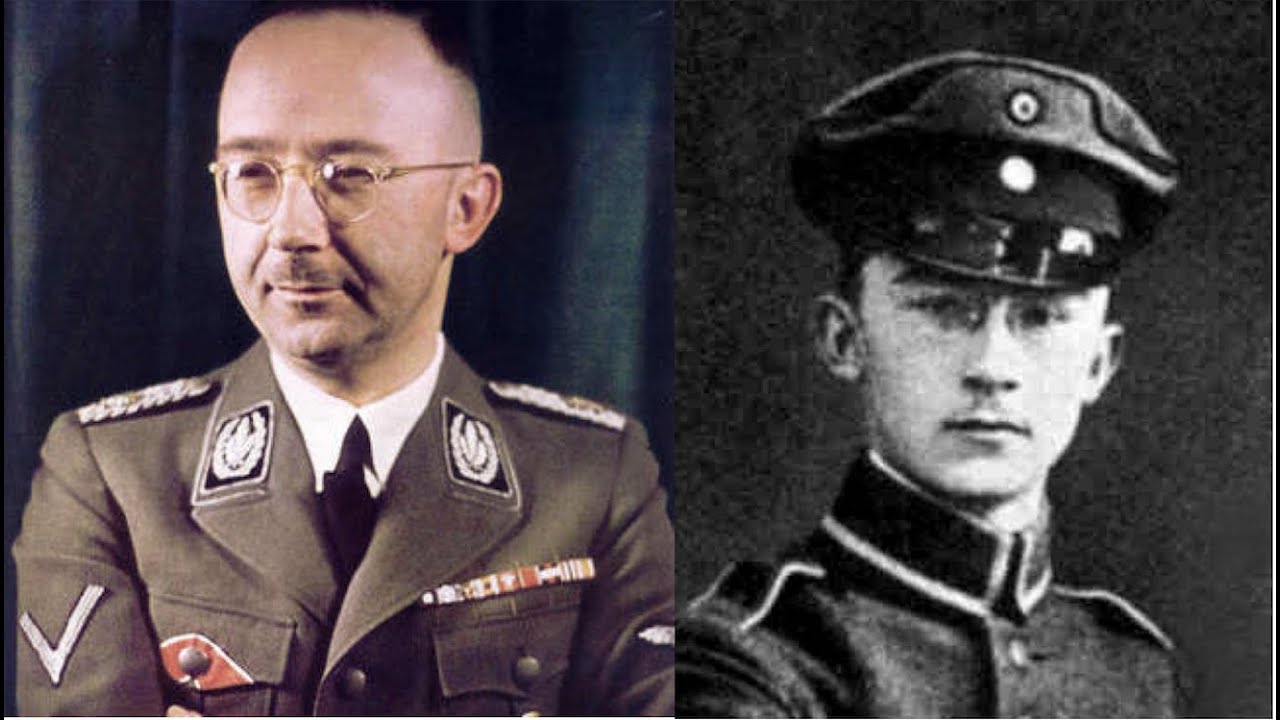
What happened next says much about Himmler's personality. He abruptly left school when he discovered that his year was liable for conscription into the army. He reasoned that if conscripted as a mere private, his chances of becoming an officer would have been lost. If he was so keen to fight, one would have thought he would have accepted conscription and gone willingly to the front, but it appears Himmler wanted to control the manner of his joining up.
He worked for a few weeks for the Patriotic Auxiliary Service in a welfare office until receiving the good news that his year group would not be drafted. He returned to school to complete his education. Then, on December 27, 1917, the 17-year-old Himmler received notice that he had been accepted as a trainee officer with the rank of Fahnenjunker in the Reserve Battalion of the 11th Bavarian Infantry Regiment, based near Regensburg.
Basic training was not a pleasant experience for Himmler, who came from a sheltered family background, but he settled down after a few weeks of homesickness, complaints about the food, and various other problems. When the training period ended, Himmler expected to be posted to a frontline battalion. Instead, he was sent on to another training course at Freising, 40 kilometers from his family home in Landshut, meaning he could visit home some weekends.
Successfully completing his second period of training with the other recruits, Himmler again expected to be sent to the front. His older brother, Gebhard, was then fighting on the Western Front as a Leutnant, or second lieutenant, and Himmler was very keen to do his duty. But even though Germany was evidently losing the war, the army refused to truncate officer training courses. On September 15, 1918, Himmler was sent on a two-week heavy machine gun course at Bamberg.
Following a week's leave, Himmler returned to Regensburg and the regimental depot to help train new recruits until finally being selected for a composite company that was to be rushed to the front. By now it was November 1918, and with the political situation inside Germany unraveling, the company was stood down at the last minute, ending Himmler's last chance to see action in World War I.
Revolution erupted in Bavaria, leading to the king's abdication on November 7. Emperor Wilhelm II abdicated and fled into exile in the Netherlands on November 9, leaving a new government to make peace on November 11, 1918, ending World War I. One consolation for Himmler was the survival of his brother Gebhard, who returned home a full Leutnant with an Iron Cross for gallantry.
Himmler was sent to the 11th Regiment's Reserve Battalion at Regensburg, hoping the new republic would have some use for a mostly trained officer. Instead, he was assigned the inglorious task of helping to demobilize the regiment as the battalions marched back to Germany from the front. The size of the German Army began to rapidly decrease as the Treaty of Versailles made it clear that Germany would only have a purely defensive force of just 100,000 men.

Himmler was told that all Fahnenjunkers from his original draft were surplus to requirements. On December 18, 1918, Himmler was honorably discharged at the age of 18 from the regular army after almost one year's service. His dream of becoming a second lieutenant was shattered.
Himmler tried to find something to do while drifting toward nationalist and right-wing politics in the economic chaos of postwar Germany. He had a new plan to achieve his dream of a commission in the regular army. In April 1919, Himmler joined his local Freikorps unit in Landshut, the Freikorps being right-wing paramilitary groups of former servicemen led by experienced officers and NCOs.
He also obtained a place in the Oberland Freikorps. The leader of this group was Rudolf von Sebottendorf, chairman of the Thule Society, a German occultist and nationalist organization destined to heavily influence Himmler and the later SS, and whose emblem was the swastika. The Oberland Freikorps took part in the bloody crushing of the short-lived Munich Soviet Republic, though Himmler was not involved in any fighting.
Himmler's hopes of rejoining the regular army were briefly raised when the government ordered Freikorps organizations absorbed into the armed forces, but Freikorps Oberland was not included. Receiving his school certificate in July 1919, Himmler enrolled to study agriculture at Munich Technical University. He chose this subject because he knew the course would be full of landed gentry and aristocrats, many of whom were reserve officers, and new friends like these might help him back into the army.
A bout of paratyphoid fever delayed Himmler's taking up of his new place, time he used to read widely. His letters and diaries note his expression of anti-Semitic and anti-Freemason views for the first time. In October 1919, Himmler started at the university, proving a good student with plenty of friends who enjoyed an active social life. He fenced for the university and also joined the reserve army, the equivalent in the United States to the Army National Guard or in Britain to the Army Reserve.
Inducted into the 14th Alarm Company of the 21st Rifle Brigade, this right-wing Reichswehr unit was called out several times during political agitation in Munich. In December 1919, the unit was mobilized and armed with rifles, standing ready to quell unrest, but in the event was stood down. On January 16, 1920, a great tumult resulted from a court sentencing former army officer Count Arco to death for his assassination of Bavarian prime minister Kurt Eisner in February 1919. Himmler's unit planned to stage a coup along with many other parts of the army against the Bavarian government, but Count Arco's death sentence was commuted to life imprisonment and the crisis was diffused.
In spring 1920, Himmler's military career was ended again by government decree as reserve units were disbanded at the request of the British, French, and Americans. All Himmler could do was join the residence reserve and a local rifle club. His Army Reserve service amounted to about six months. However, he was next to join another paramilitary formation, the Reichsflagge, a unit created by Captain Ernst Röhm in 1922.

Himmler received two medals for his wartime military service: the War Commemorative Medal 1914 to 1918 of the Kyffhäuser Union in March, and the German Honorary Commemorative Badge of the World War in December. Politics was in disarray in Bavaria, with Hitler and famous World War I General Erich Ludendorff leading opposition to a triumvirate run by Gustav von Kahr, whose job title was General State Commissioner, effectively dictator of Bavaria.
The Reichsflagge organization declared support for von Kahr, leading Röhm and a hard core of supporters to break away and form the Reichskriegsflagge, or Reich War Flag. Himmler followed Röhm's organization, threw in its lot with Hitler, and took part in the Beer Hall Putsch on November 9, 1923, when Hitler attempted to overthrow the von Kahr government by force.
Himmler, in military uniform and armed with a rifle, was the standard bearer of the Reichskriegsflagge, carrying, not surprisingly given the organization's name, the old German Imperial Battle Flag of World War I. He was by now also an NSDAP member, having joined the party in August 1923.
Röhm, Himmler, and the other members of the Reichskriegsflagge were not part of the famous march from the Bürgerbräukeller beer hall to the Feldherrnhalle War Memorial in central Munich led by Hitler and Göring that ended in a gun battle between Nazis and Munich police. Instead, the Reichskriegsflagge had cordoned off the Army headquarters in the city and would be themselves surrounded by Reichswehr troops loyal to von Kahr.
Fighting did break out, and for the first time Himmler actually saw some combat, stuck between the soldiers defending Army headquarters and more troops that arrived to break the Reichskriegsflagge's siege of the complex. Soldiers trapped inside the building opened fire, causing Röhm's men to return fire. Two members of Himmler's unit were killed. However, after a ceasefire and negotiations, the army allowed the Reichskriegsflagge to disperse, and unlike the Nazis they were not arrested or placed on trial. Himmler simply being interviewed by the police and then released.
Himmler became more closely involved with the Nazi Party, rising rapidly through the ranks throughout the 1920s to become the fourth holder of the post of Reichsführer-SS in January 1929. It has been noted by many historians that his failure to see any combat in World War I affected his personality and also made him the butt of many jokes by Hitler and the hardcore of combat veterans that surrounded the Führer, though of course never to his face.
Himmler would die under mysterious circumstances in British custody on May 23, 1945, at the age of 44.