The note my husband left that morning said, “Eat it all, my darling. ” He drew a small heart next to his name, just as he had been doing for years, back when our love was still something bright and new. I never saw that note. I didn’t even know the food existed until a detective placed a photograph of it in front of me in a hospital corridor and asked if I recognized the handwriting.
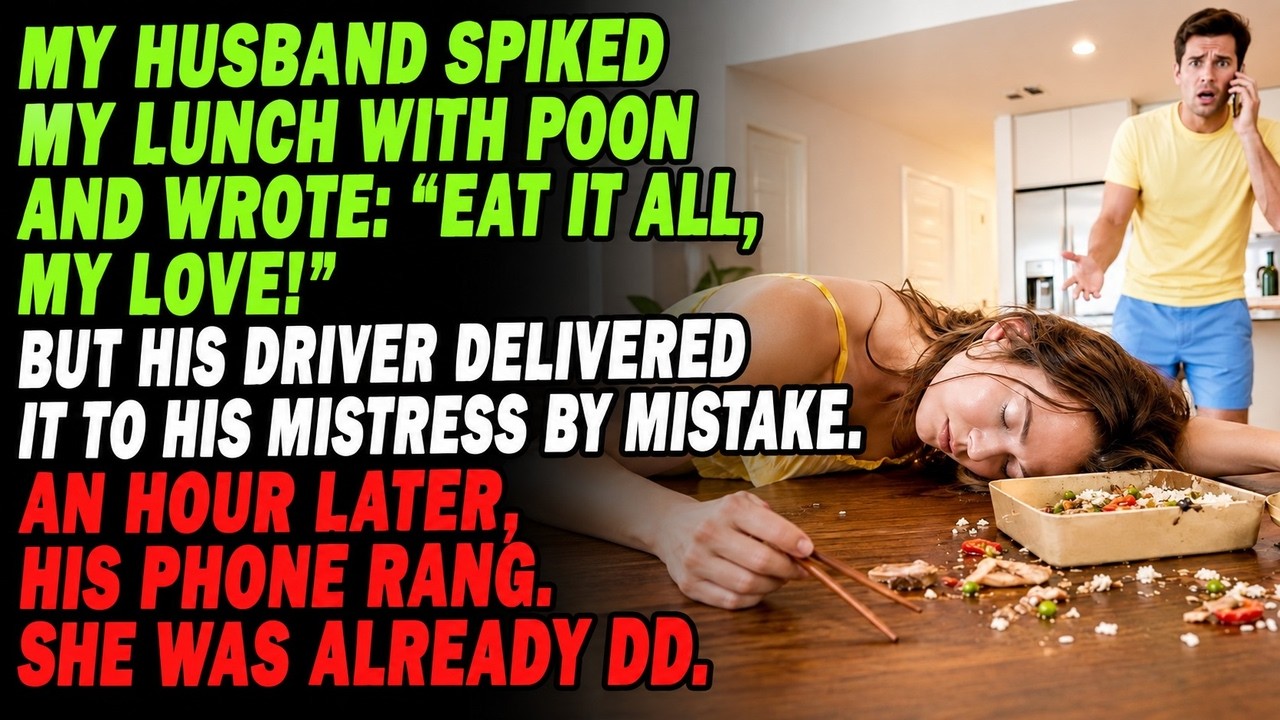
I did. Of course I did. I had been watching that man write my name for eleven years. I’m telling you this story because I still don’t fully understand how I survived it.
My name is Verity, and I was married for eleven years to Crispin Aldgate, a property developer with offices in downtown Seattle and a smile that could convince anyone of anything. He convinced me once. He convinced me he was loyal and attentive, the kind of man who remembers the name of your childhood dog and your grandmother’s birthday. By the time I understood what he really was, I had built my entire life around him—or rather, around the version of him I believed in.
Our mornings had stopped feeling like ordinary mornings long before that day. We had become like strangers sharing a kitchen, each of us circling the other carefully. I would wake early, make coffee from the fancy beans we ordered from a roastery in Portland, and pour him a cup out of habit, because routine was my anchor. Crispin would come down the stairs already dressed, tie knotted, jacket on, and drink the coffee without acknowledging that I was the one who made it, that I had gotten up before dawn to learn his preferences.
That Tuesday in March, I remember setting his cup on the kitchen table and watching him scroll through his phone with that expression he always wore now—a kind of suppressed, distracted anger, as if the whole world was demanding more of him than he could bear. He didn’t look at me. I had gotten used to that too. I told him to drive carefully.
He said he would. It wasn’t meant as a kindness. It was just noise. I found out later, much later, what had actually been going on while I stood in our kitchen in my pajamas watching him leave.
The investigation eventually revealed that Crispin had been carrying a small glass vial in the inner pocket of his Belstaff jacket for three days. He had purchased it through an encrypted channel online from someone who described it as a chemical compound used to sedate large animals on farms—odorless and tasteless when diluted in strongly flavored food, and fatal in doses smaller than a teaspoon. He had done his research. He planned it methodically, the way he planned his property deals, breaking it down into steps so that no single part of it felt like a grave act.
His mistress, a woman named Lynne Devereux, had been in his life for fourteen months. I didn’t know that then. I had sensed something, the way you sense a change in the weather before you can describe it. His new habit of leaving his phone face down on every surface.
His trips to Chicago that, according to his credit card records, had never left Seattle. But sensing something and knowing something are two different weights to carry, and I kept telling myself I was imagining things. What I didn’t know was that Lynne had run out of patience. Crispin had made her promises he never intended to keep, and she had started collecting evidence against him.
She knew about the investor accounts he had been quietly draining for two years—money belonging to clients who had trusted his company with their retirement savings. Her messages to him had stopped being love letters. She wanted a ring, a legal name, a real life, and she was willing to burn his down to get it. Crispin, in the way cowards behave, decided that the cleaner solution was to remove the problem he could control.
He couldn’t undo the embezzlement. He couldn’t make Lynne disappear. But he could remove me, and with me, access to the property in the trust portfolio my parents had left me when they died. In Washington State, the surviving spouse inherits.
He had looked it up. He stopped at Fenwick’s on his way to the office. Fenwick’s was an upscale Italian restaurant on Third Avenue. The kind of place where the portions are small and the chandeliers are massive.
I had loved it when we first got married. We used to share the truffle risotto and split a bottle of Barolo and talk for hours about everything and nothing, the way people do when they still believe in each other. He knew it was my favorite. That was the point.
He ordered my usual—truffle risotto and grilled chicken with preserved lemon sauce. He paid in cash, which he rarely did. While he waited for the order to be packed, he slipped over to an empty table in the corner and opened the food containers. His hands weren’t entirely steady, according to the surveillance footage the investigators recovered later.
He took the vial from his jacket’s inner pocket. He filled the syringe. He pierced the needle into the center of the risotto, then into the sauce. He closed both containers carefully, like a man who had rehearsed this exact sequence in his head many times.
He reassembled the bags. He walked to the counter. He picked up his order. Then he wrote the note.
A cream-colored card, in his elegant handwriting, with a small heart drawn beside his name, because he knew I would recognize it, because he knew it would move me. Eat it all, my darling. He handed everything to Marco, his driver of eight years, and told him to take it to me. “She’ll be home,” Crispin said.
“Make sure it arrives while it’s still hot, and text me when she starts eating. Don’t call. I’ll be in a meeting. ”
I know Marco now.
I sat across from him at my kitchen table and we drank coffee, and I let him talk until he had nothing left to say. He is a good man who carried guilt he didn’t deserve for a long time. He told me what he had been thinking during that drive, and I understood his logic completely, because it wasn’t illogical. It was built entirely on what Crispin had actually shown him over eight years.
For the past year, Marco had been driving Crispin to an apartment building in South Lake Union almost every weekday evening. He had watched Crispin call me, his wife, by my first name in a flat tone, when he bothered to call at all. He had watched Crispin call Lynne “my darling,” forgetting Marco could hear him. The same phrase on the note.
He had watched Lynne stand in her building’s lobby whenever she knew the car was coming, watching for the headlights, dressed like she was always ready for something wonderful to happen. I had stopped waiting for Crispin at the door a long time ago. So when Marco leaned in to read the note through the packaging, and he was nearsighted and only reluctantly wore his reading glasses, and he saw the words “my darling” in Crispin’s handwriting, his mind did the only thing it could do with eight years of accumulated evidence. He drove to South Lake Union.
I wasn’t home anyway. That morning, twenty minutes after Crispin left, I got a call from my closest friend, a woman I had known since our sophomore year of college. She had been in a minor fender bender on the highway—nothing serious, no injuries—but she was shaken up and her car was being towed, and she had to pick up her two kids from school at three and had no one else to call. I told her I was on my way.
I spent the entire day on the other side of the city. I sat on a plastic chair at the dealership for two hours reading an old magazine and buying my friend water from the vending machine. Then I drove to the elementary school and picked up two little kids who were overjoyed to learn they’d be getting ice cream before dinner. I took them for ice cream and let the younger one choose the toppings.
Then I brought everyone home and helped my friend make a simple pasta dinner because she was too rattled to cook. I was grateful to have somewhere to go and someone who needed me. The house on Queen Anne Hill had been feeling too heavy lately. Being useful somewhere else was like getting my breath back.
Our housekeeper, Mrs. Nguyen, texted me around noon to say a delivery had arrived. A bag from Fenwick’s. She said it smelled wonderful.
She said she had put it in the fridge since I wasn’t home. I texted back that I wouldn’t be home for dinner and she could eat it or take it to her family. I didn’t think about it at all. I assumed it was an order I had forgotten for myself, or maybe a delivery mistake.
I wasn’t thinking about my husband that afternoon. I was thinking about whether my friend had enough pasta in her cupboard and whether her youngest had an allergy to anything. The ordinary things of caring for people I loved. Hours passed before I understood what had been sitting in my refrigerator.
Lynne Devereux received the Fenwick’s bag from Marco at 11:47 in the morning. According to the building’s security records, she took it from him at her apartment door with both hands, looked at the packaging, and her entire expression changed. Whatever mood she had been in before the knock, it vanished. She photographed the note before she even opened the food.
The investigators found the photo on her phone later. Crispin’s handwriting in close-up, the small heart. Eat it all, my darling. She posted it to her social media story within four minutes of Marco leaving.
Her friends told the investigators her caption had been something like, “He still knows how to make things right when they go wrong. ” One of those friends replied with a string of heart emojis. Lynne replied with a laughing face. She ate quickly.
She was hungry. She had skipped breakfast because she had fought with Crispin on the phone the night before and had been too upset to eat. The risotto was still warm, the truffle smell filling the small kitchen of her apartment. She finished most of the dish in fifteen minutes, leaning over the bowl at her kitchen counter, texting with her other hand, still feeling the satisfaction of having chosen correctly.
The symptoms started at 12:22. Within thirty minutes, building security found her on the kitchen floor, phone in her outstretched hand, showing a missed call from Crispin on the screen. On the other side of town, Crispin was sitting at the long conference table on the fourteenth floor of his office when the first message from Marco arrived: “Package delivered. She received it happily and is eating it now.
” Crispin read the message twice, then placed his phone face down on the table and pressed his palms flat against the wood to keep them from trembling. He fixed a neutral expression on his face, like a man concerned about a spreadsheet presentation. He sat very still. Inside, he was counting.
He was calculating. He was already rehearsing the phone call he would receive. The shock he would perform, the way he would say “my wife” in a voice that sounded broken. His phone lit up on the table fifty minutes later, an unknown number.
He answered with the gravity and caution of a man expecting terrible news. The voice on the other end asked if he was Crispin Aldgate. She said she was calling from Harborview Medical Center. She said they had a patient who had his number in her recent call log.
She said the patient’s name was Lynne Devereux. The conference table seemed to tilt beneath him. He apologized in a voice he could barely control. He stood and left the room without looking at anyone.
In the elevator going down, alone, he hit the steel wall with the flat of his hand once, hard. He stood there breathing while the floors dropped away beneath him. I was in a grocery store parking lot helping my friend’s youngest child into a car seat when my phone rang. It was an unknown number.
I almost let it go to voicemail. Something made me answer. It was Marco. His voice sounded like a man trying to hold himself together with both hands.
He told me he had delivered a lunch from Fenwick’s that morning on Crispin’s instructions. He told me there was a woman who had become very ill. He was in a building in South Lake Union, and there were paramedics and police, and he had told them who he worked for, so they asked him to wait. He said he thought the lunch was supposed to be for someone at that address.
He said he was sorry. He said he didn’t know. He just didn’t know. I sat there in that parking lot with the engine running and two kids in the back seat asking if I was okay.
“Everything’s fine,” I told them. “Just a phone call. ” I called my friend to come get her children. Then I drove to Harborview.
I want to be honest about what I felt walking into that emergency room. It wasn’t grief. Not exactly. Not yet.
It was something colder and more confusing. The feeling of entering a room where everything familiar had been moved three inches to the left. I knew my husband’s name would be at the center of this. I didn’t yet know what that meant.
A detective met me in the corridor. She introduced herself as Detective Park. She was calm and steady in the way people learn to be in that profession. She showed me a photograph on a tablet screen.
It was Crispin’s handwriting on the cream-colored card he kept in his home office. Eat it all, my darling. A small heart. “Do you recognize this?
” she asked. Yes, I said. That’s my husband’s handwriting. “Did he send you food today, Mrs.
Aldgate? ” I don’t think so. Not that I know of, no. She studied me carefully.
“Your husband’s number was among the last calls of our victim. Her name is Lynne Devereux. The food she ate contained a high concentration of a toxic compound. We’ve spoken with your husband’s driver, Marco Reyes.
He confirmed he delivered the package this morning on your husband’s direct instructions. ”
I heard the words. I needed a moment to let them form into a comprehensible meaning. The bag from Fenwick’s, my favorite restaurant, and the note with the small heart I had always associated with the persona Crispin had performed when we first met.
“He thought he was sending it to me,” I said. It wasn’t a question. It arrived as a realization, clear and cold as the water you can see from the ferry docks on a January morning. Detective Park looked at me steadily.
“We believe that’s correct, yes. ”
I sat down on the bench in that corridor and said nothing for a while. A nurse passed me pushing a cart. Somewhere deep in the emergency room, a monitor was beeping in a patient, mechanical rhythm.
I thought about the coffee I had made that morning, which Crispin had drunk without looking at me. I thought about the prayers I still said for him every night, a habit I couldn’t shake even after everything that had happened. I thought about how I had been twenty-three when I married him, and how I had believed completely that love was something that protected you from harm. I was still sitting there when Crispin came through the corridor doors.
I heard his footsteps before I saw him—fast and forceful on the floor, the stride of a man trying to control his panic while pretending he wasn’t panicking. He rounded the corner with his jacket open, no tie, phone in hand, and stopped when he saw me. That expression. I will carry it with me for the rest of my life.
It wasn’t guilt, not at first. It was pure mechanical failure, a plan colliding with something he hadn’t accounted for. His eyes moved from my face to Detective Park’s badge, then to Marco, who was sitting fifteen feet away with his elbows on his knees and his face in his hands. “Verity.
” Just my name. Nothing else. I stood up. I wanted to stand.
I wanted him to see me standing. “Mr. Aldgate,” Detective Park said, stepping forward. “We need you to come with us.
” Crispin looked at me again, and I understood what he was searching for. Some opening, some confusion on my face he could exploit, some way to frame this as something other than what it was. I gave him nothing. I had given him everything for eleven years, and I had nothing left to offer.
“Marco,” he started, his voice already shifting into the tone of a man building a defense. “I never said you were supposed to—” “Mr. Reyes followed the instructions you gave him,” Detective Park said. “Sir, you need to come with me now.
”
Lynne Devereux died at 2:47 in the afternoon. The compound Crispin had purchased was effective. The trauma team couldn’t do anything after the first hour. She was thirty-one years old.
I never knew her. I’ve thought about that a lot since then. She was someone’s daughter. She made choices that hurt me without us ever meeting.
And she had trusted a man who was already planning to use her and discard her the moment she became inconvenient to him. The same way he had planned to discard me. She didn’t deserve what happened to her. Whatever she had done to my marriage, she didn’t deserve that ending.
Crispin was charged with second-degree murder and two counts of attempted murder. The embezzlement charges came separately after the financial investigation team finished their work. The investor accounts, the shell companies, years of carefully woven fiction—all of it collapsed the way those things do, quickly, once someone starts pulling the right threads. His lawyer tried several angles during the preliminary hearings.
None of them worked. Marco was never charged. He cooperated fully and told the truth about everything he had witnessed during eight years of quiet, loyal service. He cried when he sat across from me at my kitchen table and told me he was sorry.
I told him what I believed then and still believe now. He hadn’t made a mistake. He had made the only logical decision based on everything he had been shown. My husband had spent a year training everyone around him to understand that his real life was somewhere other than where I was.
Marco had simply learned the lesson he had been taught. He should never have had to carry the guilt for that. I divorced Crispin across a courtroom table with his public defender sitting beside him. I kept the property and the trust fund my parents had left me.
His lawyer briefly raised the matter of community property, but the judge was unimpressed. I moved out of the house on Queen Anne Hill. I didn’t want it anymore. Too many rooms holding the shadows of the woman I was trying to leave behind—the one who poured coffee for a man who wouldn’t look at her, who prayed every night for a husband who already considered her an obstacle, a nuisance, a problem to be solved and disposed of.
I bought a smaller place near the water. I can hear the ferries from my bedroom in the morning. On clear days, I can see the Olympic Mountains from my kitchen window when the light hits the right angle. I make good coffee now.
I make it the way I like it, which turns out to be a little lighter, a little sweeter—a small thing, but entirely my own. I think about that note sometimes. The small heart he drew beside his name. He drew it to make me feel loved enough to eat without suspicion, to lower whatever guard I might have had.
He used the language of tenderness as a weapon, the way he had used it for years—not to make me feel safe, but to make me obedient, pliable, easy to control. What keeps me awake sometimes, staring at the ceiling with the sound of the water outside, is the painful, bewildering irony that the tenderness worked. It worked exactly the way he designed it to work. But it worked on the wrong person, carried by the wrong hands, routed down the wrong path.
Marco’s logic. My friend’s minor accident. The chance that I was at the hospital instead of home. Every link in that chain was something no one planned and no one could have engineered.
And yet each link held. I’m not someone who uses the word “miracle” lightly. I was raised to believe the world is mostly made of ordinary, explainable things, and that we should be wary of reaching for miracles when plain luck is sufficient. But I’ve lived with this story for a long time now, turned it over many times, and I’m less certain where that line is drawn.
I left my house that morning to help someone I loved. I spent my day doing something useful. I wasn’t there to receive what was coming toward me, and by the time I returned to a world that had been completely reshaped, the worst of it was over, and none of it had touched me. What you give to the world finds its way back to you.
I spent eleven years in a house with a man who built his entire life on the quiet conviction that other people existed to be used, and that love was just a tool to make them compliant. And I spent those same eleven years trying, imperfectly and often without adequate recognition, to do the opposite—to be present, to mean what I said, to be somewhere useful when someone needed me. I don’t know what that means in any cosmic ledger. I don’t know if kindness brings protection, or if compassion builds a shield.
I only know what happened. I know I was somewhere else, doing something good, while my name was being written on a card designed to kill me. I know the food never reached my door. I know the driver chose the route he took because of choices my husband had made long before that morning.
Choices that had nothing to do with me. I know Lynne Devereux died in an apartment in South Lake Union believing, in her final moments, that she had been loved. And I know I am still here, with my coffee and my view of the water and my quiet mornings, and the ferries that come and go across the sound whether anyone is watching them or not. And the rest of my life is all ahead of me, as something I can finally decide what to do with.
“Not even close,” is what I think when I remember how close it was. Not even close.