Coffee was once considered the devil’s work by priests, banned by sultans who drowned repeat offenders in the Bosphorus, and guarded so fiercely by Yemeni traders that they boiled every exported bean to prevent anyone else from growing it. Yet today, more than two billion cups are consumed daily, and the industry generates over $400 billion a year. The story begins with goats. Around the ninth century, in the highlands of Ethiopia, a young goat herder named Kaldi reportedly noticed his flock acting strangely after eating bright red berries from a wild shrub.
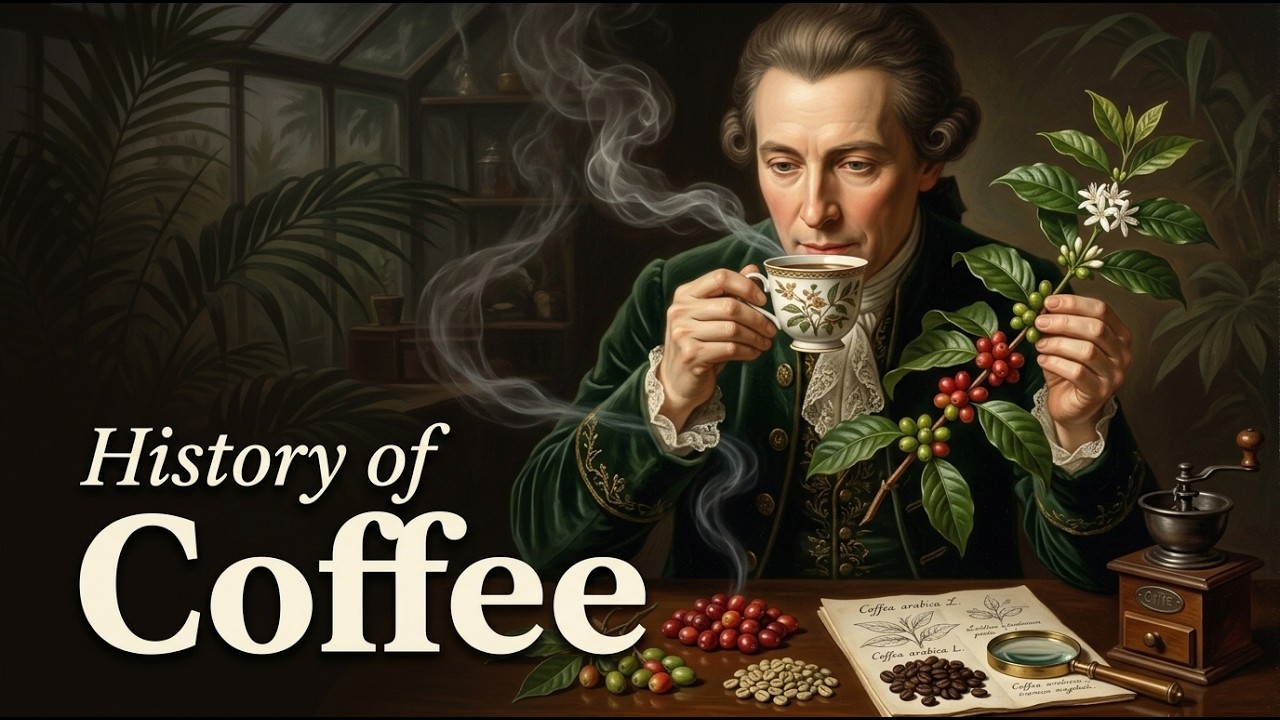
The animals leaped, bleated louder than usual, and refused to sleep at night. After observing them for days, Kaldi tried the berries himself and felt a rush of energy he had never experienced. Whether Kaldi was a real person or a legend passed down through centuries is uncertain. The earliest written version of the story appeared in the fifteenth century, hundreds of years after the events supposedly took place.
But the geography checks out. Wild coffee plants, of the type known as Coffea arabica, still grow in Ethiopia’s forested highlands today, and the region of Kaffa is widely considered the birthplace of coffee as we know it. Indigenous Ethiopian communities chewed coffee leaves and crushed the fruit into paste mixed with animal fat for energy long before anyone thought of roasting and brewing it. According to the legend, Kaldi brought his discovery to a local monastery, where a monk threw the berries into a fire, calling them the work of the devil.
As the fruit roasted in the flames, the aroma was so rich that other monks rushed over, collected the roasted beans, ground them, dissolved them in hot water, and drank. That night, they stayed awake through evening prayers without drowsiness. Word spread quickly through Ethiopian monasteries. On the other side of the Red Sea, in Yemen, coffee became a genuine force that reshaped daily life.
By the fifteenth century, Sufi monks in Yemen’s coastal cities had turned coffee drinking into a spiritual practice. They called the drink “qahwa,” an old Arabic word that originally referred to wine, and used it specifically to stay awake during long nights of religious devotion. For them, coffee was not about pleasure or socializing. It was a tool for worship.
Yemen became the first country to cultivate coffee as an actual crop, planting it on terraced hillsides outside Sanaa. The coastal port city of Mocha on the Red Sea became the center of global coffee trade, and its name lives on. Every bean that left the Arabian Peninsula for the outside world passed through that port, and the Yemenis were determined to protect their competitive advantage. They roasted every bean, fully or partially, before export to ensure no one could plant a viable seed outside their borders.
The Ottoman Empire embraced coffee with near obsession. By the early sixteenth century, coffeehouses had spread across Istanbul, Cairo, Damascus, Aleppo, and Mecca. These were not quiet places. Ottoman coffeehouses were loud, smoke-filled social hubs where men gathered to discuss politics, recite poetry, play backgammon and chess, listen to storytellers, and gossip about the sultan and his court.
Some historians estimate Istanbul alone had more than 600 coffeehouses by the mid-sixteenth century. Rulers grew alarmed, because crowds of citizens openly discussing politics unsettles governments. In 1511, the governor of Mecca, a man named Khair Beg, attempted to ban coffee entirely. He claimed it was an intoxicant forbidden by Islamic law, arrested coffee drinkers for interrogation, and closed the city’s coffeehouses.
The ban lasted about a year before the Sultan of Cairo overturned it, and Khair Beg was eventually removed from his post. The harshest crackdown came from Sultan Murad IV, who ruled the Ottoman Empire in the 1630s. Murad banned coffee outright, closed all coffeehouses in Istanbul, and reportedly ordered that anyone caught drinking coffee be beaten on the first offense and thrown into the Bosphorus on the second. Some accounts describe him wandering the capital’s streets in disguise at night, personally executing coffee drinkers caught in the act.
Whether every detail is accurate or somewhat exaggerated by later historians, the message was unmistakable: coffee had penetrated Ottoman social life so deeply that one of the largest empires on Earth considered it a direct threat to authority. While Ottoman sultans were busy trying to eliminate coffee, the drink had already escaped their borders and reached Europe. The first European coffeehouses opened in Venice around 1629, brought by Italian merchants who had tasted coffee during trading voyages to Ottoman ports. The Catholic Church reacted immediately and hostilely.
Priests in Rome declared coffee a bitter invention of the devil himself, arguing the dark, strange drink from the Islamic world was a tool of Satan to corrupt Christian souls. They petitioned Pope Clement to ban it, and a formal hearing was held at the Vatican. The pope asked to taste it first. After taking a sip, he reportedly said the devil’s drink was so delicious it would be a shame to leave it only to infidels, and proposed “baptizing” it.
Coffee received papal approval, which, depending on one’s perspective, was either one of the Vatican’s smartest political moves or its most amusing. Within decades, coffeehouses spread everywhere in Europe and changed how entire societies functioned. London alone had more than 3,000 coffeehouses by the early eighteenth century. They were called “penny universities” because for the price of a cheap cup of coffee, anyone could sit and listen to some of England’s brightest minds discuss philosophy, natural science, commercial ventures, and colonial politics.
Merchants, sailors, writers, scientists, and radical politicians sat on the same benches. Edward Lloyd’s coffeehouse on Tower Street became the foundation of Lloyd’s of London, one of the world’s most famous insurance markets. Jonathan’s Coffeehouse in Exchange Alley became the nucleus of what would later develop into the London Stock Exchange. Isaac Newton spent long hours in coffeehouses discussing mathematics.
In France, Café Procope in Paris, opened in 1686, hosted Voltaire, Rousseau, Diderot, and Benjamin Franklin at various times. Voltaire reportedly drank between 40 and 50 cups of coffee a day. The Europeans had a problem. They depended entirely on Yemen for supplies, and the Yemenis would not share their monopoly voluntarily.
Every attempt to smuggle viable coffee seeds out of Yemen met fierce resistance. Trade routes were watched, beans were treated before export, and Yemeni authorities had every right to maintain their tight grip on the market. In 1616, a Dutch merchant named Pieter van den Broecke managed to steal a living coffee seedling from the port of Mocha and smuggled it to Amsterdam aboard a trading vessel. The Dutch East India Company cultivated it in their botanical gardens in Holland, then did what colonial powers did: they transferred it to their overseas territories.
The Dutch planted coffee in their colonies in Ceylon, now Sri Lanka, and Java, now part of Indonesia. Java became so synonymous with coffee production that the word “java” is still used as slang for coffee more than 400 years later. The Dutch also established coffee plantations in Suriname on the northern coast of South America, using enslaved labor imported from West Africa. France wanted a share of the coffee trade and was willing to make extraordinary efforts to get it.
In 1723, a French naval officer named Gabriel de Clieu set out on a voyage from the royal botanical gardens in Paris to the Caribbean island of Martinique. He carried a single coffee seedling, a cutting from a tree gifted by the Dutch to King Louis XIV, placed in a glass case on his ship’s deck. The voyage was disastrous from the start. The ship was attacked by Tunisian pirates in the Mediterranean.
A violent storm nearly sank it in the Atlantic. A passenger, reportedly jealous of de Clieu’s mission, tried to tear the seedling from its case and destroy it. Fresh water supplies ran dangerously low, and the captain ordered strict rationing. De Clieu shared his daily water ration with the coffee seedling to keep it alive and went thirsty for weeks.
He arrived in Martinique sunburned, dehydrated, and exhausted, the seedling barely clinging to life. He nursed it back to health in the island’s volcanic soil, and within a few years, that single plant produced enough cuttings to establish coffee plantations throughout the French Caribbean. The genetic lineage of nearly every coffee plant in Central America and large parts of South America can be traced to that small branch on de Clieu’s ship. In 1727, the Portuguese government in Brazil realized it had millions of acres with ideal coffee-growing conditions: tropical climate, fertile soil, and cheap labor.
But it had no access to the plant itself. The French and Dutch guarded their coffee colonies jealously. So Brazil sent a man named Francisco de Melo Palheta to French Guiana on a supposed diplomatic mission to help mediate a border dispute between French and Dutch settlements. Palheta was handsome, charming, eloquent, and, according to historical records, very good at his real job: espionage.
During negotiations in Cayenne, Palheta allegedly began an affair with the wife of the French colonial governor. When it was time for him to leave and return to Brazil, she presented him with a lavish bouquet of flowers at a public dinner. Hidden inside the bouquet were fertile coffee seeds and cuttings. Palheta carried them across the border into Brazil and planted them in the northern state of Pará.
Within decades, coffee cultivation spread south through Maranhão, Bahia, Rio de Janeiro, São Paulo, and Minas Gerais. Brazil became the world’s largest coffee producer, a title it still holds today, growing roughly a third of the global supply annually. The entire Brazilian coffee industry, worth tens of billions of dollars a year, traces back to a love affair at a dinner party in 1727. The expansion of coffee cultivation in the tropics came at an unimaginable human cost.
Coffee plantations that spread across the Caribbean, Central America, South America, and Southeast Asia were built largely on slave labor. The Dutch used enslaved workers from West Africa and forced local populations to work on plantations in Java and Suriname. The French relied on enslaved Africans in Haiti, Martinique, and Guadeloupe, where conditions were so horrific that coffee and sugar plantations became a major trigger of the Haitian Revolution of 1791. Brazil, which would eventually surpass all other coffee-producing countries combined, ran its vast coffee plantations almost entirely on slave labor until the abolition of slavery in 1888.
Brazil was the last country in the Western Hemisphere to abolish slavery, and coffee was one of the main economic engines that kept the institution alive that long. Conditions on these plantations were brutal. Workers on Brazilian coffee plantations in the Paraíba Valley and around São Paulo labored from before dawn until after dark, clearing dense Atlantic forest, planting seedlings, harvesting ripe beans by hand under tropical sun, and processing them in open vats. Mortality rates were appalling.
Plantation owners, known as fazendeiros, calculated that working enslaved people to death and buying replacements from the Atlantic slave trade was cheaper than investing in better food, shelter, and medical care. Wealth flowed to Brazilian landowners and commodity traders in London, Amsterdam, and New York, while Africans and indigenous peoples bore almost the entire human cost. At the same time, an ocean away, coffee was about to play an unexpected role in the birth of a new nation. In December 1773, American colonists in Boston Harbor dumped 342 chests of British East India Company tea into the freezing water to protest taxation without representation.
The Boston Tea Party was a political act, but it had a highly practical consequence. Drinking tea suddenly became unpatriotic in the American colonies. Merchants who sold British tea were harassed and boycotted. Tea drinkers were mocked as loyalists and sympathizers.
Americans needed a replacement for their daily beverage, and coffee filled the void almost overnight. Within a few years, coffee replaced tea as the preferred drink across all thirteen colonies. Coffeehouses in Philadelphia, New York, and Boston became gathering places where independence organizers planned their next steps. The Merchants Coffee House in New York hosted some of the first meetings of what would become the new republic’s government.
The cultural shift lasted forever. To this day, the United States consumes more coffee than any other country on Earth. Americans drink nearly 400 million cups of coffee a day, a habit rooted directly in a political protest in Boston Harbor over 250 years ago. The nineteenth century turned coffee from a luxury commodity into a daily staple for working people across the Western world.
Steamships made transatlantic trade faster and cheaper. Industrial roasting equipment in cities like New York and Hamburg allowed companies to process beans on a massive scale. Vacuum-sealed tins meant roasted coffee could be shipped across continents and stored on store shelves for months without losing flavor. By the mid-nineteenth century, coffee had shifted from a drink for European elites and upper classes in the colonies to a staple for factory workers, farmers, and soldiers on two continents.
Wars broke out, and coffee became a military supply. During the American Civil War, Union soldiers received coffee beans as part of their daily field rations and treated them like treasure. They carried personal coffee mills in their packs. They roasted green beans over campfires using tin cups and gun barrels.
When supplies ran low, soldiers traded tobacco, sugar, and even ammunition with Confederate pickets across enemy lines, because the Confederacy, isolated from imports by the Union naval blockade, was desperate for coffee. Southern soldiers resorted to brewing substitutes from roasted chicory root, sweet potatoes, and acorns, but nothing matched the real thing. Many historians believe the North’s reliable access to coffee through its supply chain was a genuine strategic advantage. Soldiers wrote about coffee in letters home and personal diaries more than almost any other subject, including combat.
One Union soldier stationed in Virginia reportedly wrote that he believed coffee was more important to the war effort than gunpowder. Abraham Lincoln’s Secretary of War, Edwin Stanton, once described coffee as one of the army’s most important necessities. The world wars of the twentieth century cemented coffee’s place in American and global culture. The U.
S. military purchased massive quantities of coffee during World War I, causing severe domestic shortages that forced government intervention to control prices. American soldiers in the trenches of France drank coffee to stay alert during night watch shifts and to warm themselves in the frozen mud. During World War I, the term “cup of joe” entered American language, possibly named after Secretary of the Navy Josephus Daniels, who banned alcohol aboard warships in 1914, making coffee the strongest drink available to sailors.
During World War II, the military supply system distributed millions of rations of instant coffee to soldiers deployed across Europe, North Africa, and the Pacific. Nescafé and Maxwell House became household names largely due to their massive military contracts, and returning soldiers brought their coffee habits back to American suburbs. The postwar boom of the 1950s and 1960s saw coffee become the undisputed favorite American beverage, with brands like Folgers and Maxwell House dominating grocery shelves, diner tables, and prime-time television advertising. But something happened in the 1960s and 1970s that the big coffee companies did not expect: quality collapsed.
In the race to produce coffee as cheaply as possible for the mass market, large roasters began blending low-grade robusta beans with arabica, cutting corners on roasting standards, and prioritizing shelf life and uniformity over flavor. By the 1970s, American supermarket coffee was, plainly, bad: weak, stale, bitter, and over-extracted. Per capita coffee consumption in the United States declined for the first time in the country’s history. Young people in particular were turning away from the watery brown liquid their parents drank every morning.
In 1971, three friends, Jerry Baldwin, Zev Siegl, and Gordon Bowker, opened a small store called Starbucks in Seattle’s Pike Place Market. They did not initially sell brewed coffee. They sold high-quality whole roasted beans imported from small farms, along with coffee-brewing equipment and tea. Their focus was on educating customers about where coffee came from and how to brew it properly.
It was a niche business in a niche neighborhood, and it stayed that way for a decade. In 1982, a young marketing executive named Howard Schultz joined the company. The following year, Schultz traveled to Milan, Italy, on a buying trip and walked into an espresso bar in the city center. He watched the barista pull espresso shots with precision and care.
He saw regular customers greeting each other by name at the counter. He noticed the ritual, the celebratory atmosphere, and the sense of community forming around a perfectly made cup of coffee in a beautiful space. He decided this was what coffee in America was missing: not just better beans, but the entire experience. Schultz bought Starbucks from its founders and transformed it from a bean-selling store into a coffeehouse chain, building an empire that changed how the world viewed coffee.
By the mid-1990s, Starbucks had gone from a single store in Seattle to a publicly traded company with hundreds of locations coast to coast. The company restored coffee’s status as a symbol of aspiration. Ordering a large latte with oat milk became as much a cultural statement as a beverage choice. Independent roasters and specialty coffee shops appeared in every major city in the United States and Europe, importing beans directly from farms in Colombia, Ethiopia, Guatemala, and Kenya.
Coffee experts began competing in international championships. Coffee came to be treated with the same seriousness and terminology used in the wine industry to describe grapes. The third wave of coffee, as it was called, transformed coffee from a mere commodity into something people genuinely wanted to understand. Today, the global coffee industry generates more than $400 billion annually.
More than 125 million people around the world depend on coffee farming for their livelihoods. Coffee is grown in more than 70 countries across the tropics, from Brazil and Colombia to Vietnam, Indonesia, and Ethiopia. Brazil still leads production by a wide margin, harvesting more than 60 million bags annually on vast plantations in states like Minas Gerais and São Paulo. Vietnam has become the world’s second-largest producer, largely through robusta cultivation in the Central Highlands around Buon Ma Thuot.
Colombia remains famous for its washed arabica beans grown on small family farms in the Andes. Ethiopia, the country where a goat herder reportedly noticed strange behavior in his flock over a thousand years ago, remains one of the world’s most celebrated sources of specialty coffee. Beans from regions like Yirgacheffe, Sidamo, and Guji are prized for unique floral and fruity flavors found nowhere else on Earth. In a sense, the coffee tree has returned to its homeland as a global symbol.
The journey of that tree, from a wild shrub in the Ethiopian highlands to a $400 billion global industry, has involved espionage, religious controversy, colonial exploitation, political revolution, technological innovation, and corporate reinvention. Every cup carries the weight of that history. Beans were first guarded by Yemeni traders who boiled them to prevent theft. Then they were smuggled across oceans by colonial spies who risked their lives for a single plant.
They were planted by enslaved people who never tasted the fruit of their labor. They fueled Enlightenment thinkers in the coffeehouses of London and Paris. They served as a weapon in a political protest against British taxation in Boston Harbor. They were rationed in the trenches of wars on two continents.
They nearly destroyed by corporate cost-cutting in the 1970s, only to be saved by a man who walked into the right espresso bar in Milan at exactly the right moment. Coffee is not just a drink. It is 500 years of human ambition, greed, creativity, and cruelty, all combined in a single cup. And tomorrow morning, you will likely pour one without hesitation.
But now you know the real story.