Joan Crawford died alone in her Manhattan apartment on the morning of May 10, 1977. She was 73 years old, and the cause was a heart attack. The maid who found her walked into an apartment that was spotless, with the furniture arranged and the curtains drawn. It was exactly the way Crawford wanted it.
There were no cameras, no studio publicists, and no audience. The most controlled woman in Hollywood history had reached a moment she could not stage. Within days, her body was cremated. Within weeks, a will surfaced that split her family in two.
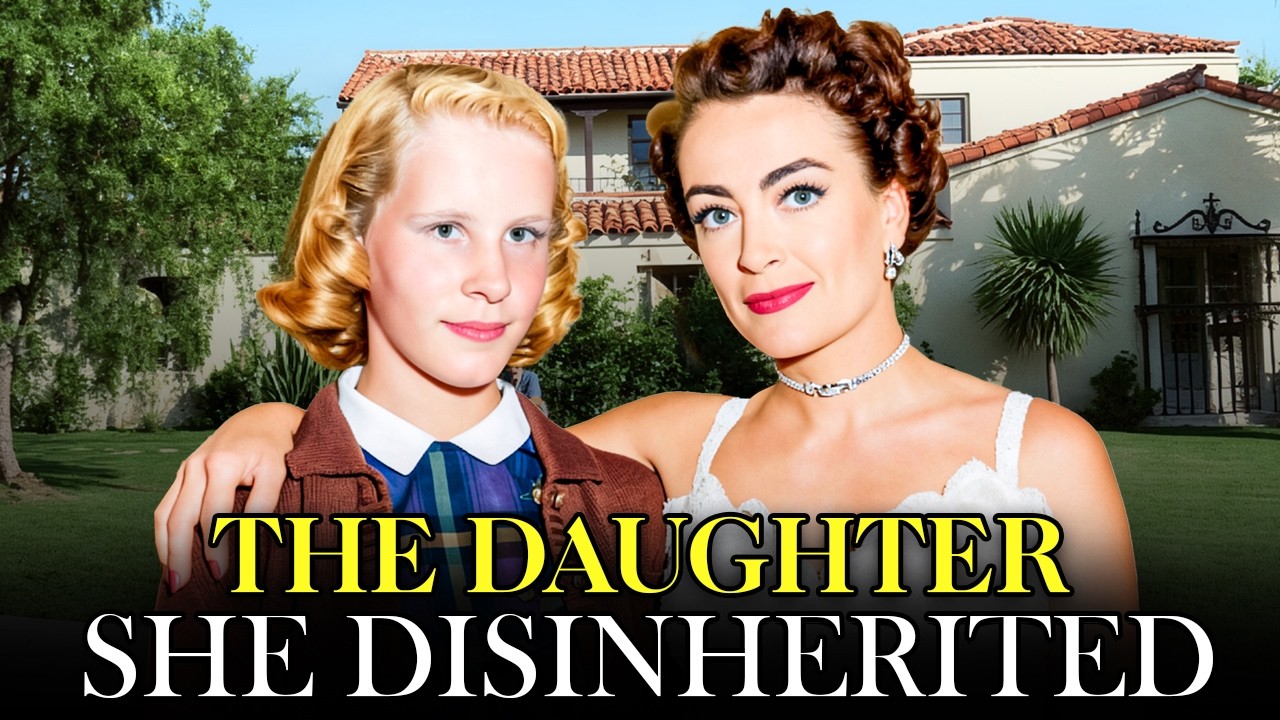
Crawford left $77,500 each to two of her four adopted children, Kathy and Cynthia, and nothing to the other two, Christina and Christopher. The will stated that she made no provision for them “for reasons which are well known to them. ” That single sentence would outlive her more durably than any film she ever made. Christina Crawford was the first child, adopted in 1939 through Nevada because California law at the time did not permit a single woman to adopt.
Christopher was adopted in the early 1940s. The twins, Kathy and Cynthia, arrived in 1947 through the Tennessee Children’s Home Society, an agency that later became notorious for coercive adoption practices and prompted reform in Tennessee child welfare law. The children grew up inside a household built around a famous woman’s need for control. Joan was born Lucille LeSueur in San Antonio, Texas.
She clawed her way from poverty to become one of MGM’s biggest stars, winning the Academy Award for best actress in 1945 for “Mildred Pierce. ” She married four times. By the 1950s, she had married Alfred Steele, president of Pepsi-Cola, and the household gained a second adult center of gravity. Joan publicly described that marriage as the happiest of her life.
The family appeared functional during those years, with glossy magazine features showing Joan beside Alfred at charity events and holiday gatherings. Steele died of a heart attack in April 1959. His estate carried significant debts, and Joan found herself responsible for maintaining the lifestyle on thinner resources than the public imagined. By several accounts, her control over the household intensified after his death.
The domestic rituals became more rigid. In 1968, a defining moment arrived. Christina had secured a recurring role on the daytime drama “The Secret Storm. ” She was hospitalized for an ovarian tumor and required surgery.
Joan stepped in and took her daughter’s place on the show, appearing in the role Christina had earned. Christina later described this as the purest distillation of the dynamic that shaped her entire childhood. Joan signed her last will on October 28, 1976. She lived through the winter into early 1977, largely withdrawn from public life.
Her health was declining. Her Christian Science faith discouraged reliance on conventional medicine. She did not reach out to Christina or Christopher before she died. The will was presented and read after her death.
Christina and Christopher learned they had been left nothing. In November 1977, they filed to invalidate the will, alleging Joan’s state of mind had been impaired by pain and alcohol and that Kathy and her husband had positioned themselves to influence Joan’s decisions. The case was settled out of court, with conflicting reports on the exact amount received. In 1978, barely a year after Joan’s death, Christina published “Mommie Dearest.
” The book described a childhood shaped by harsh discipline, alcohol, and what Christina characterized as sustained physical and psychological abuse. It became a bestseller and forced the American public to reconsider Joan Crawford. Kathy and Cynthia rejected the book with force. Kathy became the most vocal defender of Joan’s legacy among the siblings, maintaining that Christina had not told the truth about their mother.
In the late 1990s, Kathy pursued a defamation claim against Christina over remarks Christina had made about the twins’ origins. The matter was resolved through mediation. In 1981, the film “Mommie Dearest” was released with Faye Dunaway in the lead role. The movie was increasingly received as camp rather than serious drama.
The wire hanger scene became a cultural punchline. The camp reading followed Dunaway for the rest of her career. The fates of the children diverged. Christopher Crawford died in 2006 at age 63.
Cynthia Crawford Jordan died in 2007. Kathy Crawford LaLonde died on January 10, 2020, at age 72 after a battle with lung cancer. Christina Crawford is the only one of Joan’s four adopted children still alive at age 86. She has lived much of her later life privately and became an advocate for abused children.
The family as a living unit is gone. The argument about what happened inside that household has outlived almost everyone who could have settled it.