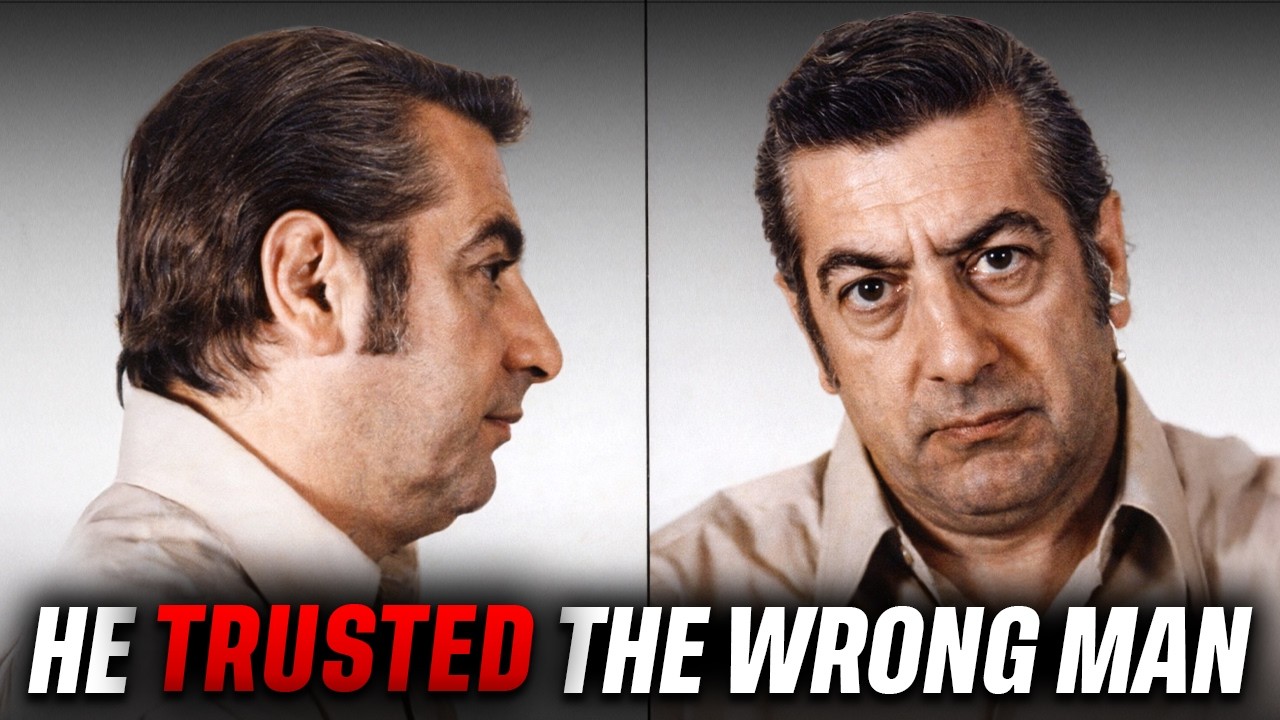
Dominick "Sonny Black" Napolitano was a Bonanno crime family captain who did everything by the mob's rules and still lost everything, including his hands. His story is one of loyalty, betrayal, and the terrible cost of trusting the wrong man.
To understand Sonny Black, you have to understand Brooklyn in the 1960s and 1970s. This was not the Brooklyn of brownstones and coffee shops. It was a Brooklyn of social clubs and envelope pickups, where a young man with ambition and nerve did not dream of Wall Street. He dreamed of getting made.
Napolitano was born in 1939 in Williamsburg, Brooklyn. He grew up on the streets the way most mob guys did, running numbers as a kid, breaking heads as a teenager, and graduating slowly into the kind of work that does not show up on a resume.
He was stocky, tough, and had a personality people remembered. He was not a screamer and he was not erratic. He was the kind of man who could sit across a table from you, smile, and leave you with no idea whether he was about to shake your hand or have you buried in New Jersey.
He earned his nickname the old-fashioned way. He dyed his hair jet black every day without fail, even into his 40s. The guys on the street started calling him Sonny Black, and the name stuck permanently.
By the mid-1970s, Sonny Black had risen to the rank of captain in the Bonanno crime family, one of New York's five families. The Bonannos in that era were a disaster waiting to happen, or more accurately, a disaster that had already started and had not yet finished.
The family was in chaos. It was not the well-oiled machine of The Godfather movies. It was a pressure cooker with a broken valve.
The Bonannos had been plagued by internal warfare dating back to the 1960s, when founder Joe Bonanno himself tried to have rival bosses killed. The act was so outrageous that the Commission, the governing body of the American Mafia, threw the Bonannos out and suspended them. They were eventually let back in, but the damage was done and the family never fully stabilized.
Then, on July 12, 1979, things got dramatically worse. Carmine Galante, the boss of the Bonanno family, was eating lunch at Joe and Mary's Italian-American Restaurant on Knickerbocker Avenue in Brooklyn. He was in the backyard with a cigar in his mouth and mozzarella on the table when three masked gunmen walked in and shot him dead. The cigar was still in his mouth in the crime scene photos, an image that became one of the most iconic in mob history.
Galante was brutal and paranoid, even by mob standards, and nobody was crying at his funeral. But his death left a power vacuum, and power vacuums in the mob are like blood in the water. Everyone starts circling.
Sonny Black was circling, and circling well. By 1980, he had consolidated his position as one of the most powerful captains in the Bonanno family. He ran his crew out of a social club on Bedford Avenue in Brooklyn called the Motion Lounge. It was there that everything that mattered in this story began.
While Sonny Black was climbing the ladder inside the Bonannos, a 37-year-old FBI agent named Joseph Pistone was doing something that had never been done before in the history of American law enforcement. He was going undercover inside the mob, not on the fringe and not as a bartender who overhears things, but inside as a member of the crew.
His alias was Donnie Brasco, a jewel thief and street guy who knew how to move stolen goods and did not ask too many questions. Pistone was perfect for the role. He had grown up around tough guys, understood the culture, and knew the language, not just the words but the rhythms, the pauses, the looks, and the unspoken rules about what you do and do not say.
He started small. He worked his way into a crew connected to the Colombo family, then drifted toward the Bonannos. He befriended a low-level associate named Benjamin "Lefty Guns" Ruggiero.
Lefty was Donnie Brasco's sponsor, his entry point, and his voucher. Through Lefty, Donnie Brasco was introduced to the Motion Lounge, to Bedford Avenue, and to Sonny Black Napolitano.
The first meeting went well. The second went better. Somewhere along the way, Sonny Black looked at Donnie Brasco and decided he liked what he saw. Not just tolerated him the way a crew sometimes tolerates an associate, but genuinely liked him and trusted him. In the mob, when a captain trusts you, your whole world changes overnight.
Sonny Black began bringing Donnie Brasco everywhere: meetings, dinners, trips, and business conversations that a federal agent had absolutely no business being in the room for. Pistone later said he attended more than 100 organized crime meetings during his undercover career, and a significant chunk of those happened because Sonny Black opened the door.
The friendship between Sonny Black and Donnie Brasco was real. Joe Pistone has said in interviews, in his book, and in testimony that Sonny Napolitano was one of the most compelling human beings he encountered in his six years undercover.
Sonny took Donnie to Florida. He set him up with business opportunities. He talked to him the way men in that world talk to people they respected. He floated the idea of getting Donnie Brasco made, sworn in as a full member of the Bonanno family. If that had happened, it would have been the single greatest intelligence penetration of organized crime in American history: an active FBI agent with a Mafia membership card.
But Sonny Black was not just opening doors out of casual affection. In mob terms, when you vouch for someone, you own their behavior. You are personally guaranteeing, with your reputation and ultimately your life, that this person is who they say they are, that they are not a cop, not a rat, not a fed. Sonny Black put his life on the line for Donnie Brasco, and he did not know it.
Pistone has spoken about this with something that sounds, if you listen carefully enough, like guilt. He described Sonny as a man of genuine loyalty, a man who lived by a code, a man who in another life might have been someone you would want in your corner. But this was the life they both chose, one of them knowingly and one of them not. There was only one way it was going to end.
By 1981, the FBI was starting to pull the plug. Six years is a long time to be someone else. Pistone had given them more intelligence than they had dared hope for: names, operations, hierarchies, murder conspiracies. The case was built and it was time to come out.

But the mob was also getting nervous. Suspicion had been creeping through the families like smoke under a door. There were questions about Donnie Brasco, nothing definitive or confirmed, just the low-level paranoia that keeps mob guys alive and the instinct that something is slightly off.
Then there was Milwaukee. In his ambition to expand his power and the Bonanno family's reach, Sonny Black had authorized his crew to operate in Milwaukee without getting permission from the Commission. In the mob's rigid protocol, this was a serious violation. You do not move into another family's territory without approval.
The Commission was furious. The Bonanno leadership was furious. The three men who had been sent to Milwaukee were killed as punishment. Sonny Black had sponsored that operation the same way he had sponsored Donnie Brasco. His name was on it, and he was running out of goodwill very fast.
In 1982, the whole architecture collapsed. The FBI formally ended Pistone's undercover operation, and it did not stay quiet. It could not. The moment legal proceedings began and the name Joe Pistone appeared in court documents connected to Bonanno family investigations, the mob knew. Not suspected. Knew. Donnie Brasco was a federal agent.
Imagine being Sonny Black Napolitano in that moment. The man you brought into your world, the man you took to Florida, the man you sat with at dinner tables where people discussed murders and money and the inner workings of one of the most powerful criminal organizations in America, that man was an FBI agent. And you vouched for him.
In mob law, this is not a misunderstanding you talk your way out of. This is not a sit-down where you explain yourself and everyone shakes hands and goes home. When you sponsor someone who turns out to be a federal agent, you have committed the worst possible violation in the entire code. You brought the enemy inside. Whether you knew or not is almost beside the point. The result is the same.
Sonny Black knew what was coming. People close to him in those final weeks have said he seemed resigned, not panicked and not running, but resigned, like a man who understood the rules he had lived by and understood what those rules now required of him.
Before Sonny Black went to what would be his final meeting, he reportedly gave away his dogs. He had pets and he loved them, and he made sure they were taken care of before he walked out the door. He knew he was not coming back and he made sure his dogs would be okay.
He also gave away his jewelry, his watch, and his ring, distributing the things that mattered to people he trusted, the way a man puts his affairs in order. Then he went to the meeting.
In August 1982, a body was discovered in a drainage ditch on Staten Island. The identification was confirmed as Dominick "Sonny Black" Napolitano. He was 43 years old.
But the detail that turns this from a mob murder into something else entirely is this: his hands had been cut off. In mob culture, when a man's hands are removed after death, it is a statement. It means he reached for something he should not have. It means he touched something forbidden.

Some accounts say it means the man shook hands with the wrong person, vouched, sponsored, or made an introduction that brought catastrophe. Sonny Black shook hands with Donnie Brasco. He introduced a federal agent to the Bonanno family, to their operations, to their secrets. He reached for a friendship that turned out to be a weapon aimed directly at him. The hands were the message, and whoever sent it made sure everyone in that world understood exactly what it said.
The fallout from Joe Pistone's undercover operation was staggering. Over 100 indictments and dozens of convictions followed. Mob figures who had operated freely for decades were suddenly sitting in federal courtrooms listening to an FBI agent describe in precise detail what they had said, who they had met with, and what crimes they had committed, because he had been in the room.
The Bonanno family was devastated. Already the most troubled of New York's five families, they were now effectively dismantled at the leadership level. The Commission was so disgusted with the Bonannos that they were once again stripped of their seat. Suspended. Again. The same family, the same punishment, a different catastrophe.
Lefty Ruggiero, the man who had first brought Donnie Brasco in, was arrested and eventually convicted. He served time. He never fully understood, even after everything, that Pistone had genuinely cared about him in some complicated, impossible way. Or maybe he did understand, and that was worse.
In 1997, the movie Donnie Brasco came out. Johnny Depp played Joe Pistone and Al Pacino played Lefty Ruggiero. The film captured the atmosphere of that world better than almost anything else in the genre. It was nominated for a Writers Guild Award and made over $41 million.
Sonny Black in the film is played by Michael Madsen, portrayed as smart, charismatic, and dangerous, which by all accounts was accurate. In the film, there is a scene where Sonny Black realizes what is coming, where the weight of Donnie Brasco's true identity lands on him fully. Madsen plays it with a quiet devastation that feels exactly right.
Joe Pistone has spoken about Sonny Black in the years since. He has said that Sonny Napolitano was the most stand-up guy he ever met in that world, that he was, within the rules of the life he chose, a man of genuine integrity. That is a remarkable thing for a federal agent to say about a mob captain, and it tells you everything about how real that friendship was.
Sonny Black Napolitano was not a good man by any conventional measure. He ordered violence. He ran criminal operations. He lived by a code that put money and power above everything else. This is not a call to mourn him the way you would mourn someone innocent.
But the cruel, almost elegant irony of his story is that the quality that killed him was his ability to trust. His willingness to look at a man, take his measure, and say, "I vouch for this guy. I believe in him." In any other context, that quality is called loyalty. In any other life, it is something to admire.
But Sonny Black lived in a world where trust was the most dangerous thing you could offer, and he offered it to a man whose entire job was to exploit it. The mob has a saying that gets repeated so often it has become almost cliché: keep your friends close and your enemies closer. Sonny Black kept his enemy so close that he took him to Florida, sat him at the table, and fought for his future inside the family. He did not just keep his enemy close. He loved him.
When they found his body in that Staten Island drainage ditch, his hands gone, his dogs already re-homed, and his jewelry already distributed, it was not just the end of a mob captain. It was the end of the most expensive friendship in Bonanno family history.