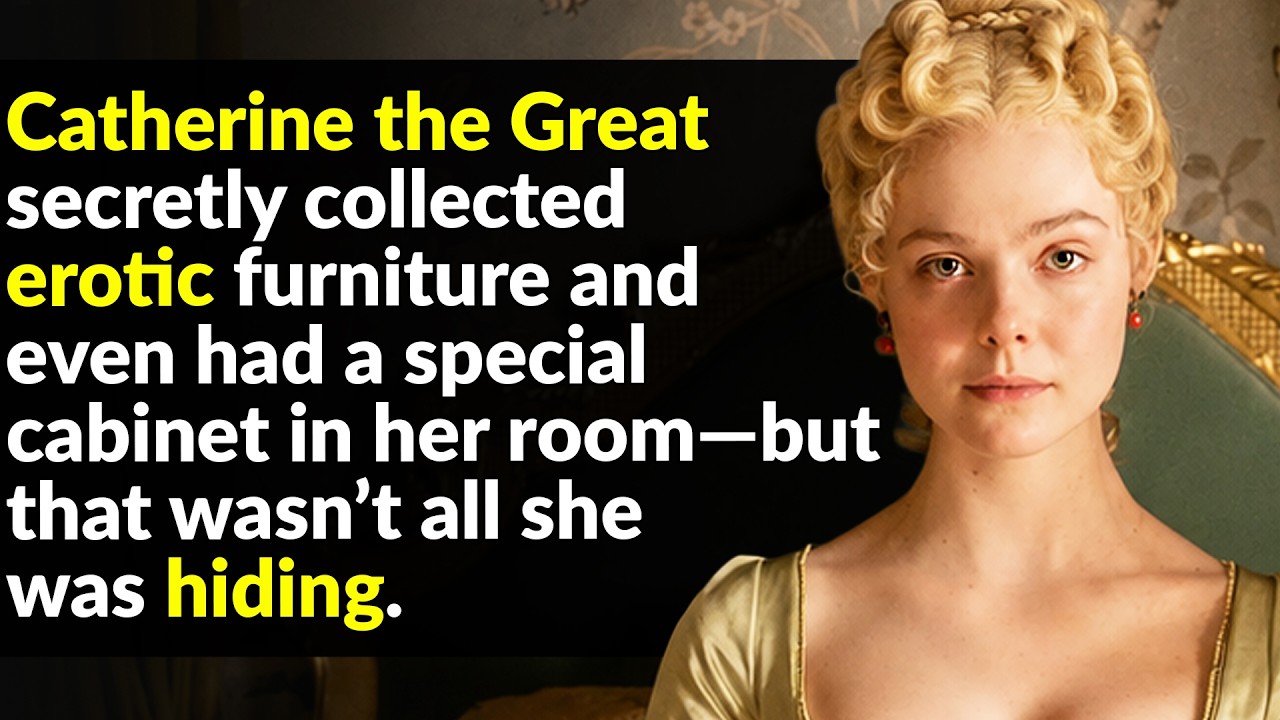
Catherine the Great presented one face to the world and kept another entirely hidden behind closed doors. She was celebrated as one of the most enlightened women of her age, yet she secretly collected erotic furniture and kept a special cabinet beside her bedroom. But that was only the smallest part of what she concealed. She earned her title through blood, lust, and the ultimate betrayal.
The woman who would become Catherine the Great of Russia began life under a different name in a different country. She was born Sophie of Anhalt-Zerbst, a German princess, in 1729 to Prince Christian and Princess Johanna. Her mother had enormous ambitions for her daughter, but even Johanna could not have predicted how far her girl would climb. At the tender age of ten, Sophie caught the eye of Peter, the heir to the Russian Empire and her own second cousin.
Even then, she knew she disliked him. The boy was pale and sickly, eleven years old, still obsessively playing with toy soldiers while nursing a growing drinking problem. Sophie understood that this marriage was her path to power, so she threw herself into becoming Russian. She worked tirelessly to master the language, never quite losing her German accent, and she would walk barefoot around her bedroom in the middle of the night practicing her pronunciation.
On August 21st, 1745, at barely sixteen years old, she married Peter and officially became Catherine Alexeievna. Quick-witted, beautiful, and endlessly curious, Catherine soon discovered that she hated her dull new husband even more than she had expected. To escape her boredom, she turned to books, devouring Voltaire and learning the art of political maneuvering from the Roman historian Tacitus. She and Peter established their court at the Russian royal palace, surrounding themselves with vibrant, handsome nobles from across the empire.
It did not take long for Catherine’s restless eyes to land on the dashing Sergei Saltykov, and the two began an affair. Catherine eventually took up with a series of lovers, while Peter pursued his own extramarital adventures. He became infatuated with the beautiful Elizaveta Vorontsova, and rumors spread that he wanted to divorce Catherine and marry her instead. In 1754, Catherine gave birth to a son.
Late in the decade, she became pregnant again and delivered a daughter, Anna. Peter refused to accept that he was the girl’s father, declaring, “God knows where my wife gets her pregnancies. ” The little girl lived for only fourteen months. Whether out of cruel indifference or overwhelming grief, Catherine almost never spoke of her again.
In 1762, Peter ascended to the Russian throne as Peter the Third, and Catherine became his consort. The royal couple moved into the Winter Palace in St. Petersburg, but within six months they were living in separate palaces. For years, Catherine had been quietly cultivating allies among the court, preparing for a coup.
With her husband out of the way, she used her solitude to sharpen her plans and prepare a brutal reckoning for the man she had come to despise. On July 9th, 1762, Catherine finally set her scheme in motion. When she learned that Peter had detained one of her allies, she knew the moment had come. She marched to the Russian regiment and, playing the part of a poor helpless woman, begged the soldiers to save her from her unhinged husband.
Then she moved to another barracks, where a host of clergymen were already waiting to proclaim her the sole ruler of the Russian Empire. Catherine was not finished. She had Peter detained and forced him to officially abdicate the throne. Peter was held captive when he suddenly fell ill and died on July 17th, 1762, at the suspiciously young age of thirty-four.
The official autopsy claimed he had suffered a stroke, but far darker rumors surrounded his death. Many historians believed that, given the convenient timing, Catherine had a hand in ensuring her husband would never return to claim his throne. Months before she plotted Peter’s downfall, Catherine had been heavily pregnant with her third child. On April 11th, 1762, she gave birth to another boy, whom she named Alexi.
There may have been confusion surrounding her first two children, but there was no doubt about this one. He was definitely Peter the Third’s child. In a bold move, Catherine named him after his true father, her lover Gregory Orlov. Removing Peter the Third was not even the worst act Catherine committed as part of her coup.
There was another claimant to the Russian throne, Ivan the Sixth, a young man of twenty-three who had been locked away since infancy because his royal blood threatened the crown. Catherine had him killed as well. Catherine took so many lovers over the years that she developed a scandalous system to manage them. She would seduce a man, promote him to a high rank, and when she grew bored, she would pension him off with a generous plot of land and servants.
Her lover Grigory Potemkin went above and beyond in this arrangement. When their own romance faded, Potemkin happily vetted her replacements, handpicking lovers for their good looks and intelligence. Though serving Catherine in the bedroom became something of a cottage industry, the empress never married again after removing Peter from the throne. This, like almost everything she did, was a calculated power move.
Why hand the crown to some man when she was already the empress of Russia? To say Catherine had a difficult relationship with her eldest son, Paul, would be an understatement. Whether because he resembled his royal father too closely or because she felt threatened by his claim to power, she never offered him a chance to co-rule. But when Paul had a son of his own in 1777, the situation grew even worse.
Catherine became a grandmother to a boy named Alexander, and she eventually planned to make the child her official heir instead of her grown son. Perhaps Catherine felt a lingering insecurity about how she had come to power, because she set out to prove herself by transforming backward Russia into one of the most enlightened powers of its day. She waged conflicts across the empire to expand its borders and modernized its cities, changing the architecture to a classical style. She took enormous risks, and sometimes they failed spectacularly.
One of her greatest humiliations came when she pushed for her granddaughter Alexandra to marry King Gustav IV of Sweden, even throwing a lavish engagement ball in their honor. Catherine poured her heart, her soul, and her rubles into that celebration, only for the guest of honor to never appear. Worried about Alexandra’s refusal to convert religions, Gustav fled back to Sweden, leaving Catherine humiliated. Some claimed the embarrassment hastened her decline.
Always hardworking, Catherine planned her days in five-minute increments and maintained that discipline until her death. The only part of her schedule that changed was her waking hour, which moved from five in the morning to six as she grew older. In 1773, one of Catherine’s darkest ghosts returned to haunt her. A group of peasants rose in rebellion, and when Catherine learned the identity of their leader, Emelian Pugachev, her blood must have run cold.
Pugachev claimed to be Catherine’s late husband, Peter the Third, resurrected and seeking vengeance. The rebellion dragged on for a year before Catherine gathered an enormous force and crushed the rebels. Then she came for Pugachev himself. She imprisoned him in a metal cage for all to see and ridicule, then had him decapitated in a Moscow square before his body was drawn and quartered.
Perhaps no one learned more about Catherine’s exhilarating heights and terrifying lows than her Polish lover, Stanisław Poniatowski. While he was in her favor, Catherine gifted him with nothing less than the kingdom of Poland, installing him as its ruler. But what Catherine gave, she could take away. Shortly after becoming king, Poniatowski made a supremely foolish decision and began rallying for Polish independence from Catherine.
This did not sit well with his former lover, and she forced him to abdicate as punishment for his disloyalty. Stanisław was lucky to escape with his life. Despite her ruthless streak, Catherine was a modernizing force in Russia. In 1762, with smallpox raging through the country, she decided to promote the then radical method of inoculation.
She did it in an unforgettable way. Rather than merely patronizing the science, Catherine put her own body on the line and was vaccinated against smallpox with the help of English doctor Thomas Dimsdale. To everyone’s shock and relief, it worked. November 16th, 1796 was supposed to be just another day in the life of Catherine the Great.
She rose early, as was her habit, and sipped her morning coffee. She told her lady’s maid that she had enjoyed the best sleep she’d experienced in a long time, then settled in to sign papers. Just hours later, everything changed. Shortly after nine in the morning, her servants found the empress lying on the floor, her face a lurid shade of purple.
Her pulse was fluttering, her breathing ragged, and she was clearly at death’s door. She fell into a coma and died soon after. In the years before her death, one of Catherine’s aides had discovered an undated will among her belongings. Its contents gave an intimate glimpse into the empress’s mind.
She asked that her body be dressed in white, with a golden crown on her head bearing her Christian name. Mourning dress was to be worn for six months and no longer. “The shorter, the better,” she wrote. In the end, Catherine’s funeral was even more lavish than she requested.
She received her golden crown, but mourners dressed her in silver brocade instead of simple white, and her coffin was decorated in gold fabric. Rather than burying her immediately, the Russians displayed her body for six full weeks in one of the most impressive rooms of her palace. While her body lay there, people came to kiss the rotting flesh of her hand. Catherine’s son Paul survived his horrific childhood to become emperor after her death, but he met the same tragic end as his father.
Just a few years into a deeply unpopular reign, Paul was killed, making way for the heir Catherine had intended all along, her grandson Alexander. Catherine’s public and private images were two very different things. While she played the role of a chaste, enlightened empress for her people, she privately collected extraordinary art, including Giulio Romano’s sensual painting Two Lovers, which she kept in her basement. The most scandalous parts of her collection were not paintings at all.
During World War II, German forces raided the Winter Palace and made a shocking discovery. They stumbled upon an old boudoir of Catherine’s filled with erotic furniture, chairs and other items decorated in ways that would make any respectable mother blush. Her many lovers were not the only scandalous presence in the royal palaces. Catherine also employed full-time foot ticklers.
In this regard, she was actually something of a traditionalist. Russian royalty had long employed sensual foot ticklers who would sing bawdy ballads while feathering their master’s feet to provide relaxation and arousal. The manner of Catherine’s death became the subject of myth and legend for centuries. Almost immediately after she passed, wild stories began to circulate.
People claimed, incredibly, that Catherine had died after intimate relations with a horse. But it was not true. Catherine the Great’s autopsy revealed the truth beneath the lies. The mighty empress had actually died of a stroke, ironically the same ailment that had supposedly taken her late husband, Peter the Third.
A sad end, but not a bestial one. Even so, the unsavory rumors about the insatiable empress have lived on, ensuring that the legend of Catherine the Great remains as complicated and contradictory as the woman herself.