Deadwood, South Dakota, is remembered as a lawless gold rush town, but its history is far more complex and darker than the legends suggest. The settlement was born in defiance, emerging in the 1870s despite a federal treaty that protected the land for the Sioux Nation. When George Armstrong Custer’s 1874 expedition confirmed gold deposits in the Black Hills, prospectors poured in illegally, and Deadwood grew without any legal oversight or government support. The lack of governance shaped every aspect of the town.
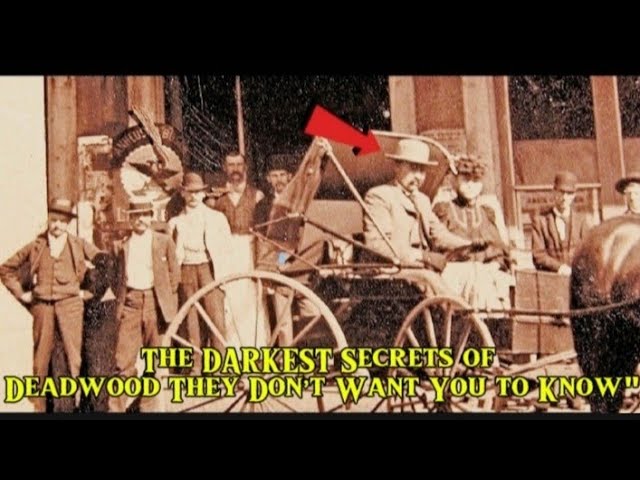
With no established law enforcement or infrastructure, Deadwood developed in a chaotic, piecemeal fashion. The absence of legal recognition meant the federal government took a hands-off approach, leaving the town to evolve on its own terms. Among the most infamous figures was Al Swearengen, the owner of the Gem Theater. While the hit television drama “Deadwood” portrayed him with moments of reluctant humanity, historical accounts describe a far less sympathetic man.
Swearengen used the Gem to lure vulnerable working-class women into sex work, trapping them in cycles of debt. The women who worked for him faced poor housing, limited health care, and substance abuse, and many died young. The fictionalized version of Swearengen suggested a degree of kindness that historical evidence does not support. Seth Bullock, the town’s first lawman, arrived in Deadwood with his business partner Sol Star to open a hardware store.
The turning point came after the death of Wild Bill Hickok, when the shaken community sought stability. Bullock, who had previously served as a county sheriff in Montana, was uniquely qualified to restore order. Despite constant tension with Swearengen, both men recognized the need for cooperation in the chaotic environment. Bullock’s commitment to order transformed Deadwood into a place where families could envision a future.
He later built a ranch near his wife and daughter and developed a close friendship with Theodore Roosevelt. When Roosevelt appointed him U. S. Marshal, Bullock transitioned from frontier lawlessness to lasting public service.
Wild Bill Hickok’s death remains the town’s most famous event. By the time he arrived in Deadwood in 1876, his reputation as a gunslinger was already established, though many of the stories were exaggerated. The claim that he had defeated hundreds of men in quick-draw duels is not supported by historical evidence. His actual gunfighting record was far more modest.
Jack McCall shot Hickok from behind while the gambler sat playing cards in a saloon. McCall claimed his actions were an act of vengeance, alleging that Hickok had killed his brother, a claim historians have not verified. Hickok’s death cemented his legend, leaving behind a legacy shrouded in mystery and myth. Calamity Jane, another legendary figure, captured the adventurous spirit of the frontier but contributed heavily to the myths surrounding her own life.
She published accounts of her exploits that blurred the line between fact and fiction. There is no historical evidence to support some of her most dramatic claims, including the assertion that she apprehended McCall after the killing. Her tendency to exaggerate made it difficult for historians to separate truth from legend, but she remains a symbol of tenacity and bravery in the American West. Deadwood’s Chinatown also played a vital role in the town’s development.
Chinese immigrants helped construct the region’s roads and were often among the first to open shops and supply essential goods. Despite facing prejudice and systemic challenges, they worked hard to integrate into the economic and social fabric of the settlement. Historical records suggest that relationships between Chinese immigrants and other residents were more cooperative and nuanced than popular depictions suggest. Claims of gruesome acts, such as bodies being fed to pigs, are not supported by historical evidence.
Following the shooting of Wild Bill Hickok, Jack McCall was quickly apprehended by locals and brought to trial at McDaniel’s Theater. During the trial, McCall justified his actions by alleging that Hickok had tampered with his brother, but the jury acquitted him. McCall’s freedom was short-lived. When he later boasted about the killing in Wyoming, he was arrested and returned for a second, more official trial.
At the second trial, McCall’s defense collapsed under contradictory stories. He claimed Hickok had kidnapped his brother, then said he was paid to carry out the murder, then claimed he acted while intoxicated and did not recall the event. In an odd twist, he even claimed he was not Jack McCall at all. In March 1877, McCall was sentenced to death and executed, closing one of Deadwood’s most infamous chapters.
The story of Hickok and McCall continues to fascinate audiences today. Every summer, actors in Deadwood reenact both the shooting and the subsequent trial, a tradition that began in the 1920s and remains one of the longest-running theatrical productions in American history. Al Swearengen’s Gem Theater suffered repeated disasters. A fire in 1879 burned much of Deadwood, including the Gem, but Swearengen rebuilt it in the same location.
A second fire in 1894 struck again, and a third in 1899 destroyed the establishment entirely when firefighters were blocked from reaching it. The Gem was reduced to ashes, and Swearengen’s attempts to restore his enterprise were maliciously destroyed. George Hearst, father of newspaper magnate William Randolph Hearst, also left a lasting mark on Deadwood. In the late 1870s, he purchased the Homestake Mine, which became one of the richest gold mines in the region.
In 1880, he bought the San Francisco Examiner and brought his son into the family business. Under William Randolph Hearst’s leadership, the Examiner rapidly grew in influence, paving the way for a media empire that shaped much of 20th-century American journalism. The gold rush dramatically altered Deadwood’s landscape. In 1876, the town had approximately 3,000 residents and nearly 200 businesses, far larger and more developed than its television depiction.
The population grew steadily, and substantial brick-and-mortar buildings replaced makeshift structures. After the catastrophic fire of 1879, the local government mandated the use of fire-resistant bricks to prevent future disasters and promote a more organized community. The question of how pioneers actually spoke has also sparked debate. The television show featured crude and colorful profanity, but linguistic experts have questioned whether such language was common in the 1870s and 1880s.
Jesse Sheidlower, the American editor for the Oxford English Dictionary, suggested the specific insults were not widely used at the time. David Milch, the creator of “Deadwood,” offered a different perspective, questioning the reliability of dictionaries in capturing the linguistic realities of the frontier. As he put it, “I’m not publishing a dictionary. ” The debate highlights the challenge of accurately depicting historical speech in a town where social norms were often pushed to the limit.
Deadwood’s legacy is one of chaos, corruption, and violence, but also of resilience and community building. The town thrived on the darker realities of frontier life, and its history serves as a harsh reminder of the unforgiving nature of the Wild West. The legends that emerged from Deadwood live on through reenactments, historical accounts, and the enduring fascination with a place where survival was never guaranteed.