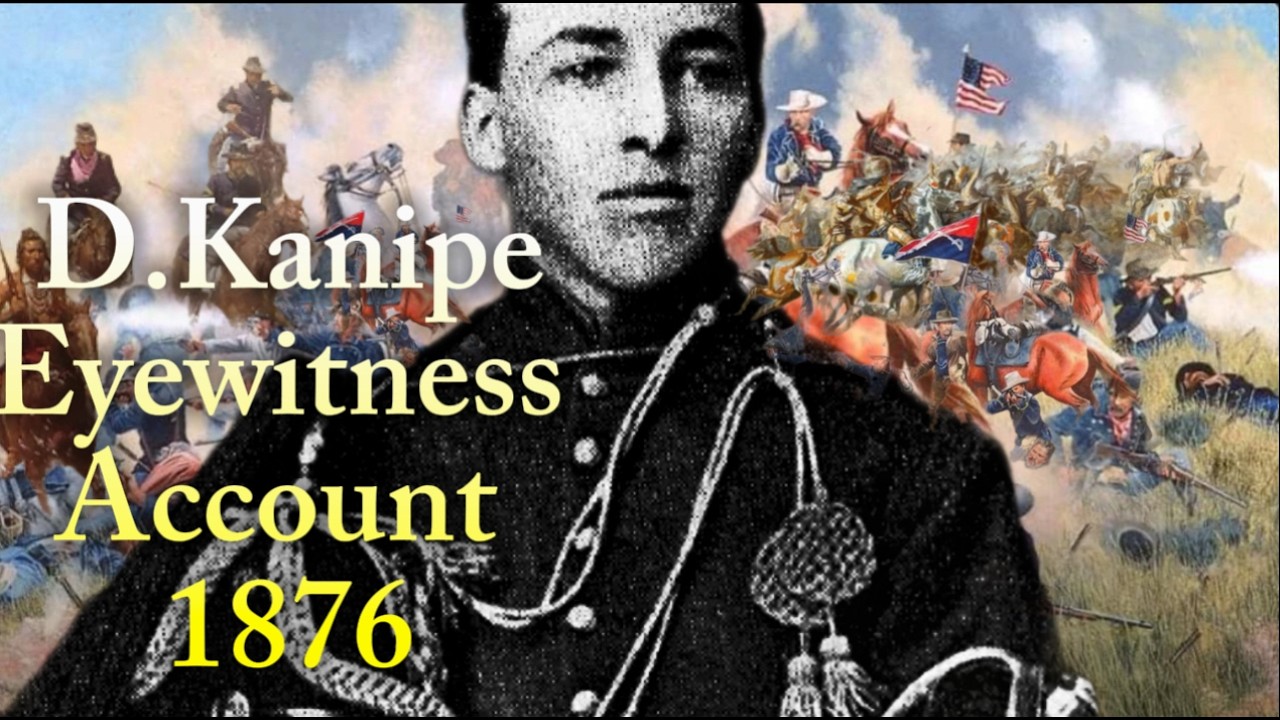
On June 25, 1876, Sergeant Daniel Kanipe of Company C, 7th Cavalry, rode into battle at the Little Bighorn—and was one of the only men from his company to walk away alive. His firsthand account, recorded in a memoir later known as the Kanipe Story, became a key piece of evidence in the official court of inquiry into the disaster. The road to that fight began weeks earlier. On May 17, 1876, the regiment set out toward the Yellowstone River, covering twelve miles before camping along the Big Hart River.
By early June, they reached the Powder River, where six of the twelve companies were detached for a scouting mission. They left their wagons behind, loaded ten days of rations onto pack mules, and pushed forward. After two days up the Powder, the column shifted toward the Tongue River, then discovered a Native American trail beside the Rosebud. They followed it through the night, stopping only to make coffee as darkness fell.
By noon the next day, detachment commander Major Reno decided their rations were running low and turned the column back toward the Yellowstone. There, the scouts rejoined the other six companies, led by Lieutenant Colonel George Armstrong Custer. The reunion came with a startling development: Custer was under arrest. The arrest reportedly stemmed from his opposition to post traders who held contracts at various forts—contracts that had been cancelled amid scandals during President Grant’s term.
Soldiers could not buy anything without going through these merchants, and a single glass of liquor cost twenty-five cents, typically served as a very modest portion of whiskey. On July 22, Custer’s unit took on a fifteen-day supply of provisions from the steamer Far West. He also had two Gatling guns and two Rodman cannons. He gave them to General Gibbon, who had them ferried across the river, because Custer believed he could manage without them.
In hindsight, Kanipe viewed that decision as a fatal error. He believed that even a single shot from a Rodman gun or the presence of a Gatling gun might have changed the outcome entirely. The column broke camp on June 22 and marched through the entire day. That evening, Custer ordered that orders be communicated by hand signals alone, that bugle calls cease, and that fires be permitted only for brewing coffee.
The march resumed the next morning and carried on until nearly sunset. On June 24, they reached a site where the Indians had held both a sun dance and a war dance. The ground was hard-packed from the dancing, and shelters stood built from brush and cottonwood branches. Among the scouting party were six Crow scouts, who harbored a deep animosity for the Sioux they pursued.
They discovered the scalp of a white soldier from Gibbon’s command hanging from a willow branch, and erupted into a frenzy of whooping and dancing. The scalp was brought to Custer, who inspected it and turned it over to the troops. Sergeant Finley of Kanipe’s company carried it in his saddlebags. The regiment continued its advance throughout the day.
Around ten that night, the Indian scouts who had been sent ahead returned. The regiment received orders to pack gear and prepare horses. They marched through the night, drawing close to the junction of the Little Bighorn and Rosebud rivers. Custer led the regiment into a ravine that seemed ideal for concealment.
As the column moved at a brisk trot and gallop, the pack train lost part of its hardtack supply. When Quartermaster Sergeant Hurst went back to retrieve it, he found two Indians helping themselves to the rations. They fled on sight. When Hurst reported the encounter, Custer ordered an immediate saddling.
Kanipe assumed Custer planned to surprise the Indians at dawn, but with the element of surprise gone, the commander ordered an immediate move. After advancing up the divide, Custer left with two scouts and the head trumpeter for two hours. When he returned, he split the regiment into three detachments. Major Reno took Companies A, M, and G.
Captain Benteen commanded H, K, and D. Captain McDougall led the pack train with Company B. Custer kept Companies C, E, I, and F for himself. The plan was an assault on the Indian camp from three directions.
McDougall was ordered to bring the pack train up along the main Indian trail. The column proceeded down what is now Benteen Creek and came upon an abandoned Indian camp with fires still smoking. Inside one standing tepee lay the body of a deceased Indian. Custer ordered the tepee set ablaze.
Reno was directed to ford the creek, and Custer advanced downstream with three companies. When the men caught sight of the Indian camp in the valley below, they shouted. Kanipe rode with Custer’s brother, Captain Tom Custer, and Sergeant Finley was nearby, his horse faltering. “Finley, come on if you can,” Kanipe called.
The captain then ordered Kanipe to turn back, find McDougall with the pack train, and deliver fresh orders from Custer. He was told to bring the pack train straight to the high ground, to cut loose any packs that came loose, and not to stop and fix them. “Be quick about it. There’s a big Indian camp,” Captain Tom Custer said.
That assignment, which Kanipe first thought was ill fortune, ultimately saved his life. Had Sergeant Finley not fallen back minutes earlier, he would have received those orders instead. Kanipe turned his horse and rode back toward the dust of the pack train. As he rode, he recalled Custer’s last words.
The troops were at full gallop, giving three cheers as they went up the hill. Men with unchecked horses raced past the general. “Hold your horses, boys,” Custer yelled after them. “There are plenty down there for all of us.
”
Kanipe delivered the orders to McDougall, then to Captain Benteen. By that time, Reno was falling back from the base of the bluffs. McDougall’s men reached the hilltop to reinforce his position, with shouts and gunfire coming from behind. Men were falling on all sides.
The Indians would fall upon the fallen soldiers to take their scalps before anyone could reach them. Dr. DeWolf was killed just as he reached the top of the slope; had he moved a few more steps, he would have lived. Kanipe noticed several Indians running nearby and raised his weapon, thinking they were hostiles.
They were, in fact, the regiment’s own scouts fleeing the engagement in such fear that they did not stop until they reached the Powder River, having quit Reno’s command entirely. Kanipe could not rejoin his own company, as Indian forces now separated him from Custer’s position. Reno’s forces were attacked and forced into a hasty skirmish line, losing several men before they could fully establish their defense. The Indians kept up fire throughout the day and through the night.
At dawn on June 26, they commenced shooting again. With sixty-eight wounded men in camp and access to water cut off, the situation was dire. Men were shot trying to fetch water, and the wounded begged for water no one could give. Kanipe remembered with perfect clarity the first cannon shot of the two-day fight, striking the earth and passing just underneath his horse’s belly.
Two officers, Lieutenants Harrington and Sturgis, and fourteen enlisted men were never found. It was said that during the nighttime celebrations, the Indians had cut off their heads and dragged them around. On the hill, fifty-six men from Reno’s command were killed. Gunfire persisted through the entire day of June 26.
By late evening, the camp began to move. Warriors kept shooting while women packed everything away. By the morning of June 27, not one Indian remained in view. The men brewed coffee, fetched water, and tended to the wounded.
Around ten, General Gibbon arrived with the overall commander, General Terry. The men cheered when Terry appeared. He wept openly, overcome with emotion. His report of seeing two hundred soldiers dead in the valley below made them understand that Custer and the four companies with him had been completely wiped out.
Until then, they had held on to hope that he might merely have been surrounded, as they were. That afternoon, Kanipe was allowed to accompany Captain Benteen to the battlefield. As he moved among the dead, he identified acquaintances and a sergeant he knew. Sergeant Finley lay at the head of his horse with twelve arrows in him.
The bodies had been lying in the sun for two days. It was easy to tell which men had been wounded, as women and young Indians had stripped them and struck their faces with tomahawks or shot arrows into their bodies. The mutilation was only ever inflicted on those still alive, never on the already dead. None of the bodies retained clothing.
The Indians had taken everything, including what Kanipe estimated was about $25,000 in cash—the men had been paid just before leaving the Powder River camp, with nothing to spend it on. Kanipe saw where the last of Custer’s men fell. They were clustered in a small group. Custer lay across several other men, only the small of his back touching the ground, a bullet having passed cleanly through his heart.
The cluster was near Captain Tom Custer and Lieutenant Calhoun, the general’s brother and brother-in-law. The conflict involved approximately 4,000 warriors, and with women and others included, the total number of Native Americans gathered was between 12,000 and 15,000. Custer and his men faced a truly overwhelming force. After the defeat, not one living soldier remained on the field to tell what happened.
The sole surviving creature from the slaughter was Captain Keogh’s horse, Comanche, found with seven bullet wounds. About 75 Indians were found inside three standing tepees, with no way to guess how many more had been carried away. Kanipe came across one Indian wrapped in buffalo robes. When he cut him free, he found four women’s scalps tied on a string as long as his arm, two with long red hair.
The sight was so gruesome he dropped the scalps at once. After the battle, the dead were buried. Wounded soldiers were moved to the steamboat, which had withdrawn to the Yellowstone. Most of the injured men, against the odds, eventually recovered.
Comanche, the only living thing to survive Custer’s final fight, was given a box stall by order of general headquarters, cared for by a soldier from the 7th Cavalry band, and led at the front of the regiment draped in black at dress parades. The Indians simply took down their camp and moved on. The regiment was in no condition to pursue; its numbers were too reduced and its men too badly hurt. Having won a decisive victory, the Indians withdrew without further loss.
Kanipe’s eyewitness account remains a rare and direct perspective on the Battle of the Little Bighorn and the Great Sioux War of 1876.