In February 1951, an 80-year-old woman died in a New York hospital room. When her lawyers went looking for her will, they found it folded inside a tin cabinet stacked between cakes of household soap. The document gave away nearly $95 million, and almost none of it went to a relative. She was Sylvia Green Wilks, the daughter of Hetty Green, the woman newspapers called the Witch of Wall Street, once the richest woman in America.
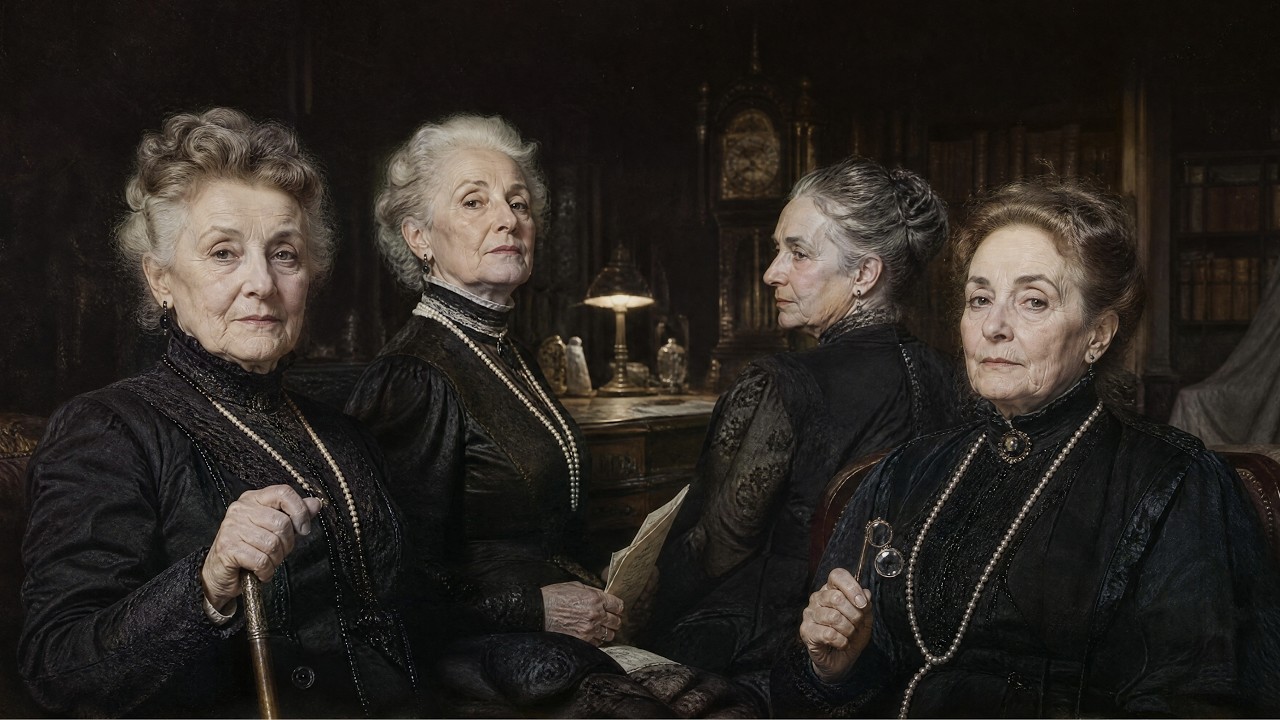
With a single signature, Sylvia ended the family name forever. She was not alone. Before her, there was a mother who built a college out of grief and cut out the nephews who were waiting. A widow who handed half a fortune to her dead husband’s business partner.
A Scottish girl who became one of the richest women alive and struck three of her own grandchildren from the page. Each had outlived the men who built the money. And each left it to strangers. The one power the law of the age handed a woman absolutely was the right to write her own will.
For several of these women, it was the first and only uncontested decision of their lives. Josephine Newcomb was born in Baltimore in 1816 and married Warren Newcomb, a merchant in the wholesale grocery trade between New Orleans and New York. When Warren died in 1866, she did not hand the business to a male relative. She managed it herself, and under her hand the fortune grew.
Their daughter, Harriet Sophie Newcomb, died of diphtheria at 15 in 1870. Josephine waited 16 years. In 1886 she gave $100,000 to found a women’s college that would carry her daughter’s name, the Sophie Newcomb Memorial College in New Orleans. By the time of her death in 1901, the gifts totaled roughly $3.
5 million. Her nephews and nieces were left effectively nothing. The relatives, the Henderson family, went to court and argued she had been of unsound mind and under undue influence. A key fight turned on whether her legal home was New York or Louisiana, since a handwritten will stood on firmer ground in Louisiana.
The litigation ran for years. In 1908, the New York Court of Appeals ruled against the family, and the college kept the money. Cornelia Clinch was born in 1802 into a New York family. In 1823 she married Alexander Turney Stewart, an Irish immigrant shopkeeper who built one of the largest fortunes in America through the department store.
He opened the Marble Palace on Broadway in 1846 and later the Iron Palace, revolutionizing retail. His fortune was estimated between $30 and $40 million. The couple was childless. Their two children died in infancy, and Cornelia bore no more.
When Stewart died in 1876, he left almost everything to Cornelia. In 1878, someone opened Stewart’s grave in St. Mark’s Church in the Bowery and stole his body, demanding ransom. The remains were eventually returned after a payment.
The episode unfolded as Cornelia was deciding what would happen to the fortune. The man Stewart had trusted to run his affairs was his lawyer and partner, Henry Hilton. After Stewart’s death, Hilton effectively took command of the empire. Under his management, the business declined, and the famous stores eventually passed to rival merchant John Wanamaker.
When Cornelia died in 1886, her will divided the residue of the fortune. Half went to Henry Hilton, who was no blood relation. Distant relatives of Alexander Stewart surfaced from Ireland and claimed a share, but the courts denied their claims. Anna Thompson was born in Dundee, Scotland, in 1871.
After her father’s death, her widowed mother moved the family to the Midwest. Anna had a real musical gift and supported herself and her mother by teaching piano and violin. In 1896 she married Horace Elgin Dodge, a machinist. The Dodge brothers supplied parts to young automaker Henry Ford, and took part of their payment in Ford stock.
That stake became hugely valuable. Later, the brothers sold it back for roughly $25 million and built their own car company. In 1920, both Dodge brothers died, Horace leaving Anna his share, an estate reckoned at around $59 million. In 1925, Anna and her sister-in-law sold the Dodge Brothers Company to the Wall Street house of Dillon, Read for $146 million in cash, then the largest cash transaction in the country’s history.
Anna’s share came to roughly $73 million. She built a mansion called Rose Terrace on Lake St. Clair near Detroit, then tore it down and rebuilt it as a limestone chateau. It was filled with furniture that had belonged to Catherine the Great and Marie Antoinette.
She commissioned the yacht Delphine, named for her daughter, at more than 250 feet, the largest private yacht in the world at its launching. Her daughter Delphine was a champion powerboat racer who lived hard and died of causes tied to drink in 1943. Her son, Horace Dodge Jr. , married five times, ran through enormous sums, and died in 1963 owing his mother around $10.
5 million, which she would never recover. Anna died in June 1970 at 98. Newspapers reported she had died at 103, a figure that was not true. Her will divided a fortune reported at more than $100 million among only four of her seven grandchildren.
Three were cut out: Anna Ray Baker, Christine Cromwell, and John Francis Dodge, a teenager. Several of them were already deep in debt, and one had borrowed millions from Anna that were never repaid. The three challenged the will. A probate judge in Wayne County, Michigan, ruled against them, and the bulk of the fortune went where Anna had directed.
Her will also left money toward a memorial fountain for Detroit that stands on the city riverfront, and the contents of her music room went in significant part to the Detroit Institute of Arts. The rest of the house’s treasures were sold at auction in London for nearly $5 million, and Rose Terrace itself was torn down. Sylvia Green was born in London in 1871, the daughter of Hetty Green. Raised inside genuine and enormous wealth, she grew up in shuttered rooms with the lights cut off, learning that money was something to guard, not enjoy.
Her mother was famous for extreme frugality, moving between cheap rooms to avoid establishing a taxable residence. Sylvia had one brother, Edward, called Ned. Neither of them had children. Hetty’s estate split the fortune between the two children, with a provision that if one died childless, that half would pass to the other.
Hetty died in 1916, leaving an estate estimated at around $67 million. At 38, Sylvia married Matthew Astor Wilks, a great-grandson of John Jacob Astor, who was more than 20 years her senior. Her mother required him to sign away any claim to the Green fortune, and he was reportedly paid a token sum of a few thousand dollars. The marriage produced no children, and Wilks died in 1926.
After his death, Sylvia withdrew almost completely. She kept several homes but used them to be unreachable. She dressed always in black. She kept a sum of about $31 million sitting in a personal checking account that paid no interest.
One banker noted that her mother would never have let money lie idle like that. In 1936 Ned died with his estate in disorder. He had on his person a blank will form. His widow, Mabel Harlow, a former dancer he had married in 1917 behind a prenuptial agreement, claimed the estate in Texas and sought a large share.
Sylvia produced an old will from 1908 leaving everything to their mother or, if she were gone, to Sylvia. The fight also involved a dispute among four states over which had the right to tax the estate, a question that reached the U. S. Supreme Court, which in 1939 awarded the tax prize to Massachusetts.
Called to testify in 1937, Sylvia gave an extended and contemptuous performance from the witness stand. Asked her name, she snapped the family knew it already. Asked where she lived, she refused to say. “You can find me,” she said, “at the bank.
” Asked her age, she called it an improper question for a strange man to ask a lady. She spoke of finding the old will: “It attracted me like a bull because of the red paper attached to it. ”
She won the fight. Mabel was reduced to a settlement of $500,000, and Sylvia inherited the bulk of her brother’s fortune, folding Ned’s half back together with her own.
Sylvia died in February 1951 at 80 in a New York hospital. The will was found folded inside a tin cabinet, stacked among cakes of soap. The estate was appraised at just under $95 million. Her nearest living relative, a cousin, was left $5,000.
When the cousin objected, the award was raised to $140,000. There were small personal gifts, including around $30,000 to a longtime gardener, a similar sum to an accountant, and $10,000 to New York official Robert Moses, who is said to have promptly endorsed the check to charity. The vast remainder went to 63 institutions, including Massachusetts General Hospital, St. Luke’s Hospital in New Bedford, the public library of New Bedford, and a gift of about $3 million to the emergency fund of the New York City Fire Department.
None of them bore the family name. In 1958, the fire department christened a fireboat with her full name. For decades it fought fires along the city’s rivers and harbor, her name spoken over the radio and painted across the vessel. The gifts endured, while the women themselves faded largely out of public memory.
The libraries filled with readers who do not know the names over the doors. The fountain in Detroit runs without anyone asking who bought it. The students in New Orleans learn under a name that belonged to a girl dead at 15. Every relative who went to court told the same story, that the old woman had not been in her right mind, because the alternative was harder to say aloud: that she had weighed her family and found them wanting.
In each case that mattered, the courts upheld the will. Was it betrayal or the last free decision any of these women ever made? The answer depends entirely on where you stand in the room.
The tragedy and the triumph are the same act seen from two chairs.