When Romania’s dictator Nicolae Ceaușescu and his wife Elena were executed on Christmas Day 1989, the world focused on the collapse of their brutal regime. In the chaos that followed, a quieter question emerged: what happened to their three children? Valentin Ceaușescu, the eldest, had chosen science over politics. Zoia Ceaușescu, the only daughter, was a gifted mathematician.
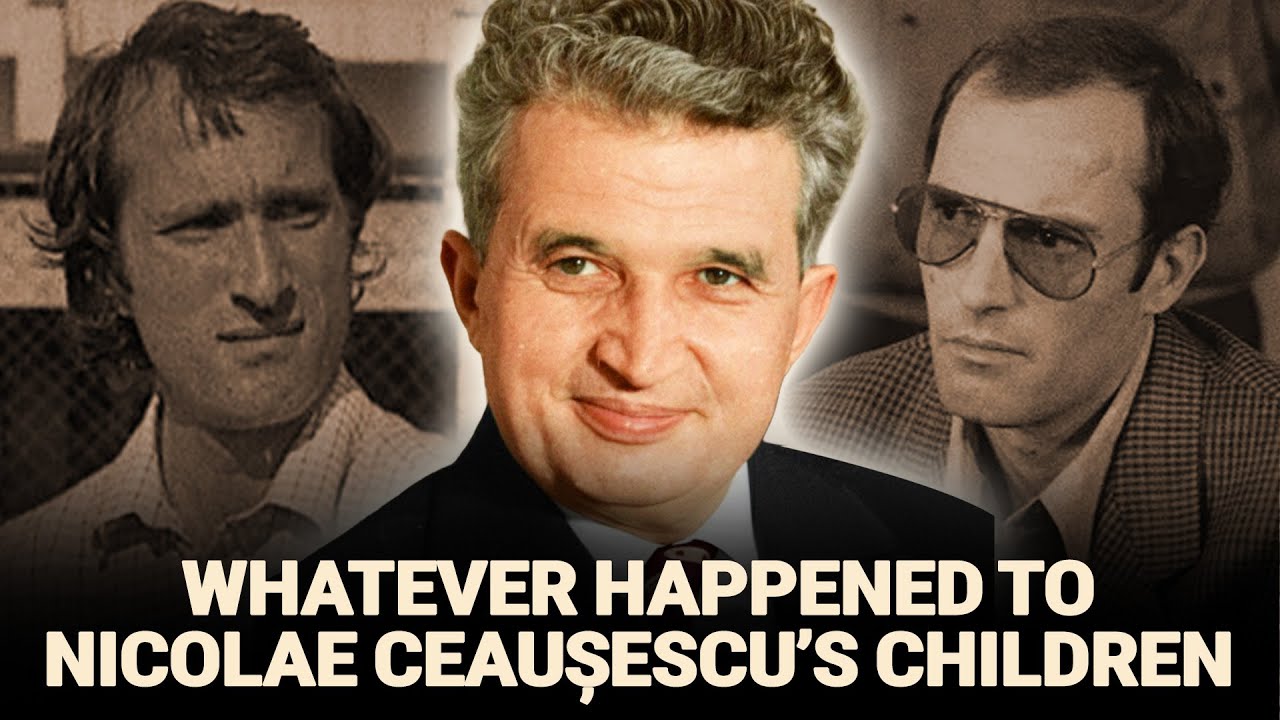
Nicu Ceaușcu, the youngest, was groomed as his father’s heir. Each took a dramatically different path through the aftermath of dictatorship. Valentin was born on February 17, 1948, in Bucharest, as his father’s political career was rising within the Romanian Communist Party. Unlike his younger brother, Valentin showed an early aptitude for mathematics and physics.
He enrolled in the physics department at the University of Bucharest in 1966. In 1967, Valentin was selected for doctoral studies at Imperial College London, an extraordinary opportunity for any Romanian student during the Cold War. The move reflected both his academic abilities and his father’s growing international stature. He spent three years in London, completing a dissertation in nuclear physics focused on particle accelerator technology.
Returning to Romania in 1970, Valentin joined the Institute of Atomic Physics in Bucharest. Throughout the 1970s and 1980s, he published roughly 20 research papers in nuclear physics and particle acceleration. His work, sometimes featured in Western scientific journals, met international standards despite Romania’s increasing scientific isolation. Valentin’s relationship with the scientific community was complicated by his family name.
Some colleagues appreciated his efforts to remain objective; others questioned whether his position came from merit or influence. While ordinary Romanians endured severe shortages, the Ceaușescu family lived in comfort, and Valentin’s international travel stood in stark contrast to restrictions placed on most citizens. He married Iordana Borilă, known as Dana, in the early 1970s, a union typical of Romania’s political elite. The couple had a son, Daniel.
After that marriage ended, Valentin married Roxana Duna, a medical doctor, in the 1980s. Their daughter, Alexandra, was born late in that decade. After the 1989 revolution, Valentin was briefly detained while authorities investigated family involvement in the regime. His scientific colleagues and international contacts emphasized his non-political, academic role, and he was released.
He then withdrew completely from public life, refusing interviews and avoiding any comment on the events that transformed Romania. Today, Valentin remains alive but maintains strict privacy. Some reports suggest he continues scientific work outside Romania. His published papers remain in academic databases, and young physicists sometimes encounter his work without initially recognizing the family connection.
Zoia Ceaușescu was born on February 28, 1949, in Bucharest, one year after her eldest brother. As the only daughter in a politically prominent family, she faced unique pressures shaped by both her gender and her family’s status. From an early age, she showed remarkable mathematical aptitude. Zoia enrolled in the mathematics department at the University of Bucharest, a choice that represented a declaration of intellectual independence.
Mathematics, with its emphasis on objective proof, offered a refuge where family connections could not substitute for genuine ability. Her undergraduate performance exceeded expectations, particularly in functional analysis. She completed her doctoral dissertation in 1977 under Ciprian Foias, one of Romania’s most respected mathematicians. Her work focused on functional analysis, specifically examining operators in infinite-dimensional spaces.
Foias, who later joined Indiana University, maintained that her mathematical abilities were genuine and substantial. Zoia joined the Institute of Mathematics of the Romanian Academy, the country’s most prestigious mathematical research institution. She published around 20 papers, primarily on operator theory and spectral analysis. Despite travel restrictions, she occasionally attended international conferences where her work was evaluated purely on merit.
In 1980, she married Mircea Oprea, a fellow academic. Unlike politically motivated marriages common among elite families, this union appeared based on genuine compatibility and shared intellectual values. The couple kept a private domestic life, prioritizing academic achievement over political advancement. In the mid-2000s, Zoia was diagnosed with lung cancer.
She died on November 20, 2006, at the age of 57. The mathematical community acknowledged her passing with respect, and her work continues to be cited by researchers in functional analysis. Nicu Ceaușescu, born on September 1, 1951, entered a world where his family’s political prominence was unquestioned. Unlike his older siblings, who experienced some of their father’s ascent, Nicu was born into established power.
From his earliest years, he was surrounded by expectations that he would assume a role in the communist system. His education was designed for political leadership rather than specialized academic knowledge. He held positions in communist youth organizations from an exceptionally early age, receiving direct mentorship from his father and senior party officials. His lifestyle became increasingly conspicuous, with access to luxury cars and entertainment that highlighted the gap between the elite and ordinary people.
In the early 1980s, Nicu was appointed first secretary of Sibiu County, a central Romanian region of economic and strategic importance. The appointment signaled his father’s succession plans. However, those who worked with him privately noted gaps between his public image and administrative capability. During the 1980s, reports circulated about Nicu’s extravagant lifestyle and controversial personal behavior.
While unverified, these accounts created concern within party circles. His conspicuous consumption became increasingly problematic as Romania’s economy deteriorated, fueling popular resentment. The December 1989 revolution caught the regime completely unprepared. Nicu, directly identified with the regime’s policies and succession plans, became a primary target for revolutionary justice.
He was arrested shortly after his parents’ capture and execution. Nicu was tried by a military tribunal and sentenced to 20 years in prison. International observers raised concerns about due process in the politically charged atmosphere. His imprisonment under harsh conditions, a deliberate contrast with his previous privileges, proved physically and psychologically devastating.
He developed severe liver disease, likely cirrhosis, which progressed rapidly. In 1992, he was granted early release due to his deteriorating health. He traveled to Vienna, Austria, for advanced medical treatment, but his condition had progressed beyond effective care. Nicu Ceaușescu died of cirrhosis in Vienna on September 26, 1996, at the age of 45.
His death occurred quietly, without the international attention that surrounded other aspects of his family’s story. He was buried in exile, symbolizing his complete severance from the country where he had expected to assume leadership. The three siblings inherited more than material wealth. They inherited expectations, scrutiny, and a name that became synonymous with dictatorship.
The siblings who chose academic pursuits built legitimate achievements that survived political transformation. Valentin’s strategy of complete withdrawal protected him but required abandoning his career and accepting permanent isolation. Zoia’s approach allowed her to maintain professional identity until her death. Nicu’s complete identification with the regime meant its collapse became his personal destruction.
Their stories offer insights into political dynasties and the challenges of inherited power. The contrast between academic and political paths suggests that intellectual achievement provides a more sustainable identity than inherited political position. The speed of the 1989 revolution caught the entire family unprepared, but only Nicu had made himself inseparable from the failing system. Three decades after their parents’ execution, the siblings have left very different legacies.
Valentin remains alive but invisible. Zoia’s mathematical work continues to be studied. Nicu’s life serves as a warning about the dangers of authoritarian succession planning.