Vivien Leigh was one of the most celebrated actresses of the 20th century, known worldwide for her Oscar-winning performances and her marriage to Laurence Olivier. But behind the glamour lay a life marked by a severe mental illness that was barely understood during her lifetime, a condition that shaped her marriages, her career, and ultimately her death. Before the fame, there was an unsettled childhood. She was born in Darjeeling, India, in November 1913, the only child of an English father and a mother of Irish and Armenian descent.
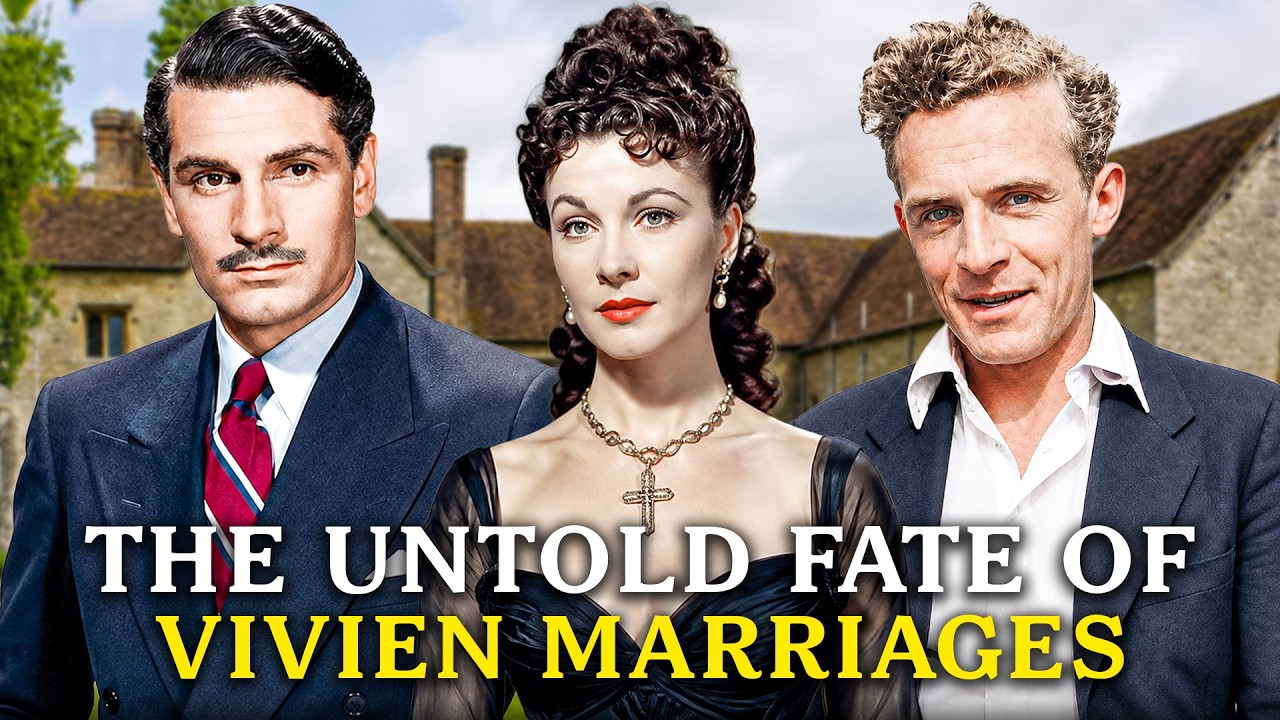
At age six, she was sent to a convent school in England while her family remained abroad, leaving her to spend years moving between schools across England and Europe without putting down roots. Even as a young child, she was determined to become a great actress, a goal most adults dismissed as a fantasy. She eventually enrolled at London’s Royal Academy of Dramatic Art, but her path took an unexpected turn in 1932 when she met a barrister more than a decade her senior. He disapproved of acting as a profession, yet within a year they were married, and she put her ambitions aside.
Less than a year after the wedding, she gave birth to a daughter. For a brief time, she seemed settled into the respectable domestic life her husband wanted, but the pull toward performing never disappeared. While raising an infant, she quietly pursued small film roles, changing her name to create the stage identity the world would come to know. Her talent quickly attracted real attention.
Her first marriage remained amicable and low-drama, but in the mid-1930s, she caught sight of another actor on the London stage and decided almost instantly that she wanted to marry him. That actor was Laurence Olivier, already establishing himself as one of the most gifted classical performers of his generation. Both were married to other people at the time. Working together on stage and screen intensified the connection between them, and by 1937 they began an affair, moving in together before either divorce was final.
In an era when divorce carried real stigma, the decision took years to resolve legally, while gossip columns speculated endlessly. During that same stretch, her career took an extraordinary turn. An American producer had spent nearly two years searching for an actress to play the lead in a historical epic adapted from a best-selling novel, a search so publicized it had become a Hollywood joke. Hundreds of actresses had been rejected, and filming had already begun without a leading lady when she entered the running.
She won the role on the strength of a screen test that convinced the production team she had the fire the character demanded. The casting made headlines around the world, with skeptics questioning whether a relatively unknown British actress could carry a story so rooted in American history. Those doubts faded once audiences saw the finished film. The film premiered at the end of 1939, and her impact was immediate.
She became one of the most famous actresses in the world, winning the first of two Academy Awards for Best Actress the following year. It was the professional triumph of a lifetime, arriving at almost the same moment her personal life caught up with her heart. Both divorces became final in 1940, and within days, she and Olivier married in a quiet civil ceremony witnessed by close friends, including the director Garson Kanin and actress Katharine Hepburn. The public announcement the next day was anything but quiet, confirming a romance that half of London and Hollywood had suspected for years.
They were treated as theatrical royalty, their names printed together so often that it was hard to think of either as an individual performer. They worked together frequently on stage and in film, and colleagues described genuine warmth between them. But even in those early years, there were quiet signs of something stirring underneath the glamour. The earliest hint came during a production of Hamlet in the late 1930s, when she suddenly turned on Olivier with a burst of anger that seemed to come from nowhere, then delivered a flawless performance with no memory of the outburst afterward.
It was written off as nerves or temperament in an era with almost no public understanding of mood disorders. Similar episodes kept recurring, arriving without warning and vanishing just as quickly. In 1939, not long after their relationship went public, she frightened those close to her by taking far more sleeping medication than she should have. It would be years before anyone connected these episodes to a single underlying condition.
The war years brought their own strain. In 1944, while performing for troops in North Africa, she developed a persistent cough that wouldn’t resolve. Doctors eventually found a tubercular patch on one of her lungs, and she was ordered into extended bed rest. It was a diagnosis that would shadow the rest of her life, flaring up during moments of stress.
That same period brought a miscarriage, a loss that friends later pointed to as a moment when her emotional stability shifted into something darker and harder to manage. Through the 1940s, she continued working steadily, delivering some of the performances that would define her career, while only the small circle of people who lived alongside her saw the cracks widening. By the end of the decade, she took on a role that many who knew her would later describe as the beginning of the end. In 1949, she played a fragile, unraveling Southern woman on the London stage, a role she reprised in the 1951 film adaptation.
It required her to inhabit a woman whose grip on reality was slowly coming apart, delivering raw monologues about faded beauty and losing her mind. It was one of the finest performances of her career, earning her a second Academy Award. But it was also, by her own later admission, one of the most psychologically dangerous roles she ever took on. She told friends that inhabiting that character for months on end had tipped something inside her that never fully righted itself again.
Those closest to her noticed changes beyond ordinary exhaustion, including sleeplessness that stretched for days, followed by crashes of profound low energy and mood swings with no apparent trigger. Olivier began consulting psychiatrists and confided in close friends, including Noël Coward, that he feared she was heading toward a major breakdown. He was right to worry. In early 1953, she traveled to Ceylon to film a story about a young bride adjusting to life on a remote plantation.
It should have been a straightforward production, but it became the most frightening chapter of her adult life. From the earliest days, she seemed unlike herself, arriving exhausted after nights without sleep and sending erratic messages back to Olivier. She stayed up drinking late into the night and showed up to set looking unwell. As the weeks wore on, her condition deteriorated sharply.
She began losing track of which character she was supposed to be playing, slipping into lines and mannerisms from roles she’d performed years earlier. She became consumed by intense racing energy that made rest impossible, followed by periods of complete collapse. Colleagues later wrote in memoirs that it was one of the most unsettling things they had ever witnessed. The production could not continue with her in the role, and arrangements were made to fly her back toward England.
Mid-flight, in the grip of what doctors would later understand as a severe manic episode with psychotic features, she became so distressed that the people traveling with her had to physically keep her safe until the plane landed. Once back in England, Olivier had her admitted to a psychiatric hospital, where she remained for an extended stretch of treatment. The care reflected the extremely limited understanding of mood disorders at the time, including sedation, enforced rest, and repeated sessions of electroconvulsive therapy. It was an exhausting, disorienting process.
Months later, she was released with a formal diagnosis of what doctors then called manic depression, now known as bipolar disorder. For the first time, there was a name for everything that had been happening for over a decade. But a diagnosis in the 1950s didn’t come with anything close to a reliable cure. In the aftermath, both she and Olivier tried to rebuild something resembling normal life.
She returned to work quickly, refusing to let the diagnosis define her career. But the underlying instability never fully disappeared, and the strain of constantly bracing for the next episode began to wear on both of them in different ways. Olivier later admitted he never stopped feeling a low-grade dread underneath even the good stretches. Both of them began seeking comfort outside the relationship.
During the production that had triggered her breakdown, she had grown emotionally attached to her co-star, an actor named Peter Finch, and their connection continued for years afterward, further complicating an already fragile marriage. By the mid-1950s, those around the couple could see the marriage was fundamentally unraveling, even as they continued appearing together publicly. Behind closed doors, the warmth that had once defined their relationship had curdled into mutual exhaustion. Olivier eventually grew close to a much younger actress named Joan Plowright.
The end arrived abruptly. She was in New York hours from opening a new play when word reached her that Olivier wanted a divorce so he could marry Plowright. Friends said she barely managed to hold herself together long enough to get through the performance. The divorce became official in December 1960.
In the years that followed, she found steady companionship with a British actor named John Merivale, who understood exactly what kind of care she needed. He committed himself to looking after her through whatever episodes still surfaced, learning to recognize the earliest warning signs before they became unmanageable. They stayed together for the rest of her life, though they never formally married. Professionally, she continued working steadily through the early 1960s.
In 1963, she won a Tony Award for her performance in a Broadway musical. She toured internationally and took on demanding stage roles well into her 50s, refusing to let her health or her history slow her down any more than necessary. But her body, worn down by years of heavy smoking, recurring bouts of tuberculosis, and the physical toll of her mental health struggles, was quietly running out of road. In May 1967, during rehearsals for a new play, the tuberculosis she’d first contracted more than two decades earlier flared up again, severely enough that she began coughing up blood and was ordered into extended rest.
She seemed, for a stretch of weeks, to be recovering at her country home. During that time, she remained preoccupied with worry over Olivier, who was undergoing treatment for a serious illness of his own, even though their marriage had ended years earlier. On the evening of July 7, 1967, Merivale left their London home briefly to perform in a play. When he returned close to midnight, he checked on her and found her resting quietly, then went downstairs.
When he came back a short while later, he found she had gotten up, likely trying to make her way to another room, and had collapsed. Her lungs, ravaged by the disease that had shadowed her for over 20 years, had finally given out. She was 53 years old. The following evening, in a rare gesture of collective mourning, every theater light in London’s West End was dimmed for an hour in her honor.
Olivier was reportedly deeply shaken by the news, later writing candidly about the guilt he carried over not being able to help her more. A public memorial service drew an overflowing crowd. Her ashes were eventually scattered near the lake at her country home in East Sussex, a quiet ending to a life split between spotlights and hospital rooms. She had two husbands and two entirely different kinds of marriage, the first steady and quiet, the second the love story the whole world watched unfold, undone not by any lack of devotion, but by an illness that neither medicine nor love, in that era, had any real answer for.
Looking back, it’s tempting to wonder how differently things might have gone had she been born a few decades later, into an age with actual language for what she was experiencing and medications that could smooth the worst of the highs and lows. But she wasn’t afforded that kind of era. What’s left isn’t really the story of a glamorous Hollywood marriage.
It’s the story of a woman who spent more than half her adult life fighting a battle almost no one around her had the tools to fully understand, and who kept walking back out onto stages and film sets anyway, delivering some of the most celebrated performances of her century until her body simply couldn’t carry her any further.