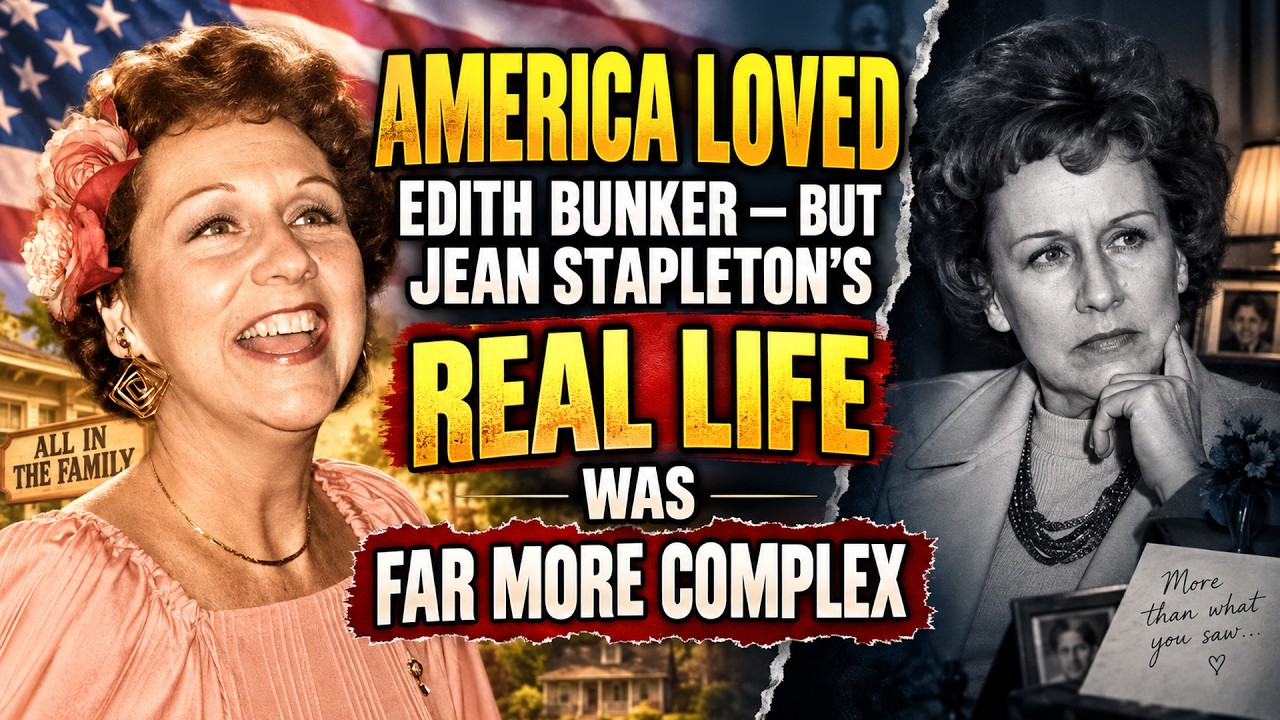
The woman who played the most famous wife in American television was not, in private life, anything like the character she made famous. Jean Stapleton, who portrayed Edith Bunker on All in the Family, was gentle but not soft, and by all accounts one of the most quietly stubborn actresses of her generation. Behind the scenes, she made decisions that shaped television history, changed how America talked about marriage, and even drew the attention of the White House. Born Gianne Murray on January 19, 1923, in New York City, Stapleton chose her professional name from her mother’s side of the family.
Her father, Joseph, was an advertising salesman. Her mother, Marie, was a concert and opera singer. Her older brother, Jack, was a stage actor who encouraged her toward acting but died young. Stapleton did not begin as a stage prodigy.
She graduated from Wadleigh High School in Manhattan, then supported herself with secretarial work, including typing for the British War Ministry office in New York during World War II. After high school, she described being seized by the urge to act. She trained with the American Apprentice Theater, the American Actors Company, and the American Theater Wing, and sang for a time with the Robert Shaw Chorale. By the early 1940s, she was performing professionally.
Through the next two decades, she built a career as a character actress in New York theater, appearing in Broadway productions including Damn Yankees, Bells Are Ringing, Rhinoceros, and Funny Girl, as well as film adaptations of some of these shows. She was never cast as the leading lady, but deliberately chose to become the best character actress she could be. In the early 1950s, she met William Putch through mutual friends while he was working in Maryland theater. They married in October 1957, after knowing each other for years.
He proposed in the box office of the Totem Pole Playhouse in Fayetteville, Pennsylvania, a small summer theater he would guide for three decades. The following summer, Stapleton began appearing there, ultimately performing in 81 productions over the years while her career expanded toward Broadway, film, and national television. That television career began when producer Norman Lear was trying to cast the wife for a new sitcom opposite Carroll O’Connor’s loud, opinionated working-class character named Archie Bunker. Lear needed a real woman who could hold her own beside O’Connor’s explosive presence.
He knew Stapleton’s stage work, and casting director Marian Dougherty understood what the role required. After earlier pilots and recasting, All in the Family premiered on CBS on January 12, 1971. The show broke every unwritten rule about what American families could discuss on television, taking on race, Vietnam, women’s rights, breast cancer, rape, and menopause inside a half-hour sitcom. Ratings were modest at first, but by the third season it was the number one program on American television, a position it held for five consecutive years.
At nearly 50, after 25 years of quiet character work, Stapleton was suddenly one of the most famous women in the country. Women wrote to her by the thousands, saying Edith reminded them of themselves, of their mothers, of their grandmothers. They wrote that when Archie shouted at Edith to stifle herself, they heard their own husbands. Stapleton took the correspondence seriously, and a large record of it survives in her papers.
Even the President of the United States weighed in on the Bunkers. On May 13, 1971, only months after the show first aired, Richard Nixon was recorded on the White House taping system discussing an episode involving a discussion of homosexuality with his chief of staff and aide. He expressed real anger about the show and worried about its influence on the country. There is no evidence that he attempted to shut the show down, but the recording is now part of the public archive.
Alongside the fame, Stapleton began using her visibility for a specific cause in the mid-1970s: the Equal Rights Amendment. She served on the National Commission on the Observance of International Women’s Year, and in November 1977 went to Houston for the National Women’s Conference, where Betty Friedan, Coretta Scott King, Rosalynn Carter, Betty Ford, and Lady Bird Johnson were also present. She spoke publicly about equality and put her name behind the amendment in documented ways. On October 16, 1977, All in the Family aired a two-part episode called Edith’s 50th Birthday, in which Edith Bunker, alone in her house, was attacked by a man who forced his way in.
The episode dealt with attempted rape on prime-time network television in a way no sitcom had dared before. Stapleton’s performance is widely considered one of the finest pieces of acting ever delivered on American television. Viewers responded intensely, writing about their own experiences as the episode entered the national conversation about sexual violence. By the following year, Stapleton was openly thinking about how long she wanted to remain Edith.
All in the Family continued through nine seasons, ending that run in the spring of 1979. The format then changed to Archie Bunker’s Place. Stapleton did not continue as a full-time co-lead but appeared several times as Edith during the first season. She then asked to be released completely.
In 1980, Edith’s death was written into the series offscreen, and Carroll O’Connor’s performance as Archie grieving became one of the most remembered moments of the continuation. Years later, Stapleton explained her decision simply. She loved Edith and understood what the character had meant to viewers, but she did not want to be buried inside one part. She feared becoming unable to escape the character.
Stories have circulated that she was offered very large sums of money to stay, but the exact figures shift from retelling to retelling and cannot be verified. There is also a recurring story that Rosalynn Carter personally telephoned her to ask her to stay. That anecdote cannot be established from the strongest available records, though Stapleton did have real connections to White House-era women’s initiatives. On November 23, 1983, William Putch died suddenly of a heart attack in Syracuse, New York.
He was 59. The couple was on the road with The Showoff, a production he was directing and in which she was performing. That night, Stapleton went on stage. She later explained that the play became a refuge.
It was William’s show, and continuing it gave the grief somewhere to go. The years after his death were not an epilogue. She portrayed Eleanor Roosevelt in television and later toured with a one-woman stage work, Eleanor: Her Secret Journey. She returned to Broadway in Arsenic and Old Lace, worked in Harold Pinter and Horton Foote plays, and took character roles in films including Michael in 1996 and You’ve Got Mail in 1998.
She appeared on Everybody Loves Raymond in the late 1990s. Stories have circulated that she was offered the role of Forrest Gump’s mother in the 1994 film and the role of Marie Barone in Everybody Loves Raymond, and turned both down. Neither story can be verified in any primary source. No interview with Stapleton or with the producers or casting directors of either project confirms them.
They are, as best as anyone can tell, industry rumors that have taken on the appearance of fact through repetition. In 2002, she was inducted into the Television Academy Hall of Fame. She continued performing into her 80s, doing classical work and new plays. In 2002, she returned to New York permanently.
Her final stage work at Lincoln Center was only a few blocks from home. Jean Stapleton died of natural causes on May 31, 2013, at her home in New York City. She was 90 years old. In keeping with her preference for privacy, she asked that there be no services.
Norman Lear released a statement calling her a national treasure. Rob Reiner and Sally Struthers spoke publicly about what she had meant to them. An entire generation of American women grieved for her the way they would have grieved for an old friend. Her children remembered her not as a remote star but as a mother who encouraged them.
John Putch became a film and television director. Pamela Putch became a television producer. Pamela said her mother always separated the public person from the private person. When strangers called her Edith, Stapleton corrected them gently.
The name, she would tell them, was Jean.