Roughly 9,000 years ago, in a river valley in what is now southern Mexico, farmers encountered a wild grass called teosinte. Its seeds were tiny, rock-hard, and encased in shells tough enough to crack a tooth. Each plant produced only a handful of these small, unimpressive kernels. Through centuries of patient selection, ancient farmers transformed this unremarkable weed into maize, the crop that would eventually feed empires and reshape global agriculture.
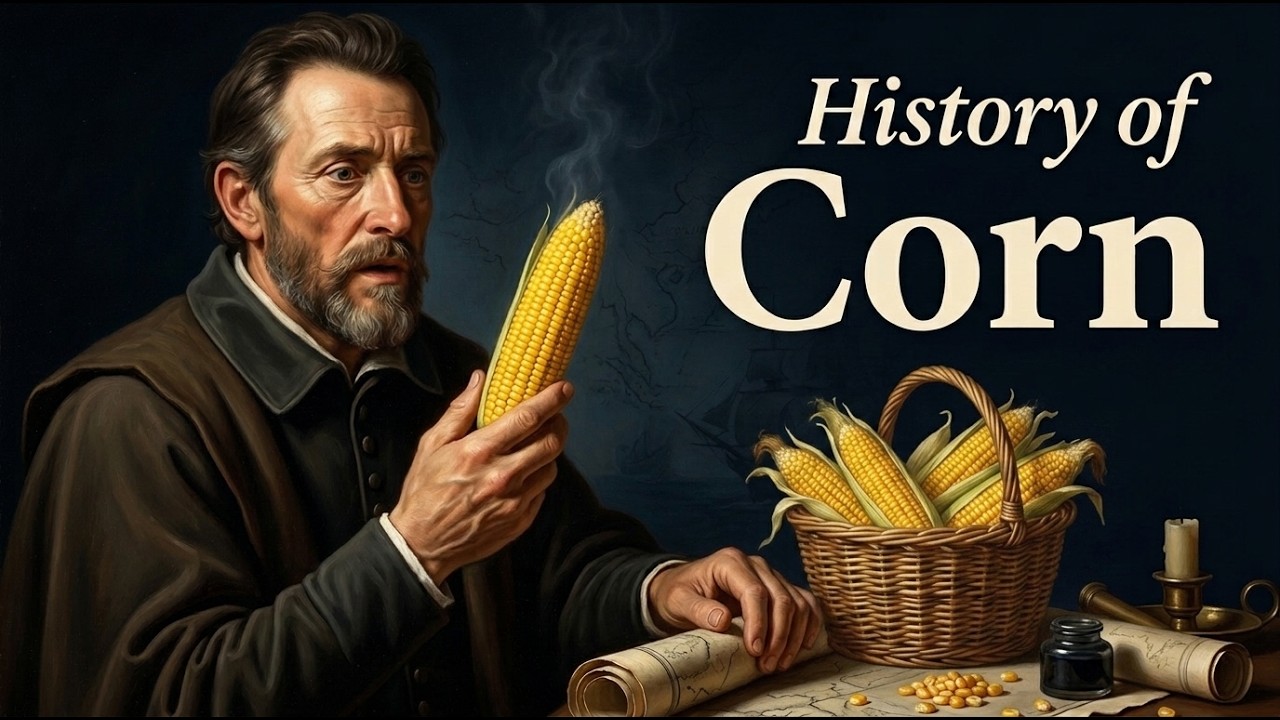
Today, corn covers more than 200 million acres worldwide, with the United States alone planting nearly 90 million acres annually. It appears in soft drinks, car fuel, toothpaste, and even aspirin coatings. Yet despite this dominance, corn is one of the most helpless plants on Earth. Drop an ear of corn on the ground and nothing happens.
The husks trap the kernels tightly against the cob, and without human intervention to peel, separate, and plant the seeds, corn simply dies where it falls. It is a crop that literally cannot exist without us. The origin of this dependence lies along the Balsas River in the Sierra Madre mountains of Guerrero, Mexico. Around 7000 BCE, the people living there were hunter-gatherers, collecting wild plants and hunting deer and rabbits.
Among the dozens of wild grasses they encountered, teosinte stood out slightly. It resembles a weed, with seeds arranged in a single row within a hard triangular casing. A modern corn cob, by contrast, contains roughly 800 kernels arranged in neat rows along a thick cob wrapped in papery husks. The difference between teosinte and modern corn is so vast that scientists refused for decades to believe any connection existed.
In the 1930s, geneticist George Beadle argued that corn descended directly from teosinte through ancient human selection. The scientific community resisted this idea fiercely. How could a roadside weed become the most productive grain crop on Earth? Other scientists proposed that corn must have descended from an extinct wild ancestor, something closer to modern corn that simply disappeared.
The debate lasted more than 40 years. Beadle devoted his career to gathering evidence, crossing teosinte with corn, analyzing the offspring, and mapping genetic differences. By the 1970s, he had proven that just five major genetic regions controlled the key differences between teosinte and corn. Five small pieces of DNA, modified through thousands of years of human selection, were responsible for the transformation from neglected grass to civilization-building crop.
Beadle eventually won a Nobel Prize, though for his earlier work on gene function rather than directly for the teosinte-corn connection. The irony is that his most controversial claim, mocked by colleagues for decades, turned out to be correct all along. The ancient farmers of Mesoamerica had no word for genetics. They did not understand chromosomes or alleles or selective pressure.
But they understood observation and patience. They noticed that some teosinte plants produced slightly larger seeds, softer husks, or stalks that branched less and concentrated energy into fewer, larger seed clusters. They saved those seeds and planted them, generation after generation, over thousands of years. Gradually, the cob grew larger.
The kernels became softer and fuller. Rows multiplied from one to four to eight to sixteen. The husk tightened around the cob to protect the developing crop from birds and rain. In doing so, those farmers unintentionally created something that could never survive on its own again.
Every modification that made corn more useful to humans also made it more dependent on them. The wider cob meant seeds could not disperse naturally. The tighter husk meant kernels could not free themselves to sprout in the soil. Corn became, in a very real sense, a genetically engineered organism thousands of years before anyone used the term.
The transformation went both ways. While humans shaped corn, corn was shaping humans. The rise of maize farming changed not just what people ate, but where they lived, how many children they had, the gods they worshipped, and how they organized entire civilizations. The Maya were among the first peoples to build a society around corn, and they did not do it halfway.
Corn was not just their staple food, but the center of their religion, their calendar system, their art, and the essence of their identity as a people. The Popol Vuh, the sacred creation text of the K’iche’ Maya, tells how the gods tried many times to create humans from different materials. They tried clay first, but it crumbled in the rain. Then they tried wood.
The wooden humans could walk and talk, but they were hollow and thoughtless, incapable of worship or gratitude. Finally, the gods ground white and yellow corn, mixed it with water, and shaped the dough into flesh and bones. In Maya theology, humans are literally made from corn. At its height, the Maya civilization supported millions of people across the Yucatan Peninsula, the Guatemala highlands, and parts of Honduras, Belize, and southern Mexico.
Towering limestone temples rose above the forest canopy at Tikal. Astronomical observatories at Chichen Itza tracked the movements of Venus with remarkable precision. The Maya developed one of only a few fully independent writing systems in human history, carving complex hieroglyphs on stone stelae and painting them on plaster walls. All of it depended on corn.
Farmers cleared sections of forest using slash-and-burn techniques, planted corn in the nutrient-rich ash, and harvested enough calories to feed a growing number of specialists who never farmed at all. Corn enabled population density. Density enabled specialization. Specialization enabled the building of pyramids, the development of mathematics, written language, and a calendar more accurate than the one Europe was using at the same time.
The Aztecs, who rose to dominance in central Mexico in the fifteenth century, pushed corn culture even further. Aztec farmers mastered the chinampa system, building vast floating gardens on the shallow lakes surrounding their island capital of Tenochtitlan. Workers dredged mud from the lake bottom, piled it on rafts of woven reeds, anchored the rafts to the lake floor with stakes, and planted willow trees along the edges whose roots grew downward and held the entire structure in place. These artificial islands were incredibly productive, yielding up to seven crops per year in central Mexico’s temperate climate.
They fed a capital of more than 200,000 people, making Tenochtitlan one of the largest cities in the world at that time, larger than London, Paris, or most European capitals. Corn was ground into dough on metate stones and shaped into tortillas and tamales. It was fermented into alcoholic beverages and offered to the gods in elaborate rituals. Aztec tribute records show that conquered provinces were required to deliver massive quantities of dried corn to the capital as taxes.
In the Aztec world, control the corn supply and you controlled the empire. Long before European ships crossed the Atlantic, corn had already begun spreading across the Western Hemisphere through ancient trade networks and the slow migration of farming peoples. It moved north into the arid Southwest, where ancestral Pueblo peoples bred drought-resistant varieties that could produce a crop with very little rain. It reached the Mississippi River valley, where something remarkable happened.
Around 900 CE, the people of Cahokia built the largest pre-Columbian settlement north of Mexico, a sprawling city of about 20,000 people centered on more than 100 massive earthen mounds in the floodplains near present-day St. Louis, Missouri. The largest mound, known today as Monks Mound, covers 14 acres at its base and rises about 100 feet into the air, containing more soil than the Great Pyramid of Giza contains stone. The surplus calories that provided enough labor to move all that earth came largely from one crop: fields of corn stretching along the fertile river bottoms.
Corn traveled south to the Andes, where highland farmers adapted it to elevations exceeding 10,000 feet and temperatures that would have killed lowland varieties. Every region that adopted corn developed its own local varieties over centuries, suited to vastly different soils, climates, and growing seasons. By the time of European contact, hundreds of distinct varieties of corn were growing across two continents. Each one was a living record of a society’s agricultural knowledge.
Along the way, one of the most elegant farming systems in history was born. The Haudenosaunee people, later called the Iroquois by Europeans, developed a method known as the Three Sisters. They planted corn, beans, and squash together in the same soil mound. Corn stalks grew tall and provided a natural trellis for bean vines to climb.
Beans fixed atmospheric nitrogen in the soil through symbiotic bacteria in their roots, feeding the hungry corn plants. Squash spread its broad, prickly leaves over the ground, shading out weeds and trapping moisture in the soil. Three crops, each solving a problem created by the others, working together in a cycle so balanced that the soil could support them year after year without becoming exhausted. Modern agricultural scientists still study this system, created by people who worked without written language, metal tools, or draft animals.
When Christopher Columbus stepped onto Caribbean shores in 1492, corn was already feeding complex civilizations across two continents. The local Taino people grew it in their plots alongside cassava and sweet potatoes. Columbus brought samples back to Spain, where European farmers regarded the new crop with cautious curiosity. It grew quickly, produced abundant harvests compared to wheat, barley, and rye, and could thrive in soils and climates where traditional European grains struggled.
Within a few decades, corn was being grown throughout Spain, Portugal, and Italy. It spread through the Ottoman Empire to the Balkans and eastern Mediterranean. By the sixteenth century, Portuguese traders had carried it to West Africa, India, and China. But corn’s arrival in the Old World carried a hidden danger.
In Mesoamerica, corn was almost always treated with an alkaline substance, usually lime water, through a process called nixtamalization. Farmers soaked the dried kernels in this alkaline solution, which softened the hard outer shell, made the corn easier to grind, and improved the flavor and texture of the resulting dough. But nixtamalization also did something invisible and crucial: it freed a B vitamin called niacin, which is chemically bound inside raw corn in a form the human digestive system cannot absorb. The Maya and their descendants knew how to do this.
They had been doing it for centuries. When Europeans adopted corn as a food crop, they skipped this step entirely. They simply ground the raw kernels into flour and cooked it. In societies that relied heavily on corn as a primary source of calories, a terrible disease began to appear.
Pellagra, caused by severe niacin deficiency, begins with skin lesions that crack and peel when exposed to sunlight. It progresses to chronic diarrhea and digestive failure. In its final stages, it leads to dementia, hallucinations, and death. Italian physicians called it pellagra, meaning rough skin, and it devastated peasant populations across northern Italy and southern France for generations.
In the American South during the late nineteenth and early twentieth centuries, pellagra killed thousands of poor rural families who lived essentially on cornmeal, lard, and molasses. It was not until 1937 that biochemist Conrad Elvehjem identified niacin as the missing nutrient and proved it could cure pellagra almost overnight. Indigenous corn farmers in Mesoamerica had solved this problem thousands of years earlier through nixtamalization. The rest of the world simply never asked how they prepared their food.
Back in North America, corn was becoming the foundation of a new kind of economy. The first English colonists who arrived in Virginia and Massachusetts would have starved without it. The Powhatan and Wampanoag peoples taught them how to plant corn in mounds, fertilize it with fish, and dry and store it through harsh coastal winters. Corn fed families during long winters, fattened pigs and cattle so efficiently that farmers found it more profitable to feed corn to animals and sell their meat than to ship raw grain to market over dirt roads.
It was also distilled into whiskey, which served as a social lubricant and a practical form of currency on the early American frontier. In rural areas west of Pennsylvania and in Kentucky, where roads were poor and banks barely existed, a jug of corn whiskey held its value better than paper money. This was so central to the frontier economy that when Alexander Hamilton imposed a federal tax on whiskey in 1791, it triggered an armed uprising known as the Whiskey Rebellion. President George Washington personally led 13,000 militia troops to western Pennsylvania to suppress it.
As the United States expanded westward in the nineteenth century, corn traveled with the settlers in covered wagons and saddlebags. The flat, deep-soiled plains of the Midwest proved ideal for it, and the region soon earned the nickname the Corn Belt. By the mid-1800s, states like Iowa, Illinois, Indiana, and Ohio were producing astonishing quantities. Railroads connected these farms to the slaughterhouses of Chicago and the markets of New York, turning corn from a regional commodity into a nationally traded one almost overnight.
Then came the breakthrough that changed the course of agriculture itself. In the early twentieth century, scientists at agricultural colleges across the Midwest began experimenting with hybrid corn varieties. By carefully inbreeding two separate lines of corn for many generations until each line was genetically uniform, then crossing those two lines, they could produce offspring that exhibited a phenomenon called hybrid vigor. The hybrid plants were taller, stronger, and significantly more productive than either parent line.
The first commercially successful hybrids hit the market in the 1930s, and the results were extraordinary. Corn yields that had hovered at about 20 to 30 bushels per acre for generations suddenly jumped to 50, then 80, then past 100. By the end of the twentieth century, average US corn yields had increased by about 600 percent over pre-hybrid levels. But hybrid corn came with a structural catch that reshaped the economics of farming.
Unlike traditional open-pollinated varieties, where a farmer could save seed from this year’s harvest and plant it the next spring with reliable results, hybrid corn does not reproduce its characteristics. Save seeds from a hybrid harvest and the next generation will be weaker, wildly inconsistent, and significantly less productive. Farmers who adopted hybrids had to buy new seed from seed companies every season. Seed companies understood this perfectly.
Pioneer Hi-Bred, founded by Henry Wallace, who later became vice president of the United States, built a commercial empire on this dependence. Farmers got higher yields, and seed companies got a guaranteed annual market. The ancient practice of saving seed from your best plants, a tradition as old as agriculture itself, began to disappear from the American landscape. Once productivity exploded, production costs fell, and the government guaranteed a minimum price, the central question of American agriculture became: what do we do with all this corn?
The answer turned out to be practically everything. In the 1970s, Japanese food scientists developed a process for converting corn starch into a thick, intensely sweet liquid called high-fructose corn syrup. American food companies saw the potential immediately. It was cheaper than cane sugar, easier to transport in tankers, and blended seamlessly into liquid products.
By the early 1980s, both Coca-Cola and Pepsi had quietly switched from cane sugar to high-fructose corn syrup in their flagship drinks. Cheap sweeteners flowed into foods that had never been particularly sweet before: bread, ketchup, salad dressing, yogurt, canned soup, pasta sauce, breakfast cereal, granola bars. One by one, recipes changed. Because these reformulated foods were cheaper to produce, retail prices fell, which meant people bought more of them and consumed more without consciously deciding to eat more sugar.
But sweeteners were only one branch of the industrial corn complex. Corn starch thickens sauces and gravies in restaurant kitchens and frozen meals. Corn oil fills deep fryers and coats baking pans. Corn-derived dextrose runs through IV solutions in hospital rooms.
Corn-derived citric acid is sprayed on cut fruit to prevent browning inside plastic packages. Corn-derived ethanol is blended into nearly 98 percent of gasoline sold at American fuel stations. The waxy coating on supermarket cucumbers, the adhesive on a postage stamp, the filler in a vitamin capsule, biodegradable packing peanuts: corn is in all of it. According to some estimates, roughly 75 percent of all products in a typical American supermarket contain at least one corn-derived ingredient.
You can walk through the entire store, from the produce section to the pharmacy, and nearly everything you touch traces back to Midwestern corn fields. The system that makes all this possible runs on public money. The US government has supported corn production in various forms since the New Deal era of the 1930s. But the modern support machine really took shape under Agriculture Secretary Earl Butz during the Nixon administration in the early 1970s.
Before Butz, the government managed corn prices by paying farmers to leave parts of their land unplanted, keeping national supply under control and prices relatively stable. Butz dismantled that system with a philosophy summed up in one phrase: Get big or get out. He asked American farmers to plant every inch, maximize every acre’s productivity, adopt the latest chemical inputs and the largest machinery they could finance, and promised the government would cover the gap if market prices fell below production costs. Small farms that could not afford to expand were expected to sell their land to neighbors who could.
Farmers listened, partly because economic conditions left them no alternative. Corn production exploded, prices collapsed under the weight of surplus, and the government began writing massive checks. Between 1995 and 2020, US corn subsidies totaled more than $116 billion, and the majority of that money did not go to small family operations. It went to large-scale industrial farms, operations big enough to plant thousands of acres and handle the paperwork required for federal compliance.
The hidden costs of cheap corn are staggering and show up in places grocery receipts never mention. Industrial corn farming requires enormous amounts of synthetic nitrogen fertilizer, with American farmers using nearly 12 million tons on corn fields each year. When it rains, that nitrogen washes off fields into drainage ditches, which empty into streams, then rivers, and eventually the Mississippi. From there it flows into the Gulf of Mexico, where it triggers massive algae blooms on the ocean surface.
When those algae die and sink, their decomposition consumes all the dissolved oxygen in the surrounding water, creating what marine scientists call a hypoxic dead zone. Every summer, the Gulf of Mexico dead zone expands to roughly 6,000 to 7,000 square miles, an area about the size of New Jersey, where shrimp, fish, and crabs either flee or suffocate. This has happened every year for decades, and the main driver is fertilizer runoff from Midwestern corn and soybean fields. Modern corn farming is also one of the largest monocultures in human history.
Tens of millions of acres planted with genetically similar hybrid varieties, treated with the same herbicides and pesticides, and harvested with the same machinery year after year in the same soil. It is efficient. It is staggeringly productive. And it is vulnerable in ways that are deeply concerning.
A single new disease or pest that evolves to target those specific hybrid strains could devastate the national corn crop in a single growing season. In 1970, a fungal disease called southern corn leaf blight swept through the Corn Belt and destroyed nearly 15 percent of the entire US corn crop. Its rapid spread and devastating impact occurred because all the hybrid corn then being grown shared the same genetic trait, a type of male-sterile cytoplasm that seed companies used to make hybrid production cheaper. One shared vulnerability across millions of acres was exploited by a single pathogen.
The wild relatives of corn and the ancient local varieties that carry the broadest genetic diversity are disappearing from Mexican hillsides as traditional farmers abandon subsistence farming for wage labor in cities. Every local variety that goes extinct takes with it thousands of years of accumulated genetic adaptation that can never be recovered. The raw material for future corn breeding, the insurance policy against the next epidemic, is shrinking even as our dependence on the crop grows. The explosion in high-fructose corn syrup use in the American food supply tracks almost perfectly with rising rates of obesity, type 2 diabetes, heart disease, and metabolic syndrome in the United States.
Correlation does not equal causation, and there are many other factors involved. But the sheer volume of added sugars the average American now consumes, estimated at 77 grams per day by some estimates, was made possible directly by the cheapness and abundance of corn-derived sweetener. When a two-liter bottle of corn-sweetened soda costs less than a single head of fresh broccoli, the economics of eating begin to work against you in ways that are very difficult to fight with willpower alone. The same government subsidies that make corn artificially cheap also make less nutritious foods the most affordable options on the shelves.
In food deserts across the rural South and urban Midwest, the nearest fresh produce may be a 30-minute drive away, but the corner gas station sells corn-sweetened energy drinks for a dollar and corn-based snack chips for less. The cheapest calories in America are mostly corn calories, and people who cannot afford anything else end up consuming them in quantities unimaginable two generations ago. Corn is the most productive grain on Earth, with more than 1. 2 billion metric tons grown worldwide every year.
It feeds livestock on six continents. It sweetens beverages on every grocery store shelf. It powers cars and goes into the production of coats, pharmaceuticals, fillers, diapers, and the stiffening of cardboard shipping boxes. It enabled the Maya to build limestone pyramids above the forest canopy, and the Aztecs to engineer floating gardens on a mountain lake.
It kept early settlers alive through harsh winters in a continent they barely understood. It transformed the American Midwest into the most productive agricultural region in human history. Yet corn also cannot survive a single generation without human intervention. It depletes the soil it grows in.
It poisons downstream waterways. It sweetens a national diet that is making millions chronically ill, and it costs taxpayers billions of dollars annually to keep the machine running. Nine thousand years ago, a farmer in the Balsas River valley looked at a wild grass with pitiful little seeds and decided to reshape it into something better. That farmer could never have imagined that this patient work would someday feed empires, cross oceans, power cars, and reshape the metabolism of an entire nation.
The question now is whether we have reshaped our entire food system around corn so completely that we have forgotten how to imagine an alternative. Corn did not conquer the world alone. We carried it, planted it, subsidized it, poured it into our fuel tanks, our sodas, and our children’s breakfast bowls.
Now, in ways we barely notice, it feeds us and deceives us every day.