On a soft September evening in 1970, a 38-year-old woman from a small town in the Appalachian foothills sat through the Venice Film Festival jury announcements with the blank expression of someone who had long ago stopped expecting good news. She was the only American with a feature film in the official competition that year. She won. The strangest part came afterwards.
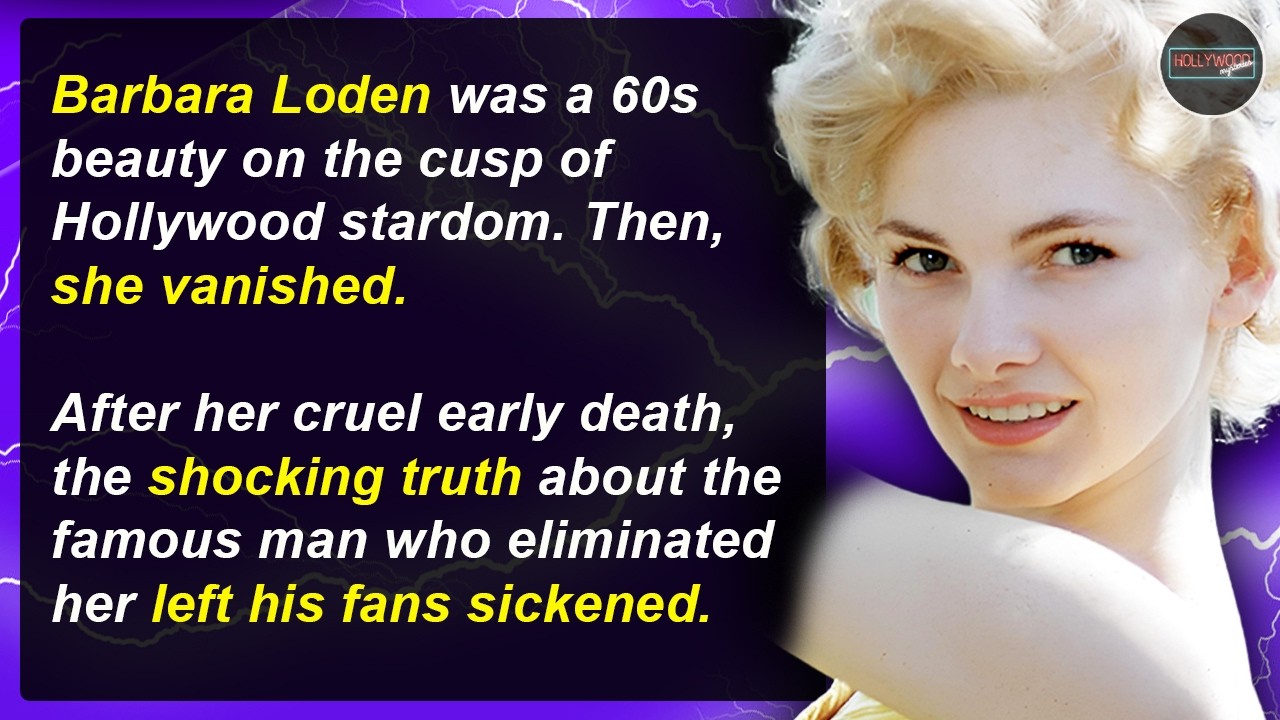
The negative would vanish. The director would die at a bizarrely young age, and her world-famous husband would go on to describe the entire enterprise as a sort of charity project granted to her. Barbara Loden and her work disappeared completely for 40 years, until the most astonishing thing happened. She was born Barbara Anne Loden on July 8th, 1932, in or near the town of Marion, North Carolina.
Some records say Asheville, 20 miles up the road where the hospital was, but the town she would always describe as home was Marion, with its slogan affixed to its main street like a luggage tag where the main street meets the mountains. In 1929, three years before she was born, the town had been the site of a textile strike in which police gassed the picketers and three workers were shot dead. This was not an obscure tragedy but a weighty moment in the history of blue-collar America. Sinclair Lewis filed a column on it, and Woody Guthrie wrote a ballad.
Her father was a barber. Her mother left for work in another town, and her brother was sent off to school. Barbara, the leftover daughter, was deposited with her religious maternal grandparents at the foot of the Blue Ridge, where she was raised, as she put it later, in a household that had run out of affection sometime before her arrival. She always spoke about that childhood with the honesty of someone who had decided that lying about it would be more humiliating than the truth.
“I spent most of my childhood hiding behind the stove,” she told one interviewer. The line is so evocative that you have to remind yourself it is also true. She had, she said, no friends. She described herself with an exhausted little flourish as a hillbilly’s daughter from a broken home.
When she was finally old enough to do anything about it, she did the only thing the lay of the land permitted. She ran. She was 16 years old. A small insurance payout from a car accident bought her a railway ticket to New York City.
She arrived with no plan beyond the desire to never be in Marion again. “If I had stayed there,” she told French critic Michel Ciment in 1970, “I would have gotten a job at Woolworth’s. I would have gotten married at 17 and had some children and would have got drunk every Friday and Saturday night. Fortunately, I escaped.
”
New York in 1949 was not yet friendly to teenage girls with great cheekbones but no useful contacts. She supported herself by modeling for detective magazines and romance pulps, the kind of stiff, half-undressed photo work the trade called cheesecake. She danced in the chorus at the Copacabana, where her stage name, for reasons that explain themselves, was Candy Loden. She found her way eventually to the Actors Studio and to a teacher named Paul Mann, who told her in the standard Method idiom of the period to mine her own life for her work rather than pretend she had come from somewhere nicer.
She would say later that this was the moment she stopped being an aspiring screen blonde and started being an artist. The trouble was that nobody else seemed to have noticed the transition. In the mid-1950s, she landed on the Ernie Kovacs show as a scantily dressed comic sidekick, a job her first husband, the producer Larry Joachim, had helped her secure. Kovacs himself she always defended.
He had wanted her, she said, and had given her television exposure when she had none. The exposure, though, was of a peculiarly compromised kind. She stood next to Kovacs in a costume that consisted of not much more than a strategically arranged towel. At least the audience laughed, and then the checks came in, and she went home and read scripts.
It had paid her rent and given her a face, but it had also stamped her as the kind of girl who looked good behind a fishbowl. Eventually, Kovacs took pity on her and elevated her to the role of the girl who gets pies thrown in her face, but she wound up with the industry nickname Dumb Barbara all the same. Larry Joachim, the husband she had married sometime in the early 1950s, was a useful man inside the small ecosystem of New York television and would also be the one who eventually introduced her to Elia Kazan. He receives less press than her later husband for obvious reasons, but he gave her two of the doors she most needed and a son, Marco, whom she adored.
Her stage career began in earnest in 1957 with a Broadway turn in Compulsion, the courtroom drama drawn from the infamous Leopold and Loeb case. She followed it in 1959 with Noël Coward’s Look After Lulu and in 1960 with The Long Dream, Ketti Frings’ adaptation of the Richard Wright novel. She appeared opposite Robert Redford in The Highest Tree and opposite Ben Gazzara in Night Circus. None of it made her exactly a star.
What it did was establish her on the small island of mid-century New York theater as a decent actress, presentable, far from dumb, and visibly more interesting than the parts she was being offered. The decisive break came, as so many breaks did in those years, through Elia Kazan. He cast her in Wild River in 1960 in a small role as a secretary, and then in Splendor in the Grass the following year as Jenny Stamper, Warren Beatty’s wild, drunken, doomed older sister. It is one of the most career-useful five minutes of work in early 1960s American film.
Jenny is presented as a sexual ruin, a flapper gone wrong, and Loden plays her with such unembarrassed appetite that she carries the moral tone of the picture without actually being its subject. Kazan quickly became entangled with her in less professional ways, but their affair did not blind him. He saw what was on the screen, and so, more troublingly, did everyone else. The role confirmed her in the trade’s mind as the blonde who would not behave.
The cousin of Marilyn, not only in looks but in temperament, the casualty in the rumpled silk dress. Kazan cast her accordingly in After the Fall, Arthur Miller’s 1964 play which opened at the ANTA Washington Square Theater on January 23rd of that year and ran for 208 performances. It was a thinly veiled inquest into Miller’s marriage to Marilyn Monroe, who had died 18 months before the curtain went up. The character Maggie, the doomed jazz singer whose suicide closes the second act, was understood by everybody in the audience to be Marilyn, and the woman they were watching play her was Kazan’s lover.
Even by Broadway standards, this was a piece of casting of breathtaking nerve. Loden played Maggie with what one critic called the rawness of an open wound. The reviews on which her career was supposed to vault instead reprinted almost verbatim the only language the press knew for women with that hair and that mouth. She was the new Jean Harlow.
She was a blonde bombshell. She was Marilyn reborn. Still, she won the 1964 Tony Award for Best Featured Actress in a Play and the Outer Critics Circle Award, and was then a made woman in the acting racket. She loathed it.
The fame, when it arrived, arrived in completely the wrong shape. “I didn’t enjoy the fame,” she said later, “and sort of became a recluse. ”
She read every offer, more try-hard scripts about Marilyn, scripts about Jean, scripts about pneumatic young women with damaged pasts, and she said no to almost all of them. She would say later that the part had drawn her in the first place because Maggie’s interior was uncomfortably close to her own.
The fame, however, had nothing to do with the interior. The fame was all about the surface. The first and maybe sharpest professional wound of her career came in the summer of 1966. The American Film Institute catalog confirms that Loden had been cast as Shirley Abbott in The Swimmer, Frank Perry’s adaptation of John Cheever’s most famous short story, by June of that year.
Burt Lancaster, in late middle age and bare-chested for two hours, was to swim home across the suburban pools of Connecticut, and Loden was the woman in the cabana who would deliver the film’s coldest piece of news. She shot her scenes. The footage went into the cans, and then producer Sam Spiegel watched a rough cut with Lancaster, and Lancaster did not care for it, or for her, or possibly for the way her gravity made him look smaller. Frank Perry was eased out, Sydney Pollack was brought in to reshoot, and actress Janice Rule was hired to replay the scenes.
When The Swimmer opened in 1968, every frame of Barbara Loden’s work was gone. According to trade gossip, Kazan had sat in the screening room for The Swimmer and actually agreed with Lancaster that Barbara’s work was not strong enough. She had walked into the picture as the female lead and walked out of it as a deleted scene, on her husband’s advice. By then, they were indeed newlyweds.
In the middle of that disaster, on June 5th, 1967, Loden and Kazan discreetly married at the home of Kazan’s son in Little Rock, Arkansas. He was 23 years older than her. He was already by 1967 doubly scarred, first by his 1952 testimony to the House Un-American Activities Committee in which he named eight former Communist Party associates, and second by the slow decline of his late-period films which the new Hollywood was about to outrun. He was still Kazan, still the most decorated stage director of his generation, still the man who had directed A Streetcar Named Desire and East of Eden.
Being married to him meant access to a world that Loden on her own credentials had never quite been allowed inside. It also meant being announced for the rest of her life as someone’s wife. The other indignity came shortly thereafter. Kazan was preparing The Arrangement, his own self-adapting screen version of his own bestselling 1967 novel.
The novel was a soft roman à clef about a Greek American adman cracking up around his marriage and his mistress. Loden, who had been the actual mistress and was now the actual wife, expected to play the actual character. He cast Faye Dunaway instead. Studio pressure, he said.
Hot off Bonnie and Clyde, he said he needed a name. There was a further small humiliation in the choice: Dunaway had actually been Loden’s understudy in the 1964 Broadway run of After the Fall. The understudy was now playing the role written about Loden by the husband who had directed her in the play in the first place. Loden, who saw it as a total betrayal, did not forgive him for it.
The wound is still discernible in the way friends of hers described their marriage for years afterwards. The man who had directed her to a Tony had now, in the most public possible way, declined to put her on the screen as a version of herself. It was around this period, around the suburban humiliation of The Swimmer and the betrayal of The Arrangement, that she began to dig out the newspaper clipping she had kept since 1960. It was a small wire story about a woman in eastern Pennsylvania who had been arrested as the accomplice in a bank robbery and sentenced to 20 years in prison.
The woman’s name, established later by researchers, was Elma Malone. The robbery had gone badly. Her boyfriend, the actual robber, had been killed, and she had been picked up nearby with the money. When the judge had told her she would not see daylight for two decades, she had stood up in court and thanked him.
Loden never forgot it. She kept the clipping and she kept turning it over. Somewhere in those years between her Broadway triumph and her quiet evaporation off Burt Lancaster’s set, the clipping fused in her head with her own memory of growing up in Marion in a household that did not love her, with her own marriage to Kazan, with her own sense, never fully articulated, that she had spent her entire adult life apologizing to people for being there at all. An idea formed in her mind, and that idea was called Wanda.
“I’ve been like Wanda myself,” she would say later. “I came from a rural region where people have a hard time. They don’t have time for wittily observing the things around them. I was nothing.
I had no friends, no talent. I was like a shadow. I had no identity of my own. I just became whatever I thought people wanted me to be.
”
She wrote a screenplay. She tried for years to get someone, anyone, to direct it. Kazan, she said in several interviews, declined. He told her in essence that nobody could direct it but her.
Whether this was artistic generosity or its opposite remains an open question. Eventually, a man named Harry Caster, a New York real estate investor who had made some money and developed a taste for funding the arts, agreed to put up the budget. The figure varies. Most sources give $115,000, others give $100,000 or $80,000.
It was less in any case than the budget for a single day on a Kazan production, and it was raised over a period of years. The shoot itself, when it finally happened, was so unlike a film shoot as to practically constitute a civic offense. There was no union crew. There were two professional actors, Loden and Michael Higgins, who played the bank robber, Mr.
Dennis. Everyone else was a local cast off the street. The cinematographer and editor, Nicholas T. Proferes, came out of documentary work and shot the film on 16mm using mostly available light, blown up to 35mm for release.
The lighting and sound man, Lars Hedman, was also the production manager. The assistant, Christopher Croman, was by default doing the work of every remaining role. The locations were chosen for what they were rather than what they could be made to look like: the slag heaps and corner bars and ill-lit motel rooms of eastern Pennsylvania coal country, with detours into Connecticut. The shooting style was largely improvisational, with Loden directing and acting at once, arguing through the day’s pages with Higgins in the morning and watching dailies with Proferes in the evening.
Higgins would say later, slightly boasting, that he had never experienced such freedom on a film set in his life and never would again. Loden’s stated program throughout the writing, shooting, and editing was the rejection of what she called slickness. The full version of the line given to McCandlish Phillips of the New York Times in 1971 is one of the great anti-Hollywood manifestos of the period: “I really hate slick pictures. They’re too perfect to be believable.
I don’t mean just in the look. I mean in the rhythm, in the cutting, the music, everything. The slicker the technique, the slicker the content becomes until everything turns into Formica, including the people. ”
Asked in another interview whether Bonnie and Clyde had been an influence on the script, she said she had thought Bonnie and Clyde unrealistic.
“It glamorized the characters. People like that would never get into those situations or lead that kind of life. They were too beautiful. ” Wanda, she said, is anti-Bonnie and Clyde.
What appeared on the screen when the film was finally cut was extraordinary. The character of Wanda Goronsky, played by Loden in a cheap pale wig and a cheaper white suit, walks out of a divorce hearing in a Pennsylvania mining town, surrenders her two children, drifts through a series of bars and motels, gets picked up by a man she takes to be a customer and who turns out to be Mr. Dennis, the world’s saddest small-time bank robber, and stays with him because she has nowhere else to go. The bank robbery, when it comes, is a disaster.
He dies. She escapes by being too anonymous to notice. The final shot is of her face in a bar, close-up, freezing mid-life into something far worse. The character has no awakening, no transformation, no rescue, no moral, and almost no dialogue.
She is best described in the film’s most devastating epitaph, delivered by Mr. Dennis with the air of a man closing a door: “If you don’t want anything, you don’t have anything. If you don’t have anything, you’re nothing. You might as well be dead.
” Wanda in the film does not contradict him. The film premiered at the Venice Film Festival in late August 1970 as the only American entry in the official competition. It won the International Critics’ Prize. The press in Italy and France took it seriously at once.
The German critic Katja Raganelli would begin the long acquaintance that would, ten years later, produce the only film documentary record of Loden as a working artist. Then, in early March 1971, Wanda opened in New York at one theater on one screen in a city of seven and a half million people, distributed by a small outfit that did not know how to push it in a market gorging itself on Easy Rider, Five Easy Pieces, and the rest of the new Hollywood. Loden’s film played a brief run and quietly closed. Some critics, to their credit, recognized it.
Vincent Canby in the New York Times praised the absolute accuracy of its effects. Roger Greenspun, also in the Times, called it “the rare film that really does get better, much better as it goes along. ” Pauline Kael, for whom no review was ever quite the friend it appeared to be, called Wanda herself “a sad, ignorant” cat, which she meant as praise but which set in print did Loden no favors. Novelist and filmmaker Marguerite Duras, on the other side of the Atlantic, said the only sentence about the film that has lasted: “I believe there is a miracle in Wanda.
Usually there is a distance between the visual representation and the text, between the subject and the action. Here this distance is completely nullified. There is an instant and permanent continuity between Barbara Loden and Wanda. ”
In the months after the film opened, Loden worked the small American press circuit.
The most useful surviving artifact of that period is her appearance on The Mike Douglas Show on February 18th, 1972, the famous week when John Lennon and Yoko Ono were co-hosting the show out of Philadelphia and bringing on Black Panthers, Ralph Nader, and Chuck Berry between commercial breaks. Loden walked through the polka-dotted set doors in white jeans, a black knit shirt, and lace-up boots, and was introduced by Lennon as “a very lovely lady” who was married to a very famous gentleman, and also, almost as an afterthought, a filmmaker in her own right. Mike Douglas had not bothered to see Wanda, a fact he made no effort to hide. Loden absorbed the slight with the practiced serenity of a woman who had been written off in better rooms than this.
When she finally got going about the film, she sped up, her hands moving, her voice lifting, telling Lennon and Ono with sudden finality that Wanda was “trying to get out of this very ugly type of existence, but she doesn’t have the equipment. ”
Ono nodded. Lennon listened. Douglas changed the subject.
The country on the whole did the same. The rest of the decade was a series of slow disappointments. She continued to act intermittently on stage. She did not direct another feature.
She taught acting with the seriousness that she had previously reserved for her own work, and her students remembered her without reservation. She directed two short educational films, The Frontier Experience in 1975 and The Boy Who Liked Deer, which the existing catalogs date variously somewhere in the second half of the 1970s. She wrote screenplays with Proferes and tried to get them financed. She told interviewers repeatedly that her ambition was to film Kate Chopin’s The Awakening, the 1899 novella about a woman who walks into the sea rather than back into a marriage.
Nobody in eight years would give her the money to make it. Her marriage to Kazan was, according to people who knew them in those years, hard. There were affairs, his and possibly hers. She moved out at one point, then back in.
He continued to write. They had a son together. She continued to teach. By 1979, according to multiple later accounts, she had agreed to divorce Kazan.
Her cancer diagnosis the same year arrested the proceedings, and she died still married to him. The hardest moment perhaps of the entire post-Wanda period was her clash with the women’s movement that should, on the most obvious reading, have been her natural constituency. In a 1974 interview reprinted by the Madison Women’s Media Collective and republished in the Sabian online journal, she described her experience at the New York Women’s Film Festival in distinctly unenthusiastic terms. The atmosphere, she said, had felt hostile rather than collective.
Worse, she had encountered feminists who had been unable to forgive her for making a film about a passive, drifting, damaged woman rather than about an assertive and boisterous heroine they could march behind. She objected then and afterwards to the idea that women’s cinema had to provide role models. “It is not a women’s lib picture,” she snapped in another interview, irritated for once into bluntness. The reproach, as she heard it, was that women like Wanda, women like in fact herself in her teens, were not the kind of women feminism had set out to liberate.
They were the kind of women feminism had set out to leave behind. By 1974, she had also begun to talk with a faint, brittle disgust about the way the Hollywood machine had treated her. She called it the Hollywood albatross. She had been a sex symbol and a Tony winner and the wife of Elia Kazan.
She had made a film that had won at Venice and could not be seen in her own country. She had been written about as a phenomenon and was being treated as a dinosaur by her own kind. “It won’t float anymore,” she said of the albatross. The marketing of Barbara Loden, she meant, no longer worked.
What was being marketed was no longer her. In 1978, she was diagnosed with breast cancer. She was 46 years old. She had a second feature, several of them in various stages of development.
She also had by this point a small but dedicated following among European critics and a near-zero profile in the United States. She underwent surgery. She continued to teach. She continued to write.
In 1980, knowing she was dying, she agreed to be filmed by Katja Raganelli, the German documentary maker who had first encountered her at Venice a decade earlier. The resulting film, eventually released as I Am Wanda, is the closest thing to a self-portrait Loden ever made. She speaks with a fluent, unself-pitying directness about her childhood, her work, her acting students, her sense of identity, her marriage. She teaches a class on camera.
She’s not glamorous. She’s also not dying in front of the lens. She is instead doing the work she had spent her life trying to be allowed to do, knowing it would be the last footage of her ever shot. Richard Brody of The New Yorker would later describe it as an artistic testament.
Loden characteristically would not have used the phrase. She died at New York Hospital on September 5th, 1980. She was 48. The obituaries identified her, with rare exceptions, as the wife of Elia Kazan and the actress from After the Fall.
The Los Angeles Times ran the immortal headline: “Dumb blonde made one brilliant film,” which is approximately three-fifths of an obituary and is, in its truncation, almost a micro-history of how American journalism handled her. The next 20 years did her almost no favors either. Wanda became in the United States the kind of film known mainly to academics, to second-wave feminist film theorists, and to a small clutch of cinephiles who would occasionally find a battered 16mm print in a college film society and put it on. In Europe, the picture stayed in circulation.
French actress Isabelle Huppert, in concert with Ronald Chammah, helped engineer a 2003 French theatrical re-release and DVD edition. In Wanda became, on that side of the Atlantic, a quiet touchstone for a certain kind of female-led independent picture. In America, however, the camera negative had simply literally gone missing. It had, by one of the most bizarre quirks of the era’s archival history, been left at a New York film laboratory in the 1970s and not retrieved before that lab’s holdings were dispersed.
In the late 2000s, Ross Lipman, the great film restoration specialist then working at UCLA, began the long and mildly heroic process of locating the original elements. The camera rolls were eventually found in a forgotten section of a film lab that had been on the point of being scrapped. UCLA, with the support of Martin Scorsese’s Film Foundation and Gucci’s restoration money, undertook a full restoration from the original elements. The work was completed in 2010, and the film began touring the festival circuit in 2011.
It was in the most literal sense a film returned from the dead. Wanda, the picture about disappearance and unbelonging, had itself disappeared and unbelonged for the best part of 40 years, and then it had come back. The screenings in 2011 were rapturous. Audiences who had heard about the film for years, often as a rumor, finally saw the print they were supposed to be seeing.
By that time, Kazan was also dead. He had died in his 95th year in September 2003. The autobiography he had published in 1988, A Life, contained a portrait of Loden that has rankled essentially every subsequent reader of it. He patronized her.
He minimized her. He suggested in language that would not have looked out of place in a Hollywood Reporter casting brief from 1956 that her directing Wanda had been “like a favor I was doing for her to give her something to do. ”
The line is so casually contemptuous that one almost wants to believe it has been paraphrased upwards by hostile critics. But the published source is the source.
The current consensus in the academic and curatorial literature is that she made one of the founding texts of American independent cinema, an anti-Bonnie and Clyde, an anti-women’s lib picture, an anti-Hollywood film made on a budget that would not have heated Burt Lancaster’s pool for an afternoon. She is also increasingly talked about as the missing female counterpart to John Cassavetes. Casavetes had a genius wife, Gena Rowlands, to complement his own brilliance, and a company of actors, and a sense of bombastic mission, and he made twelve features of varying quality on essentially his own terms. Loden had Kazan, the albatross, and a near total sense of dislocation from society.
And she made just one picture. The difference between the twelve and the one is the entire history of women directing in mid-century America compressed into the rhetoric of a single comparison. What is striking watching Wanda now is how unmistakably her film is hers. The cadence of the cutting, the willingness to sit with a face a while, the refusal of any kind of musical underlining of events, the total absence of glamour, the steady documentary attention to the gas stations and the diners and the cheap pale clothing.
All of it is the work of one specific intelligence. And you do not find anything quite like it in Kazan’s filmography, nor in anyone else’s. It looks now, over five decades on, like the start of a tradition. “I tried to be independent,” she said once, perhaps not realizing how much more that would come to mean.
It is also a fair epitaph for a woman who spent her childhood hiding behind a stove, her youth in the chorus line at the Copacabana, her middle years married to one of the most famous men in American theater, and a single immortal year directing the film that everyone now wishes she had been allowed to follow with another. She did not float anymore by the end, she said, and she was right. The albatross had sunk.
What lasted instead was Wanda, a small, gray, slow, magnificent picture about a woman who walks out of one life and into nothing, made by a woman who knew exactly how that felt and refused, for 98 minutes, to look away.