Wallis Simpson spent the final eight years of her life confined to her bedroom in a mansion near the Bois de Boulogne in Paris, fed through a tube by nurses. Her fingers were so swollen with arthritis she could not hold her wedding ring. When she died in April 1986, a friend observed that it had not truly been a life for years. Fifty years earlier, a king had given up the British throne for her.
In a broadcast heard around the world on December 10, 1936, Edward VIII said he could not carry out his duties without the help and support of the woman he loved. The following night, he left England on a naval destroyer. Declassified files from British and American intelligence suggest Wallis may never have wanted Edward to abdicate at all. Evidence indicates she tried to stop it.
Her private letters tell a different story than the public was given. Born June 19, 1896, in a cottage at a resort hotel in Blue Ridge Summit, near the Maryland-Pennsylvania border, Wallis Warfield had no birth certificate, no hospital record, and no newspaper announcement. Her father, Teackle Wallis Warfield, died of tuberculosis five months after her birth. Her mother, Alice, depended on the generosity of her brother, Solomon Davies Warfield, president of the Continental Trust Company.
Solomon paid for Wallis to attend Oldfields, the most expensive girls’ school in Maryland. She was known as charming but rebellious, sneaking out after curfew, smoking, and collecting boyfriends despite the rules. Her first marriage, to Navy pilot Earl Winfield Spencer, fell apart almost immediately. Win drank heavily and reportedly crashed his own plane because of it.
They separated and reconciled repeatedly, each attempt more miserable than the last. In 1924, Wallis sailed for Hong Kong after Win wrote letters claiming he had changed. The reconciliation lasted about a week. The drinking had not stopped.
According to the wife of one of Win’s fellow officers, he brought Wallis along to brothels in Hong Kong. The marriage was effectively finished. Wallis traveled to Beijing and stayed with American friends Katherine and Herman Rogers, who would remain her closest companions for the rest of her life. She had at least one serious affair during this period, with Alberto de Zara, an Italian naval attaché.
The relationship was later rewritten in rumors that never quite corrected themselves. Her divorce from Win was finalized on December 10, 1927. A decade later, when her relationship with the heir to the British throne threatened to crack the monarchy, the establishment went looking for ammunition. What surfaced became known as the China dossier.
Supposedly compiled by MI6 in 1935 at Prime Minister Stanley Baldwin’s request, the file allegedly documented affairs, techniques learned in Shanghai brothels, and a pregnancy that ended in a botched abortion. The abortion story claimed Wallis had an affair in Beijing with Count Galeazzo Ciano, who later became Mussolini’s son-in-law. It was repeated in biographies and even made it into the script of The King’s Speech. The problem is the timeline.
Historian Paul French has shown that Ciano’s first documented entry into China came six months after Wallis had already left. They could not have overlapped. French identified her actual companion as Alberto de Zara, a less famous name, which is probably why the story migrated to Ciano and never corrected itself. No copy of the dossier has ever surfaced in any declassified archive.
It may have been real or a convenient weapon assembled from gossip. Either way, the rumors moved through London drawing rooms in 1935 and 36 with the efficiency of a professional operation. Wallis married Ernest Aldrich Simpson, an Anglo-American shipping executive and former officer in the Coldstream Guards, in London in July 1928. The arrangement worked for a while, but on January 10, 1931, Lady Thelma Furness introduced her to Edward, Prince of Wales.
Thelma was Edward’s current mistress and had no reason to see Wallis as competition. Three years later, Thelma left for New York and asked Wallis to keep the prince company. When Thelma returned, she discovered she had been replaced. Edward was consumed, and Ernest Simpson found himself pushed to the edge of his own marriage.
In June 1935, Wallis and Edward attended a dinner at the London home of Lady Cunard. Among the guests was Joachim von Ribbentrop, Germany’s ambassador to Britain. Winston Churchill was also present but reportedly grew bored with Ribbentrop’s praise of Hitler and left early. After that evening, Ribbentrop began sending Wallis flowers regularly.
The FBI later produced a report claiming he had sent 17 red roses to an address where she was staying, each one allegedly representing a time they had slept together. Whether accurate or embellished, the report was read at senior levels in both countries. British intelligence was tracking Wallis’s private life well before the abdication became a public crisis. MI5 had her under domestic surveillance, as did the Metropolitan Police Special Branch.
Files declassified decades later show she was monitored, including her contacts with the Duke of Leinster. A former German Foreign Office official named Paul Schwartz, who had turned against the regime, published a book during the war alleging that classified British government papers were circulating freely in Berlin. The suspected source, according to Schwartz, was Wallis Simpson. Nobody has proven that claim, and the intelligence files that could settle it remain largely sealed.
What is documented is what the government did next. On December 5, 1936, five days before the abdication, Home Secretary Sir John Simon signed an order stamped “most secret. ” It directed the General Post Office to intercept all telephone communications between Fort Belvedere and Buckingham Palace on one end and the European continent on the other. The government of Great Britain was recording the private telephone calls of its sitting king.
No transcripts have ever surfaced. For months, the rest of the world had known. American newspapers printed photographs of Wallis and Edward together. European tabloids speculated openly about whether the king intended to marry his mistress.
But inside Britain, the press said nothing under an informal agreement between newspaper proprietors and the government. The silence broke on December 3, 1936, when the Bishop of Bradford gave a speech criticizing the King’s religious commitment. Fleet Street treated it as permission to finally report what everyone on the continent already knew. Prime Minister Stanley Baldwin had already delivered the government’s position.
The King could not marry a divorced woman and remain on the throne. The Church of England would not sanction it. The cabinet would not support it. The governments of Canada, Australia, South Africa, and the rest of the dominions were unanimous.
Winston Churchill urged Edward to slow down and not make a permanent decision in the middle of a crisis. Edward refused. A morganatic marriage option surfaced and died within days. Baldwin put it to the cabinet and the dominion prime ministers.
They turned it down. On the same day the newspapers broke the story, Wallis left England. A friend drove her to the coast under cover of darkness, and they crossed the channel while journalists chased them south. By the time she reached a villa near Cannes, the world’s press had found her.
What gets lost in most retellings is that Wallis appears to have tried to stop it. From France, she telephoned Edward and offered to withdraw from the relationship entirely. Multiple accounts from people who were in the room describe her as panicked, not triumphant. According to those close to the situation, Edward told her it was too late.
The decision had been made. On December 10, 1936, Edward signed the instrument of abdication at Fort Belvedere. His three brothers witnessed the signing. The Duke of York, who would become King George VI the following day, was reportedly so shaken he could barely hold the pen.
That evening, Edward made his broadcast from Windsor Castle. He spoke for less than five minutes. He told the country he could not carry the heavy burden of responsibility without the help and support of the woman he loved. He had been king for 325 days.
The following night, Edward boarded HMS Fury at Portsmouth and crossed the channel to France. The brother he left behind had never wanted the crown and was terrified of wearing it. The woman waiting at the villa in Cannes was, by every account, in tears. She had spent the final days telling anyone who would listen that she had never asked for this.
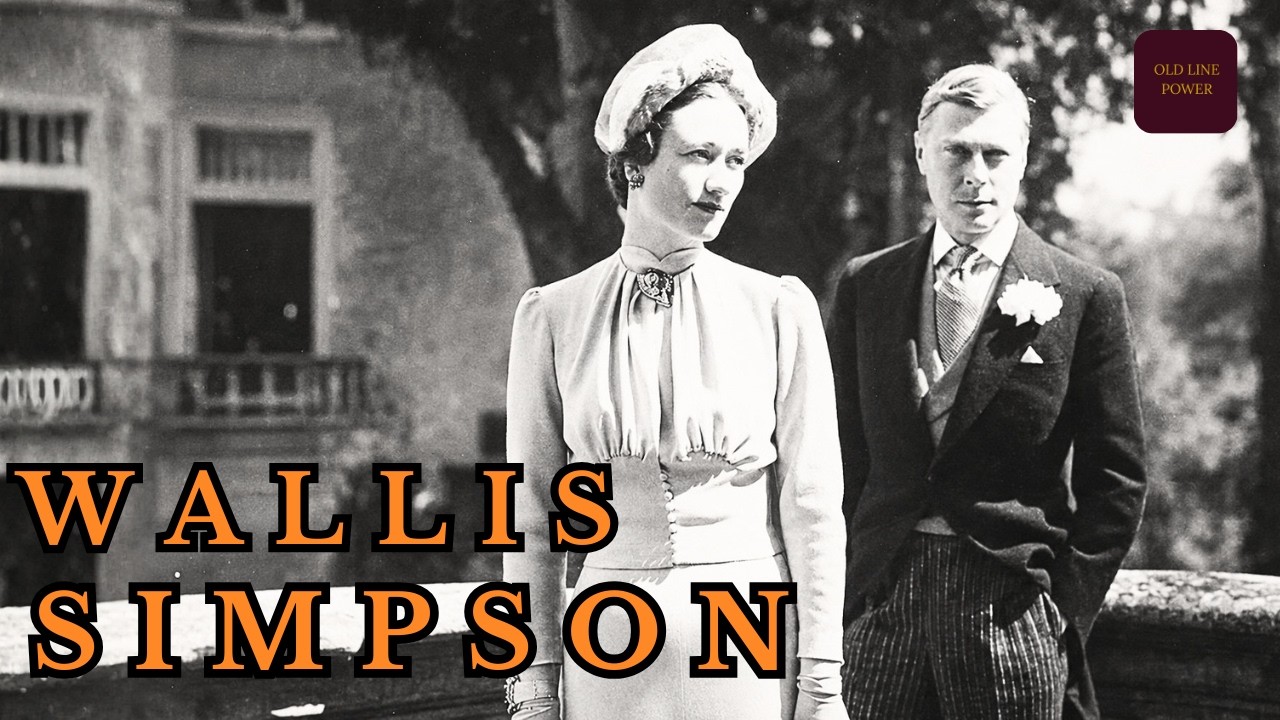
The chateau where Wallis Simpson married the former king belonged to Charles Eugène Bedaux, a French-born American industrialist with business ties on both sides of the Atlantic, including in Nazi Germany. In 1944, Bedaux was arrested on suspicion of trading with the enemy and took an overdose of sleeping pills in his cell in Miami. He never stood trial. Edward had spent nearly six months in Austria waiting for Wallis’s divorce from Ernest Simpson to come through.
It did on May 3, 1937. Exactly one month later, on June 3, they married at the Chateau de Condé in the Loire Valley. No member of the royal family attended. No representative of the British government sent a message.
The Church of England refused to sanction the ceremony. A clergyman from County Durham performed it on his own initiative and was later reprimanded. King George VI had granted his brother the title Duke of Windsor, but under pressure from the government and by most accounts from Queen Elizabeth herself, he refused to extend the courtesy to Wallis. She would be Duchess of Windsor, addressed as “Your Grace,” not “Your Royal Highness.
”
This was a calculated demotion. It meant anyone meeting her was instructed not to curtsy. Edward treated it as a wound that never healed. For the remaining 35 years of his life, reversing that decision became his most persistent campaign.
He never succeeded, not once. Four months after the wedding, the Windsors toured Nazi Germany, a trip arranged by Charles Bedaux. In October 1937, they traveled through Germany for 12 days. Edward visited factories, inspected workers’ housing projects, and told reporters the German economic model was a miracle.
He was photographed in what appeared to be a Nazi salute, though his supporters would argue for decades that it was a wave captured at a misleading angle. The tour ended at the Berghof, Hitler’s mountain retreat, where the Windsors were received for tea. Wallis, according to Andrew Morton’s biography, found Hitler’s eyes magnetic and tried to draw him into conversation. She concluded that he did not care for women.
Hitler reportedly told aides afterward that Wallis would have made a good queen. In the summer of 1940, while the Windsors were in Cascais, outside Lisbon, someone threw a stone through the window of the villa where they were sleeping. It was not random vandalism. It was part of a German intelligence operation designed to terrify the Windsors into believing British agents were trying to kill them.
The plan had a code name: Operation Willi. France had fallen. The Windsors had fled south ahead of the German advance and crossed into Spain on June 20 after days of desperate telegrams. From Madrid, they moved to Portugal, and from that moment became the center of one of the strangest intelligence operations of the war.
All of it is documented in German Foreign Office files captured after the war. Ribbentrop, now Hitler’s foreign minister, believed Edward could still be politically useful. If the Windsors stayed in Europe, they might serve as a channel for peace negotiations with Britain. In a more ambitious version, Edward would be restored to the throne after a successful German invasion.
The man assigned to make this happen was Walter Schellenberg, an SS intelligence officer. The approach had layers. First, intermediaries tried to persuade the Windsors to remain in Europe voluntarily. Miguel Primo de Rivera, an old friend of Edward’s, traveled to Lisbon to suggest the Duke return to Spain.
Don Nicolas Franco, Spain’s ambassador to Portugal, told Edward that after Britain’s inevitable defeat, only he could hold the country together. According to diplomatic dispatches, Edward listened and appeared to take the idea seriously. The second layer was fear. Schellenberg’s agents planted stories that British intelligence was plotting to assassinate the Windsors.
Stones hit the villa. Unfamiliar cars circled outside. Churchill had already decided the Windsors needed to be removed from the continent entirely. Lord Caldecote wrote to him directly with a warning: the Duke was “well known to be pro-Nazi and may become a center of intrigue.
” The solution was the governorship of the Bahamas, a remote colonial posting that would place an ocean between Edward and anyone who might exploit him. Edward did not want to go. He stalled, complained, and made demands. He appears to have genuinely wavered.
Churchill sent Sir Walter Monckton, one of Edward’s oldest friends, to Lisbon with a single objective: get the Windsors on a ship. The Germans made a final attempt. According to Schellenberg’s post-war memoirs, Hitler learned the Windsors were about to leave and ordered an outright abduction. The Spanish ambassador made one last appeal.
The car carrying their luggage was sabotaged to delay departure. None of it worked. On August 1, 1940, the Duke and Duchess of Windsor sailed for the Bahamas. The full record of what had taken place remained in German Foreign Office archives until May 1945, when American soldiers discovered it near the Harz Mountains.
The documents became known as the Marburg Files. They were published in 1957 over fierce British objections. Before the Windsors arrived, King George VI sent a telegram to colonial officials in Nassau with precise instructions. The Duke was to be addressed as “Your Royal Highness.
” The Duchess of Windsor was to be addressed only as “Your Grace. ” Even here, at the far edge of the empire, the palace wanted the distinction enforced. The Windsors arrived on August 17, 1940. Government House had termite damage and Victorian-era furniture.
Wallis called it a shack in a letter to her aunt and described the locals as petty-minded. What she did next was unexpected. She threw herself into charity work, becoming president of the Bahamas Red Cross, taking on infant welfare, health care access, and support for unwed mothers. A report by the Rockefeller Foundation later identified her by name as the only person known to have practiced philanthropy in the interest of health for the poor on the islands.
She befriended Alice Hill Jones, a Black nurse, and bought her a new car when she learned Alice traveled to every appointment by public transport. The Bahamas years could have been remembered for that work. They are remembered instead for a murder. On the night of July 8, 1943, during a violent tropical storm, Sir Harry Oakes was killed in his bed, beaten on the head and set on fire.
Oakes was the wealthiest man in the Bahamas, a Canadian gold mining magnate personally close to the Duke of Windsor. His murder displaced war news in newspapers around the world. The Duke’s response was disastrous. Rather than contact Scotland Yard or rely on local police, he called in two detectives from Miami, whose professional reputations would not survive the case.
The reason he bypassed legitimate law enforcement has never been satisfactorily answered. His critics believe he was protecting someone, possibly himself. His defenders say he panicked. The Miami detectives focused immediately on Oakes’s son-in-law, Alfred de Marigny, who had eloped with Oakes’s 18-year-old daughter against her father’s wishes.
De Marigny was arrested and charged with murder. The jury acquitted him after the fingerprint evidence was shown to be unreliable. Some witnesses suggested it had been fabricated entirely. Despite the verdict, de Marigny was deported from the Bahamas.
No one else was ever charged. The theories have multiplied for more than 80 years without resolution: Meyer Lansky and the American Mafia, who wanted to bring casino gambling to the islands; Axel Wenner-Gren, a Swedish industrialist with documented Nazi ties who had been expelled from the Bahamas; a financial scheme connecting the Duke himself to Mexican bank accounts; Harold Christie, who was in the house that night and whose account of his movements never fully held together. The case has never been solved. For nearly three decades after the war, the Duke and Duchess of Windsor lived in Paris at the center of international society.
Their home near the Bois de Boulogne was provided by the French government at a nominal rent. Edward never held another official position after the Bahamas. He filled his time by buying Wallis jewelry. Pieces from Cartier and Van Cleef & Arpels, each engraved with a date and a private inscription.
A panther bracelet in onyx and diamonds. A flamingo clip encrusted with colored stones. A heart-shaped brooch carrying their initials, W and E, commissioned for their 20th anniversary. The collection grew into something the press called the alternative crown jewels.
What Edward could not give her in title, he attempted to replace with stones. They were not invited to the coronation of Queen Elizabeth II in 1953. They were not welcome at family occasions. The Queen Mother continued to refer to Wallis privately as “that woman” and worked quietly to ensure the exile held.
By the early 1970s, Edward was dying of throat cancer. He was 77 years old and weighed roughly 80 pounds. In May 1972, Queen Elizabeth II traveled to Paris with Prince Philip and Prince Charles to see him. He refused to receive the Queen in bed.
He insisted on being dressed, sitting upright in a chair, with every tube hidden beneath his clothing. He had one request. He asked the Queen to grant Wallis the title of Her Royal Highness. According to Julie Alexander, his former nurse, the Queen refused even that day.
“It was breaking his heart,” she said. That title for his wife was the only thing he still wanted. Edward died on May 28, 1972, ten days after the Queen’s visit. His body was returned to England and lay in state at St.
George’s Chapel, Windsor Castle. Wallis flew to London for the funeral and stayed at Buckingham Palace, by most accounts the only time she was received there as anything close to a guest. Then she returned to Paris. What followed was a slow disappearance.
Wallis suffered a series of strokes, coronary artery disease, and arthritis that curled her hands until basic tasks became impossible. Her mind deteriorated. She stopped accepting visitors. She stopped leaving the upper floor of the villa.
For the final eight years, she was confined to her bed. She was not invited to the wedding of Prince Charles and Lady Diana Spencer in 1981. She died on April 24, 1986, of bronchial pneumonia. She was 89.
Diana Mosley, who had known her for decades, received the news with relief. “It had stopped being a life long before that,” she said. She was glad it was finally over. The bulk of Wallis’s estate went to the Pasteur Institute in Paris, at the time among the leading centers for HIV and AIDS research.
Her body was flown to England and buried beside Edward at the Royal burial ground at Frogmore. She had spent half a century being told she did not belong with that family. They buried her there anyway. In April 1987, less than a year after Wallis died, Sotheby’s held what became the most valuable single-owner jewelry auction ever held at that time.
More than 200 pieces went under the hammer over two days. When it was over, the total had passed $50 million, more than seven times Sotheby’s estimate. Edward had left instructions about the collection. After Wallis died, no other woman was to wear these pieces.
The jewelry was to be taken apart, destroyed. The engravings, the dates, the private messages between a man who had given up a throne and the woman he could not let go of were meant to disappear. That instruction was ignored. Wallis Simpson did not ask Edward to abdicate.
She tried to stop it. She spent the remaining 50 years of her life dealing with the consequences of a decision that was his, not hers, while the world treated it as though she had engineered the whole thing. The jewelry is scattered now, in private collections, museum vaults, and auction houses on three continents. The pieces Edward selected for her, the ones engraved with their story, are worn by people who never knew either of them.
He did not want that. But very little about the way this ended was what anyone had wanted.