The contempt between Frederick Benteen and George Armstrong Custer was forged years before the Little Bighorn, in the frozen aftermath of a dawn raid that the Army called a success and Benteen called a disgrace. It began on November 27, 1868, when Custer led the 7th Cavalry in an attack on a Cheyenne village along the Washita River in Indian Territory. The raid was hailed as a tactical victory, and Custer controlled the official narrative with carefully worded dispatches that reached headquarters ahead of his own arrival. What those dispatches left out was Major Joel Elliott.
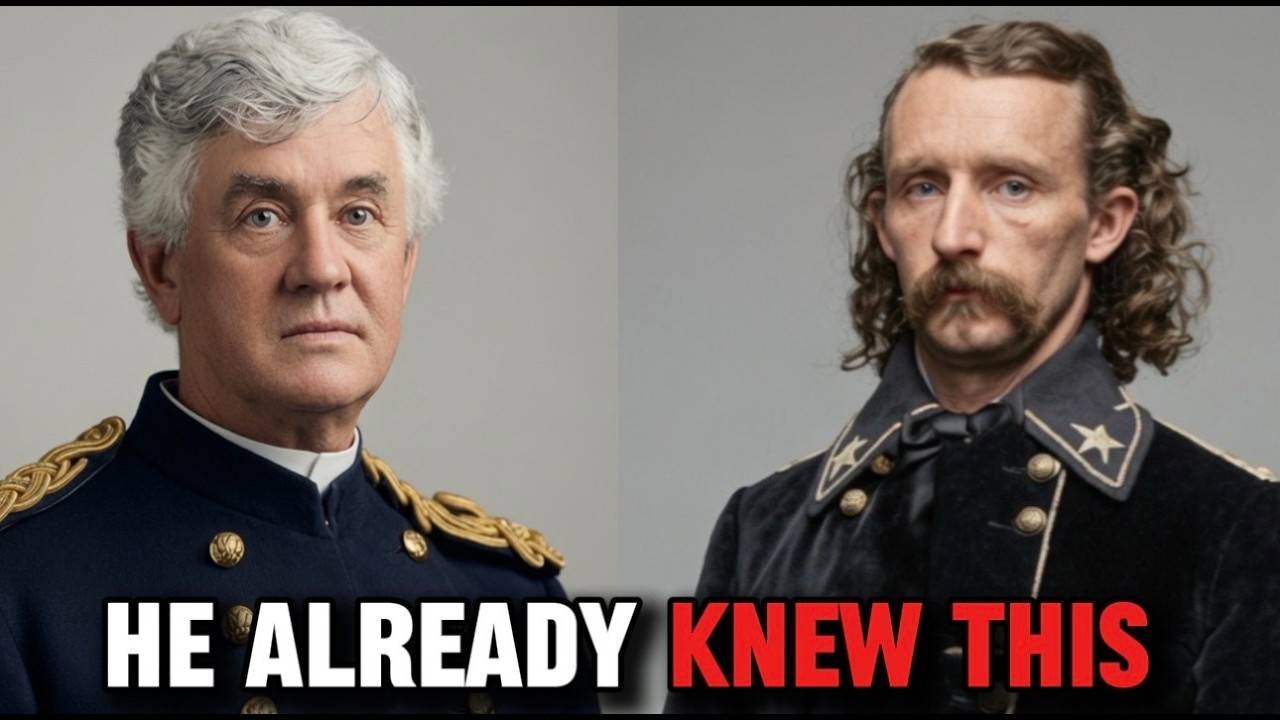
Elliott had ridden off with roughly 17 men in pursuit of fleeing warriors and never came back. Custer did not search for him. He did not send riders to locate the missing detachment. He collected his own dead, destroyed the village, slaughtered the pony herd, and marched the regiment out of the valley with the band playing.
Elliott and his men were found weeks later, their bodies mutilated in the frozen earth less than two miles from where the regiment had stood. Benteen witnessed all of it and never forgave it. He wrote an anonymous letter to a Missouri newspaper describing what had happened, identifying Custer without naming him, and detailing Elliott’s abandonment in careful, measured language. The letter circulated through military circles and made its way back to Custer, who confronted Benteen in front of the assembled regiment with a horsewhip in hand.
Benteen reportedly told him to go ahead and use it, warning that if he did, Benteen would kill him on the spot. Custer never brought the whip down, and the two men settled into a permanent, corrosive feud. To Benteen, Custer operated on a logic that had nothing to do with the safety of the men under his command. His calculus was fame, press coverage, and promotion.
The army, Benteen argued, rewarded the officer who delivered the biggest headline, not the one who brought the most soldiers home, and the institution encouraged Custer’s worst instincts at every turn. Benteen watched the pattern repeat across nearly a decade of frontier campaigning: columns pushed beyond what terrain or horses could sustain, unilateral decisions that ignored protocol and intelligence, performances for newspaper correspondents while enlisted men went short of food and equipment. He said so openly, often outside proper channels, and left a long paper trail of his objections. By the time the 7th Cavalry left Fort Abraham Lincoln in May 1876, Benteen had no illusions about his commanding officer.
The expedition was moving against a coalition of Lakota, Northern Cheyenne, and Arapaho fighters that scouts estimated at several thousand warriors, larger than anything the regiment had previously engaged. General Alfred Terry’s plan called for multiple columns to converge simultaneously on the encampment, preventing the village from scattering before contact. The strategy required patience, communication, and subordination of personal initiative to collective timing, qualities Custer’s career suggested he lacked. On the morning of June 25, 1876, Custer observed the village at the Little Bighorn from the Wolf Mountains.
His own Crow and Arikara scouts told him repeatedly that the encampment was unlike anything they had seen. He also knew the regiment had been spotted and that the element of surprise was already compromised. Terry and Gibbon were a day’s march away. The coordinated plan remained viable if Custer simply held his position for twenty-four hours.
Instead, he divided his regiment into three battalions: one under Major Marcus Reno, one under Benteen, and the third under his own command. Benteen was sent on a scouting sweep to the south and west, a direction for which there was no reported threat and no tactical objective that surviving officers could later clearly explain. Historians have debated the order’s purpose for generations. The most pointed reading is that Custer sent his sharpest internal critic on a purposeless errand while he rode toward what he expected to be the defining moment of his public career.
Reno struck the southern end of the village first and was overwhelmed almost immediately. Warriors poured out of the camp in numbers that swallowed the attack before it gained momentum. Reno fell back to the bluffs above the river in a disorganized withdrawal that cost him nearly a third of his command. When Benteen returned from the south, he found Reno’s survivors on the high ground, shattered and taking fire from multiple directions.
He chose to consolidate the position rather than advance blindly into terrain he had not seen, toward a command about which he had no reliable information. Then a note arrived, carried by trumpeter John Martin and written in the hand of adjutant William Cooke. It read: “Benteen, come on, big village, be quick, bring packs. ”
Critics would later say Benteen did not come on fast enough.
What he came on to, in his telling, was a defensive position with a demoralized, partially broken force, no knowledge of Custer’s location, and no reliable picture of the terrain ahead. He defended his judgment for the rest of his life: riding forward with what remained would not have saved Custer; it would only have added his men’s bodies to the ridge. By the time Benteen and Reno’s combined survivors pushed north toward Custer’s last known position, the battle there had been over for hours. Every man in Custer’s battalion was dead.
In the years that followed, congressional hearings and court-martial proceedings dragged the battle back into public examination. At the Reno Court of Inquiry in 1879, Benteen testified with careful precision. He called Custer’s decision to divide the regiment tactically indefensible given the available intelligence. He described the southern scouting order as tactically purposeless.
He described a command culture in which Custer’s personal ambition had functionally replaced institutional doctrine, and in which officers who objected found their careers managed accordingly. The professional historical consensus of the past fifty years has largely confirmed the substance of Benteen’s argument. Custer made a series of cascading errors on June 25: attacking without adequate reconnaissance, dividing his force against a numerically superior enemy he had been warned not to underestimate, discarding the coordinated operational plan that gave the campaign its best chance, and launching his assault before the other columns were in position. These are not contested points in serious scholarship; they are the working conclusions of military historians.
But in 1876, and for decades afterward, that analysis had no purchase on the public narrative. That narrative belonged to Elizabeth “Libby” Custer, who outlived her husband by fifty-seven years and spent much of that time constructing a monument to his memory. She wrote books, gave lectures, and cultivated relationships with veterans, journalists, and politicians who could sustain the image she was building. In the story Libby and her allies maintained, Benteen was the failure: the man who moved too slowly, whose personal animosity had compromised his judgment at the critical moment, whose bitterness made him an unreliable narrator of everything that followed.
It was a coherent story. Its essential architecture, historians now conclude, was wrong. The actual record shows a man who had been correct about Custer for eight years before anyone was prepared to hear it, who watched those warnings validated on the worst afternoon in the regiment’s history, and who then spent the rest of his career held responsible for a catastrophe the commanding officer’s own decisions had made inevitable. Benteen never made general.
He ended his active service under a court-martial in 1887, in a separate incident involving alcohol, a convenient final note for those who preferred to read him as the villain. He died in Atlanta in 1898, largely forgotten outside a small community of veterans and historians. The hundreds of letters he left behind were written with the directness of a man who had stopped managing his reputation around 1868 and never started again. Historians who have worked through that correspondence tend to come away with a complicated admiration for him, not because he was uncomplicated or always right, but because he spoke true things in a professional culture that punished honesty, and because the core of what he argued held up.
The soldiers who rode north with Custer on that last June afternoon received no quick monuments. They got a mass grave on a hillside in Montana, marked by simple white stones stretched across the ridge in rows that still stop visitors cold when they see them for the first time. Benteen had their names right. He had what happened to them right.
He had why it happened right. That it took the better part of a century for the historical record to catch up with what one ornery, insubordinate, widely despised cavalry officer had been saying all along is not a footnote to the story of the Little Bighorn. It is, in many ways, the story.