In the spring of 2021, a bearded man sat before a laptop inside his Kensington Palace apartment. On the screen were two strangers who claimed to run a gold company that did not exist. The man was a first cousin of Queen Elizabeth II, and he was willing to deliver their message to associates of Vladimir Putin for £10,000 a day. His name was Prince Michael of Kent, a royal born into the family but never provided for by it.
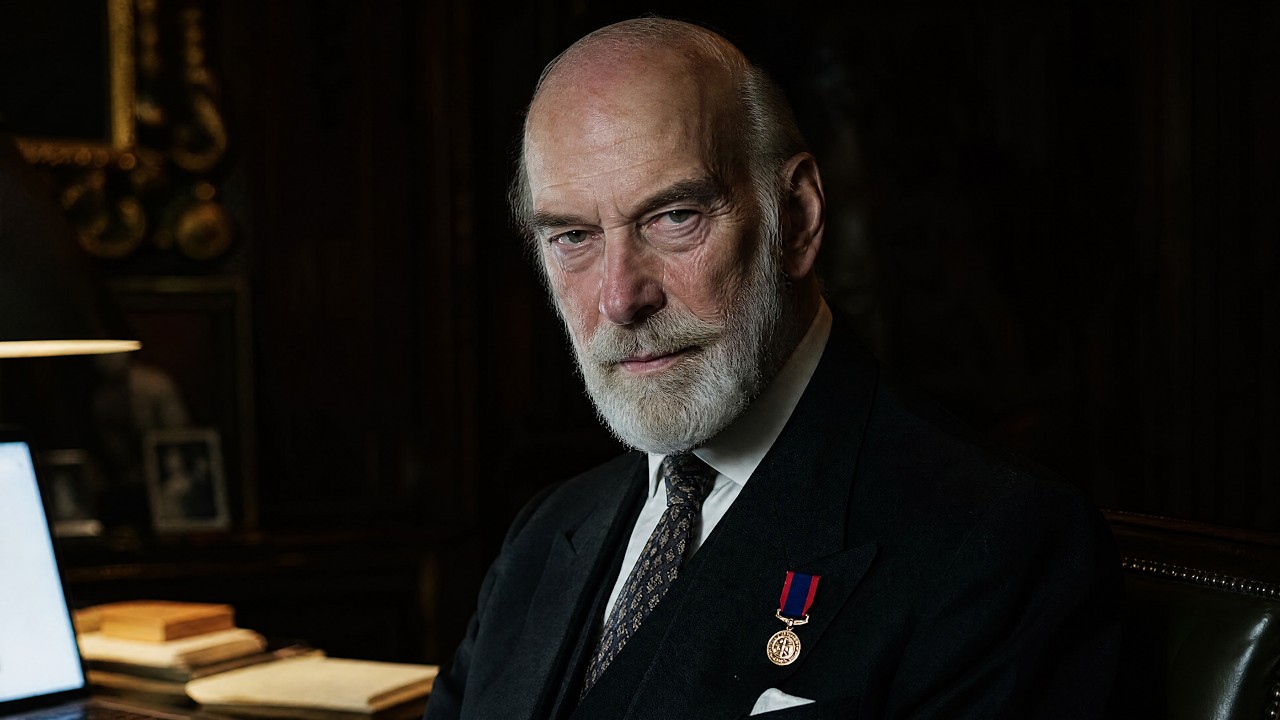
The story of how he reached that laptop begins some 80 years earlier, with a father he never knew. Prince Michael was born on July 4, 1942, at Coppings, a country house in Buckinghamshire, while wartime blackout tape covered the windows. He was the third child of Prince George, Duke of Kent, and Princess Marina of Greece and Denmark. At birth, he stood seventh in line to the British throne.
His father, the fourth son of King George V, was considered the most glamorous member of the royal family. The Duke of Kent married Marina, a princess from an exiled dynasty, and the pair became the palace’s most stylish couple. When war broke out, the duke served in the Royal Air Force. On August 25, 1942, the aircraft carrying him crashed into a hillside near Dunbeath, Scotland, killing nearly everyone aboard.
The duke was 39. His youngest son was under two months old. Prince Michael grew up without a father, surrounded by photographs of a smiling man in uniform and his mother’s grief-stricken stories. He inherited a title and proximity to the throne, but little else.
The royal family always includes outsiders from the start: nephews who inherit the blood but not the crown. Michael was born close enough to feel the pull of the monarchy but never close enough to enjoy its security. His older brother, Edward, became Duke of Kent and carried out senior duties. His sister, Alexandra, grew into one of the family’s hardest-working members.
Michael, the youngest, was the spare to the spare, with no fixed path. His widowed mother, Princess Marina, held the family together. But her pride could not change the fundamental financial reality. The Kent branch of the family was grand in name but modest in income.
Michael learned this lesson throughout his life. The mathematics of his position were unforgiving. Seventh in line at birth, he slipped steadily down the succession as cousins and their children were born. By his later years, he had fallen into the fifties, with no realistic prospect of the throne.
He was a prince in identity but nearly empty in fortune. As a young man, he followed tradition. In 1963, he was commissioned into the 11th Cavalry Regiment and served as a professional soldier for nearly 20 years. He was posted to Germany, Hong Kong, and Cyprus on a UN peacekeeping mission, held posts on the Defence Intelligence Staff, and retired as a major in 1981.
Then came the marriage that would define his later life. In 1978, he wed Baroness Marie-Christine von Reibnitz, a tall German aristocrat. She was a divorced Roman Catholic, both facts in conflict with royal rules. Under the Act of Settlement of 1701, marrying a Catholic caused Michael to lose his place in the line of succession.
He gave up that right for her. The press, unkindly, nicknamed her “Princess Pushy. ”
Crucially, Prince Michael never received a penny of public money for his royal role. Unlike his brother and sister, he received no parliamentary annuity.
The state paid him nothing for being a prince. He was expected to maintain royal standards, attend functions, and support charities, but all costs fell on him. So he became a businessman, opening his own consultancy firm. The palace’s official position was proud: he and his wife carried out their duties at their own expense, without government funding.
For years, this was presented as a virtue. Here was a prince who cost taxpayers nothing. But the arrangement had a hidden danger. A man with a royal title and no royal income has only one thing to sell: the title itself, and the access and prestige that come with it.
Prince Michael spent his entire adult life in that gap, unable to take an ordinary job, unable to disappear into private life, and unable to draw on state funds. The only open door was the one marked with his own name. In 2002, the House of Commons Public Accounts Committee examined royal palace costs. It emerged that the couple paid only £69 per week in rent for their Kensington Palace apartment, one of the most desirable properties in the country.
Buckingham Palace stepped in to resolve the matter and revealed something that complicated the self-funded prince narrative: the Queen herself was paying £120,000 a year from her personal funds so the couple could remain in the apartment. This was presented as recognition for their unpaid charity work. The figure contradicted the carefully maintained story that the prince was fully self-supporting. He was not a burden on the state; he was a burden on the monarchy itself.
The money for his lifestyle had to come from somewhere, and those who provided it were not always palace-approved figures. One name is essential to understanding what followed: Boris Berezovsky, one of the largest oligarchs of post-Soviet Russia, who later fled to Britain as a Kremlin opponent. It emerged that Berezovsky had provided substantial financial support to the prince through offshore companies. According to the oligarch himself, it was simply a matter between friends, with nothing hidden or improper.
There is no evidence this money purchased any inappropriate advantage, but the pattern was notable: the prince’s income increasingly came from wealthy, controversial Russians. Another name raised further concern. The prince had worked closely with a businessman named Wyn Parker, who had a record of financial misconduct, had been banned from serving as a company director, and had been described by a judge as operating in the manner of a fraudster. Parker arranged and accompanied Michael on foreign royal visits.
When questioned, the prince denied the association, saying he never received fees or payments from Parker and was unaware of the man’s reputation. These denials should be clearly recorded; the prince was never charged with or convicted of any offense. But the pattern raised questions about judgment. By the early 2000s, Prince Michael’s Russian role had become a quasi-profession.
He served as patron of the Russo-British Chamber of Commerce, which promoted trade between the two countries. He established a foundation in 2004 to support heritage and cultural restoration projects, mostly in Russia. He led charity fundraising rallies across Russia in 1999, 2003, and 2005. He collected Russian honors the way others collect stamps: honorary doctorates from Moscow academies, an honorary professorship, and in November 2009, the Order of Friendship from the Russian Federation, a formal state award presented by the government of Vladimir Putin.
The Queen’s own cousin now wore a medal given by the Kremlin. Collectively, these achievements created a brand built on one promise: access. He was a British royal fluent in Russian, a living echo of the murdered Tsar, with Romanov blood in his veins, a patron of the trade chamber, a recipient of Kremlin honors, and a figure who could reportedly move through Moscow’s circles of power. For anyone seeking entry to the Russian market, he appeared to be the key.
In the spring of 2021, the investors who approached him were not investors at all. The company they named was invented to trap him. The investigation was a joint effort of The Sunday Times and Dispatches, the Channel 4 documentary program. They created “House of Heding,” a fictional South Korean gold investment firm supposedly seeking to expand into Russia.
Its executives were undercover journalists in disguise. They offered the prince exactly what his brand had promised: a chance to help a wealthy outsider penetrate the Russian market. They told him directly that they wanted access to the Russian president’s inner circle and offered money for that access. The meeting was held by video call, attended by the fictional executives, Prince Michael, and a longtime friend and business associate, Lord Reading, the Fourth Marquess of Reading.
According to the resulting reports, the recording captured a series of damaging offers. The prince indicated that for £10,000 a day, he could discreetly lobby the close circle around President Putin on their behalf. He also proposed making a video endorsement for the company, to be filmed at Kensington Palace, for $200,000. The fake executives had offered £143,000 for specific work plus £36,000 monthly retainers.
Collecting the numbers produced a portrait of a royal life run as a business, and the business was the royal name itself. The timing added to the offense: the recorded meeting took place the day after the EU imposed fresh sanctions on the Kremlin. The West was tightening pressure on Putin, and the next day the Queen’s cousin was discussing how to deliver a private company’s message into the heart of the regime being sanctioned. The most damaging words did not come from the prince, however, but from the man beside him.
During the same recorded call, Lord Reading described Prince Michael as an unofficial ambassador for Her Majesty the Queen to Russia, hinting that the prince had direct contact with Putin. In a few sentences, he suggested the prince carried the Queen’s own name into business negotiations. Lord Reading later acknowledged that he had overpromised. When the investigation was published in May 2021, the prince’s representatives responded quickly.
A spokesman categorically denied that Michael had any special relationship with President Putin, stating the two had last met in 2003, 18 years earlier. The prince had no current access to the Russian president and no ability to deliver the promises his friend had made. In this telling, the prince was guilty of poor judgment and bad company, while the most explosive claim belonged to Lord Reading. Condemnation was swift and strong.
Marina Litvinenko, widow of Alexander Litvinenko, the dissident poisoned in London in 2006, said the incident proved the prince cared nothing about human rights, democracy, or those dying in Russia. Conservative MP Bob Seely demanded to know what the prince was doing that made the country’s values and standards look optional. No charges were brought. The prince received no official punishment.
He received no government salary that could be stopped, no official role that could be removed, and no state funding that could be withdrawn. The independence that had been praised for years now functioned as armor. You cannot dismiss someone from a job for which they are not paid. The damage was purely reputational.
Then history delivered the final blow. On February 24, 2022, Russia launched its full-scale invasion of Ukraine, ordered by the very Vladimir Putin whose inner circle the prince had offered to lobby. The invasion made Prince Michael’s lifelong friendship with Russia not merely embarrassing but untenable. On March 4, 2022, slightly more than a week after the tanks crossed the border, Prince Michael returned the Order of Friendship awarded by Russia in 2009.
He stepped down as patron of the Russo-British Chamber of Commerce and reportedly cut all his ties with Russia. The entire construction of his identity, the language learned in youth, the Romanov blood, the medals, the doctorates, the twice-yearly trips to Moscow, was dismantled within days. In June 2022, approaching his 80th birthday, Prince Michael announced his retirement from public life. In 2024, his son-in-law Thomas Kingston, husband of Lady Gabriella, died by suicide in Gloucestershire.
The prince himself had earlier been treated for prostate cancer. The deeper tragedy is structural. The monarchy created a man whose only asset was the family name, refused to support him, and left him for decades to monetize his proximity to the throne. When that monetization became a public scandal, the institution had no mechanism to punish him because it had never formally claimed him as its own.
The same system that pushed him toward wealthy strangers for financial survival also protected him from consequences in a crisis. The final judgment is necessarily mixed. The recording showed a man setting prices on his own access and the prestige of the palace. The denials showed a man insisting the access was not as real as it sounded.
Both can be true at once. The pattern of his life is beyond dispute: he was almost royal in status but never royal in support, present in every family photograph but in no royal budget, standing at the funeral of an emperor and sitting at a laptop designed to trap him. What this story ultimately reveals is that the monarchy’s mystique has a financial value. Proximity to the throne can be quietly converted into cash.
The line between a royal who lends his presence to good causes and one who rents it to bad people is thinner and more fragile than the palace would like to admit. Prince Michael of Kent did not break that line; he exposed it.