Chuck Hughes collapsed on his face on the wet grass of Tiger Stadium with no one touching him. There was no hit, no collision, no tackle. He simply clutched his chest and went down. The game between the Detroit Lions and the Chicago Bears stopped, but only for a moment.
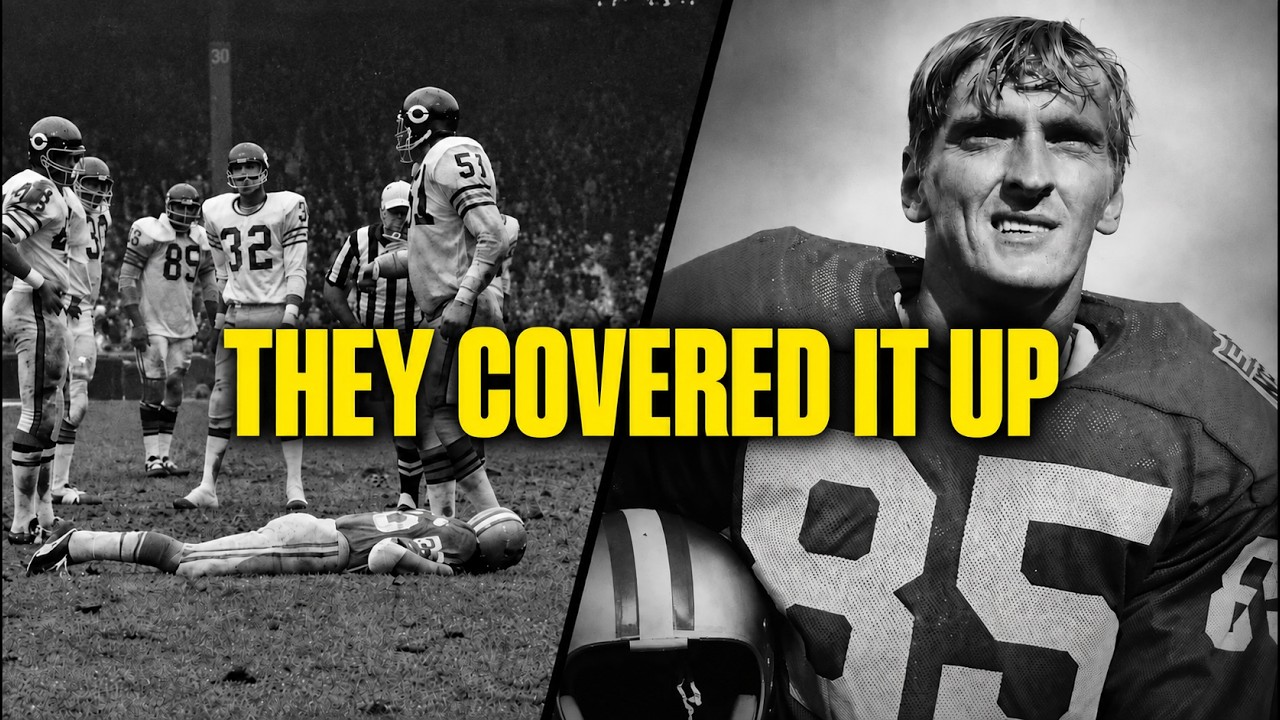
The clock was restarted, and the final 62 seconds were played while Hughes lay unconscious in an ambulance nearby. Hughes was a 28-year-old wide receiver for the Lions. He had entered the game in the fourth quarter as a replacement for the injured Larry Walton. With just over a minute left, quarterback Greg Landry threw an incomplete pass toward Charlie Sanders.
Hughes, acting as a decoy, was jogging back toward the huddle near the Bears’ 15-yard line when he fell. He would become the only player in NFL history to die during a game. What most people never knew was that Hughes had already survived one heart attack. Seven weeks earlier, in an empty locker room after a preseason game against the Buffalo Bills, he had collapsed.
He spent four days in the hospital. Doctors suspected a spleen injury, possibly a lung or kidney issue, but the tests available in 1971 could not confirm a diagnosis. He was sent home without a real answer. For the next two months, Hughes privately complained of sharp pains in his stomach and chest.
He told the Detroit News the pain was not that bad. He continued to dress for games. The collapse in the locker room was not a spleen injury. It was the first of two heart attacks, and the men paid to protect him sent him home with the wrong answer.
Hughes was not handed anything easily. In 1962, at age 18, he arrived at a Texas college campus with a scholarship offer from coach Bam Phillips. Before Hughes played a single full season, Phillips left for another job, and the new staff tore up the offer. Hughes joined the team anyway, paying his own way to be on a roster that owed him nothing.
Over the next three years, he became a record-holder at the school. He was drafted by Philadelphia in the fourth round in 1967, spent three seasons mostly on special teams, then was traded to Detroit in 1970. He was a backup receiver, a role he had always known. Hughes and his wife, Sharon, had attended a party together the night before the game.
They argued there, not about football or money, but about whether their two-year-old son, Shane, should be allowed to chew a piece of gum. The argument escalated more than either expected. Sharon went home. Chuck went to the team hotel.
Neither apologized. They assumed they would fix things over the phone the next day. That argument turned out to be the last conversation Chuck Hughes ever had with his wife. The Lions trailed Chicago 28-23 in the fourth quarter when Hughes entered the game.
On his second play, he caught a 32-yard pass from Landry, his first catch of the entire season. The ball moved deep into Chicago territory. For a brief moment, a marginalized player did something of real significance. Then came the failed pass to Sanders, and Hughes collapsed with 62 seconds left on the clock.
Bears defensive end Ed O’Bradovich stood about 12 yards away. His first instinct was that Hughes was faking an injury to stop the clock. He started yelling at him to get up. Then he saw Dick Butkus crouching over Hughes, both arms in the air, waving wildly toward the Detroit sideline, screaming for help.
O’Bradovich’s heart turned cold. Whatever this was, it was not what he thought. Trainers and doctors from both benches rushed onto the field. A physician sitting in the stands climbed over the wall to help.
Hughes convulsed on the wet grass and then went still. The crowd of 54,418 fell into near-total silence, the kind 54,000 people rarely make together. Doctors worked on him at the 15-yard line for long minutes in the open. As he was finally lifted onto a stretcher, his arm slipped off the side and dragged along the ground all the way to the ambulance.
People in the upper stands gasped audibly. No one in that crowd had ever seen anything like it, because nothing like it had ever happened on an NFL field before. Officials then did something unthinkable by today’s standards. They restarted the clock.
Both teams played the final 62 seconds while Hughes lay unconscious in an ambulance a few hundred yards away. Chicago won 28-23. Hardly anyone inside Tiger Stadium that evening knew if he was still alive. In the Lions’ locker room afterward, team physician Richard Thompson told reporters, in a voice one writer described as shaken, that Hughes’s heart had stopped on the field, that they thought they had restarted it, and then it stopped a second time.
Charles Frederick Hughes was pronounced dead at 4:41 that evening at Detroit Receiving Hospital, with his wife nearby. He was 28 years old. The autopsy revealed exactly what the doctors had missed in August. One of his coronary arteries was 75% blocked by advanced, undiagnosed heart disease.
His family had a history of the disease, but no one had connected it to two months of stomach pain. A blood clot had broken loose and stopped his heart completely. Doctors later determined it was likely his second heart attack, not his first. The one in the locker room in August had already been trying to warn everyone who examined him.
In 1972, Sharon Hughes filed a $21. 5 million medical malpractice lawsuit against the hospital that had examined her husband in August and sent him home without answers. It took two years to resolve. In October 1974, nearly three years after her husband collapsed on that field, the case was quietly settled for an undisclosed amount, an implicit admission without trial or verdict that a correct diagnosis in August would have changed everything that followed.
All 40 of Hughes’s Lions teammates traveled to San Antonio for his funeral, along with head coach Joe Schmidt. Most knew him as a quiet man who wore a cowboy hat, preferred singing along with Waylon Jennings records or finding a golf course over talking about himself. Team owner William Clay Ford, holding back tears, told reporters he never imagined something like this could happen to one of his players. The following Thursday, before their next game, the Lions made two announcements.
Chuck Hughes’s number 85 was retired. And team doctors began preparing a portable cardiac unit, equipped with treatment devices and emergency supplies, to travel with the team to every away game for the rest of the season. It was one of the first times emergency cardiac equipment became a permanent part of professional football, not just an afterthought. Decades later, when Sharon Hughes learned the Lions had quietly re-issued number 85 to other players, she said plainly that the family never felt it should have been worn again.
She later worked to raise awareness about heart conditions. Fifty-one years after that October afternoon, Buffalo Bills player Damar Hamlin collapsed on a Monday night after a routine tackle. His heart stopped completely. This time, both teams stopped playing immediately.
The game was suspended within minutes and never resumed that night. From her home in Texas, Sharon Hughes stayed up as long as she could, needing to hear that history was not repeating itself. She spoke quietly about Hamlin’s mother, who had ridden in the ambulance with her son, the same ambulance ride Sharon Hughes herself had taken five decades earlier and never stopped thinking about. Dick Butkus carried the memory of that October afternoon with him for the rest of his life.
Decades later, when asked to describe it again, he did not use football terms at all. “I couldn’t believe it, the color his face turned,” he said. “He just dropped. ” He remembered exactly which doctor he had called onto the field, because at that moment, the game stopped meaning anything to him at all.
What Butkus realized as he knelt on the grass in 1971 was not just that an opponent was injured. It was that a man was dying in front of him. Hughes never asked to be remembered as a tragedy. He asked for a place on a team that no one wanted to give to an undersized receiver from a school that did not want him either.
In the end, he got that place. The game he loved did not stop for him in 1971. But somewhere between the empty locker room in August and that quiet stretch of grass in October, the game slowly began to change into something that might stop for the next man.
Fifty years later, it finally did.