The bride was 18 years old, dressed in a gown that looked like a Gilded Age fantasy, and she was weeping openly as she walked down the aisle of St. Thomas’s Church on Fifth Avenue. Over 2,000 guests watched as Consuelo Vanderbilt married Charles Spencer-Churchill, the ninth Duke of Marlborough, on November 6, 1895. The spectacle looked like a fairy tale, but the tears were not from joy.
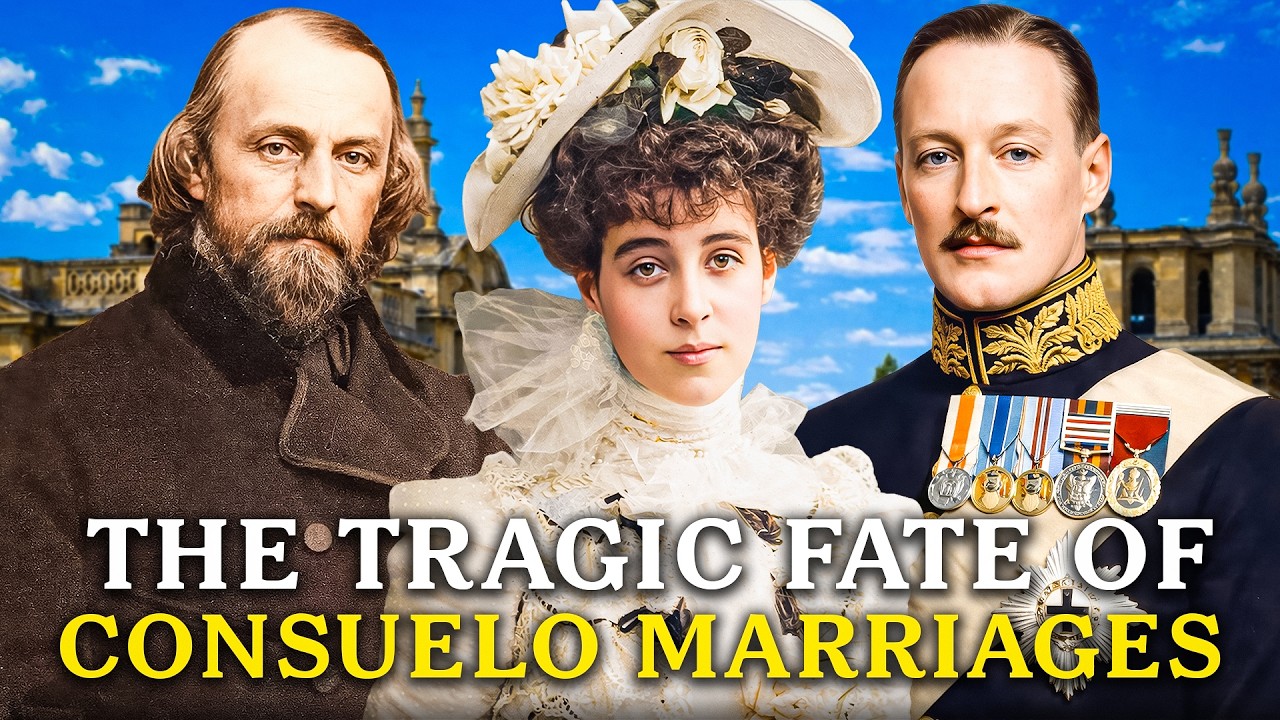
Consuelo was born on March 2, 1877, the only daughter of William Kissam Vanderbilt and his wife, Alva. The Vanderbilt fortune, built by her great-grandfather Cornelius through shipping and railroads, was among the largest private accumulations of wealth in American history. Her mother, Alva, had married into the family with fierce ambition and had become one of the most powerful social figures in New York, having forced open the doors of old society with lavish events and grand mansions. Consuelo was raised with every privilege money could buy, but almost none of the freedoms ordinary children took for granted.
She was educated in multiple languages and trained in deportment, but she was not allowed to choose her friends, her reading material, or her opinions. Alva’s control was psychological and absolute, combining genuine love with coercion that her daughter could not separate from affection. As Consuelo approached adulthood, she was recognized as one of the great heiresses of her generation, with a fortune estimated at roughly $20 million, a sum equivalent to billions today. That wealth was not hers in any practical sense.
It defined her, and her mother had already decided what she was for: a title. In the early 1890s, Consuelo fell in love with Winthrop Rutherford, a wealthy, well-born New Yorker who returned her feelings. Alva immediately ended the relationship. She intercepted their correspondence, banned him from the house, and took Consuelo to Europe.
When Rutherford followed, Consuelo was forbidden to see him. Alva then claimed the Rutherford family had a history of mental illness, a claim that was false, and warned that Rutherford could not have children. When that was not enough, she told her daughter she was suffering from heart trouble caused by the stress of disobedience, suggesting the consequences for her own health were uncertain. The man Alva had chosen was the ninth Duke of Marlborough.
Known as “Sunny” to his circle, he was cool, proud, and disdainful, and he was in serious financial trouble. Blenheim Palace, the great ancestral home of his line, was falling into disrepair, and he needed a very large sum of money quickly. The solution was to marry an American heiress. Alva invited him to Marble House, her Newport estate, in the summer of 1895, and arranged for Consuelo to be constantly in his company.
The Duke proposed in the Gothic Room at Marble House. He was businesslike, not romantic. Consuelo accepted because she had been told she had no other choice. The marriage settlement delivered approximately $2.
5 million in railroad stock, equivalent to around $75 million today, plus a joint annual income of $100,000. In exchange, Consuelo received the title of Duchess of Marlborough and a life in a country she had not chosen. On the morning of the wedding, Consuelo was locked in her room. She had spent the night in profound distress, but Alva had her dressed and placed in the carriage anyway.
Hundreds of police officers managed the crowds outside the church, where thousands of onlookers had gathered to watch the fairy tale. Inside, the guests who could see clearly saw the bride crying as she walked down the aisle, the kind of weeping that accompanies something irreversible. During their honeymoon, the Duke told his new wife the truth. He had been in love with another woman, an Englishwoman, and had given her up to marry Consuelo and save Blenheim.
He said the marriage was not about her, it was about the palace, and that he had no regard for anything that was not British. He made the statement coldly, as a matter of fact, and returned to his congratulatory correspondence, including a letter from Queen Victoria. Life at Blenheim was magnificent from the outside. Consuelo was presented at court, attended Queen Victoria’s funeral, and carried one of the canopies at the coronation of King Edward VII.
She dazzled society and was admired by the royal family. She also bore two sons, John in 1897 and Ivor in 1898, fulfilling her primary function. The Duke had his heir, but the marriage gave her nothing resembling a partnership. The Duke and Consuelo had nothing in common beyond their sons.
They disagreed about everything, and within a few years they were living separately within the palace, maintaining the public appearance of marriage while privately understanding it was a performance. The woman the Duke had given up, Gladys Deacon, remained a presence in his life, and Consuelo knew it. She responded by throwing herself into the life of the estate, visiting workers’ cottages, running charitable initiatives, and becoming genuinely loved by the local community. She joined the Women’s Liberal Federation, advocated for working women, and focused on education and social welfare.
She managed Sunderland House in Mayfair during the London season with flawless skill, then returned to a husband who regarded her as a piece of aristocratic furniture. The money that made the life possible also made it impossible to leave. The annual income was jointly controlled by the Duke, and the railroad stock had gone directly to stabilizing Blenheim. Under the property laws of the era, Consuelo had limited individual claim to the fortune she had brought into the marriage.
The formal separation came in 1906, eleven years into the marriage, without drama. They remained technically married for another fifteen years. During that time, Consuelo found the companionship her marriage had never contained. Jacques Balsan, a French aviator and textile heir, had been in love with her since her debutante years, and their relationship deepened discreetly after the separation.
The Duke, meanwhile, continued his attachment to Gladys Deacon. The divorce was finalized on July 4, 1921, and Consuelo married Jacques Balsan the same day. She was 44 years old. The annulment came five years later, initiated by the Duke, who had converted to Roman Catholicism and needed the Church’s recognition that his first marriage had not been valid.
The grounds required the absence of free consent, so Alva Vanderbilt, by then a prominent suffragist, appeared before the church tribunal and testified that she had forced her daughter into the marriage. She stated she had always had absolute power over Consuelo, that she had issued an order, and that nobody discussed it. The annulment was granted on August 19, 1926. The Duke married Gladys Deacon later that year.
That marriage deteriorated into the same cold, separate existence as his first, and he eventually evicted her from Blenheim. She lived the rest of her life in increasingly reduced circumstances. Winthrop Rutherford, the man Consuelo had loved and lost, married twice, lived a long life, and died in 1944. Whether they ever had contact again is not resolved in the record.
What came after 1921 was the life Consuelo had never been permitted to have. Her marriage to Jacques Balsan was the inverse of everything before it. He was warm where the Duke had been cold, curious where the Duke had been disdainful. They divided their time between Paris, the French Riviera, and a chateau in Normandy that Consuelo renovated with care.
Winston Churchill, a cousin of the Duke and a friend of Consuelo throughout her married years, was a frequent visitor, coming to paint and to talk. Alva bought a neighboring chateau in France to be near her daughter in their old age, a late reconciliation after decades of navigating the damage done by her ambitions. Consuelo continued her charitable work, building a hospital in France for working-class patients with her friend the Princess de Polignac, running a play school, and establishing a sanitarium. When the German invasion of France began in 1940, the Balsans were evacuated through Spain and Portugal to the United States.
Jacques Balsan died in 1956 at age 87, after 35 years of marriage. Consuelo published her memoir, “The Glitter and the Gold,” in 1953, a restrained account of a life that had been extraordinary in its misery and, later, in other ways. She wrote about her mother with complexity, about Blenheim with distance, and about Jacques with quiet happiness. Consuelo Vanderbilt Balsan died on December 6, 1964, in Southampton, New York, at age 87.
In accordance with her wishes, she was buried in the churchyard of St. Martin’s in Bladon, Oxfordshire, within sight of Blenheim Palace, near her son, her grandson, and where Winston Churchill would be buried the following year. She chose to rest near the place that had represented so much unhappiness, and near the people who had made it bearable. She outlived nearly everyone who had stood in that church in 1895, outliving the Duke, his second wife, and the Gilded Age machinery that had produced her circumstances.
She built something real inside a marriage that offered her almost nothing, worked consistently for people less fortunate than herself, found love late, and told the truth about what happened to her without self-pity. The newspapers had called it the wedding of the century, but the bride who wept at the altar used the time she was given to become the last one standing.