On the afternoon of December 5, 1919, two United States senators walked into a White House bedroom to determine whether the president was still fit to govern. The woman beside his bed had already decided what they would be allowed to see. Albert Fall and Gilbert Hitchcock found Woodrow Wilson propped against pillows, his left side hidden beneath a blanket tucked up to his chin. A Senate report lay within reach of his working right hand.
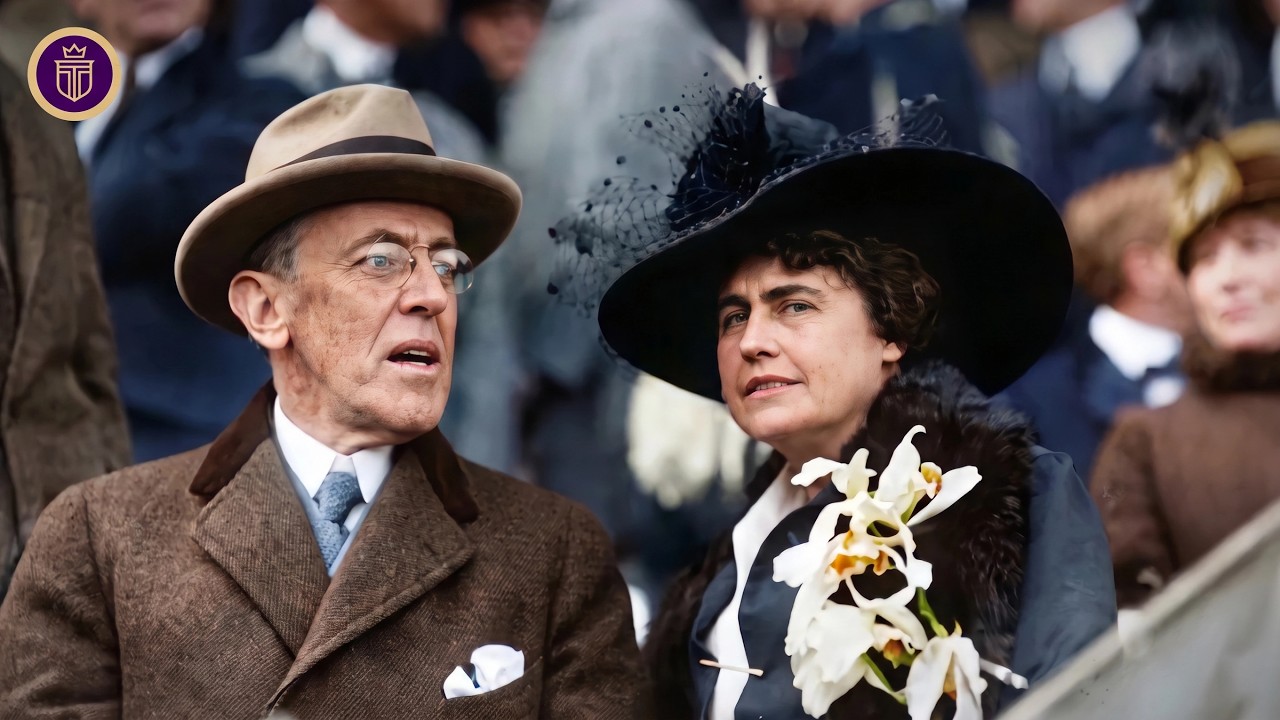
The chairs had been positioned so the visitors could see only his unaffected side, while the right side of the bed remained in shadow. Edith Wilson took notes throughout the meeting, and both senators later told reporters that the president’s mind remained sharp. What none of them mentioned was that Wilson had been paralyzed for two months, had not met with his cabinet since September, and was effectively governing through the judgment of his wife and his physician. That staged meeting survives in detail, and it represents the closest the historical record comes to catching Edith Wilson rehearsing a deception that her inner circle maintained for a year and a half.
Wilson did not die from that stroke. He lived until February 1924, though severely weakened. Whether his wife actually ran the government or simply shielded an injured husband remains one of the most debated questions in presidential history. Her own memoirs claim she never made a single state decision.
The documentary record tells a more complicated story. Born Edith Bolling on October 15, 1872, in Wytheville, Virginia, she was the seventh of eleven children of Sally White and Judge William Holcombe Bolling. Eleven children under one roof left little room for individual attention, and Edith learned early that attention was something to be earned rather than given. Formal education was not for her.
At fifteen, she enrolled at Martha Washington College in Abingdon to study music, disliked the experience, and returned home within a year. At seventeen, she tried again at the Richmond Female Seminary, known locally as Powell’s School, with similarly limited enthusiasm. Her total time in a classroom was less than two years. From childhood, she traced her ancestry to Pocahontas and Thomas Jefferson, a claim based on family memory rather than documented fact, though she never abandoned it.
She became an active member of the Confederate Memorial Literary Society, an organization that campaigned for Confederate monuments in the South and promoted the Lost Cause narrative as established history. She also opposed the expansion of women’s suffrage, a position she maintained even as the suffrage movement gained ground around her. The Woodrow Wilson House Museum states plainly that her views were shaped by her Southern upbringing and that she was an active participant in an organization that promoted what historians now call the false Lost Cause narrative. Long before Washington, her path first crossed a jewelry counter and a marriage that ended sooner than anyone expected.
Edith met Norman Galt, an established Washington jeweler, while visiting a married sister in the capital. They married on April 30, 1896, in St. John’s Episcopal Church in Wytheville. The marriage placed her in Washington society for the next twelve years.
In 1903, she gave birth to a son who died shortly after birth. She had no other children. In 1904, she became the first woman in Washington, D. C.
, to hold a driver’s license, evidence of a woman comfortable operating machinery and claiming firsts in a city that rarely expected them of her. Norman Galt died in 1908, leaving Edith a widow at thirty-five with a jewelry business, Galt and Brother, that she suddenly had to manage. She did not sell the firm. She hired a competent manager, kept ownership herself, and ran the business profitably for more than two decades.
Washington’s social elite accepted her as an independently established businesswoman rather than a widow living off an inheritance. That status mattered enormously when a much larger opportunity came her way. President Wilson had lost his first wife, Ellen Axson Wilson, to kidney disease on August 6, 1914, leaving him a grieving widower in his demanding first term. His niece, Helen Woodrow Bones, had taken on the role of acting White House hostess.
It was through Bones that Edith Galt was introduced to the president in March 1915. What followed moved at a pace that surprised his own staff. Wilson proposed on May 4, 1915, barely two months after they met. Her answer, preserved in her own memoirs, captured both attraction and hesitation in a single breath: “You can’t love me, for you really don’t know me.
And it isn’t a year since your wife died. ”
A letter the next day showed she had not closed the door, and within a month she had confessed her own feelings. By June 28, she had agreed to marry him. During the courtship, Wilson sent her daily policy updates and awaited her replies with an eagerness that made his own advisers uneasy.
She spent time with him aboard the presidential yacht Mayflower as the relationship deepened. His political team feared that remarrying so soon after Ellen’s death would damage his reelection chances and reportedly plotted to prevent the marriage entirely, a scheme that the Miller Center at the University of Virginia has documented as a serious attempt rather than mere staff gossip. The plan failed. It left Edith with a lasting distrust of men like Colonel Edward House, a resentment that hardened into persistent political animosity.
None of the advisers pushing their plot knew about a second complication unfolding at the same time. Wilson had been writing to a woman named Mary Hulbert Peck since February 1907, after meeting her on a Bermuda vacation he had taken without his first wife. Over the following eight years, he sent her more than 200 intimate letters. Seven of those years he was a married man.
On September 22, 1915, with his engagement to Edith newly begun, Wilson sat down with Colonel House to discuss the friendship directly, admitting he had been reckless in writing letters warmer than was wise. Two days earlier, he had drafted a public confession to release should the letters ever surface: “These letters reveal a period of folly and gross indiscretion in my life. I am deeply ashamed and repentant. ” He never sent it.
About a week before that meeting, Wilson had sent Peck $7,500, worth well over $100,000 today, after she said she needed money for a business venture in California. Encyclopedia Virginia records the episode with institutional caution, noting only that Wilson reportedly had some sort of affair during his first marriage and remained in contact with Peck even while actively courting Edith. Whether the relationship was a physical affair remains debated among historians, but the pattern of secrecy, the unsent confession, and the payment together paint a president managing a hidden burden at the very moment he asked a new woman to marry him. Rumors in the press during the courtship went further, suggesting that Edith herself had somehow been involved in Ellen Wilson’s death, an ugly and unfounded rumor that showed how quickly Washington grew suspicious of the new romance.
Most of Peck’s replies to Wilson were destroyed or lost, and who destroyed them remains an open question among Wilson experts. Edith, as sole executor of his estate, figures among the possibilities historians have named. The engagement survived the revelation and was formally announced on October 6, 1915. Press coverage turned considerably more positive afterward, favoring stories of Edith’s claimed Pocahontas ancestry over any lingering interest in the Peck affair.
Edith and Woodrow Wilson married on December 18, 1915, in a private ceremony at her own home near Dupont Circle, after obtaining their marriage license just two days earlier. The scale and privacy of the wedding reflected the political sensitivity surrounding a sitting president remarrying so soon after his first wife’s death. As first lady, Edith made her preferences clear immediately, insisting on being addressed as Mrs. Woodrow Wilson, a small but deliberate signal of how fully she intended her identity to coincide with his office.
The choice stands in sharp contrast to the independent businesswoman who had run Galt and Brother for seven years before this marriage. She never softened her earlier beliefs once installed in the White House. She remained opposed to women’s suffrage even as the movement she had long dismissed moved toward a national victory. She behaved as a traditional Southern hostess rather than a reformer entering public life.
That contradiction, a woman later nicknamed “America’s first female president” while opposing suffrage for ordinary women, lies at the core of her legacy and resists easy explanation. When the United States entered World War I in 1917, Edith reorganized the White House for wartime austerity, using the same practical instincts she had once applied to running a jewelry business. Public tours were stopped, breaking with decades of tradition. The annual Easter egg roll and the New Year’s reception were canceled.
Formal dinners were drastically reduced. She embraced what contemporaries called the “Hooverizing” of the household: meatless Mondays and wheatless Wednesdays. She wore simple, thrifty clothing to model sacrifice for a watching public. In one of the most memorable gestures of that period, she borrowed twenty sheep from a nearby farm to graze the White House lawn, freeing manpower for the war effort.
The wool was later auctioned for charity, raising $50,000. She knitted caps for the trenches, sewed pajamas and blankets for soldiers, promoted war bonds, answered mail from servicemen, and volunteered for the Red Cross at Union Station. What fell outside expected duties was her role in more sensitive matters. She helped decode military messages and directly advised the president on how to steer Congress.
In early 1919, Edith accompanied her husband to Europe as he pursued the diplomatic project that would define the rest of his presidency: the League of Nations. When Wilson presented the plan to the Paris Peace Conference in February, Edith personally persuaded the conference chairman, French Premier Georges Clemenceau, to let her attend the session, a bold move that placed her physically inside a diplomatic negotiation where most leaders’ wives never went. She also pressed her own political judgment on her husband, urging him to include more Republicans on the American Peace Commission to secure Senate support at home. Wilson waved the suggestion away.
That decision later proved consequential, as the Senate coalition he needed to ratify the treaty never fully materialized. Wilson’s health gave way completely months after a peace conference that had consumed nearly six months of his life. In the late summer of 1919, he began an exhausting nationwide tour to sell the League of Nations directly to the American public, despite Edith’s personal fears that his health could not sustain the pace. Those fears proved true faster than anyone wanted.
Wilson collapsed on September 25, 1919, and Edith brought him back to Washington, where he suffered a severe stroke on October 2 that paralyzed his left side. The official story told to the traveling press spoke only of a nervous reaction in his digestive organs, a diagnosis so vague that no journalist on the trip questioned it at the time. That silence shaped public understanding of the presidency for months. The physical damage was severe and lasting: a paralyzed left arm, blindness in one eye, a weak voice, and confinement to bed until mid-November.
The first cabinet meeting was not held until the following spring, a gap of many months in which the executive branch effectively governed itself without any formally designated leader. What followed was, according to the Miller Center’s account, the choice that defined the rest of Edith Wilson’s life. She insisted her husband must not resign, believing that losing his office entirely would mean his death. She told his doctor plainly: “I am not thinking of the country now.
I am thinking of my husband. ”
Until January 1920, Wilson had virtually no contact with anyone outside a small circle of family and doctors. White House administrator Hoover later wrote: “The President seemed just as helpless as anyone could be and remain alive. ”
The stewardship that followed lasted by most external estimates about seventeen months, from the stroke to the end of Wilson’s term in March 1921.
Edith herself later insisted in her memoirs that the true crisis lasted only about six weeks. No mechanism existed in the Constitution to address an incapacitated president. The Twenty-fifth Amendment would not close that gap until 1967, decades after it would have applied to Wilson. The crisis that forced outside inspection began far from Washington when an American consular official named William Jenkins was kidnapped in Puebla, Mexico.
Secretary of State Robert Lansing sent a strong diplomatic demand to the Mexican government. When the Senate Foreign Relations Committee asked whether he had consulted the president first, Lansing admitted he had not spoken with Wilson at all since September. Senator Albert Fall of New Mexico seized on this admission and proposed sending a small delegation to see the president directly. The Democrats countered by naming Senator Gilbert Hitchcock of Nebraska to accompany him and prevent the visit from becoming a purely partisan ambush.
Wilson himself called the planned visit a “smelling committee. ”
What followed on December 5, 1919, was carefully staged political theater. The president received the senators while lying down, his left side covered by a blanket tucked to his chin. Secretary Joseph Tumulty placed a copy of the Mexican Senate report within reach of Wilson’s working hand, and Dr.
Cary Grayson positioned the senators’ chairs to limit their view of the paralyzed side, leaving their chairs brightly lit while the bed itself lay in shadow. When Fall asked whether the president had read the Mexican report, Wilson lifted it with his good hand from the nightstand and answered simply: “I have a copy here. ”
Midway through the meeting, Grayson stepped away to take a phone call and returned to report that Jenkins had been released. Both men emerged and told reporters the president’s mind remained sharp, quieting rumors of incapacity that had circulated in Washington for two months.
Within weeks, that same control faced a challenge far more serious than a visiting delegation of senators, this time from within Wilson’s own cabinet. During the winter of 1919 and 1920, Secretary of State Robert Lansing had begun convening cabinet meetings on his own authority, arguing that someone had to keep the executive branch running during the president’s incapacity. Wilson, informed by Edith and Grayson rather than by Lansing himself, considered this an unforgivable intrusion on powers belonging solely to the president. In a letter dated February 11, 1920, he wrote that it would relieve him of the shame of Lansing’s reluctant and divergent judgment if the secretary would resign.
Lansing resigned the next day, effective immediately. Bainbridge Colby took his place. A memorandum dictated by Edith Benham, later published in the journal Diplomatic History, records Edith Wilson’s own account of the episode. She described Lansing as disloyal to the president for convening cabinet meetings he was not authorized to call, and recounted how he had brusquely questioned Dr.
Grayson about whether the president was permanently incapacitated. Grayson answered that the president’s mind was clear enough to ask who had called the meeting. Lansing himself saw it differently, later arguing that the cabinet meeting accusation was a pretext and that the real cause lay in disagreements over the peace negotiations that had developed between the two men during the treaty fight. His simultaneous protest struck at the core of the problem: “It is not Woodrow Wilson, but the President of the United States who is sick.
”
Edith’s private verdict on the man, confided to Secretary of the Navy Josephus Daniels, was blunt: “I hate Lansing. ”
That episode, more than any other event of the period, is the reason Edith’s name remains attached to a nickname she always publicly rejected. It came from the floor of the United States Senate itself, where a Republican senator dismissed the entire arrangement as a “petticoat government. ” The press produced its own variation, calling the period “Mrs.
Wilson’s regency,” a label that stuck in newspaper accounts even as the White House publicly insisted the president remained fully in charge. The institutional record contradicts itself within a single official source. One historical page of the White House states that Edith functionally ran the executive branch for the rest of Wilson’s second term. Several paragraphs later, the same document maintains that she initiated no programs and made no major decisions, merely selecting which matters reached her husband’s desk.
Britannica sits closer to the cautious middle, noting that historians have generally concluded her role in personnel and policy matters did not go beyond what some of her predecessors had done, while also warning that her memoirs are notoriously inaccurate on many subjects. Biographer Rebecca Boggs Roberts argues that the real damage was not that Edith fully seized presidential authority, but that she shielded Wilson so completely from external challenges that he became disconnected from the sentiments of the electorate he was supposed to represent. Even basic facts remain unsettled. External accounts usually cite seventeen months for her stewardship, from the stroke to the end of Wilson’s term, while Edith herself claimed the true crisis lasted only six weeks, a discrepancy of more than a year that no one has ever fully explained.
The question of who blocked a possible resignation has at least three divergent versions. One credits Dr. Grayson with urging Wilson’s resignation and Edith with resolutely refusing. Another describes her general insistence that her husband not resign.
A third attributes it to medical advice rather than her personal intervention. Those three versions cannot all be equally true, and their simultaneous existence says as much about how thoroughly the full picture was hidden from the public as any other factor. When Wilson’s term ended on March 4, 1921, the couple moved to a house on S Street Northwest, where Edith spent three years as her husband’s full-time caregiver during his slow physical decline. In 1923, she stood beside him at the first live long-distance radio broadcast, an Armistice Day speech, and some historians believe her own voice is faintly audible on the surviving recording.
Woodrow Wilson died on February 3, 1924, nearly four and a half years after his stroke. Edith then devoted the remaining thirty-seven years of her life almost entirely to protecting and shaping his historical reputation. She preserved his papers as sole executor of his estate, worked closely with his official biographer, and turned both his Virginia birthplace and their Washington home into national memorials. In 1939, she published My Memoir, in which she insisted: “I myself never made a single decision regarding the disposition of public affairs.
The only decision that was mine was what was important and what was not. And the very important decision when to present matters to my husband. ” Nearly every historian who has written about her since has quoted that line, usually as a starting point for disagreement rather than acceptance. On January 20, 1961, at her last major public appearance, she rode in President Kennedy’s inaugural parade.
Later that year, she sat beside him as he signed legislation establishing the Woodrow Wilson Memorial Commission. Edith Bolling Wilson died on December 28, 1961, at age eighty-nine, on what would have been her husband’s 105th birthday. She was buried beside him in the Washington National Cathedral, making the Wilsons the only presidential couple interred in the nation’s capital.
The final tribute centered the marriage itself, rather than any individual career, in how the country wished to remember them.