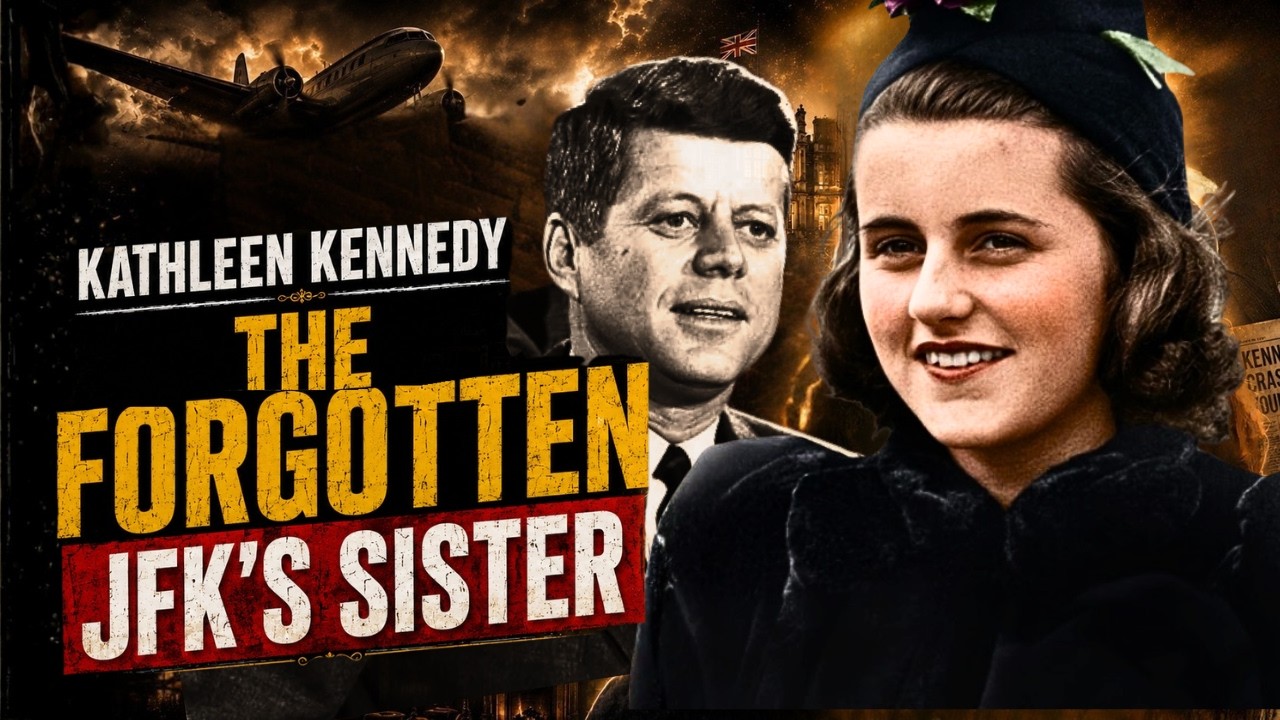
Kathleen Agnes Kennedy was born on February 20, 1920, in Brookline, Massachusetts. She was the fourth daughter and second child of Joseph P. Kennedy Sr. and Rose Fitzgerald Kennedy.
Her parents did not run an ordinary household. They ran what amounted to a training camp for political and social power, with the goal of building a strong American dynasty. Every child was expected to serve that goal.
Joseph Sr. and Rose demanded strict obedience and high performance. Rose managed the family with extreme precision, keeping an index card box on her desk with each child's weight, medical history, dental appointments, and shoe sizes.
Rules were enforced harshly. A child who was late for a meal was not allowed to eat with the family. Dinner conversation was highly structured. Joseph Sr. required his children to read the New York Times daily, then quizzed them on politics, history, and current events during meals. A weak or uninformed answer drew public criticism.
Joseph Sr.'s core rule was that the Kennedys do not lose and do not show weakness.
Kathleen did not fit the expected image of a debutante daughter in the 1920s and 1930s. Her parents wanted girls who were quiet, nurturing, and prepared for advantageous marriages. Kathleen was loud, highly energetic, and impulsive.
She preferred rough football in the yard with her older brothers to indoor activities. Her physical, rough style of play earned her the lifelong nickname "Kick."
Her athletic and outgoing nature was a practical survival mechanism within the family dynamics. By staying in constant motion and joining her brothers' activities, Kick carved out space that was harder for her mother to control.
Among her siblings, Kick was closest to her older brother Jack. Jack suffered from chronic health problems, including scarlet fever and severe digestive issues, that often left him bedridden. Because Joseph Sr. favored the eldest and healthiest son, Joe Jr., Jack was often marginalized.
Kick spent long hours with Jack during his recoveries. They shared a skeptical view of their parents' intense ambitions. While the other siblings followed family rules without question, Jack and Kick used dark humor to secretly mock the strict expectations placed on them.
Their skepticism grew from their parents' actual behavior. The family presented a public image of devout, strict Catholicism. Behind closed doors, Joseph Sr. systematically contradicted those values.
Joseph Sr. built his fortune in banking, Wall Street, and the Hollywood film industry. During his time as a film producer, he engaged in extramarital affairs very openly. His most famous relationship was with silent film star Gloria Swanson. He did not hide it from his family.
In a direct display of control, Joseph Sr. frequently brought Swanson to the family home. On one occasion, he invited Swanson's young daughter to a Halloween party at the Kennedy house. Kick and her siblings were forced to socialize with their father's mistress's daughter, while their mother, Rose, ignored the situation entirely.
The Kennedy home was also unsafe for young women. When Kick reached adolescence, she and her friends learned to avoid certain areas of the house. The family had a private cinema in the basement. Joseph Sr. used this secluded room to lure young women brought by his daughters and harass them. Kick's friends explicitly warned each other never to go near the basement or be alone with Joseph Sr.
Seeing her father act as a predator without consequences permanently changed Kick's worldview. It destroyed her trust in the religious and moral lectures her parents delivered.
Rose Kennedy's response to her husband's behavior was a complete detachment from reality. To cope with the public humiliation of his affairs, Rose focused obsessively on Catholic rituals. She attended Mass daily, sometimes several times a day, and imposed strict religious study on her children. When she could not bear the pressure, she left the family for weeks to travel to Paris. She offered no emotional support to her children. Jack Kennedy later said he never once heard his mother say "I love you."
Kick learned early that her mother would always choose protecting the family's public image over acknowledging dysfunction inside the home. The most brutal example of this priority was the treatment of Rosemary, Kick's older sister.
Rosemary was born in 1918. During her birth, the attending nurse forced Rose to keep her legs closed to delay the delivery until the doctor arrived. This caused a severe oxygen shortage that left Rosemary with permanent intellectual disabilities.
By her late teens and early twenties, Rosemary suffered from mood swings and behavioral episodes. She could not meet Kennedy standards of physical and intellectual perfection. Joseph Sr. viewed Rosemary's condition as a political burden on his sons.
In November 1941, when Rosemary was 23, Joseph Sr. secretly decided to subject her to an experimental prefrontal lobotomy. He authorized brain surgery without informing his wife. The operation was performed by Dr. Walter Freeman and Dr. James W. Watts.
It was a catastrophic failure. The surgery permanently destroyed Rosemary's cognitive abilities. She lost the ability to walk on her own and her speech became unintelligible. Her mental capacity regressed to that of a two-year-old.
Instead of caring for her at home, Joseph Sr. committed Rosemary to an institution. She was eventually sent to Saint Coletta, a facility in Wisconsin where she was hidden from public view for decades. Joseph Sr. ordered the rest of the family to stop talking about her. Rosemary was completely removed from the family history.
For Kick, her sister's surgery and subsequent exile was the defining moment of her early life. She saw clearly what happened to any Kennedy who became a source of inconvenience. Rosemary's disposal proved that the family structure was built on harsh transactions.
Kick realized that to survive and keep her independence, she had to distance herself physically and emotionally from her parents' control. Her childhood rebellion turned into a permanent revolt.
In the 1930s, the American upper class operated under a strict set of visual and behavioral codes. For women in these elite circles, physical appearance and passive compliance were the primary currency. The Kennedy family took these social expectations and amplified them into an institutional standard.
Joseph Sr. and Rose Kennedy viewed their children's physical attractiveness as a vital public relations asset. Kennedy aesthetics were carefully engineered. The boys, especially Joe Jr. and Jack, were expected to reflect strong athletic masculinity. The girls were groomed to be slim, elegant, and visually ideal. They wore matching tailored outfits and were taught to present themselves as ideal, quiet companions for future political leaders.
Kathleen failed completely to meet this physical standard. By her teenage years, family, friends, and biographers described her as plain. Her height stopped at 5 feet 3 inches. She had a strong, broad build, a thick neck, and a round face. Her hair was naturally curly and difficult to style, contrasting sharply with her sisters' ideal hairstyles.
Kick was also not interested in fashion at all. She often wore her older brother's oversized sweaters, worn flat shoes, and coarse fabric skirts. She frequently looked untidy, with a shirt always coming out of her waistband or grass stains on her knees.
In a family obsessed with physical perfection, a daughter who looked ordinary was considered a problem. Rose Kennedy constantly criticized Kick's appearance, reminding her to improve her posture, watch her weight, and style her hair.
But Kick showed a highly developed psychological ability to adapt to this criticism. Instead of withdrawing or developing an eating disorder like many girls of her social class, she bypassed physical competition entirely. She used her personality as her weapon.
Kick had exceptional emotional intelligence and a razor-sharp sense of humor. Because she realized she could not compete on traditional beauty standards, she relied on her natural charisma. She was completely free of pretension and vanity.
At the formal, boring social gatherings of the East Coast elite, Kick was a disruptor. She laughed loudly, spoke her mind directly, and refused to act shy or submissive. This approach produced an unexpected result. She became overwhelmingly popular with young men.
Heirs of prominent families and young men studying at Harvard and Yale were used to debutantes trained in quiet compliance. Kick treated these men as equals. She challenged their ideas, mocked them, and played sports with them. She offered a level of authenticity and lively companionship that was extremely rare in high society. Her lack of vanity was highly attractive. Men were drawn to her because she was genuinely fun and completely unpredictable.
This intense, sudden popularity with admirers provoked an immediate and harsh reaction from Rose Kennedy. To Rose, an independent daughter attracting male attention was a direct threat to family stability. Rose adhered strictly to Catholic doctrine on chastity. She viewed teenage dating not as a normal social development but as an imminent danger of mortal sin and public scandal.
Moreover, Kick's popularity meant she was gaining social influence outside her mother's control. If Kick continued to act independently, she might choose a husband who did not align with the Kennedy family's strategic political goals.
Rose's solution was swift and aggressive: physical isolation. In 1933, when Kick was 13, Rose removed her from her local environment and sent her to the Sacred Heart convent in Noroton, Connecticut. This was not just a boarding school. It was an institution designed to break the will of young women and mold them into obedient, pious Catholics.
The environment at Noroton was harsh. The nuns enforced strict rules of silence during certain hours of the day. Reading materials were heavily censored. The school administration read and monitored all incoming and outgoing mail. The curriculum focused heavily on religious doctrine, obedience, and domestic skills rather than serious intellectual development. The convent's primary goal was to suppress individuality and enforce absolute submission to authority.
For Rose Kennedy, sending Kick to Noroton was a calculated move to extinguish her daughter's independence and separate her from the young people who encouraged her outgoing behavior. The strategy failed.
Kick was not broken by the convent's discipline. Instead, she adapted her survival mechanisms. She maintained her sense of humor and quietly defied the nuns' expectations without committing offenses that would justify expulsion. She became a beloved central figure among the other girls at the convent, using her charisma to build a network of loyal friends. She obeyed the rules outwardly but never internalized the demand for subservience.
Realizing that Noroton had failed to suppress Kick's independent spirit, Rose escalated her strategy. In 1937, she decided to send Kick completely out of the country. Kick was enrolled at the Sacred Child convent in France.
The French convent was notably more isolated. Kick was separated from her beloved brother Jack, her friends, and familiar American culture. Catholic discipline in France was strict, and the language barrier was intended to isolate and humiliate her further. Rose expected the European educational system to finally instill the quiet aristocratic elegance she demanded from her daughters.
Instead, European exile sharpened Kick's thinking and provoked a more direct form of rebellion. At the Sacred Child convent, Kick stopped using humor merely as a shield. She began using intellectual confrontation.
She engaged in sharp debates with the nuns. When she received instruction on strict theological doctrines or arbitrary behavioral rules, Kick refused to accept them blindly. She demanded logical explanations. She constantly interrupted lessons to ask about the reasoning behind Church teachings and school regulations. Her persistent questions and her refusal to accept "because God commands it" as a sufficient answer frustrated the administration deeply.
The French nuns, accustomed to absolute submission, did not know how to handle her. They officially classified her as a troublemaker and permanently nicknamed her "Mademoiselle Pourquoi" — Miss Why. It was not an affectionate nickname. It was a mark of rebellion. But for Kick, it was a badge of honor. It proved that her mind remained her own.
Isolation in France did not make her obedient. It cemented her conviction that authority, whether from the Church or from her parents, was often arbitrary and could be challenged.
When Kick finally returned to the United States after completing her convent terms, she was older, sharper, and completely indifferent to her mother's attempts to control her. She tested the boundaries immediately upon her return.
Knowing that Rose carefully planned her daughters' social connections and monitored their speech, Kick began publicly dating Peter Grace. Peter was the heir to the W.R. Grace & Co. fortune in chemicals and shipping. He was wealthy but also known for being crude, loud, and completely impolite. He did not possess the refined political image the Kennedys demanded for their partners.
Kick's relationship with Peter Grace was not a great love story. It was a strategic, calculated display of defiance. She flaunted the relationship specifically because she knew it irritated her mother. She was sending an unmistakable message to Rose Kennedy: the years of isolation, strict convents, and geographic exile had not worked. Kick had survived psychological conditioning and was determined to dictate the terms of her own social life.
She had secured her independence within the United States. But the real test of her independence and her complete break from family control was about to happen on an international stage.
In late 1937, President Franklin Roosevelt made a political calculation that would unintentionally hand Kathleen "Kick" Kennedy the key to her freedom. Roosevelt appointed Joseph P. Kennedy Sr. as United States Ambassador to the United Kingdom.
For Joseph Sr., this was the ultimate triumph. He was the first Irish Catholic to hold the position at the Court of St. James's. He forced the British establishment — the same people who had historically persecuted the Irish, the same aristocracy that had despised him in Boston — to accept him as an official representative of the United States. He viewed the appointment as a massive public relations opportunity. He intended to use his large, attractive family as a geopolitical tool to charm the British public and cement his political power in America.
In early 1938, the Kennedy family moved to London. For 18-year-old Kick, the move was a massive psychological shift. She was removed from the stifling social hierarchies of the American East Coast and placed in an entirely new arena.
British aristocracy in 1938 was a rigid, highly organized society. It operated on centuries of unspoken protocol, deep reserve, and emotional restraint. The London Season — that intense period of social events in spring and summer designed to present aristocratic daughters to potential husbands — was a test of strict rules. Debutantes were expected to be shy, polite, quiet, and completely deferential to the existing hierarchy.
Kick's arrival was a shockwave. She did not try to imitate British debutantes. She ignored the usual rules entirely. When she was formally presented to King George VI and Queen Elizabeth at Buckingham Palace, she complied with the physical requirements, wearing the mandatory white gown and feathered headdress, but she brought her American energy straight into the Mayfair salons.
Kick was overly friendly. She approached duchesses and earls, shook their hands firmly, and called them by their first names or titles — a grave breach of traditional British etiquette. She chewed gum. She took off her high heels at formal parties when her feet hurt. She laughed loudly and challenged young British aristocrats in debates about politics and sports.
By all traditional standards of the London Season, her behavior should have led to social ostracism. Instead, it made her the talk of the town in the best possible way. The British upper class was charmed by Kick. They were bored with the quiet, predictable compliance of their own debutantes. They found her spontaneity and lack of pretension extremely refreshing. Her directness was not seen as rudeness. It was considered a unique American charm.
She had an innate ability to read a room and defuse the most intimidating personalities with a quick joke or a self-deprecating comment. She was skilled at breaking down barriers in conversation. She treated prime ministers and young dukes exactly as she treated her brothers.
Her triumph was officially crowned at the Queen Charlotte's Ball, the most prestigious event on the London social calendar. At the end of the season, the British press and aristocratic society experts named Kathleen Kennedy "Debutante of the Year 1938."
It was a massive personal victory. Throughout her life, Kick had been defined by her relationship to her family. She was Joe's daughter, or Jack's sister, or Rose's problem. Now, in the most exclusive society in the world, she was celebrated entirely for her independent, distinctive personality. She had won on her own terms, using the same traits — loudness, humor, and physical energy — that her mother had tried to suppress in the convents. London gave her the recognition she had desperately lacked in Massachusetts. For the first time, she felt she truly belonged.
During this intense social season, Kick expanded her network beyond the superficial debutante circle. She began spending time at the vast country estates of British nobles. During these weekend parties, she was introduced to a social circle known as the "Cavendish set."
At the heart of this group was William Cavendish, Marquess of Hartington, known to everyone as Billy. Billy was the heir to the 10th Duke of Devonshire, meaning he would eventually inherit one of the largest fortunes and highest titles in the United Kingdom.
Unlike Kick, Billy was deeply rooted in the traditional British mold. He was quiet, serious, somewhat awkward, and heavily burdened by the responsibilities of his future title. Despite their contrasting temperaments, a quiet, stable bond began to form between them. Billy was drawn to Kick's loud energy, and Kick found in Billy stability and genuine kindness. They were just friends at this stage, but the foundation for the most important relationship of her life had been laid.
However, the triumphant success of 1938 was happening against the backdrop of an impending global catastrophe. While Kick was conquering London society, Adolf Hitler was expanding his control over Europe. The geopolitical situation was deteriorating rapidly.
Joseph Kennedy Sr. was an isolationist and a strong supporter of appeasement. He believed Britain could not win a war against Germany and strongly advocated avoiding conflict at any cost, even if it meant submitting to fascist demands.
Kick, living at the embassy and closely connected to her brother Jack, who was watching the political landscape with a sharper, more realistic eye, was fully exposed to these high-level tensions. The Munich Agreement in September 1938 temporarily delayed conflict, but anxiety in London was palpable. Kick watched her British friends prepare for the inevitable. The young men she danced with were joining the military reserve. The country houses she visited were making plans to convert into hospitals. The reality of war was approaching.
In August 1939, Kick traveled to the south of France for a late-summer holiday with a friend. While she was there, the geopolitical order collapsed. On September 1, 1939, Germany invaded Poland. On September 3, Britain and France declared war on Germany. World War II had officially begun.
The immediate aftermath was chaos. Kick found herself stranded in France as civilian transport networks shut down and borders closed. The American embassy rushed to locate her. She managed a difficult, turbulent crossing of the English Channel to a London that had transformed overnight. The city was completely blacked out to prevent aerial bombing. Barrage balloons floated over the skyline. Her British friends were mobilizing to fight.
Kick wanted to stay. She felt a deep, genuine loyalty to the British people who had embraced her. She wanted to volunteer to contribute to the war effort and stand by the friends who now faced severe danger.
Joseph Sr. flatly refused her request. His priority was not British solidarity. It was his family's safety and the preservation of his political standing. He ordered his wife and children to evacuate immediately.
Kick resisted him. She argued, pleaded, and cried, begging to be allowed to stay in the city that had given her independence. But Joseph Sr. exercised absolute paternal authority. The family was returning to the United States. There was no room for negotiation.
In late September 1939, Kick was forced aboard a passenger ship bound for New York. As the ship pulled away from the British coast, Kick suffered a massive psychological shock. She had been stripped, in a moment, of the independence, identity, and freedom she had built over the past year and a half. She was being dragged back to the same environment she had spent her teenage years trying to escape.
After returning to the United States, Kick sank into a deep depression. The contrast between her life in London and her reality in America was unbearable. In London, she had been at the center of a historic global crisis, surrounded by people who treated her as an independent adult. In America, she was immediately demoted to merely a daughter of the Kennedy family.
Her parents expected her to resume a quiet, socially acceptable life. She briefly enrolled at Finch College in New York, a finishing school for wealthy young women, but found the curriculum trivial and left. She lived without purpose, feeling completely disconnected from her American peers who did not grasp the severity of the war in Europe.
While she was stagnating, the Kennedy family machine was pushing her brothers forward. Joe Jr. was in law school preparing for his political launch. Jack was writing his Harvard thesis, later published as the best-selling book "Why England Slept." Kick was fully aware that the family's resources and attention were entirely focused on the males. The sons were being trained to make history. The daughters were expected to sit on the sidelines and watch.
To combat her growing despair, Kick took a job in Washington, D.C., in 1941, working at the Washington Times-Herald, run by the powerful Cissy Patterson. Kick started as an assistant and eventually took over a column titled "Did You Happen to See?" The job involved reviewing plays, covering elite events, and interviewing prominent figures in the capital.
On paper, it was a glamorous job. She was a working professional in a major political center. But internally, Kick was miserable. She felt that covering Washington cocktail parties was trivial and meaningless work. While her friends in London were surviving the Blitz, every report of German bombs falling on Mayfair or the East End increased her guilt and isolation. She was trapped in American safety writing about socialites while her loved ones fought for survival.
The Washington years were a period of intense psychological imprisonment for Kick. She was geographically safe but emotionally suffocating. She dated American men, attended the political events her father required, and played the role of the beautiful daughter. But the rebellion that had begun in her teenage convents was quietly turning into a calculated plan.
Kick realized her father would never give her permission to return to a war zone. If she wanted to reclaim her life and return to England, she could not ask for it. She had to engineer a situation in which she could leave on her own authority. She began searching for an exit strategy, fully aware that taking it would mean a permanent break with her parents.
By the summer of 1943, Kathleen "Kick" Kennedy had reached a breaking point. She had spent three years trapped in the United States, watching from the sidelines as the defining conflict of the twentieth century tore Europe apart. Her father, Joseph Sr., had been forced to resign his ambassadorial post in disgrace over his defeatist, anti-British public statements. Her brothers Joe Jr. and Jack were deployed in the military, pursuing the Kennedy mandate for male glory.
Meanwhile, Kick was expected to remain a decorative daughter in Washington, D.C. But she needed an exit strategy that could not be refuted, one Joseph Sr. could not politically oppose. She found it in the American Red Cross.
In the midst of World War II, volunteering with the Red Cross was one of the few socially acceptable ways for a young woman of high status to enter a war zone. Kick applied, passed the rigorous screening process, and was accepted. When she presented it to her parents, Joseph Sr. was cornered. He could not publicly prevent his daughter from serving the war effort without appearing unpatriotic — a critical concern for a man desperately trying to salvage his political reputation.
In the summer of 1943, Kick boarded the RMS Queen Mary. The luxury ocean liner had been stripped of its finery, painted wartime gray, and converted into a massive troop transport ship. Crossing the Atlantic in 1943 was not a vacation. It was a deadly gamble. German U-boats actively hunted Allied convoys, and the Queen Mary sailed in a zigzag pattern to evade torpedoes.
This voyage highlights the extreme nature of Kick's psychological state. To escape the emotional suffocation of the Kennedy household, she voluntarily placed herself in the crosshairs of German submarines. She traded the absolute safety and luxury of her American life for a city under constant bombardment by the German Air Force. For Kick, physical danger in London during the Blitz was better than the psychological prison imposed by her family.
When Kick arrived in London, the city was completely different from the glittering playground she had conquered in 1938 as a debutante of the year. The grand ballrooms were boarded up. The streets were completely dark at night due to mandatory blackout measures. Rationing had stripped the city of its richness, and the constant threat of V-1 flying bombs created an atmosphere of chronic terror.
But for Kick, this shattered, wounded London was freedom itself. She was assigned to the Hans Crescent Club in Knightsbridge, a massive Red Cross facility serving thousands of American soldiers. Her daily reality was a radical departure from her privileged upbringing. Kick was not the ambassador's daughter here. She was just a worker.
She wore a uniform. She rode her bicycle through bombed-out streets. She spent her days clearing tables, managing logistics, organizing dances for young soldiers who were homesick, and serving thousands of cups of coffee. She excelled at it. The work gave her a sense of stability. For the first time in her life, she was valued for her actual work and her ability to boost morale, rather than for her last name or her father's bank balance.
She used her natural charisma and sharp wit to bring moments of fun to American soldiers who knew they would likely die in the imminent invasion of Europe.
In this environment charged with danger and adrenaline, Kick reconnected with William Cavendish, Marquess of Hartington. Billy, as he was known, was now an officer in the Coldstream Guards, an elite infantry regiment of the British Army.
As the 10th heir to the Duke of Devonshire, Billy carried the weight of one of the United Kingdom's oldest, wealthiest, and most historically significant families. His family owned Chatsworth House, an estate so vast it functioned like a small sovereign territory.
Billy was the complete opposite of the Kennedy men, who had been trained by Joe Jr. and Jack to be loud, charming, and relentlessly ambitious. Billy was extremely introverted, sober, and burdened by a massive sense of inherited duty. He was a quiet man who preferred the countryside to the city. He did not seek the spotlight. He simply accepted the heavy responsibilities his lineage imposed on him.
Under normal circumstances, the loud, bold American girl and the quiet British aristocrat would have found nothing in common. But the war stripped everyone of superficial social barriers. Billy was facing the imminent deployment of his unit to the front lines. He knew the survival rate for infantry officers was brutally low.
Kick found in Billy a burning flame of life, a spontaneous energy that pierced the harshness of his military service. And in Billy, Kick found a man who possessed immense power but lacked entirely the predatory cruelty and manipulative ambition that characterized her father. Billy offered her genuine respect and quiet stability. Their friendship quickly developed into a deep, desperate wartime love affair.
However, the moment Billy proposed marriage, they hit an immovable theological wall. The conflict was not about personalities. It was about institutional power and religious doctrine.
The Kennedy family was staunchly Irish Catholic. In the 1940s, the Catholic Church operated under the strict decree of Ne Temere. This law dictated that if a Catholic married a non-Catholic, the marriage was only valid if the non-Catholic party agreed in writing to raise all children in the Catholic faith.
Billy Hartington could not make that promise. He was an Anglican, a member of the Church of England. The issue was not merely personal faith. It was a constitutional matter. The Duke of Devonshire held immense political and historical power in Britain. The British aristocracy had been radically Protestant since the Reformation. If Billy's heir were raised Catholic, it would create an unprecedented constitutional and social crisis for the Devonshire dynasty. The title, the estates, and the legacy required an Anglican heir. There was no room for compromise.
When Kick informed her parents of her intention to marry Billy, the reaction from Massachusetts was explosive. Rose Kennedy launched a psychological warfare campaign unprecedented even by Kennedy family standards.
For Rose, Kick's desire to marry outside the Catholic Church — specifically, agreeing to raise her children as Anglicans — was not just rebellion. It was a mortal sin that guaranteed her daughter's soul would burn in hell. Moreover, it was a public relations disaster for Joseph Sr., who relied heavily on the Irish Catholic voting bloc in the United States.
Rose bombarded Kick with a barrage of telegrams, letters, and phone calls. Rose bypassed Kick and contacted the Archbishop of New York and other senior Catholic officials, demanding they intervene and order Kick to stop. Rose used guilt as a weapon, telling Kick that this marriage would destroy the family, ruin her father's political standing, and bring shame on her brothers. Rose threatened to disown her completely, cut off all financial support, and permanently exile her from the family.
Joseph Sr., always the pragmatist, was conflicted. He admired Billy Hartington and understood the immense social value of a marriage alliance with the Devonshires. Having a duke as a son-in-law was a strong asset. But Joseph Sr. also knew that alienating the Catholic base was political suicide. He ultimately sided with Rose, explicitly forbidding the marriage.
Kick was left completely isolated. She sat in a war-torn city, facing the prospect of losing the man she loved to German bullets while simultaneously fighting a vicious battle against her mother. The psychological toll was immense for weeks.
Kick suffered and agonized. She consulted priests in London. She desperately tried to find a loophole in Catholic canon law. She asked Billy whether there was any way his family could relent. The answer from both institutions was a flat refusal. The Catholic Church would not bend. The British aristocracy would not bend.
Kick realized she had two choices. She could surrender, return to America, appease her mother, and accept a life of compliance within the Kennedy family. Or she could sever ties, marry the man she loved, and accept permanent exile.
She chose Billy. She chose herself.
The decision was sealed by the undeniable pressure of the war. In early May 1944, the buildup for D-Day was in its final stages. Billy's regiment was preparing to move to the front. Time had run out.

On May 6, 1944, Kathleen Kennedy and William Cavendish were married. It was not a grand society wedding in a majestic cathedral. Because Kick was marrying outside the Catholic Church, she was denied a religious ceremony. The wedding took place at the register office at Caxton Hall, a government building in London. It was a purely civil, austere procedure that lasted only 10 minutes.
Kick did not wear a traditional white wedding gown. She wore a simple, short pink dress with a matching small hat. Billy wore his military uniform. The visual contrast between this modest, quick ceremony and the immense wealth of both families was striking. It underscored the absolute isolation of the moment.
The Devonshire family, despite their profound disagreement with Kick's Catholicism, chose to support their son. The Duke and Duchess of Devonshire attended the ceremony, welcoming Kick into their ranks with aristocratic grace. The Kennedy family boycotted the wedding entirely.
Joseph Sr. and Rose refused to travel to London. They refused to send any representative. They refused to issue any public statement of congratulations. In Massachusetts, Rose Kennedy checked into a hospital for routine tests on the day of the wedding, a calculated public relations move to avoid the press and express her disgust at what her daughter had done. Rose wrote in her diary that she was horrified and felt she had failed as a mother.
Only one member of the Kennedy family broke the ban. Joe Jr., Kick's older brother, was stationed in England as a Navy pilot. Ignoring his parents' explicit orders, Joe Jr. arrived at Caxton Hall in his formal military uniform. He stepped forward, took his sister's arm, and walked her down the short aisle of the register office. It was a singular gesture of brotherly defiance that Kick would never forget.
When Kick signed the marriage register, she officially became the Marchioness of Hartington. But in doing so, she forfeited her place in the Kennedy family. She had gained her freedom, but she had severed herself completely from her family.
As they left Caxton Hall into the wartime streets of London, Kick and Billy had achieved their victory. But they did not realize that the war that had brought them together and forced this decision was about to destroy everything.
The victory Kathleen "Kick" Kennedy achieved at the Caxton Hall register office on May 6, 1944, was absolute, but it was also extremely fragile. She had defied her mother, broken away from the Kennedy family, and married William Cavendish, Marquess of Hartington. In doing so, she became the future Duchess of Devonshire.
But there was no time to celebrate this new reality. The world was on the edge of the largest military invasion in human history. Kick and Billy were granted only five weeks together as husband and wife.
Those 35 days were spent in a tense, agonizing atmosphere in England on the eve of the invasion. They briefly retreated to Compton Place, one of the Devonshire family properties in Eastbourne on the south coast. But even there, the war was inescapable. The English Channel was teeming with Allied ships preparing for D-Day. The sky was filled with bombers heading toward France.
For Kick and Billy, they lived their honeymoon only in the present because the future was merely a small statistical possibility. Billy was an officer in the Coldstream Guards, an elite infantry battalion that would be at the forefront of the Allied push across Europe. He was fully aware of the mortality rates among front-line officers. He spent those five weeks quietly preparing his wife for the high probability of his death.
He updated his will, explained the details of managing the Devonshire estates, and familiarized her with the heavy administrative duties she would take on if he did not return. For her part, Kick hid her terror behind the familiar coolness of the Kennedy family. She understood the unwritten rules of wartime marriages. Do not cry, do not cling, and do not make the goodbye harder than it already is.
In mid-June 1944, just days after Allied forces stormed the beaches of Normandy, Billy's battalion received its orders. He packed his bags, kissed his wife goodbye for five weeks, and deployed to France.
Kick remained in London, completely cut off from her family in America and now separated from the man who had been her anchor in England. To maintain her psychological balance, she threw herself back into her work with the American Red Cross.
But London in the summer of 1944 was no longer the city it had been during the German Blitz. Hitler had unleashed his vengeance weapons, the V-1 flying bombs known as "doodlebugs." Unlike conventional bombers, these unmanned aircraft flew with a terrifying, distinctive buzz. When the engine stopped, the bomb fell in dead silence before exploding.
The psychological warfare of the V-1 was devastating. Kick lived in a constant state of hyper-vigilance, listening for the engines to stop, while waiting for the inevitable telegram from the War Office about Billy's unit.
Yet the first catastrophic blow did not come from the trenches of France, and it was not about her husband. It came from the skies over England and struck at the heart of her family.
The tragedy that struck Kick in August 1944 was rooted directly in the toxic sibling rivalry between her brothers. Jack Kennedy, despite his frail physical constitution, had become a national hero after a Japanese destroyer split his boat in half in the Pacific. His survival story received widespread publicity orchestrated by Joseph Sr. This drove the older brother, Joe Jr., to the edge of reckless desperation.
Joe Jr. was the golden son, the chosen one to become the first Catholic president of the United States. He could not bear the idea of being outshone by his sickly younger brother. To reclaim the family spotlight, Joe Jr. volunteered for Operation Aphrodite, a highly secret and incredibly dangerous experimental mission.
The plan called for loading a B-24 bomber with 21,170 pounds of Torpex explosives, stripping it of all unnecessary equipment, and flying it as a massive bomb toward German weapons bunkers in France. Joe Jr. and his co-pilot were supposed to arm the explosives in flight, set the autopilot, and parachute out before crossing the English Channel, leaving a control aircraft to guide the bomb to its target by radio.
On the evening of August 12, 1944, Joe Jr. took off from a base in Suffolk. At 5:52 p.m., while still over the English coast, a massive electrical malfunction detonated the payload prematurely. The explosion was so violent it shattered windows in towns miles away. The B-24 vaporized instantly. No wreckage was ever found. Joe Jr. was simply gone.
When the news reached Kick in London, the psychological impact was devastating. Joe Jr. was not just her older brother. He was her protector. He was the only member of the Kennedy family who had defied their parents to attend her wedding. He was the one who walked her down the aisle at Caxton Hall when the rest of her family abandoned her. He was her bridge back to America, the only sibling who promised to help her reconcile with their father after the war.
With Joe Jr.'s death, Kick's primary family safety net collapsed.
The tragedy temporarily broke the silence between Kick and her parents. Joseph Sr. and Rose were utterly shattered by the loss of their eldest son and political heir. But even in their shared grief, the geographic and emotional distance between Kick and her mother remained vast. Kick grieved in London, completely alone, realizing that the myth of Kennedy invincibility was just that — a myth.
She relied heavily on Billy's letters from the front. Billy was advancing through northern France into Belgium. His letters were brief, heavily censored, and focused on trivial details to spare her the horrors of the infantry. He wrote about the weather, asked about the Red Cross, and repeatedly told her how much he loved her.
As August ended and September began, the Allied advance accelerated, and the Coldstream Guards were tasked with liberating a series of fortified Belgian towns. On September 9, 1944, less than a month after Joe Jr. vaporized over the Channel, Billy's unit received orders to secure the small Belgian town of Heppen.
German forces were withdrawing, but they had left elite sniper units to disrupt the Allied advance. Billy was leading his men on foot, advancing along a country road toward the town center. He stepped out from behind cover to signal his men. A German sniper hidden in a farmhouse had him in his sights.
The shot was instantaneous. A sniper's bullet struck Billy Hartington directly in the heart. He was killed instantly before his body touched the ground.
In London, Kick was working at the Red Cross club. It took several days for the official notification to arrive through military bureaucracy. When her door was finally knocked on, Kick was handed the standard War Office telegram. She was 24 years old. She had been married for only four months. She had spent a total of five weeks with her husband.
The shock of losing two people within 28 days pushed Kick's psychological defenses to their absolute limits. First her brother, then her husband. The two men she loved more than anything in the world, the two who had stood by her when she declared her independence, had been violently erased.
Adding to the agony was the brutal reality of wartime logistics. Because Allied forces were moving so quickly and casualties were so heavy, the British Army did not repatriate bodies. Billy was not returned to the vast green hills of Chatsworth. He was buried exactly where he fell, in a temporary military cemetery in Belgium under a simple wooden cross.
Kick was denied the chance to say goodbye by seeing her husband's body. She was denied the traditional mourning rituals of the British aristocracy. She became a widow in a strange city that was still being bombed.
The scale of the psychological devastation of this period cannot be overstated. Kick had bet everything. She sacrificed her American family's security, severed ties with her devout Catholic mother, and risked her social standing, all for the right to build a life with Billy. And at the moment she secured that life, the war erased everything.
She was left with the title Marchioness of Hartington, but it felt completely hollow without the man who had given it to her. She was a Kennedy by blood but an exile by choice. She was a Cavendish by marriage but a widow by circumstance.
By the fall of 1944, Kathleen Kennedy found herself unmoored, standing in the ruins of her rebellion, facing a terrifying question. When you sacrifice your entire family for a future that no longer exists, how do you continue to live?
When a person suffers catastrophic emotional trauma, the mind resorts to extreme defense mechanisms to ensure basic survival. For Kathleen "Kick" Kennedy, the fall of 1944 was a psychological ground zero.
Within 28 days, she lost her beloved older brother, Joe Jr., and her husband of only four months, Billy Hartington. Both were completely annihilated by the machinery of World War II. At 24 years old, she was a widow standing in the wreckage of a life she had barely begun to build.
Her immediate reaction was to retreat to the only familiar structure she had left: her family in the United States. In late 1944, Kick crossed the Atlantic and returned to the Kennedy compound in Hyannis Port. She arrived hoping to find a safe haven. Instead, she found a mausoleum.
The Kennedy family was completely unequipped to handle grief. Joseph Sr., the patriarch who had engineered his family to be invincible, was shattered by the death of his eldest son. He withdrew into silence, spending hours sitting alone staring at the ocean.
Rose Kennedy, true to her lifelong approach, suppressed her emotions entirely. She refused to discuss Joe Jr.'s death or Kick's mourning, enforcing a terrifying atmosphere of forced normalcy inside the house. She simply attended Mass at an increased rate and demanded her remaining children continue their strict schedules.
For Kick, the return to America was suffocating. Her younger sisters, Eunice, Pat, and Jean, had spent the war safely inside elite boarding schools. They could not comprehend the brutal reality of the London Blitz, let alone the actual horror of a sniper's bullet in Belgium. Kick realized she was a stranger in her own home. The Kennedy family understood only the language of victory and forward momentum. They had no protocol for dealing with the despair of a young widow.
Recognizing that staying in America would destroy her, Kick made a decisive choice. She packed her bags, turned her back on Massachusetts, and returned to London.
She arrived in post-war Britain, which was exhausted, bankrupt, and under strict rationing. But she returned with a new title: Lady Hartington. Since Billy had died without an heir, the title of Duke of Devonshire would eventually pass to his younger brother Andrew. Nevertheless, the Cavendish family embraced her fully, appreciating her immense loss and her genuine loyalty to Billy. They provided her with a home in Westminster and maintained her position within the highest tiers of the British aristocracy.
But Kick did not use this position to retreat into quiet mourning. Instead, she turned her social standing into a weapon. Beginning in 1945 and accelerating in 1946, Kick threw herself into London society with feverish, almost aggressive energy. She became a fixture at every major party, diplomatic reception, and country house gathering. She drank heavily, danced until dawn, and surrounded herself with politicians, artists, and aristocrats.
Outwardly, she was the life of the party, the vibrant, wealthy American widow who had conquered London all over again. But internally, this was a classic trauma response. Psychologically, Kick was using a strategy of overactivity to escape her grief. Silence was the enemy. If she stopped moving, if she sat alone in her Westminster home, the reality of Billy's grave in Belgium would crush her. She used the loud party scene as an anesthetic.
Moreover, the double trauma of 1944 had radically altered her moral compass. The strict rules of Catholicism and social propriety that her mother had tried to instill in her seemed utterly absurd. She had followed the rules. She had endured agonizing theological debates to marry Billy, and fate had killed him anyway. Having realized how fragile and random life was, Kick abandoned her last moral restraints. She adopted a reckless, nihilistic approach to her personal life. She decided to live in the moment, regardless of consequences, because she no longer believed in a guaranteed future.
This dangerous psychological vulnerability paved the way for the most controversial and destructive relationship of her life.
In 1946, Kick met Peter Wentworth-Fitzwilliam, the 8th Earl Fitzwilliam. If Billy Hartington embodied quiet, responsible British duty, Peter Fitzwilliam was his complete dark opposite.
Peter was obscenely wealthy. His family owned Wentworth Woodhouse in Yorkshire, a palace so vast it was considered the largest private residence in the United Kingdom, with a facade wider than Buckingham Palace. But Peter's immense wealth was dwarfed by his toxic reputation.
He was a notorious womanizer, an alcoholic, and a compulsive gambler who lost vast fortunes at horse races. He possessed a sharp, cruel intelligence and a volatile temper. He behaved with the arrogance of a man who knew his money and title protected him from all consequences.
Most importantly, Peter was a married man. He was legally tied to Olive Dorothea Plunket, a woman who suffered from severe alcoholism. Their marriage was a toxic, highly publicized battleground.
By all objective measures, Peter Fitzwilliam was a disaster. He was the exact type of man a grieving, vulnerable widow should avoid. So why did Kick throw herself into a relationship with him?

The answer lies in the specific nature of her trauma. Kick was not looking for another Billy. Replacing Billy was impossible, and the grief associated with his memory was too pure and too heavy. She was looking for a distraction, and Peter was a walking hell.
He was dangerous, unpredictable, and completely detached from the suffocating morality of the Kennedy family. Kick even gave him a nickname that revealed her clear assessment of his character. She called him "Rhett Butler," after the cynical, selfish antihero of "Gone with the Wind." She knew exactly what he was. She knew he was ruthless. But Peter's chaotic energy matched her internal chaos. With Peter, there were no expectations of Catholic purity or political perfection. There was only adrenaline, money, and scandal.
For a woman trying to numb a fatal emotional wound, the toxic relationship provided the perfect high-impact distraction.
Their relationship escalated rapidly through 1947. They made no effort to hide it. Kick and Peter were seen together at exclusive Mayfair clubs, at horse races, and traveling across Europe. The British tabloid press, hungry for post-war scandal, eagerly picked up the story of the Kennedy widow and the married Earl.
The British aristocratic elite, who had adored Kick during her marriage to Billy, began closing their doors to her. Although affairs were common among the upper class, they were supposed to be conducted with absolute discretion. Kick's blatant, open relationship with a married man was considered a crude American breach of protocol.
But the displeasure of the British aristocracy was nothing compared to the backlash building across the Atlantic. Eventually, the rumors crossed the ocean and reached Rose Kennedy's desk.
If Kick's marriage to Billy Hartington, a respectable single Protestant, had nearly caused Rose a nervous breakdown, her relationship with Peter Fitzwilliam drove her into a state of absolute, calculated fury. Peter was not just a Protestant. He was a married man seeking a divorce. Under the strict Catholic doctrine of the 1940s, divorce was an unforgivable abomination. An affair with a married man was a first-degree mortal sin.
Rose Kennedy immediately deployed all her manipulative power. She did not see Kick as a traumatized daughter needing psychological intervention. She saw her as a rogue asset destroying the Kennedy family brand.
Jack Kennedy was then a U.S. Congressman, carefully building the political base that would eventually propel him toward the presidency. The Kennedy family relied heavily on conservative Irish Catholic votes in Massachusetts. If the press revealed that the congressman's sister was a homewrecker planning to marry a divorced Protestant earl, it could derail Jack's political career.
Rose did not send letters expressing maternal concern. She sent ultimatums. She informed Kick that if she did not end her relationship with Peter Fitzwilliam immediately, she would face complete, irrevocable ostracism from the family. Rose threatened to cut off Kick's trust fund, severing her financial lifeline. She explicitly confirmed that Kick would be banned from all family properties, erased from its public history, and treated as if she were dead. None of her siblings would be allowed to contact her.
This was the same method Joseph Sr. had used to erase Rosemary after the failed lobotomy. The threat was clear: comply with the Kennedy machine or be disposed of.
Rose expected this brutal threat of isolation and poverty to bring Kick back into line. But she completely misread her daughter's psychological reality. Kick read the ultimatums and did not blink. The threat of disinheritance and exile held no power over someone who had already lost everything that mattered.
Kick had buried her favorite brother. She had buried her husband. She had already experienced the worst pain a human being can feel. The idea of being cut off from a mother who had never shown her genuine affection was not a deterrent. It was almost a relief.
Moreover, the ultimatum triggered the deep-seated stubbornness that had defined Kick since childhood. Telling her she absolutely could not do something was the surest way to guarantee she did it. Instead of backing down, Kick accelerated the timeline.
When Olive, Peter's wife, finally agreed to a divorce settlement in early 1948, the path was clear. Kick and Peter made a decisive plan to marry as soon as the legal paperwork was finalized.
However, Kick knew that executing this plan meant an ugly, ongoing war with the American Catholic establishment. She needed a strategic advantage. She realized she would never win her mother over, but she calculated that she might be able to outmaneuver her by appealing directly to the highest authority in the family.
Her father, Joseph Sr., was on a business trip in Europe at the time. Despite his harshness, Joseph Sr. was a pragmatist. He respected power, wealth, and titles. Peter Fitzwilliam possessed all of these in massive quantities. Kick believed that if she and Peter could meet her father face-to-face, away from Rose's hysterical religious interference, they could negotiate a truce. Peter could use his immense charm and aristocratic influence to convince Joseph Sr. that the marriage was an asset, not a liability. If Joseph Sr. blessed the union, Rose would be forced to comply.
In May 1948, Kick learned that her father was staying at the Hotel George V in Paris. She and Peter were in England. They quickly devised a plan to fly across the English Channel, intercept Joseph Sr. in Paris, and secure his approval for their forbidden marriage.
It was a desperate, high-stakes gamble. It was the final move in a decade-long war for her independence. She was prepared to confront the architect of the Kennedy machine and force him to accept her on her own terms.
To execute this plan, Peter chartered a small private plane. The date was set for May 13, 1948. Kick packed her bags, unaware that this final act of rebellion would be her last.
The plan to intercept Joseph Kennedy Sr. in Paris was a massive gamble born of Kathleen "Kick" Kennedy's desperate need to secure her future on her own terms. By May 1948, she and Peter Fitzwilliam were operating in a state of high-stakes urgency. The British press was hounding them. Rose, the Kennedy matriarch, had explicitly threatened total canonical expulsion.
Kick calculated that if she could get her father and Peter in a room together — a man of the kind of aristocratic power and immense wealth that Joe Sr. deeply respected — they could force a truce.
On May 13, 1948, Kick and Peter arrived at an airfield in Croydon, just south of London. Peter had chartered a de Havilland DH.104 Dove, a small twin-engine aircraft. Their pilot was Peter Townshend, a highly experienced RAF pilot, accompanied by navigator Arthur Freeman.
The flight plan was clear and direct. A brief refueling stop in Paris, then a direct flight to the French Riviera, where they intended to meet Joseph Sr. in Cannes.
The first leg of the journey to Paris was uneventful. But while the plane was parked on the tarmac at Le Bourget airport for refueling, the situation deteriorated rapidly. Weather reports indicated a massive, violent storm system forming over the Rhône Valley, directly between Paris and the Riviera.
Pilot Townshend recognized the severe danger. The de Havilland Dove was a light aircraft, completely unequipped to handle the severe turbulence and violent updrafts of a major storm. Townshend explicitly advised against taking off. He recommended they stay in Paris and wait for the weather system to clear.
Six other passengers who had accompanied them on the flight from London listened to the pilot's advice. They recognized the risk, gathered their luggage, and left the plane, choosing to remain safely on the ground in Paris.
But Peter Fitzwilliam refused. The decision to take off into known bad weather was a fatal embodiment of aristocratic arrogance. Fitzwilliam was an Earl with immense wealth. He was a man entirely unaccustomed to being told no. He had lived his entire life on the assumption that rules, limits, and even the laws of nature could be bypassed if one had enough money and power.
He ignored the pilot's warnings. He was impatient. He wanted to reach the Riviera, and he ordered Townshend to take off. Kick, who had survived the London Blitz and lost her husband, adopting a reckless, fatalistic view of life, did not stop him. She boarded the plane.
The aircraft took off from Paris and headed south. Within an hour, they flew directly into the heart of the storm. The sky turned black. Torrential rain immediately engulfed the de Havilland Dove, with visibility reduced to zero and massive pressure fluctuations. The radio communication system failed completely, cutting them off from any ground support or radar guidance.
For 20 agonizing minutes, the small plane was battered by severe turbulence. In aviation, severe turbulence is not just an uncomfortable ride. It is a violent loss of control. The aircraft encountered massive updrafts and downdrafts, causing it to pitch and roll violently and drop thousands of feet in seconds. The passengers inside the small cabin were subjected to terrifying gravitational forces, completely helpless in the dark.
As the plane penetrated the lower layer of the storm clouds near the town of Saint-Bauzile, the pilot found himself in a deadly situation. The aircraft was in an uncontrollable steep descent, heading directly toward a rocky mountain ridge. In a final, desperate attempt to save the plane, Townshend pulled back hard on the controls, attempting to abruptly raise the nose and climb away from the terrain.
The maneuver was too much for the light aircraft's structural limits. The combination of severe wind shear, high descent speed, and a sudden, powerful change in direction created aerodynamic stresses the de Havilland Dove could not withstand. The aircraft literally tore apart in mid-air.
The violent stress ripped the right wing completely off the fuselage. Both engines separated from their mounts. The tail section broke off. The plane disintegrated. The main fuselage, essentially a metal tube filled with aviation fuel, plummeted to the ground and slammed into the side of a hill near Saint-Bauzile in the Ardèche region of France.
No rescue efforts were needed. The impact was total and fatal. Kathleen "Kick" Kennedy, Peter Fitzwilliam, pilot Peter Townshend, and navigator Arthur Freeman were killed instantly. Kick was 28 years old.
Local French farmers found the wreckage hours later. When authorities arrived to identify the bodies, the news was quickly relayed to the American embassy in Paris and then to the Kennedy family.
Joseph Sr., who was already in France, traveled to the crash site area. The father who had planned to conquer the world with his family was forced to enter a small French rural morgue and visually identify the shattered remains of his most vibrant daughter. He was devastated.
But across the Atlantic, Rose Kennedy's reaction defied normal human expectations. When Rose received the news that her daughter had died tragically in a plane crash in the company of a married Protestant man, she did not mourn. She began calculating.
Rose did not view Kick's death as a family tragedy but as a final betrayal of her Catholic faith and a massive political liability for the Kennedy reputation. Jack Kennedy was in the middle of a crucial congressional campaign. If the press focused on the scandalous nature of Kick's death — traveling for a romantic rendezvous with a married Earl in the process of divorcing — it could severely damage Jack's standing with conservative Catholic voters in Massachusetts.
Rose executed a ruthless, cold public relations maneuver. She refused to travel to England for the funeral. She refused to allow Kick's body to be returned to the United States. And to ensure she would not have to answer press questions or face the public, she fabricated a medical emergency.
On the day of Kick's funeral, Rose Kennedy checked herself into New England Baptist Hospital in Boston for routine medical tests. She hid in a hospital bed, safely insulated from reporters, using the healthcare system as a shield against her daughter's death.
Furthermore, Rose's coldness dictated the behavior of the rest of the family. Because the mother refused to attend, and because political considerations were deemed too dangerous, none of Kick's siblings — not Eunice, not Pat, not Jean, not even Jack — traveled to England for the burial. The Kennedy family abandoned Kick completely.
The only Kennedy who attended the funeral was Joseph Sr. He stood entirely alone in England, surrounded by the British aristocracy instead of his own family.
Because the Kennedy family had disowned her, the Cavendish family, the Dukes of Devonshire, stepped in to claim her. Although Billy had died four years earlier, and Kick was in a controversial relationship with another man when she died, the Devonshires recognized her deep loyalty to Billy during the war. They treated her with the kindness and dignity her mother had denied her.
Kathleen Kennedy was not buried in the Kennedy family plot in Brookline. She was buried in the traditional resting place of the Dukes of Devonshire. In the churchyard of St. Peter's Church in the small village of Edensor, located within the vast Chatsworth estate.
On the day of the burial, Joseph Sr. stood beside the Duke of Devonshire and watched his daughter's coffin lowered into English soil. The family she was born into had rejected her. The family she had joined through marriage gave her a permanent home.
The Devonshire family commissioned a simple, elegant headstone. The inscription they chose did not mention the Kennedy family, the scandals, or the tragedy of her early death. It perfectly captured the essence of the woman who had captivated London and fought fiercely against the darkness of her upbringing. The inscription reads: "Joy, she gave joy and she found joy."
After her death, the Kennedy family carried out a systematic erasure of Kathleen's legacy. In the decades that followed, as the Kennedy name became synonymous with American royalty, Kick was marginalized into a footnote. When the family published authorized biographies or produced documentaries, her name was barely mentioned. Rose Kennedy rarely spoke of her. It was as if the wild, rebellious daughter had never existed.
The Kennedy family reached the pinnacle of American political power. Jack became President of the United States. Bobby became Attorney General. Ted became one of the most powerful senators in history. But the machine that produced them was a meat grinder. The Kennedy ambitions demanded a brutal price, leaving behind sisters subjected to lobotomies, brothers assassinated, and wives shattered.
Kathleen "Kick" Kennedy remains the most vibrant and compelling exception in this family's history. She was the only one who saw the machine for what it was. She recognized early that the wealth, power, and polished Catholic image were built on a foundation of emotional abuse, hypocrisy, and unjust control.
While her brothers surrendered their independence to serve their father's grand plan, Kick demanded the right to own her life. She used her humor as a weapon, her charm as a shield, and her fierce stubbornness to escape her gilded cage. She forced the British elite to accept her on her own terms. She defied the constraints of her religion to marry the man she loved. And when the war tore that love away, she refused to crawl back to the safety of a family that valued her only as a political tool.
Her life was short and frightening, but it was entirely her own. She was not a victim of the Kennedy curse. She was a victim of her own fierce, uncompromising demand for freedom. By refusing to be an obedient cog in the Kennedy machine, she guaranteed her exile. But in that exile, far across the ocean from the family that erased her, she achieved the one thing no other member of her Kennedy generation truly possessed: complete independence.