Shortly after midnight on November 15, 1942, an American battleship stood in the darkness between Guadalcanal and Savo Island, her main guns trained on a target she could not see. Her radar could see it, though, tracking a large enemy ship at 8,400 yards. On the bridge of the targeted vessel, no one knew the American ship was there. Over the next seven minutes, 75 sixteen-inch shells were fired from her guns.
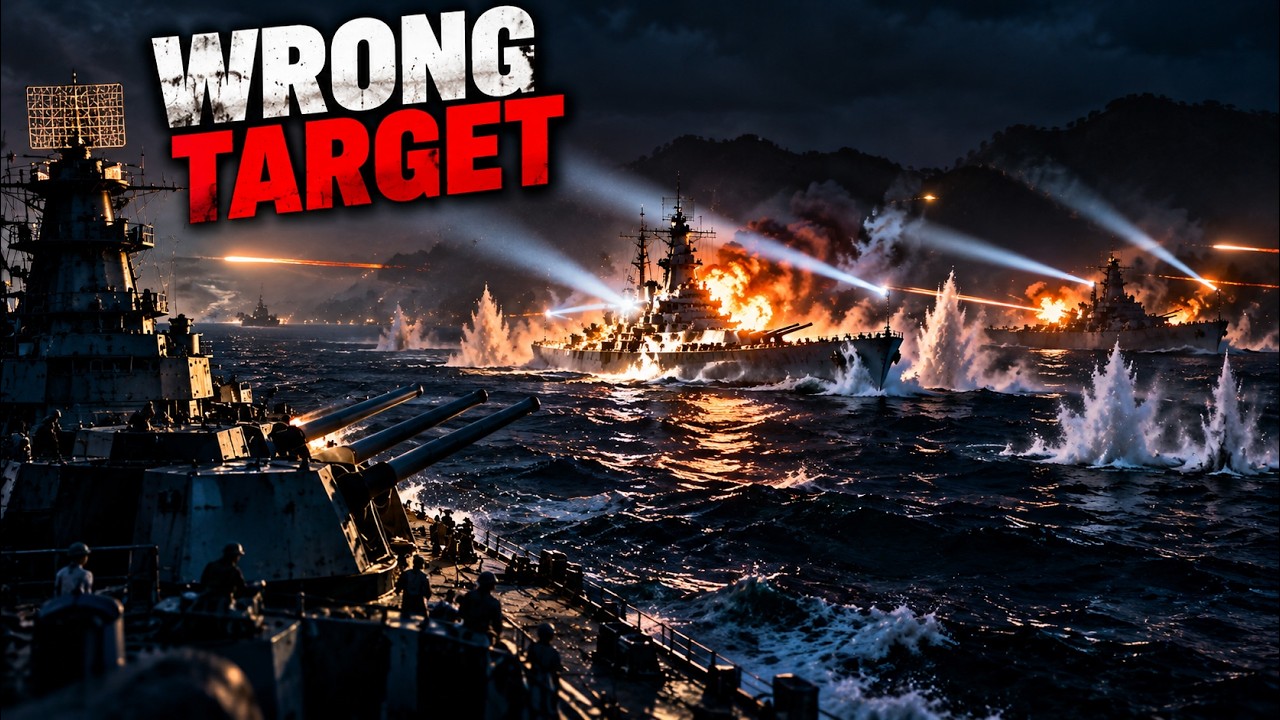
At least nine struck the Japanese ship, while not a single Japanese shell hit her hull. How the U. S. Navy came to stand in that darkness, betting a battleship on an electronic device nearly the entire fleet did not fully trust, is the story of the hours that led up to that moment.
The story begins three months earlier, 600 miles to the north. On August 7, 1942, the First Marine Division, under Major General Alexander Vandegrift, landed on Guadalcanal in the Solomon Islands. It was the first American offensive of the Pacific War, and its objective was small on a map but enormous in consequence: a half-finished airfield the Japanese were carving out of the jungle. The Marines seized it in a single day, named it Henderson Field in memory of a Marine aviator killed at the Battle of Midway, and had aircraft flying from its dirt runway within two weeks.
Everything that followed in the campaign revolved around that airfield. As long as fighters and dive bombers could take off from Henderson by day, no Japanese naval force could operate safely near Guadalcanal in daylight. Supply ships could reach the Marines. Japanese reinforcements had to land at night in small groups, a routine the Americans nicknamed the Tokyo Express.
If the airfield fell into darkness, the equation flipped. Japanese transports could land troops by day, while American supply ships could not. The Marines, already living on captured rice and meager rations, would be cut off, and with them would collapse the entire American strategy of island-hopping toward Japan. The Japanese understood this as clearly as the Americans did.
On the night of August 9, 1942, a cruiser force under Vice Admiral Gunichi Mikawa slipped past Allied pickets off Savo Island and, in roughly half an hour of close-range fire, sank four heavy Allied cruisers. It ranked among the worst surface defeats in U. S. Navy history.
Over the next three months, night battles inflicted heavy losses on both fleets. Long Lance torpedoes, superior optics, and years of intensive night training kept the Imperial Japanese Navy dominant after dark. By early November, Admiral Isoroku Yamamoto, commander of the Combined Fleet, judged that the moment for a knockout blow had arrived. He resolved to use his battleships, whose 14-inch guns would pound Henderson Field into rubble in a single night.
The first attempt came on the night of November 12–13, at 9:42 p. m. A Japanese bombardment force centered on the battleships Hiei and Kirishima, supported by a light cruiser and 11 destroyers, headed south under Vice Admiral Hiroaki Abe. Waiting in the deep water between Guadalcanal and Savo were five American cruisers and eight destroyers under Admiral Daniel Callaghan.
The ensuing battle was not a battle in the conventional sense. Callaghan led his column directly into the middle of the Japanese formation. Ships passed each other at less than 3,000 yards, so close that Hiei’s 14-inch guns could not depress enough to hit some targets accurately. Searchlights blazed.
Gun directors fired on anything that did not look friendly, and sometimes on things that did. Callaghan’s flagship, San Francisco, took heavy gunfire from three directions, killing him on the bridge. Scott died on Atlanta minutes later. Two American admirals were killed in a single surface action, something that had never happened in U.
S. Navy history and would not happen again in the war. By dawn on November 13, the waters off Lunga Point had become a graveyard. Four American destroyers and the cruiser Atlanta were gone.
The damaged light cruiser Juneau, struggling away, was torpedoed by a Japanese submarine a few hours later and disintegrated in a single explosion that killed nearly 700 men, including the five Sullivan brothers. The Japanese paid a price as well. Hiei absorbed dozens of hits and limped away, circling crippled off Savo. Aircraft from Henderson and the carrier Enterprise worked her over all day, and by evening she was gone, the first Japanese battleship lost in the war.
Yamamoto relieved Abe of command and ordered Vice Admiral Nobutake Kondo to take Kirishima south the next night and finish what Abe had failed to do. Even as Yamamoto reshuffled his forces, the man who would meet Kondo off Savo had already sailed south. Rear Admiral Willis Augustus Lee Jr. was 54 years old, born in Owen County in 1888, and known throughout the Navy as “Ching,” a nickname from his days as a midshipman at Annapolis.
He graduated from the Naval Academy in 1908, served on the Mexican coast at Veracruz, and commanded destroyers in the Atlantic in World War I. None of that made him unusual. What made him unusual was the way he thought and the way he shot. In 1907, while still a midshipman, Lee became the only American to win both the national rifle and pistol championships in the same year.
Thirteen years later, at the 1920 Olympics in Antwerp, he entered 14 separate shooting events and came home with seven medals: five gold, one silver, and one bronze, all in team competition. He and teammate Lloyd Spooner held the record for most medals in a single Olympics for 60 years. Lee understood the physics of placing a small projectile on a distant target, and how wind shifts at varying ranges. He treated a battleship’s main battery as a very large version of the same problem.
Between the wars he served on the staff of the Chief of Naval Operations, helping develop naval gunnery. When the first shipboard radar sets appeared in the late 1930s, he read every report he could find, sat with engineers, and reached a conclusion most senior officers were not yet ready to accept: radar, capable of measuring the distance to an enemy ship within a few dozen meters in total darkness, was the future of naval gunnery. The battleship Washington had already fired her 16-inch guns at night targets in Casco Bay, off Maine, in early 1942, using only radar for positioning and ranging. When Lee took command of Battleship Division Six in August of that year, he made Washington his flagship and trained his crews to feed radar data directly into the fire-control computer, preparing them for a battle in which they might never see the enemy at all.
By noon on November 14, 1942, Vice Admiral William Halsey had almost nothing left to stop Kondo’s second attempt. The heavy cruiser force that had fought two nights earlier was gone or damaged. His only operational carrier, Enterprise, was damaged and could not fight at night anyway. What he had was Enterprise’s battleship screen: Washington and South Dakota, both new fast battleships, each armed with nine 16-inch guns and capable of 27 knots.
Halsey detached the two battleships from the carrier and sent them north to intercept the bombardment force before it reached Guadalcanal. The formation Lee commanded was called Task Force 64. Washington was commanded by Captain Glenn Benson Davis, followed by South Dakota under Captain Thomas Gatch, a firm officer known for his aggressive drive. Ahead of the battleships sailed four destroyers: Walke, Benham, Preston, and Gwin.
Commander Thomas Fraser, commanding Walke, also led the small destroyer group. None of the six ships had ever operated together as a formation. This was, in essence, a scratch force of whatever remained. Since the start of the Pacific War, the Navy had kept its fast battleships with the carriers or on distant patrols.
It had not sent them into the narrow, wreck-strewn waters around Guadalcanal, which American sailors were beginning to call Ironbottom Sound. Halsey’s decision to send two of them there for a surface night action was unprecedented. Had Lee’s force lost, Enterprise would have been left unprotected. Had he not advanced, Henderson Field would likely have burned before dawn.
Kondo was coming south with a bombardment unit centered on Kirishima, under Captain Sanji Iwabuchi, and the heavy cruisers Atago, his flagship, and Takao. They had close protection under Rear Admiral Tamotsu Takama aboard the destroyer Asagumo. A sweeping unit under Rear Admiral Shintaro Hashimoto on the light cruiser Sendai steamed with the destroyers Ayanami, Shikinami, and Uranami. A second destroyer group under Rear Admiral Susumu Kimura on the light cruiser Nagara covered the eastern flank.
In all, Kondo brought one battleship, two heavy cruisers, two light cruisers, and nine destroyers. On paper, he outnumbered Lee more than two to one in ships and held an overwhelming torpedo advantage. Task Force 64 rounded the western end of Guadalcanal shortly before 11 p. m.
on November 14 and turned northeast into the passage between the island and Savo. The strait was about seven miles wide at its narrowest, leaving little room to maneuver by battleship standards, and it was littered with the hulls of ships lost in earlier battles. There was no moon; low clouds blotted out the starlight. Visibility from a ship’s bridge was less than a mile.
For Japanese lookouts, who would fight this battle the way they had fought every previous one, relying on trained night vision and high-quality optics, these were among the worst conditions they had ever faced. For American radar operators sealed in dark compartments belowdecks, it did not matter at all. Around 11:05 p. m.
, Washington’s SG surface-search radar began picking up targets behind Savo. Within twenty minutes it showed at least a dozen ships spread across three separate groups. Kondo’s bombardment force was arriving on schedule, unaware it had been detected. Lee had already put his ships in formation.
The four destroyers, spaced roughly 600 yards apart, steamed in a column ahead of the battleships. Washington followed about 2,000 yards behind Gwin. South Dakota was supposed to hold position behind Washington. Commander Fraser, watching the nearest Japanese destroyers on his radar at about 12,000 yards, asked permission to launch torpedoes early.
Lee refused. Lee would not allow American and Japanese torpedoes into the same black water, where a ship maneuvering to avoid one might collide with another. The destroyers would engage with gunfire when the enemy closed to range. The battleships would stay behind and let the radar do its work.
Everything Lee had believed about radar for the past decade was about to be tested against everything the Imperial Japanese Navy had learned about fighting in the dark. The first American gun fired that night, however, came from none of the destroyers and not from the battleships’ secondary batteries. It came from Washington’s main 16-inch battery, and its target was the Japanese sweeping unit, not Kirishima. At about 11:17 p.
m. , the fire-control director’s rangefinder locked onto the largest target in the group of ships approaching from the western side of Savo, at 18,500 yards. Lee gave permission to open fire. The first salvo went out at 11:17 p.
m. , followed by a second, third, and fourth. The muzzle flashes lit up the entire eastern sky for a mile in every direction. Rear Admiral Shintaro Hashimoto, leading the light cruiser Sendai at the head of the sweeping unit, saw the flashes from the south, judged by the size of the guns that the Americans had deployed battleships in Ironbottom Sound, and immediately reported to Vice Admiral Nobutake Kondo.
Then he did what a Japanese cruiser commander trained in night fighting was supposed to do: he turned away, laid down a heavy smokescreen, and vanished into it. His two destroyers followed behind the curtain. Ayanami, the fourth ship in his unit, continued south toward the American column. Washington fired for about four minutes.
Then Captain Glenn Benson Davis, with Lee, ordered a cease-fire. Ranging shots had become ragged. It was difficult to see shell splashes in the darkness. South Dakota was somewhere behind them and slightly west.
There was a real danger that the two American battleships might confuse each other’s radar returns for enemy contacts. Rather than waste ammunition on false targets, Lee checked his main battery and let the tactical situation settle. He had already given something away: the enormous muzzle flashes had told every Japanese observer within 16 kilometers that heavy guns were present. But in return he had learned that his guns could hit targets at ranges his eyes could not see.
That proved to be of enormous consequence about forty minutes later. As Washington reloaded and waited, the destroyer fight began in earnest. Ayanami, under Commander A. J.
Sakuma, continued south alone while the rest of Hashimoto’s sweeping unit broke away. She joined the light cruiser Nagara and the destroyers of Rear Admiral Susumu Kimura’s close-support group, which were moving east of Savo. Together these ships closed on the American destroyer column from the west and northwest at ranges of no more than a few thousand yards. What followed was thirteen minutes of intense night destroyer combat for the Americans against opponents who had been training for it since 1922.
Commander Thomas Fraser’s Walke led the destroyer column. Ayanami’s searchlight found her first. Nagara’s guns and the other destroyers opened fire within seconds. Walke was hit repeatedly along her forward hull.
Her forward 5-inch gun jammed. Fires broke out on the bridge. A Type 93 torpedo, launched by a Japanese destroyer, tore into her port side. The explosion wrecked the forward magazines.
The forward third of the ship broke apart in a single fireball, and the vessel split in two. Fraser was killed on the bridge with most of his senior officers. Between 75 and 80 men died in the explosion or went down with the wreck. Preston, under Commander Max Sturges, drew heavy fire from Nagara and the surrounding destroyers the moment Walke caught fire.
Several hits within seconds destroyed her after engine room, killing the men inside with superheated steam. Her radar fell from its mast. Fire spread to her midsection. Then, around 11:30, a massive underwater explosion broke Preston’s back.
There has been debate ever since over whether the explosion came from a Japanese long-lance torpedo or from friendly fire misidentified in the chaos. Either way, Preston rolled to starboard and went down by the bow within a minute. Sturges went down with her. About 116 of her crew were killed.
Benham, the third ship in the column, turned hard to avoid the burning wreckage ahead. A Type 93 torpedo struck her bow. Roughly sixty feet of her hull disappeared. The forward watertight bulkhead held, and Benham stayed afloat on her own power, but she could no longer keep up.
Her commander, Lieutenant Commander John Taylor, turned her south away from the battle. She would wander for the next day trying to reach safe waters until she was scuttled by gunfire from the destroyer Gwin, the last ship in the American destroyer column. Gwin herself, under Lieutenant Commander John Fellows, took a shell in her after engine room, killing several men and disabling one shaft. She fell back damaged but kept fighting.
In roughly thirteen minutes, the destroyer screen Lee had placed ahead of his battleships had been destroyed. Almost at that same moment, South Dakota took a blow that nearly killed her. Shortly before 11:30, her chief engineer ordered a circuit breaker locked closed in the electrical distribution system to prevent it from tripping repeatedly under load. It was a workaround the ship’s own designers had explicitly warned against.
When the breaker failed moments later and could not open, the fault current flowed through connected conductors. Within seconds, power was lost to every working system on South Dakota. Radar screens went black. Both main gun directors lost power to control gun train and elevation.
The Mark 8 range keepers stopped receiving signals. Fire-control communications between plotting rooms and turrets were cut. Even the ship’s radio circuits and most interior lighting failed. In some magazines and handling rooms, sailors worked by lantern light.
Ventilation stopped in boiler and engine rooms. Turret train motors froze in place. The propulsion system was the only major system still running. The main engines continued driving the ship forward at nearly 26 knots, straight toward the enemy formation.
Damage-control parties raced to find the fault and restore power gradually, circuit by circuit. It took roughly three to five minutes to bring back the most critical circuits. Radar came first, then the forward director, then partial fire control. Captain Thomas Gatch, who had lost contact with Lee during the outage, continued his efforts to bring the main battery back up.
But the ship had spent those minutes closing the distance at maximum speed. When South Dakota’s plan reappeared, the nearest Japanese ships were far closer than they had been when her lights went out. She had entered a danger zone without knowing it. Then came the searchlights.
As South Dakota steamed north through the wreckage and burning fuel oil left by the destroyer battle, the fires of Walke and Preston silhouetted her almost perfectly against the water. In the last minutes of November 14, the heavy cruiser Atago, flying Kondo’s flag, put a searchlight on her from about 5,300 yards. Takao followed within seconds. So did the light cruiser Sendai from farther out, and several destroyers.
Kirishima, having trained her main battery on the illuminated target, opened fire with 14-inch shells from a range very close for a capital ship. South Dakota was hit by shells of every caliber the Japanese had in the water. Kirishima’s 14-inch shells struck her at least once, possibly more. The heavy cruisers threw 8-inch shells into her superstructure.
The light cruiser Sendai and destroyers added dozens of 6-inch and 5-inch hits. Modern accounts put the total at roughly 27 shell hits over the next three or four minutes. Her armored belt and turret faces were never seriously threatened. Her superstructure was another story.
The forward main-battery director was hit by a shell that did not penetrate its armor but killed men inside by concussion. Turret No. 3 took an 8-inch shell at its base. Radar antennas were torn away.
Fire-control cables were severed. A fire spread along the superstructure. Thirty-eight men were killed and about sixty wounded. South Dakota kept sailing.
Her main engines, which had never lost power, drove her out of the danger zone at roughly 26 knots. Gatch turned hard to starboard and headed south out of the strait. Without intending it, she had done one thing more important than anything her guns achieved. Every Japanese searchlight and every Japanese gun that engaged her was oriented east.
That meant they were pointed away from Washington. On Atago’s bridge, Kondo watched South Dakota’s silhouette vanish behind smoke and haze, reading the situation consistently with everything he had seen. The night had opened with sixteen ships. He had lost none of them.
He had briefly forced Hashimoto’s sweeping unit to fall back, but only because the Americans had shown battleships. He still had a battleship of his own. The American destroyer screen was gone. Two ships were burning wrecks on the water.
A third had been hit and was falling back south. The American battleship he had just illuminated and shelled was also withdrawing. From the flag bridge on Atago, Kondo signaled Kirishima and the two heavy cruisers to reform. He intended to press on with the primary mission.
The bombardment of Henderson Field was to proceed as planned. There was no radar on Atago. There was no radar on Kirishima, Takao, Sendai, or Nagara. Everything Kondo understood about the tactical situation came from human eyes searching the darkness for the sources of muzzle flashes.
For the past three minutes, all those eyes had been fixed on the wreckage of the American destroyer column and on the South Dakota lit by his searchlights. Not a single observer in the Japanese formation was watching the dark patch of water to the south. The Japanese battle plan for the rest of the night rested on a picture of the enemy that no longer matched the one Lee’s radar was drawing. Aboard Washington, that picture was almost complete.
The SG surface-search radar had held the entire Japanese formation on its plan-position indicator throughout the destroyer action and the shelling of South Dakota. Operators tracked every target, watched Atago turn to illuminate the American battleship, watched Sendai and destroyers do the same, and watched Kirishima slow and steady on a firing course. When South Dakota turned south, they lost her briefly amid the flare of burning destroyers, then regained her. All American ships were plotted, and all enemy ships.
One enemy ship stood out from the rest. In the forward main-battery director, the Mark 3 fire-control radar locked onto Kirishima. Range data came back at just over 10,000 yards and closing. In the plotting room, the Mark 8 range keeper had spent the last minutes refining the firing solution against her: target course, target speed, own course, own speed, wind, air temperature, and the arc up which 16-inch shells would rise to nearly 20,000 feet before falling.
All nine guns had been reloaded with armor-piercing shells. Turrets were trained to the calculated bearing. Gun muzzles rose to the computed angle. Lee stood on the bridge beside Captain Davis.
He had spent the past hour listening to fire-control circuits over his headset. He had watched the destroyer screen fade from his radar screen. He had watched South Dakota disappear into enemy searchlights. He had chosen not to fire through all of it because until that moment there had been no clear picture to shoot at.
Now the picture was clear. Range was 8,400 yards. The enemy battleship was moving slowly across Washington’s firing arc. There was nothing on the Japanese side looking south.
Lee turned to Davis and ordered him to stand by. Davis passed the order to the main battery. At 12:11 a. m.
on November 15, 1942, the order to commence firing was passed to the turrets. All nine 16-inch guns fired one salvo. The blast heeled Washington several degrees to starboard. The muzzle flashes lit up the entire western horizon for a moment as bright as noon, then faded back to darkness.
Nine armor-piercing shells, each weighing 2,700 pounds, flew a curved ballistic path, carrying them to nearly 20,000 feet and back down onto Kirishima at a steep angle of fall in about twenty seconds. The Mark 8 range keeper in the plotting room was already computing the next solution before the first shells landed. Kirishima’s lookout saw the flashes to the southwest and understood almost nothing of their meaning. There had been earlier American firing from that direction, but it had been thought to have stopped.
Captain Sanji Iwabuchi, on the bridge, had trained his main battery east toward the withdrawing South Dakota. His secondary 5-inch battery, under Lieutenant Commander Ikeda, had just been given permission to open fire on the same target. Washington’s salvoes reached him before he could change course. At least two of the first nine shells hit.
One struck the forward superstructure. A heavy shell pierced unarmored plating and exploded inside the forward hull, destroying the main rangefinder above. A second shell pierced the forward bridge and cut fire-control cables from the main gun directors. Casualties fell around Iwabuchi’s bridge crew, though he survived and fought to regain control.
Communications between bridge, plotting room, and turrets began cutting out almost immediately. His 5-inch battery fired a few shells at South Dakota before reports from below clarified that the danger was not to the east but to the south. The second salvo arrived about half a minute after midnight, with two more armor-piercing hits forward. One shell burst near main turret No.
1, starting fires in the handling rooms below. Damage-control officers flooded the forward magazines to prevent a catastrophic magnesium fire from the incendiary shells still stored inside. That saved Kirishima from an internal explosion but disabled her forward guns for the rest of the battle. The third hit struck amidships.
A shell penetrated an engine room and knocked out a boiler. Steam pressure began dropping. Kirishima started losing speed. With the fourth hit, about a minute and a half into the firing, the target picture on Washington’s radar began to change.
The blip representing Kirishima was moving more slowly and beginning to veer from her previous course. A shell hit near the after steering compartments. Water and debris jammed the rudders at about 10 degrees to starboard. The ship, still under way, began a slow turn that would carry her through nearly a full circle over the next twenty minutes and end with her stern pointing at Washington.
The fifth and sixth hits fell during that turn, along the port side and around the stern. Underwater damage was opening her hull to the sea. Further hits amidships tore through crew berthing spaces, killing dozens of men. In the after turrets, hydraulic pressure began dropping, and training and elevating motors froze.
Kirishima’s after main battery, her last working heavy guns, fell silent because it could no longer be trained. Washington had fired 39 rounds from her main battery in about two minutes and thirty-nine seconds. Then Captain Davis ordered a cease-fire. A spotting report from one director suggested the target had capsized and sunk.
That was not true, but visibility across 8,000 yards at night made the spotter’s error understandable. Firing stopped for about a minute and a half while the situation was reassessed. When it became clear the target was still there, the main battery reengaged and fired another 36 shells into the water around Kirishima over the next two minutes and forty-five seconds. Washington’s secondary 5-inch battery had been firing the whole time, adding 107 rounds of its own.
At 12:14 a. m. , Lee ordered a final firing run. Over the seven minutes from the first salvo, Washington fired 75 sixteen-inch shells and 107 five-inch shells at Kirishima and other targets.
Main-battery hits, as reported in Lee’s own dispatch to Admiral Chester Nimitz, numbered eight. A postwar Japanese report by Lieutenant Commander Tokuno Horishi counted nine 16-inch hits. In 2019, a sonar survey of the wreck by the research vessel Petrel, analyzed by Robert Lundgren the following year, revised those numbers to between 17 and 21 sixteen-inch hits and between 17 and 25 five-inch hits. Whatever count one accepts, the result was the same: Kirishima was destroyed as a fighting ship in roughly seven minutes of firing by a single American battleship.
The danger to Washington did not end when her guns stopped. Japanese destroyers around Kondo’s formation launched Type 93 torpedoes toward the source of the muzzle flashes as soon as they could fix its bearing. Dozens of oxygen-fueled torpedoes were racing through the water at 48 knots with almost no wake. Lee ordered hard maneuvering.
Washington turned right, steadied, then turned hard left, then right again, driving south through the strait at high speed. Lookouts saw torpedo tracks pass close by, perhaps within 100 yards, but none struck. Not a single Japanese shell had hit Washington’s hull during the engagement, and no Japanese torpedo would either. She left the strait nearly untouched.
Vice Admiral Nobutake Kondo, about ten minutes after midnight, realized the bombardment mission was over. From the bridge of Atago he could see Kirishima clearly enough to know she was burning from bow to stern, heavily listed, and no longer answering her helm. He canceled the attack on Henderson Field and ordered his force north out of the strait. Atago and Takao withdrew.
The light cruiser Nagara moved in to tow Kirishima. Towing was never a realistic option. Water was entering Kirishima faster than her pumps could handle it. Her starboard list grew from 10 degrees to 15 degrees and kept increasing.
Rear Admiral Abe ordered the surviving crew forward and asked the destroyers Asagumo and Teruzuki to come alongside and take them off. Between those two destroyers and Samidare, nearly 2,000 officers and men of Kirishima were transferred over the next two hours. Around 3:25 a. m.
on November 15, 1942, about 7. 5 miles northwest of Savo Island, in water more than 2,000 feet deep, Kirishima rolled onto her starboard side and sank by the bow. She took 212 of her crew with her. The strategic consequences of those seven minutes off Savo emerged within days.
Yamamoto sent no other heavy naval force into Ironbottom Sound for the remainder of the campaign. The reinforcement convoy that was supposed to follow the bombardment lost seven of its eleven transports to air attack from Henderson Field on November 14 and 15. The four ships that finally beached at Tassafaronga were destroyed at dawn by artillery and aircraft. Only about 2,000 troops out of nearly 10,000 reached the island, with little of the food, ammunition, and heavy equipment they needed to fight.
From that point, Japan’s supply line to Guadalcanal depended on the nightly destroyer runs of the Tokyo Express, which could not carry enough to sustain an army. On February 7, 1943, the last surviving Japanese defenders were evacuated from the western end of the island. Guadalcanal was American. Those seven minutes also answered a question the U.
S. Navy had been asking itself for eighteen months. Radar-directed gunnery, in the hands of a commander who understood the equipment’s capabilities and limits, could defeat the best-trained night-fighting force in the world. Lee himself noted this in a letter to Halsey after the battle: the American edge off Guadalcanal was almost entirely due to radar, and the Americans were not superior to the Japanese in experience, training, or crew performance.
Within a year, radar-directed gunfire and radar-directed torpedo attacks had shifted the balance in the Solomons. At Vella Gulf in August 1943, at Empress Augusta Bay in November, and at Cape St. George at the end of that month, American destroyers and cruisers located and destroyed Japanese forces at ranges where Japanese lookouts could not see them. The Combat Information Center, the dark compartment from which a modern warship fights, was formally established in the months after the battle as a direct response to what Washington had done with the equipment she carried in November 1942.
Not all the men at the center of the battle lived to see the change take hold. Captain Sanji Iwabuchi survived his ship’s sinking, was promoted to rear admiral, and in February 1945 took command of the naval defense of Manila, where his refusal to withdraw and the atrocities committed by forces under his command contributed to the deaths of nearly 100,000 Filipino civilians. Captain Thomas Gatch recovered from his wounds and continued to serve. Willis Augustus Lee, promoted to vice admiral in 1944 and placed in command of the fast battleships of the Pacific, died of a heart attack in a fast boat off Casco Bay, Maine, on August 25, ten days after Japan’s surrender, at the age of 57.
USS Washington was decommissioned in 1947, remained in reserve for thirteen years, and was sold for scrap in 1961. The seven minutes she fired off Savo Island in November 1942 were the only occasion in which an American battleship engaged and sank an enemy battleship in a direct surface action. They were also the moment the U. S.
Navy realized that the next naval war would be fought by machines capable of seeing in the dark.