In 1955, a single dollar bill was still real money. The war had been over for a decade, the suburbs were booming, television was in every living room, and prices reflected what things actually cost.
It was the absolute peak of post-war American prosperity. It was also before the inflationary pressures of the 1960s, before Vietnam, before Great Society spending, and before the dollar was backed by something other than gold.
That makes 1955 a useful measuring stick. Here is what one dollar bought then, compared with prices in 2025.
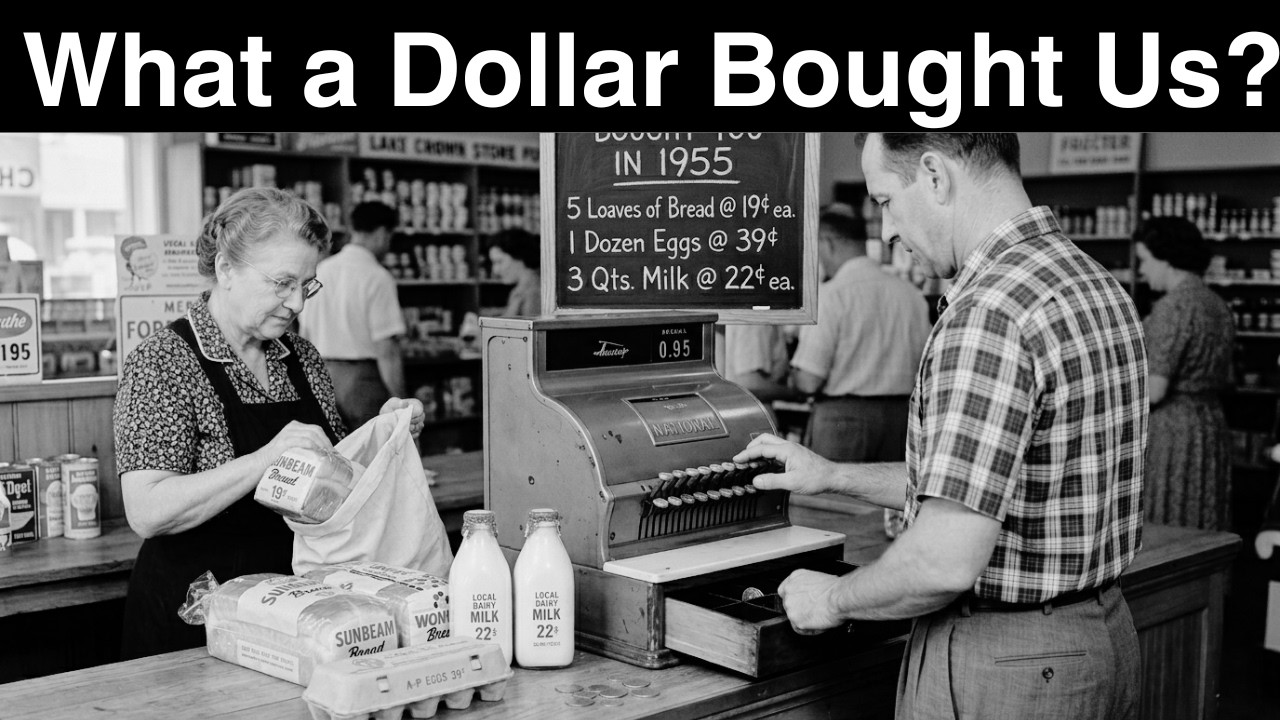
Bread was the baseline of survival. A loaf of white bread cost 18 cents, so a dollar bought five loaves. Wonder Bread came in wax paper or a thin plastic bag, soft and impossibly white, and it lasted about three days before going stale.
Today a name-brand loaf runs around $4.50. That is an increase of 2,400%. If the minimum wage had tracked that increase, workers would be making $40 an hour.
Milk cost about 28 cents a quart, so a dollar bought three and a half quarts. The milkman delivered heavy glass bottles with cardboard caps to the doorstep, and customers left the empties on the porch to swap for full ones.
It was whole milk, cream-top milk that tasted like milk. Today a quart runs about $1.50, roughly a 400% increase, and it is often ultra-pasteurized to sit on shelves for weeks. In 1955, a minimum-wage worker earned a quart in 12 minutes. Today it takes nearly an hour.
A dozen large eggs cost 61 cents, so a dollar bought a dozen with 39 cents left over. Eggs were the cheap protein, the standard fuel for the American workforce, and bacon and eggs was not a luxury breakfast.
They came in flimsy cardboard cartons, sometimes with bits of feather still stuck to them. Today a standard carton hovers around $4, with organic or free-range eggs at six or seven dollars. That is an increase of over 500%. A dollar now buys two eggs, maybe three.
A full one-pound tin of Maxwell House or Folgers coffee cost about 93 cents, leaving seven cents for a pack of gum. The can was metal, opened with a key that peeled a strip around the rim, and the smell hit you like a wave.
Today the plastic tubs and vacuum-sealed bags hold 12 ounces, sometimes 11 or 10 and a half. A 12-ounce bag of decent coffee costs $8 or $9, which works out to nearly $12 for a full pound. That is an inflation rate of over 1,200%.
Ground beef cost 29 cents a pound, so a dollar bought three pounds, enough for meatloaf on Monday, spaghetti on Wednesday, and hamburgers on Friday. A butcher in a white apron and paper hat ground it fresh, weighed it on a scale, and wrapped it in white butcher paper tied with string.
Today ground beef comes in a plastic-wrapped Styrofoam tray at $5 or $6 a pound, mixed from dozens of cows. A dollar buys about three ounces, not even enough for one burger.
Gas was 23 cents a gallon, so a dollar bought more than four gallons. A teenager in uniform pumped it for you, checked your oil, wiped your windshield, and checked your tire pressure, all for that price.
The pumps were tall and round with a glass globe on top, and you could watch the gas slosh inside before it went into your tank. Today the national average hovers around $3.50, you pump it yourself, and you watch ads on a screen at the pump.
A Hershey bar was a nickel, so a dollar bought 20 of them. The bar was bigger and thicker, with more cocoa and less sugar, and a kid who found a nickel on the sidewalk could have a great afternoon.
Today a standard Hershey bar is $1.79, a 3,400% increase. A nickel on the sidewalk is basically trash.
A bottle of Coke was five cents, so a dollar bought 20 bottles. They were the iconic 6.5-ounce green glass bottles, bought ice cold from a red cooler at the drugstore or gas station.
You dropped your nickel in the slot, slid the bottle along the track, pulled it out dripping with ice-cold water, and popped the cap on the opener mounted to the side. The carbonation was sharp and the sweetness was real sugar, not corn syrup.
Today a single bottle at a convenience store is two or three dollars, a 5,000% increase, and it is high fructose corn syrup in plastic. A dollar now buys a third of one bottle.
A movie ticket for a kid cost 50 cents, and an adult ticket was around a dollar or $1.10. A dollar got you in the door for the matinee.
You bought your ticket from a woman behind glass, walked into a theater that smelled like popcorn and carpet, and sat in red velvet seats. There was one screen, one movie, no commercials, and the newsreel and cartoon played before the feature.

Today a ticket in a major city is $18, and IMAX is $25, a 2,400% increase. A teenager in 1955 could work one hour at minimum wage and see a movie with money left for popcorn. Today it takes three hours just to get in the door.
A pack of cigarettes cost 23 to 25 cents, so a dollar bought four packs, or two packs with 50 cents left over. You bought them from vending machines in restaurants, bowling alleys, and grocery stores, and the pack dropped with a metallic thud.
Smoking was everywhere, in offices, airplanes, hospital waiting rooms, and grocery stores. Today a pack is $10, or $15 in places like New York, a 5,000% increase driven by tax as much as inflation.
A pound of bacon cost around 65 cents, leaving 35 cents change. It came wrapped in butcher paper, sometimes sliced right at the counter, and it was fried at home in a cast iron skillet until the whole house smelled like bacon for hours.
Today bacon costs seven or eight dollars a pound, over a 1,000% increase, and the strips are thinner, shrink more when cooked, and are half water and fat.
A first-class postage stamp cost three cents, so a dollar bought 33 stamps with a penny left over. You could pay all your bills by mail, write to relatives across the country, and send birthday cards.
You licked the back, dropped the letter in the blue mailbox on the corner, and it arrived anywhere in America three days later. Today a first-class stamp is 73 cents, a 2,300% increase.
A quart of high-quality motor oil cost 40 cents, so a dollar bought two quarts with 20 cents left. The cans were metal and cone-shaped, opened with a spout or a church key to punch one hole for pouring and one for air.
It was messy, oil dripped on the driveway, and you wiped your hands on a rag that used to be a T-shirt. Changing your own oil was part of being a man. Today a quart of synthetic oil is nine or ten dollars, and most people pay someone else $30 to change it.
A man's haircut cost 75 cents, leaving a quarter for a tip. The barber shop was a ritual: waiting in a chair along the wall, reading the newspaper, then sitting in the big leather chair while the barber cut with scissors and comb, used clippers on the back and sides, and shaved the back of your neck with a straight razor.
The whole thing took 20 minutes. Today a basic haircut is $25 or $30, a 3,300% increase, and most places do not even use a straight razor anymore.

A paperback book cost 35 cents, so a dollar bought two with 30 cents left. They were real books, 200 pages on cheap pulp paper that yellowed with age, with colorful covers: detective novels, westerns, science fiction, romance.
You bought them at the drugstore from a spinning wire rack, read them, and passed them to a friend or kept them to build a library. Today a paperback costs $15 or $16, a 4,000% increase, and half the time you are buying a digital file you do not own.
A 45 RPM vinyl single cost 89 cents, leaving 11 cents change. The record came in a paper sleeve, and you took it home, put it on the turntable, and dropped the needle. You owned the song and could play it as many times as you wanted.
Chuck Berry, Elvis, Fats Domino, and Little Richard all arrived on 45s that cost less than a dollar. Today a vinyl single is $15 if you can find one, or you pay $10 a month for a streaming service where you own nothing.
A massive Sunday edition of the newspaper cost around 15 cents, so a dollar bought the Sunday paper and still left money for the weekday editions. It weighed two or three pounds and included news, comics, sports, classifieds, a magazine insert, and a TV guide.
It took all morning to read. Your father sat with the paper spread across his lap, your mother read the recipes and society pages, and the kids fought over the comics. Today a Sunday print edition can cost $6, and most people get their news from their phones.
A gallon of quality interior paint cost $1.49, so a dollar bought most of a gallon, enough to paint a bedroom. It came in a metal can with a wire handle, pried open with a screwdriver and stirred with a wooden stick.
It smelled like turpentine and progress and dried overnight. Today a gallon is $35 or $40, a 2,600% increase, in a plastic can with low-VOC paint.
A full meal at a diner cost around 75 cents: meatloaf, mashed potatoes, green beans, a roll, and coffee, with a quarter left for a tip. The diner had swivel stools, vinyl booths, a jukebox at every table, and a waitress with a pencil behind her ear who called you hon and poured your coffee without asking.
The meatloaf came on a plate the size of a hubcap, and you left full. Today that same meal costs $15, a 2,000% increase, and the portions are smaller.
To afford all of this in 1955, you needed a job. The federal minimum wage was 75 cents an hour, so a man over 18 had to work about 80 minutes to earn a dollar.
The average wage for a man was around $1.90 an hour, so he earned that dollar in about 32 minutes. Women did not get the same deal: average hourly pay for office work was often around $1.20, meaning she had to work 50 minutes for the same dollar.
It was unequal and unfair, and the economic disparity was real. But that dollar in 1955 could keep a single person alive for a day on food staples: bread, milk, eggs, ground beef. A dollar bought survival. Today it will not even buy the shopping bag to put them in.