In February 1978, Jimmy Carter was in the White House and the Bee Gees topped the charts with "Stayin' Alive," a title that would soon take on a grim irony. It was an era of heavy steel cars, rear-wheel drive, and no traction control. There were no cell phones to check the radar and no weather apps to deliver warnings. Americans had the morning paper, the AM radio, and the gray sky above them.
It began as a Monday like any other. On February 6, alarm clocks rang in the dark across the Ohio Valley and New England. Coffee brewed in percolators. Millions buttoned up their wool coats, scraped frost off their windshields, and headed out. The forecast called for snow, typical for February.
Nobody knew what was actually coming. Two massive weather systems were hurtling toward a collision. One was a cold, dry arctic blast diving down from Canada. The other was a warm, wet moisture plume surging up from the Gulf of Mexico. They were destined to meet over the Ohio Valley and explode into a meteorological bomb.
The barometric pressure was about to crash to levels usually seen only in category 3 hurricanes. By evening, the street signs, the fences, and the familiar roads home would be gone. The enemy was not a foreign army. It was the wind and the ice. For the next week, America would be under siege by a white hurricane.
The storm did not announce itself with a roar. It began with a lie. In many places, the morning of February 6 started with rain, a cold drizzle that lulled people into a false sense of security. Rain meant the roads were wet, not slick. It felt routine. People looked out their office windows at 10 a.m. and saw gray, slushy streets. They thought about dinner and the weekend, not survival.
But the trap was already closing. Around midday, the temperature plunged off a cliff. Within an hour, rain turned to sleet, peppering windows like buckshot. Then the sleet turned to snow, heavy and wet, not the fluffy romantic kind. Then came the wind. It did not gust, it screamed, sustaining speeds of 50, 60, then 70 mph. In coastal New England, gusts hit 100 mph. It was a hurricane with a wind chill of 50 below zero.
The transition was so violent that the National Weather Service could not update the forecast fast enough. People in Cleveland and Boston reported their ears popping from the collapsing atmospheric pressure. The morning rain flash-froze into a sheet of black ice. On top of that ice, snow piled up at three, four, sometimes five inches an hour. The deception was over. The ambush had begun.
The trap sprang in the early afternoon. Because it was a Monday, schools were full, factories were running, and offices were busy. When the sky turned black and snow blinded the windows, everyone made the same decision at the same time: I need to get home. Millions of cars flooded the highways simultaneously. The result was catastrophic.
On Route 128, the beltway around Boston, traffic slowed to a crawl, then stopped, then was buried. This was not a traffic jam. It was a mass casualty event in slow motion. Snow fell so fast that plows were rendered useless. A plow would clear a lane and five minutes later it was impassable again.
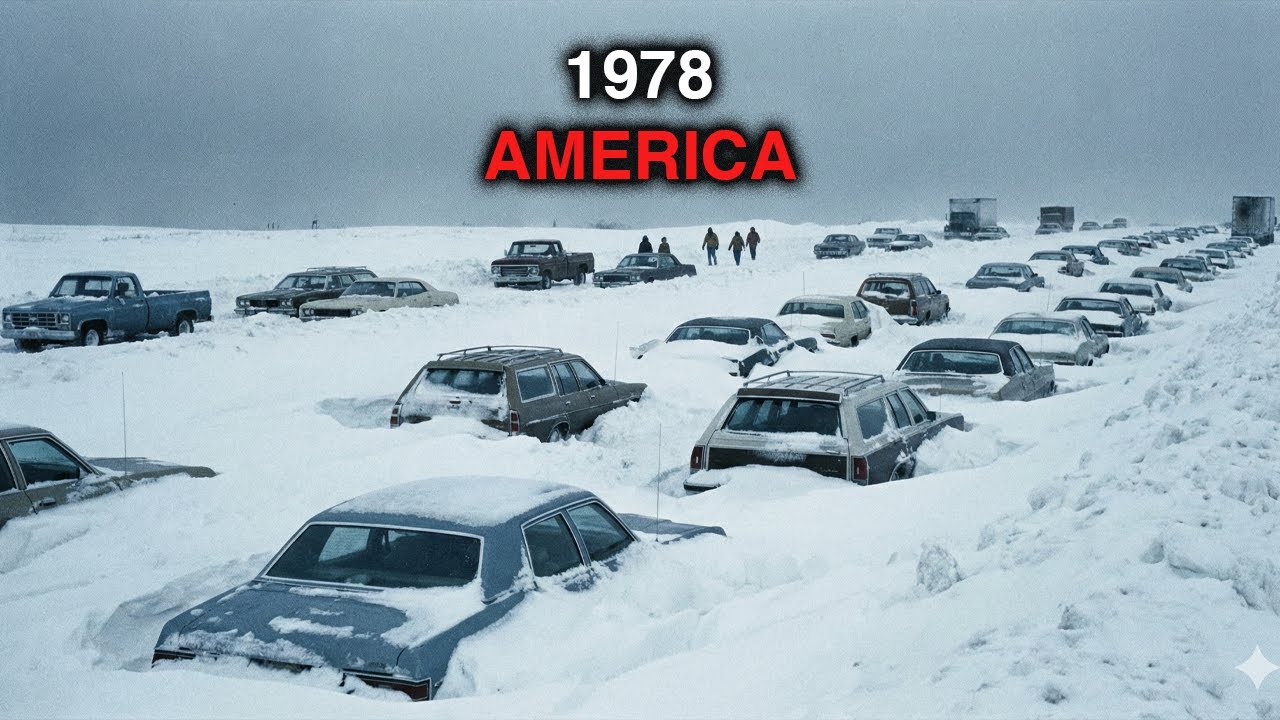
Drivers sat in idling cars watching the whiteout consume the world. They could not see the car in front of them or the guardrails. All they could hear was the wind howling like a jet engine and the gravel-like sound of ice pelting the metal of their doors. Minutes turned into hours. Gas gauges dropped. Heat faded. Snow crept up the tires, reaching the hubcaps, then the door handles. It sealed the cars in.
Thousands of motorists realized with dawning horror that they were not going home. They were trapped in a frozen tomb of steel and glass. On I-75 in Ohio, the scene was apocalyptic. The wind used the open highway as a runway. Semi trucks weighing tons were tossed aside like toys, jackknifing across all lanes and forming walls of metal that blocked escape routes. Drifts built against these trucks, rising 10, 15, 20 feet high.
Inside the cars, the psychological toll was immense. There was no mapping app to show a red line of traffic and no social media to reveal whether help was coming. There was only the static of the AM radio, where panic-stricken voices tried to make sense of the chaos. People faced a life-or-death choice.
Staying in the car offered shelter from the wind, but as snow buried the exhaust pipes, carbon monoxide began to seep into the cabins. Some people simply fell asleep and never woke up. Walking meant stepping into a whiteout where you could not see your hand in front of your face. Many chose to walk, tethering themselves together with scarves and jumper cables, forming human chains and stumbling toward the faint glow of house lights.
They abandoned their Pontiacs, Buicks, and Chevys, leaving them as monuments in the snow. Those who lived near the highways became accidental heroes. They saw headlights disappearing into the drifts and opened their doors. Strangers took in dozens of refugees. Living room floors became triage centers. People pulled from their cars, frostbitten and terrified, were given coffee and blankets by people they had never met.
On the road, silence descended as engines died one by one. The highway, a symbol of American freedom and movement, became a graveyard. As the sun went down, though no one could see it, only a gray, swirling void faded into pitch black. The siege then moved to the homes.
The power grid was the first casualty. Battered by hurricane-force winds and weighed down by heavy ice, lines snapped. Transformers exploded in blue-green flashes that lit the blinding snow for a split second before plunging entire counties into darkness. In 1978, houses were not insulated like they are today. There were no triple-pane windows or high-efficiency foam.
When the furnace died, the cold kicked the door down. Inside, the temperature dropped to 60, 50, 40 degrees. You could see your breath in the bedroom. Water pipes burst in the walls, sounding like gunshots, flooding basements that then froze solid and cracked foundations. Families retreated, abandoning bedrooms and upper floors to huddle in a single room, usually the kitchen or living room, with a fireplace.
They hung blankets over doorways to trap what little heat they had and laid mattresses on the floor in front of the fire. There was no choice but to endure. The food supply became a sudden obsession. Grocery stores were closed and the roads were gone. You had what was in your pantry, and that was it.

Families opened cans of Campbell's soup and heated them on wood stoves. They ate cold beans. They raided the freezer, realizing the food inside was now warmer than the air outside. The noise was relentless. The wind did not stop for days. It battered the siding and shook the shingles, sounding like a freight train parked on the roof. The house groaned under the weight of the snow.
For three days, the isolation was total. You could not open your front door, not because it was locked, but because a 10-foot drift was packed against it like concrete. People had to crawl out of second-story windows just to check the vents or see if the world was still there.
The radio became the lifeline. In the darkness, huddled under piles of quilts, families listened to local DJs who stayed on the air for 24, 48, even 72 hours straight. They read lists of open shelters and took calls from people trapped in their homes. They became the voice of the storm and the only proof that civilization had not completely ended.
Inside that struggle, there was a divide. For adults, the blizzard of 1978 was a catastrophe, a battle for heat, oil, and food. It was the fear of the roof collapsing, the anxiety of a missed paycheck, and the terror of not knowing what had happened to the car abandoned on the highway.
For kids, it was Narnia. It was Hoth. It was absolute magic. School was cancelled, not just for a snow day but for a week or more. The drifts were not obstacles but architecture. The wind had sculpted the snow into hard-packed waves you could walk on without sinking.
Kids put on their one-piece nylon snowsuits and climbed out the windows. They sledded off garage roofs because the snow was piled high enough to create a perfect ramp. They dug elaborate multi-room tunnel systems through front yards and created caves where the wind could not reach them, lit by ethereal blue light filtering through the snowpack. To a 10-year-old in 1978, the blizzard was not a disaster. It was the greatest adventure of their lives.
They walked to the local convenience store, pulling sleds behind them on missions to get milk or bread. They walked down the middle of main streets that were usually filled with traffic, now silent canyons of white. The adults were paralyzed by the snow, but the kids were liberated by it. They did not see the fear in their parents' eyes as the woodpile dwindled. They only saw a world transformed into a playground of ice.
By the third day, reality forced a different kind of response. Local police and fire departments were overwhelmed. Cruisers were buried and engines frozen. Mayors and governors realized they had lost control of their territory and called in the cavalry. The National Guard was mobilized, not to fight a riot or a war, but to fight the drifts.
It was a surreal sight. In suburban neighborhoods of Boston and Cleveland, M60 tanks and armored personnel carriers rolled down the streets, the rumble of their tracks shaking the frozen ground. They were the only vehicles capable of crushing the snow. They were not looking for insurgents. They were delivering bread.

Soldiers in full winter gear rode on the backs of trucks, handing out gallons of milk and prescription medicine to elderly people trapped in their homes. Helicopters landed on high school football fields to evacuate heart attack victims. In some places it was called Operation Snowdrop, a full-scale military mission to save civilians from their own weather.
But the military could not be everywhere. That is where the true spirit of the blizzard revealed itself. The snowmobiles became the citizen navy. In towns across New England and the Midwest, anyone who owned a snowmobile became a first responder. These were not government employees, just guys from the neighborhood.
They organized themselves into rescue squads. They ferried doctors to hospitals, weaving through buried cars on the highway. They carried police officers to crime scenes. They brought insulin to diabetics and baby formula to panicked mothers. They strapped toboggans to the backs of their sleds and moved groceries, firewood, and people. For a week, the laws of the road did not apply. The snowmobile was king.
It was the American spirit distilled to its essence. When the system breaks, the people step up. There was no social media to post a status asking for help. You had to physically check on your neighbor, and people did. They put on snowshoes and trekked next door. If you had a wood stove and your neighbor did not, your house became the neighborhood shelter.
Strangers slept on living room floors. People shared what little they had: cans of tuna, candles, batteries. If a car was stuck, 10 people appeared out of the mist to push it. No money was exchanged. There was no hesitation. The adversity stripped away the superficial barriers of society. In the face of the storm, everyone was equal. Everyone was cold, and everyone needed each other.
When the storm finally broke and the low-pressure system moved out to sea, the sun came out. It glared off the blinding white landscape with an intensity that hurt the eyes. The silence was broken by the sound of shovels. The cleanup began, and it was not just shoveling. It was excavation and archaeology.
People dug out cars that looked like igloos, guessing which lump of snow was a Volkswagen and which was a mailbox. They found roads that had been missing for a week. The sheer volume of snow was staggering: 27 inches in Boston and nearly 40 inches in parts of Rhode Island. But the drifts made those numbers meaningless. Drifts reached traffic lights and buried the first floors of houses.
As the snow was cleared, the tragedy was revealed. Bodies were found in cars on the highway, people who had just gone to sleep and never woken up. The toll was grim. Nearly 100 people died in Massachusetts and Rhode Island alone. The economy had been paralyzed. Businesses lost millions. Roofs of arenas and warehouses collapsed under the weight. It took weeks for life to return to normal, and in some shady corners the snow did not fully melt until May.
The great blizzard of 1978 changed the country. It taught a generation to respect the sky. It exposed the fragility of modern systems: how quickly highways can close, how fast power can die, and how thin the veneer of civilization is when the temperature drops. But it also revealed strength.
It is remembered not just for the records broken or the lives lost, but for the way people huddled together in the dark, waiting for the plow. It was the storm that buried America, but it was also the storm that proved Americans could dig themselves out. For those who lived through it, the winter of 1978 is not just a weather event. It is a benchmark and a badge of honor.
It is the story they tell their grandchildren when they complain about an inch of slush or a canceled bus. They lean back, look them in the eye, and say, "You think this is snow? Let me tell you about the time we walked out of the second-story window." It was a time of hardship, a war against the wind. But looking back through the lens of history, it was also a time when people saw the best in themselves, reflected in the white frozen mirror of the storm. They survived the white hurricane, and they will never forget it.