In October 2025, three men in their sixties stood around a simple table in a bank in the Canadian province of Quebec, watching an employee set down a small brown leather suitcase. It was the kind of bag a person carries when leaving in a hurry and may never return. Its corners were worn, its leather softened by time.
Inside, wrapped in yellowed paper, lay a jewel the world had hunted for more than a century. Experts on three continents had claimed the stone was recut, broken, smuggled, pawned, or simply lost. Karl von Habsburg-Lothringen, grandson of the last emperor of Austria, opened the suitcase himself and began lifting away the paper piece by piece. The others leaned in. None of them had ever seen what was inside.
What he finally revealed was the Florentine Diamond, weighing 137.27 carats, with a faint yellow brilliance. It still had its irregular nine-pointed form, exactly as a Venetian jeweler cut it in 1615. No one had touched it. It had not been recut to hide its identity, as nearly every serious gem historian had assumed.
The diamond had been kept in that vault since around 1940, placed there by an exiled empress who carried it with her from a collapsing empire and then asked her family to stay silent for years. What is surprising is not that the diamond survived. Great stones outlast wars and revolutions; that is part of what makes them great. What is surprising is the silence that surrounded it.
For a century, the Republic of Austria, the European press, gem dealers, novelists, and FBI art-crime experts all worked from the assumption that the Florentine Diamond had been lost, stolen, or destroyed. Many assumed the Habsburgs had secretly sold it during their years of poverty and exile. The family was accused, publicly or implicitly, of losing its own treasure. The truth, when it finally emerged, was the opposite of theft.
A stone that passed through four dynasties and vanished from historical records had been kept intact by the royal family. It was not a challenge to the law but a silent challenge to a republic that had spent decades trying to take it away.
Every great diamond has two histories: one documented and one people prefer to tell. The Florentine carries the second kind more than almost any other diamond in Europe. The version scholars accept today does not begin in a European court but deep in the mines of Golconda in southern India, the same legendary source that produced the Koh-i-Noor and the stone that would one day be known as the Hope Diamond.
There, around the early sixteenth century, a rough yellow crystal of exceptional size emerged from the earth. The documented chain begins with the Portuguese, who by the sixteenth century had built a trading empire along the Indian coast. According to accounts drawn from later Medici inventories, Dom Luís de Castro, Count of Monsanto, the Portuguese colonial governor of Goa, obtained the rough crystal from the king of Vijayanagara in what is now southern India.
Castro did not keep the crystal for himself. He deposited it with the Jesuits in Rome for safekeeping, where it waited through long negotiations before money and ambition caught up with it. Against this realistic account stands the legend, which is worth telling precisely because so many believed it.
According to a version largely rejected by historians, Lodewyk van Bercken, a Flemish gem cutter in Bruges, cut the diamond for his patron Charles the Bold, Duke of Burgundy. In this tale, Charles wore the stone on his body when he fell at the Battle of Nancy on January 5, 1477. A soldier or peasant was said to have found it on the duke's corpse, taken it for a piece of glass, and sold it for a florin or two.
From there, the legend says, the diamond passed to a man from Bern named Bartholomew May, then to the Genoese family, then to Ludovico of Milan, then perhaps to the Vatican, where Pope Julius II is listed among its owners, before it finally reached Florence. The problem with this legend is that the stone itself does not confirm it.
The cut visible in all surviving descriptions is a complex double cut in the Indian style, not the simpler pyramidal and flat cuts European gem cutters used in van Bercken's era. The diamond's weight matches no documented Burgundian diamond. Even the sources disagree about which battle it was, with some naming a campaign in 1476 and others Nancy in 1477. That contradiction alone is evidence of a story that is hard to verify.
Most gem historians describe it as fabricated, yet it remains popular because the image of the dead duke and the soldier selling a king's ransom for a coin is the image that seems to suit a diamond. The stone's real origin, from an Indian mine and a Jesuit treasury in Rome, is less romantic and more likely. The men who bought the stone were not soldiers or popes but bankers, and that suited Florence better than any battlefield.
Ferdinando I de' Medici, Grand Duke of Tuscany, bought the rough crystal from the Castro-Noronha family for 35,000 Portuguese cruzados, a sum that shows how serious the Medici banking dynasty was about acquiring the diamond. The Medici had financed the Italian Renaissance. They were the patrons behind Michelangelo, Leonardo da Vinci, Botticelli, and Raphael. They were entitled to a rough crystal of this size, as befits a masterpiece in a great art collection.
But buying it was only the beginning. A stone like this had to be turned into a work of art. The task fell to Cosimo II de' Medici, son of Ferdinando, who ruled from 1609 to 1621 and entrusted the rough crystal to the skilled Venetian jeweler Pompeo Studenti, who worked in Florence. The cut jewel was delivered on October 10, 1615, in the form it still has today: an irregular nine-sided shape with 126 facets in a double rose pattern.
An inventory prepared at Cosimo's death recorded the acquisition and described the stone as cut on both sides and set in a diamond-studded ring. The Florentine jewel became an ornament of the court, and a surviving image shows Archduchess Maria Maddalena of Austria wearing it, a precious jewel displayed at the height of Florence's wealth.
The first time the outside world had a reliable chance to see the diamond after decades came in 1657, when the French jeweler, traveler, and historian Jean-Baptiste Tavernier reached Florence. Tavernier is the same figure linked to the blue diamond that would one day captivate the world. A man who handled more gemstones than almost anyone else alive, he was shown the Florentine among the collections of Ferdinando II de' Medici.
He described it as the largest diamond in Europe, noted its pale lemon-yellow color and its distinctive double rose cut, and then did what made his account so often quoted afterward: he set a value on it. Tavernier estimated the stone at 600,000 scudi, an enormous figure that placed the Florentine among the most valuable objects on the continent. He was trying to appraise something the Medici allowed almost no one to examine closely.
That contradiction appears clearly in early documents. Thomas Cletscher, around 1625, recorded the weight of the rough and cut jewel as 170 carats and 120 carats respectively, and both figures are inaccurate. The modern accepted figure of 137.27 carats was only established by scientific measurement in the nineteenth century. The Medici had a gem everyone wanted to describe and almost no one was allowed to weigh, a practice a family that understood the value of mystery preferred to maintain.
Despite their vast wealth, the Medici could not solve the one problem that ends every ruling dynasty: male succession. The male line was gradually fading during the early eighteenth century. When the last grand duke of the Medici, Gian Gastone, died without an heir in 1737, Florence's continuous rule over Tuscany ended, and the diamond passed with the duchess.
Its fate was not settled in Florence but in the diplomatic corridors of Vienna, through one of the most important marriages of the century. In 1736, Francis Stephen of Lorraine married Maria Theresa of Austria, founding the Habsburg-Lorraine dynasty that would rule a vast empire in Central Europe for nearly 200 years. The Treaty of Vienna of 1738 was the document that transferred the stone, confirming the transfer of all of Tuscany to Francis Stephen in exchange for his renunciation of the Duchy of Lorraine to France.
The Florentine Diamond, as part of the grand ducal Medici treasury, moved with Tuscany to its new owner and was taken north to Vienna. There it was displayed in Chamber No. 13 of the Imperial Treasury at the Hofburg Palace, and the way it was catalogued mattered far more than anyone in 1738 could have imagined.
The diamond was placed among what the dynasty had previously called the private imperial court jewels, kept separate from the crown jewels and listed in their own records as private family property. This distinction between private property and state jewels was a mere accounting procedure in the eighteenth century. It would become a legal weapon in the twenty-first.
In the meantime, the diamond did what great court jewels do: it appeared at the most splendid moments of rule. When Francis Stephen was crowned Holy Roman Emperor in 1745 as Emperor Francis I, he wore the Florentine in his imperial crown. Maria Theresa herself appears to have given the stone the name it has carried since.
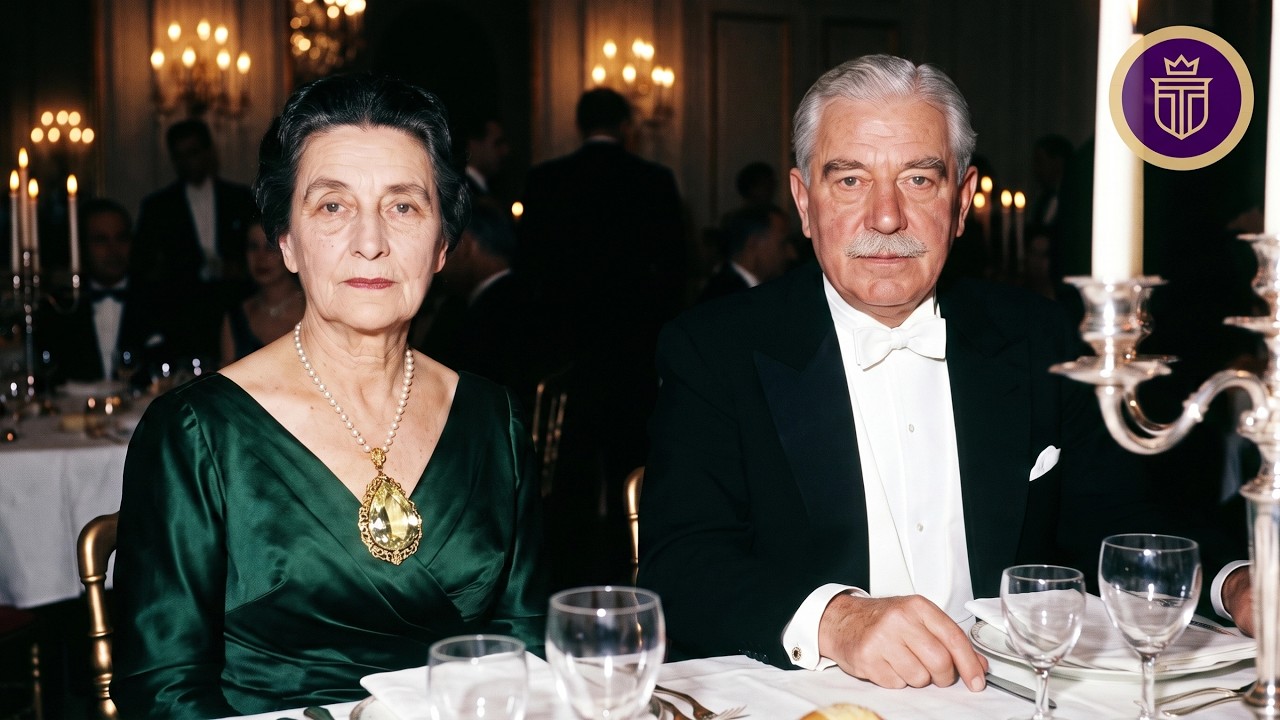
Maria Theresa, who exercised real power behind the throne, and Francis Stephen were the parents of Marie Antoinette, meaning this unique yellow diamond touched both the Austrian imperial court and, through their daughter, the doomed Bourbon court at Versailles. The diamond continued to move with the family's fortunes.
In 1810, Marie Louise of Austria, the archduchess who became Napoleon Bonaparte's second wife, received the jewel among the Habsburg properties linked to her wedding. When Napoleon's rule ended in 1814, she returned to Austria and brought the diamond with her. All these movements were recorded, forming a documented chain of possession that researchers later relied upon.
The diamond, once nearly impossible to weigh, became generation after generation one of the best-documented gemstones in Europe. These documents would one day be the only thing separating the family from accusations that they had lost it.
By the nineteenth century, the Florentine was firmly established as one of the highest jewels of the Habsburg court, and the dynasty finally did what the Medici never had: measure it precisely. In 1865, Dr. Moritz, head of the mineral cabinet of the imperial and royal court, officially documented the stone's weight and exact specifications.
A plaster mold was made, and a replica of rhinestone was produced at El Seman in Paris, with great care taken to match the original's color. A copy is still kept today in the Natural History Museum in Vienna. The official color description was the color of wine mixed with water, a strangely delicate phrase for an imperial inventory and an accurate description of a luminous pale yellow that no modern term captures precisely.
This measurement turned the Florentine from a legend into a documented artifact. The descriptions that survive from that period explain why many observers struggled to describe it accurately. The American writer Nathaniel Parker Willis, who visited the Imperial Treasury in Vienna in 1833, described it as a mass of light, adding that although massive diamonds surrounded it, it hung among them like a Hesperus star among stars.
That such a description came from a visiting writer rather than a court official shows the stone's effect when seen directly. It was not merely a large stone; it seemed to gather light and hold it in a way the surrounding brilliance did not. The secret of that effect lies in the cut, which later made it possible to identify the stone with extreme precision.
The Florentine double rose cut, with matching triangular facets above and below, was developed in the sixteenth and seventeenth centuries to enhance light reflection in candlelit rooms. Unlike modern brilliant cuts designed to sparkle under electric light, the double rose scatters light more softly, producing the ethereal glow observers tried to describe with phrases like "a mass of light." It was a cut designed for a world lit by fire, and it continued to shine in a court that still depended on candles and chandeliers.
During that era, the diamond appeared in various forms: as a hat ornament, a heron-shaped decoration, pins, and a crown ornament displayed on the facade of the monarchy. The only known original photograph of the stone, a black-and-white image taken between 1870 and 1900 and kept at the Kunsthistorisches Museum, shows the stone mounted in a hat pin.
That photograph alone was enough to settle the diamond's fate, more than any document. During the century the diamond itself was absent, its shadow in that brooch was the only fixed image researchers relied upon. The Habsburgs, by photographing and carefully cataloguing their own jewel at the height of their rule, were unknowingly preparing the evidence that would one day prove the diamond they kept was real.
Everything that made the Florentine safe depended on the empire that controlled it. In the final weeks of World War I, that empire fell apart within days. On the morning of November 1, 1918, Emperor Karl I, the last Habsburg ruler and nephew of Archduke Franz Ferdinand, whose assassination in Sarajevo ignited the war, realized his kingdom could not be saved. Crowds in the streets of Vienna were demanding a republic.
With the monarchy collapsing around him, Karl turned to his loyal master of the household, Count Leopold Berchtold, and entrusted him with a sensitive and urgent task. Berchtold and his men went to the imperial Hofburg treasury and emptied dozens of pieces from the display cabinets in Chamber No. 13, the same chamber that had held the Florentine since the eighteenth century.
Amid the chaos of revolution, they moved the treasures across the border to Switzerland on November 4, 1918, three days before Karl issued his official declaration of withdrawal from Austrian affairs on November 11. Among the pieces taken out was the Florentine Diamond, still mounted in its hat brooch, the diamond crown worn by Empress Elisabeth, known as Sisi, and a brilliant-cut diamond bracelet set with a large emerald that Maria Theresa had worn on her sleigh rides, among many others.
The jewels were first deposited in the Swiss National Bank in Zurich. Once they crossed the border, the diamond was no longer merely a private ornament. It became disputed property, and claims soon poured in. The new First Austrian Republic, rebuilding itself from the ruins of the empire, quickly turned to legal mechanisms to claim all Habsburg property as state property.
The Kingdom of Italy filed a claim to the Florentine, arguing that the Medici had bequeathed it to the people of Florence and that its transfer to the Habsburgs in 1737 was illegal. Every claimant wanted the stone, and none of them had it, because it sat in a Swiss vault under the control of a family that had lost everything but its jewels.
The family's defense rested on two facts: one geographic and one procedural. In 1921, the Austrian public prosecutor declared that all pieces in the collection, including the Florentine, were purely private property of the Habsburg-Lorraine family, a position the Austrian state confirmed again decades later. And because the pieces were physically outside Austria, when the republic enacted confiscation laws, the principle of territorial sovereignty prevented those laws from reaching them.
Thus the empire that had protected the diamond for nearly two centuries vanished within a week. But the precise decision made in the eighteenth century to classify it as private rather than public property quietly survived the destruction, waiting to be used.
The collapse of the monarchy produced not only a republic but a set of laws designed specifically to dismantle what the Habsburg family had been. The republic abolished all noble and imperial titles under the Nobility Abolition Act of 1919, and the broader Habsburg Law sought to seize Habsburg property for the state. The goal was unambiguous: to ensure the dynasty could not turn its assets into a base for restoration.
The Florentine, as the family's most famous movable piece, fell into the path of this goal, and determining its ownership became a matter of international arbitration rather than family discretion. That ruling came in 1923, when the Allied Reparations Commission issued its decision on the Italian claim and rejected it, holding that the diamond was private property of the Habsburg family.
The decision was crucial because it did not come from the family itself claiming its rights but from an external body that reviewed competing claims and concluded the gem belonged to the family, not to the Italian state or the people of Florence. It was an early external confirmation of the argument the Habsburgs would repeat for more than a century: that the Florentine was always private property, not the holdings of any state.
The stone's legal status therefore rested on a precise structure rather than mere possession. The Austrian public prosecutor declared in 1921 that the pieces were separate private property of the Habsburg-Lorraine family, and the 1923 commission decision rejected a competing sovereign claim. The principle of territoriality meant the republic's confiscation laws, written for assets inside Austria, could not cover objects in a Swiss bank.
In theory, the family's position was strong. In practice, what the family actually owned and where was about to become one of the century's greatest mysteries. What gave the legal argument its strange shape was that it would be debated in the absence of the thing itself. The Austrian state believed it had a right to a diamond no one could find. The family owned a stone the law said was theirs, but the world believed they had lost or sold it.
For the next hundred years, the legal status of the Florentine would be discussed by people who did not know whether the object they were arguing about still existed in its original form. The gap between the law and the thing is where the entire puzzle lies. Into that gap rushed every theory the twentieth century could invent.
By 1921, the European press had already begun reporting that the Florentine had disappeared from the family's possession in Switzerland, coinciding with a disastrous season. Karl I made two failed attempts to regain control of Hungary that year, and the second ended with his arrest and forced exile from Central Europe.

He and Empress Zita were taken on British ships down the Danube to the Mediterranean, where their ship eventually docked in Madeira. There Karl died of pneumonia on April 1, 1922, leaving Zita a widow at twenty-nine with eight children and almost no protection. Against this image of an exiled and impoverished imperial family, suspicions about jewel sales became obvious.
The Swiss chapter was overshadowed by a real betrayal that sharpened those suspicions. Karl and Zita were said to have fallen victim to a deception by an official financial adviser who managed to steal several pieces from the full collection. The Swiss diamond dealer Alonse de Sondheimer claimed in his memoirs, published in 1966, that the family jewels were offered to him by the emperor's private secretary, a man named Steiner, later known as Bruno Steiner, and that he acquired several pieces.
The exiled emperor, Sondheimer wrote, did not need gold but money, and according to his account, emeralds were cut, necklaces and crowns broken, diamonds pried from their settings, and even the Florentine itself detached from a brooch and broken. The accusation against Steiner was not mere gossip. A 1923 New York Times article reported that Baron Steiner had been arrested for questioning about the loss of the Austrian crown jewels. The headline referred to Steiner as the man who pawned the Austrian jewels.
A later account said Sisi's missing diamond crown was last seen after 1921, when Steiner wore it during a drunken episode before it vanished forever. Multiple sources support the idea that one trusted insider converted some Habsburg jewels into cash, a point that is not in dispute. What was disputed for a hundred years was whether the Florentine itself was among the things he sold, and the discovery of the stone in its original form in 2025 answered that question.
Amid this uncertainty, theories multiplied, each with some plausibility. The prevailing view among serious gem historians was that the stone had been recut and sold, probably in the United States, on the logic that any large stolen diamond is recut to hide its identity. A 99.52-carat yellow cushion-cut diamond that appeared on the American market in 1923 briefly drew suspicion before its shape and origin were ruled out.
A more intriguing diamond appeared at Christie's autumn auction in Geneva in 1981: a brilliant yellow stone of unknown name weighing just under 82 carats. Hussela said it had been in her family since shortly after the war and had been recut from an unusual old form, a theory said to be supported by the prominent British diamond historian. Others claimed the stone was smuggled to South America, pawned to finance Karl's Hungarian adventure, seized by Nazi Germany, or secretly returned to Vienna by American forces after World War II.
But all these theories failed for lack of evidence. They shared one fatal oversight: none of their authors knew that Empress Zita had deposited it in a bank in Quebec, and she lived keeping the secret until 1989. The fact that the diamond survived comes down to one woman, and her life is the driving force of this entire story.
Zita von Bourbon-Parma was born in 1892, became Empress of Austria and Queen of Hungary at twenty-four, and by twenty-nine was a widow with eight children, stateless, and on the verge of bankruptcy after her husband's death in Madeira. Zita did not surrender to despair. She kept moving, settling first in the Basque Country in Spain, then in Belgium, where the family lived throughout the 1920s and 1930s.
Their lives were organized around survival and around her children. The eldest, Prince Otto von Habsburg, later became the family's most prominent public figure. The danger that shaped the family's life returned in a new form in the 1930s. From Belgium, Otto campaigned publicly against the growing Nazi threat and offered his services to the First Austrian Republic in its struggle to remain independent of the Third Reich. When Germany annexed Austria in March 1938, he was declared an enemy of the state. For the second time in a generation, the family found itself in imminent danger.
When German forces attacked Belgium and France in May 1940, Zita was fleeing again, this time with eight children, some now adults, and the surviving Habsburg jewels with them. One incident from that journey captures her character precisely. At the Spanish border, a guard recognized the former empress and allowed her to cross, then at her request also allowed all the desperate refugees waiting in line behind her to enter Spain.
Karl von Habsburg-Lothringen, recounting the scene decades later over dinner in a Viennese restaurant, gestured at the empty air as if a long line of refugees were still standing there, and quoted his grandmother's instruction to the guard about the people behind her: all of them.
The family moved from Spain to Portugal, then with American help to North America in 1940, eventually settling in Sillery, a suburb of Quebec City, where they lived modestly. There Zita said she loved Canada and Quebec, held particular affection for French Canadians who treated them kindly, and did not intend to leave.
Throughout her journey, she carried the jewels in a small bag, described in some accounts as brown leather and in others as cardboard. The two descriptions may reflect different stages of the journey. Karl later spoke of it with deep emotion, describing it as a small immigrant's bag, the kind in which a person carries their last possessions while fleeing.
Once the family settled in Quebec and Zita could finally breathe, as Karl put it, she placed the bag in the vault of a Quebec bank around 1940, in a bank and city the family no longer remembers precisely. In 1953, she returned to Europe. But she made a deliberate decision to leave the jewels in the vault, and she died in Switzerland on March 14, 1989, at the age of 96, having kept her secret for nearly half a century from a continent that spent all those years wondering about the fate of the world's fourth-largest diamond.
What Zita built around the diamond was not merely a hiding place but a covenant, precisely designed by a woman who understood the full cost of persecution. She told only two of her sons where the jewels were stored: Archduke Robert and Archduke Rudolf. She deliberately kept the rest of the family in the dark, including her eldest son, Crown Prince Otto, the most prominent surviving Habsburg and himself a member of the European Parliament.
The instructions attached to the secret were clear. The location was to remain secret for one hundred years after Karl's death, meaning at least until April 1, 2022, the centenary of the emperor's death in Madeira. The motive was not emotional but practical, rooted in the family's history of exile and confiscation. For security reasons, and given everything the family had been through, Zita advised her descendants to keep the collection's existence secret.
A family that fled twice to save its life and watched a republic and a foreign regime compete for its property understood that the most valuable treasure is the one no one knows exists. The covenant turned the diamond's disappearance from a misfortune into a strategy and asked each generation to choose silence over the glory of revealing what they owned.
The mechanism for passing on the secret is the most disciplined part of the story. Before their deaths, Robert and Rudolf passed the secret to only one son each: Lorenz von Habsburg-Lothringen, Robert's son and the husband of Princess Astrid of Belgium, and Simeon von Habsburg-Lothringen, Rudolf's son and a managing director of an asset management company in Liechtenstein. Knowledge passed vertically, from father to son, without spreading horizontally among family members.
Otto, the eldest son, died in 2011 without knowing the diamond survived. Thanks to his mother's resolve, he never learned that the family still held its most famous possession. More remarkably, the current head of the family, Karl von Habsburg-Lothringen, did not know either. Otto's son was not among those in on the secret and learned of the jewel's existence for the first time in 2024, when Lorenz and Simeon contacted him. He later admitted that his father had mentioned the subject in passing, but Karl had paid it no attention at the time and had not thought about it deeply.
The covenant worked so well that it outlived the two brothers who carried it and passed smoothly to one son of each, while the head of the family remained entirely unaware of his greatest inheritance until he was past sixty. A secret that survives the passing of those who keep it and stays hidden from the head of the family is not an accident. It is a deliberate construction. Zita built this secret to last exactly one hundred years.
As the hundred-year term ended in April 2022, the two guardians, Lorenz and Simeon, informed Karl in 2024, and the decision was made to reveal the secret. The official announcement came in November 2025, with The New York Times granted exclusive access to document the moment. But before that, the family had to do what none of them had ever done: look at the diamond.
In October 2025, the three cousins, Karl, Lorenz, and Simeon, traveled together to Quebec, accompanied by journalists and by Christoph Köchert, the sixth generation of the owners of A.E. Köchert, a Viennese firm that had served the imperial Habsburg family as court jeweler since 1814. Köchert brought the tools of his trade: a portable scale, a refractometer, and an electronic diamond tester.
The scene at the table was quiet and deliberate. Karl stood with his two cousins and slowly opened the worn bag, then carefully removed the yellowed paper in which each jewel was wrapped, moving toward the diamond itself, which was wrapped separately from the others. The three men, who live in Europe, were seeing the jewels for the first time in their lives.
When the last paper was removed, the Florentine appeared, still sparkling and captivating. The stone that could be set in a jeweled brooch was also among the pieces on display, the brooch recognizable from the old photograph that had been the world's only reference for a century.

Köchert's reaction was that of a man who had spent his life surrounded by precious jewels and yet found himself unprepared. He described it as a sublime moment, perhaps one of those moments a person experiences only once in a lifetime. Of the stone itself, he said it is rare to see a diamond of such perfection, so pure, its color reminding him of a good Scotch whisky.
He noted that the cutter had left the original crystal surface in some places along the edges. The fingerprint of a craftsman who made it more than four centuries ago is still visible on the stone. He also noted something less comfortable: the diamond was not tightly secured in its setting, and he speculated that someone may have begun the process of selling it separately, perhaps even considered dismantling it before changing their mind or failing to complete the process. The detail fits the old Sondheimer account, but it also fits the idea that the setting simply corroded over a century in a vault.
What the vault contained was not only the diamond; what it did not contain also mattered. Köchert prepared a checklist from the 1918 imperial treasury catalogue, and many of the pieces listed there were not among the sixteen found in Canada, including a crown set with a 44-carat diamond, an emerald necklace, Maria Theresa's famous rose necklace, and Sisi's diamond crown. The last was said to have been seen when Steiner wore it during a drunken episode before it disappeared.
Köchert said no one knows where these pieces are, and Karl admitted he did not know either. The recovery was real but incomplete, a partial restoration of a collection scattered over a century. For Karl, the most moving thing in the bag was not the diamond at all but the medal of the Order of the Golden Fleece, the dynasty's highest order, founded in 1430. He said he was more interested in the present than the past. Then he paused and said: "But my grandmother."
The central figure in the 2025 revelation is Karl von Habsburg-Lothringen, born on January 11, 1961, in Starnberg, Bavaria. He is the grandson of the last Habsburg emperor and the current head of the Habsburg-Lorraine family. He carries out his role without any official display, using no title because Austrian law abolished all noble and imperial titles in 1919; his legal name is simply Karl Habsburg-Lothringen.
He succeeded his father Otto as head of the family on January 1, 2007, when Otto stepped down, and he was 64 at the time of the revelation. One interviewer described him wearing a zip-collar jacket over a red-and-white striped shirt, his face framed by a thick gray-and-white beard, a man who carries imperial history quietly rather than performing it.
His life has been one of public service rather than nostalgia for a lost throne. Karl served as a member of the European Parliament for the Austrian People's Party from 1996 to 1999. He holds degrees in law, philosophy, and political science. He completed training as a pilot in the Austrian Air Force, holds the rank of reserve captain, and is a paratrooper.
From 2008 to 2020, he served as president of Blue Shield International, an organization dedicated to protecting cultural heritage in conflict zones, work that put him in direct contact with the kind of cultural loss his own family had suffered. He has been regularly present in Ukraine since the start of the Russian invasion and has publicly called for the overthrow of Vladimir Putin. He is also head of the Order of the Golden Fleece, a royal order whose medal was kept in the Quebec vault, one reason that medal moved him more than the diamond.
Karl described the discovery simply, as a man determined not to exaggerate it. He said the Florentine is in a bank vault in Canada along with other pieces of the family jewels. Strictly speaking, the jewels had never disappeared. It was simply that very few people knew where they were. Until a year earlier, he himself had known nothing about them.
That understatement is itself a kind of argument. A man trying to inflate his treasure would not insist it was never lost, and a family that had stolen something would not invite The New York Times to photograph them unwrapping it. But the decision to reveal the diamond reopened the legal question that had been left to a century of uncertainty.
The moment Karl confirmed the stone's existence and identified its location, he gave the Republic of Austria something it had never had: something specific, in a known place, that could be claimed. The Austrian government commissioned its own response, and Karl, for his part, prepared a defense based not on possession but on the same papers his ancestors submitted in 1921. The man who broke a hundred-year silence understood that breaking it would ignite a battle, so he chose to begin it on the basis of law rather than secrecy.
Austria moved almost immediately after the announcement. The vice chancellor and culture minister stated that if the Florentine were proven to belong to the Republic of Austria, he would begin proceedings to return it to the state. By December 2025, Austria had formally established the Florentine Commission. A panel of experts met to assess whether the state has a legitimate legal right, holding its first meeting on December 4, 2025, with findings expected by autumn 2026.
The government's language was sharp, describing the jewels as taken from the treasury and moved abroad, a description that portrays the 1918 transfer as a removal of state property rather than the protection of private property. At the heart of the dispute is a conflict between two principles. Austria's position rests on the 1919 Habsburg Law, which stated that Habsburg property belonged to the state, and on the claim that the imperial jewels were state holdings the family had no right to move.
The Habsburgs argue that the Florentine and the other pieces found in Canada were kept in a separate register classified as private family property, not public crown jewels, and that they were outside Austrian territory when the 1919 law was enacted. Under the principle of territoriality, they argue, Austrian law cannot cover property that was first in Switzerland and then in Canada.
The family points to documents in the Swiss federal archives showing that Austria tried, unsuccessfully, to pressure Switzerland into handing over the pieces on purely legal grounds in 1921. To make this case, the family commissioned the British historian Richard Bassett, author of two major biographies of Maria Theresa and a history of the Habsburg army and a professor at Christ's College, Cambridge, to prepare a report on the jewels' legal status.
Bassett's report concludes that the jewels are separate private property and that the Austrian Habsburg Law has no bearing on the question of ownership. It also notes that the jewels were transferred to a Canadian trust whose rules ensure the family heritage of cultural and historical importance is kept together and remains in Canada over the long term.
The family also relies on history, including a 2001 statement by the then-director of the Kunsthistorisches Museum treasury that the recovered pieces were private jewels, and the 1921 declaration by the Austrian public prosecutor that these pieces were purely private property of the family, at a time when the government was fully aware of their location.
Behind this legal language lie strategic calculations the family has not entirely hidden. The Habsburgs are concerned that the Republic of Austria could claim jewels that remained hidden for more than a century. The decision to keep the collection in Canada rather than move it to Vienna is partly intended to keep it outside Austrian jurisdiction while outstanding questions are resolved.
The commission's final decision may hinge on whether the diamond's classification as personal property before the abolition of the monarchy can be proven, or whether Austria can show it was formally part of state insignia. After a hundred years in which the central question was whether the diamond existed at all, the question has finally narrowed to whether a republic that abolished the royal dynasty can claim its most private stone.
According to the latest reports, the diamond remains in the Quebec bank vault where it was placed around 1940, and the family has placed it in a Canadian trust under Quebec law, with the direct descendants of Karl I and Zita as beneficiaries. The family does not intend to sell the diamond and has refused to set a price for it.
The only public estimate, a modest figure far below the value of comparable historical gems, reflects not the diamond's importance but the legal uncertainty surrounding it and the family's stated intention never to part with it. Plans are underway to display the collection at the National Museum of Quebec in Quebec City, where the provincial culture minister described it as a unique story linking Quebec to the Habsburg family.
The Austrian Florentine Commission is expected to present its findings by autumn 2026, a report that will determine whether Austria will formally request the return of the collection. The context of the revelation added an unexpected dimension: the announcement followed the Louvre theft, when thieves used a truck-mounted lift to steal crown jewels from the Apollo Gallery in Paris.
The contrast was stark. Great public institutions had failed to protect priceless holdings entrusted to them, while the Habsburg dynasty kept its core private treasures intact through strict and sustained secrecy. A family long suspected of losing or selling a diamond turned out to have guarded it better than the guards of the world's most famous museum guarded its own jewels.
Accounts written during the diamond's absence reveal how completely the world had surrendered to the assumption. A 2020 novel by Amy Meyerson imagined an American family inheriting the lost Florentine. Meyerson, through conversations with FBI art-crime experts and gem library curators, concluded the stone had probably been recut, a view that contradicted the scientific consensus until 2025.
A French film built its plot around the theft of a diamond believed already to have disappeared. During a visit to an Austrian museum, a historian told Meyerson that the empty display cases represented the crown jewels the Habsburgs had stolen and would remain empty until the jewels returned to Austria. The reality, that an elderly empress simply placed the stone in a Canadian vault and asked her family to stay silent for a hundred years, was stranger than anything novelists dared invent.
The Florentine is unique among the world's great recovered gems precisely because of how it was saved. Other diamonds were taken through imperial conquest and then sold commercially again and again. The Orlov was given as a political gift to Catherine the Great, and each of them ended up in a government collection or museum through institutions. The Florentine survived because of the determination of one widow who chose secrecy over display, instruction over glory, and held to her covenant so firmly that it endured beyond her death and the deaths of her sons, keeping the head of her family unaware until the year before it was opened.
The family did not hide the diamond because they stole it. They hid it because they had learned twice the consequences of the world knowing what they owned. They decided that a stone no one had seen for a century was a stone no one could take.