In 1943, the Gestapo posted a bounty of five million francs for a single person in southern France. They did not know her name. They knew only her nickname: the White Mouse. She escaped every time they closed in.
That woman was Nancy Grace Augusta Wake, born in New Zealand in 1912 and raised in Australia. She was living in France when the war began. She worked on an escape line that moved downed Allied pilots out of occupied France and into Spain. When the network was dismantled, she crossed the Pyrenees on foot herself.
She reached London and joined the British Special Operations Executive. Her personal file is held in the British National Archives. In April 1944, she parachuted back into France as a liaison agent for a resistance network working with the Maquis. She was responsible for money, weapons, and radio communications for thousands of men.
In 1945, she received the British George Medal, published in the London Gazette, along with the American Medal of Freedom and the French Croix de Guerre three times. The price on her head was written on a poster, not in a history book.
In 1933, an employee at the US consulate in Turkey tripped over a fence while carrying a loaded shotgun. The shot struck her left foot. Her leg was amputated below the knee, and Virginia Hall of Baltimore began using a wooden prosthetic leg. She named it Cuthbert.
The State Department rejected her as a diplomat because of the amputation. The British did not. In August 1941, she entered occupied France with the SOE, posing as a reporter for the New York Post. She set up a network in Lyon that helped downed pilots get out of the country.
The Gestapo in Lyon opened a file on her without knowing her name. The description in the document was the way she walked: the woman with a limp. Klaus Barbie wanted that woman. In November 1942, with the net closing in, she crossed the Pyrenees on foot in winter through a mountain pass more than 2,000 meters high. It took three days.
In 1945, she received the Distinguished Service Cross, the only civilian woman awarded it during the war. She crossed the Pyrenees in winter on foot with a wooden leg named Cuthbert.
In June 1943, the Prosper network fell apart in Paris. One by one, the British agents were arrested or pulled out of France. One person was left with a radio. Noor Inayat Khan was born in Moscow in 1914 and grew up in France. She was 29 years old and used the code name Madeleine.
London offered her a flight back, and she refused. For almost four months, she was the only radio link between Paris and London. She moved from one address to another, carried the transmitter through the streets, and kept sending messages.
She was arrested in October 1943 and taken to German headquarters on Avenue Foch in Paris. In German records, she was marked as a highly dangerous prisoner. She was kept in chains at Pforzheim prison and on September 13, 1944, executed at Dachau.
Five years later, on April 5, 1949, the London Gazette published the award of the George Cross to Noor Inayat Khan. It is Britain's highest decoration for acts of courage outside direct combat, and she received it posthumously.
Before the war, Lyudmila Pavlichenko was studying history in Kiev. She dropped out of college in 1941, enlisted, and ended up in the Red Army's 25th Rifle Division. She fought in Odessa and Sevastopol. Her military record lists 309 confirmed kills. Each one had to have a witness and be officially recorded.
In June 1942, a mortar blast hit her in the face. She was evacuated from Sevastopol by submarine and never returned to the front lines. Later in 1942, the Soviet government sent her to the United States. She stayed at the White House at Eleanor Roosevelt's invitation, becoming the first Soviet citizen to be received there.
In Chicago, she told the audience that she was 25 years old and had killed 309 enemy soldiers. She asked whether the men there had been hiding behind her back for far too long. On October 25, 1943, by decree, she was awarded the title Hero of the Soviet Union and the Order of Lenin. From the front lines of Sevastopol to a stage in Chicago in the same year.
On October 8, 1941, Order Number 0099 of the People's Commissariat of Defense created three all-female air regiments. The request was signed by Marina Raskova, a navigator known throughout the country. One of them, the 588th Night Bomber Regiment, was given the Polikarpov Po-2, a training biplane with a wooden frame and fabric covering, no radio, and no parachutes.
During the first few months, it flew at around 100 kilometers per hour. Each crew could fly anywhere from eight to 18 missions a night. As they approached the target, the pilot would cut the engine and glide down. All the German troops below could hear was the wind against the fabric. That is where the nickname came from: Nachthexen, the Night Witches.
On February 8, 1943, the unit became the 46th Guards Regiment. It ended the war with more than 23,000 sorties and 23 women awarded the title Hero of the Soviet Union. Nadezhda Popova, one of them, logged 852 missions. They would shut off the engine and come in without making a sound. The nickname came from the people below.
Southern France, August 13, 1944. Three British agents ran into a German roadblock: Francis Cammaerts, head of the Jockey network in southeastern France, Xan Fielding, and Christian Sorensen. The sentence was execution by firing squad.
The person who showed up at the prison door was not an armed commando. She was a 36-year-old Polish woman born Krystyna Skarbek and registered with the SOE as Christine Granville. She went to Albert Schenck, the middleman between the Gestapo and the local government, and then to Max Waem, the Belgian who worked for the Germans.
She said she was General Montgomery's niece and the wife of one of the prisoners. She reminded them that the Allies were coming and that people would be held accountable by name. She closed the deal at two million francs, dropped by parachute by the British service itself. On August 17, the three men walked out the front door hours before the scheduled execution.
The SOE file at the National Archives preserves the case, and the George Medal record documents the act in her name. Her main weapon that day was conversation, and it worked.
Haarlem, the Netherlands, 1941. Frans van der Waals knocked on the door of the Oversteegen home and asked their mother for permission to take her two daughters. Truus was 16. Freddie was 14. Both joined the resistance council, the Raad van Verzet.
It started with leaflets and bicycles. Then it turned into dynamite on a railroad bridge and eventually street ambushes. Freddie would go ahead wearing braids and looking like a little girl. No one searched a 14-year-old girl.
On April 17, 1945, the Germans executed Hannie Schaft, the sisters' fellow resistance member, by firing squad in the dunes of Bloemendaal. There were three weeks left until the end of the war in the Netherlands.
On April 15, 2014, almost 70 years later, Prime Minister Mark Rutte presented both of them with the Mobilisatie-Oorlogskruis, the Mobilization War Cross. Freddie died on September 5, 2018, one day before turning 93. In an interview, she said she did what had to be done and that she was never able to get rid of it.
In 1943, the University of Amsterdam required students to sign a declaration of loyalty to the German occupiers. A 22-year-old law student, Jannetje Johanna Schaft, known as Hannie, refused, dropped out, and joined the resistance council. Her hair was red. On wanted posters, the Germans called her the girl with the red hair. She dyed it black and started wearing glasses.
On March 21, 1945, at a checkpoint in Haarlem, she was stopped with underground newspapers in her luggage. Her red roots had grown out. She was taken to the dunes of Bloemendaal and executed by firing squad on April 17, 1945, at the age of 24. Three weeks later, Germany signed the surrender.
On November 27 of that year, she was buried at the Bloemendaal Honorary Cemetery with Queen Wilhelmina in attendance. In 1946, she received the Resistance Cross. One of the men who shot her, Martin Kuiper, was tried and executed in 1948. There were three weeks left, and they did not wait.
Josephine Baker was born in St. Louis, Missouri, in 1906 and became a star on the stages of Paris. In September 1939, Captain Jacques Abtey of the Deuxième Bureau, France's military intelligence service, registered her as an agent. The cover was already there. A touring performer crosses borders with a stamped passport and luggage full of paper.
The paper was the point. Baker wrote down the names of ports, troop movements, and aircraft numbers in invisible ink between the lines of musical scores. She carried material to Lisbon, Madrid, and Casablanca. No customs officers searched a sheet of music.
In 1946, France officially recorded her Croix de Guerre and Resistance Medal with Rosette. In 1961, the Legion of Honor. She died in 1975. On November 30, 2021, by decree of the President of the Republic, she entered the Panthéon alongside Voltaire and Victor Hugo. The coffin did not carry her body. It carried soil from St. Louis, Paris, and Monaco. Intelligence crossed the border inside a musical score.

The arrest happened on a Thursday. By the following Monday, she was dead. Munich, February 18, 1943. Sophie Scholl, 21 years old, a biology and philosophy student at Ludwig Maximilian University, went up to the second floor of the main building carrying a suitcase full of leaflets. She and her brother Hans left the papers in the empty hallways. At the end, she pushed what was left over the railing into the atrium below.
The janitor, Jakob Schmid, saw the papers fall, locked the doors, and called the Gestapo. The group was called the White Rose. The leaflet was the sixth. The Gestapo interrogation records signed by Inspector Robert Mohr are still preserved today.
On the 22nd, the People's Court met in Munich. Presiding judge Roland Freisler came from Berlin. The charges were high treason and undermining the war effort. The trial ended before lunch. The sentence is on file: Case 1H47/43. At 5:00 in the afternoon at Stadelheim Prison, the execution was carried out. Four days from arrest to execution, and her weapon was paper.
The 18-year-old French woman with a German weapon on her shoulder. August 1944. A photographer with the US Army Signal Corps captured a young woman in uniform wearing a beret and carrying an MP40 submachine gun on her shoulder. Her name was Simone Segouin, born in Thivars near Chartres on October 3, 1925. In the resistance, she used the code name Nicole Minet.
She joined the group after stealing a bicycle from a German, and it was by bicycle that she started carrying messages. The weapon in the photo was also German. She took it from a German. Most captions say Paris. A large number of those photos were taken in Chartres on August 23, 1944, two days earlier.
Over the course of 80 years, the number of Germans she was said to have killed kept going up from caption to caption without any document to back it up. What does exist on paper is the Croix de Guerre and her promotion to lieutenant. After the war, she became a pediatric nurse and died on February 21, 2023, at the age of 97 in Courville-sur-Eure. The photo is real. The captions are what changed.
Jeannie Rousseau, code name Amniarix, Paris, 1943. A 23-year-old interpreter worked for an association of French industrialists. She translated for German officers who started speaking freely around her. In London, she existed only under a code name.
At one of those meetings, an officer mentioned a weapon being tested on an island in the Baltic, Peenemünde. She said she did not believe him. He showed her the papers. In September 1943, the material reached London in what became known as the Wachtel report, named after the German colonel in charge of the program. It included the test site, the schedule, and the launch ramps on the French coast.
R.V. Jones, head of British scientific intelligence, went on record saying it was one of the most remarkable reports received during the war. In 1944, she was arrested in Brittany and deported to Ravensbrück. She survived. In 1993, CIA director R. James Woolsey presented her with the agency's Seal Medal. She never carried a weapon. What she sent changed the target of an entire bombing campaign.
In 1943, the Kremlin received a letter from a seamstress asking for a tank. Maria Oktyabrskaya was 38 years old and had just learned that her husband, Commissar Ilya Oktyabrsky, had died near Kiev in August 1941. She sold everything she owned, including her sewing machine, raised 50,000 rubles, and wrote directly to Stalin.
The letter included one condition in writing. The money would buy a T-34, and she would be the driver. The reply telegram approved both requests. She spent five months at a driver-mechanic school, painted the name Boyevaya Podruga, fighting girlfriend, on the hull, and went into action in October 1943 with the 26th Guards Tank Brigade.
On January 17, 1944, she got out of the tank under fire to repair the track and was hit in the head by shrapnel. She died on March 15 in a hospital in Kiev. On August 2, 1944, she was awarded the title Heroine of the Soviet Union. She paid for the tank and demanded in writing to drive it.
The French Foreign Legion accepted a woman only once in nearly two centuries. Susan Travers, an English woman born in 1909, drove an ambulance for the Red Cross until she became the driver for General Marie-Pierre Kœnig, commander of the 13th Half Brigade of the Foreign Legion.
In June 1942, in the Libyan desert, the fort at Bir Hakeim had been surrounded for two weeks. On the night of June 10 into the 11th, Kœnig ordered a breakout. Travers took the wheel of the lead car and drove through the minefield with the column behind her. The vehicle made it to the other side with 11 bullet holes, broken brakes, and a destroyed shock absorber. It is in the operation report.
After the war ended in 1945, she filled out the Legion's enlistment form. The sex field was left blank. She was accepted, served in Indochina, and left with the rank of adjudant-chef. The Médaille militaire only came by decree in 1996, more than 50 years after Bir Hakeim. It took 50 years for the document to say what everyone in that convoy already knew.
In 1945, the war was over and 118 agents from the SOE's F Section had not returned from France. Vera Atkins, an intelligence officer in the section, asked for permission to go look for them. In 1946, she was given an officer's rank in the WAAF, the British Women's Auxiliary Air Force, so she could interrogate prisoners, and she was attached to the British War Crimes Unit.

She traveled from camp to camp, cross-checked transport lists, read files, and questioned people like Rudolf Höss, commandant of Auschwitz, and Josef Kramer of Bergen-Belsen. She established the fate of 117 of the 118. Among them were Andrée Borrel, Vera Leigh, Diana Rowden, and Sonia Olschanezky, taken to Natzweiler-Struthof in July 1944.
Noor Inayat Khan, Yolande Beekman, Eliane Plewman, and Madeleine Damerment died at Dachau in September 1944. Denise Bloch, Lilian Rolfe, and Violette Szabo died at Ravensbrück in early 1945. Her testimony became part of the Ravensbrück trial in Hamburg in 1946. France later awarded her the Legion of Honor. Someone went looking for each one of them, one by one, and wrote down what she found.
The medal exists. It is cataloged and it has a number. The woman who earned it was not alive to see it. On June 10, 1944, near Sussac, France, British agent Violette Szabo was surrounded and captured. She was 23 years old and worked for the SOE in occupied Europe.
She was taken to Ravensbrück concentration camp and executed by firing squad around February 5, 1945. The document recording what she did did not appear until almost two years later. The George Cross citation was published in the London Gazette on December 17, 1946. The person who received the medal at Buckingham Palace was her four-year-old daughter, Tania.
It was similar with Noor Inayat Khan, arrested in Paris in October 1943 and killed at Dachau on September 13, 1944. Her George Cross did not appear in the Gazette until April 5, 1949, five years later. Of the three SOE agents who received the George Cross, only one was alive for the ceremony: Odette Sansom in 1946. Add up the dates and the pattern speaks for itself. The medal came, and it came too late for almost all of them.
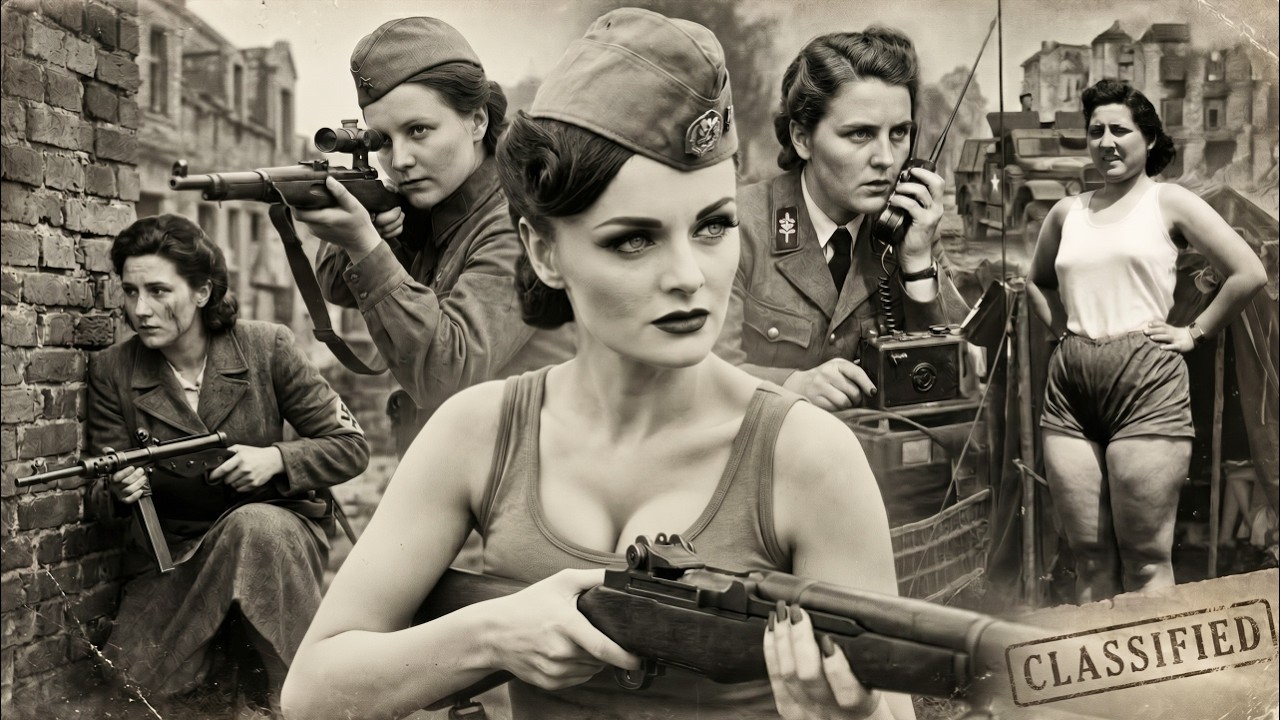
The SOE files stayed closed for decades. The British Special Operations Executive was dissolved in 1946. Some of the papers were destroyed in a fire that same year, and what remained was stamped secret and put away. It was not until the 1990s and 2000s that those boxes started arriving at the British National Archives and opened to the public.
F Section sent 39 women into occupied France. Thirteen did not come back. That was where the names came off the page. Nancy Wake, the Australian woman the Gestapo called the White Mouse and put a five million franc bounty on. British George Medal. Virginia Hall, an American from Baltimore with a wooden leg she called Cuthbert, Distinguished Service Cross in 1945, the only civilian woman awarded it during the war.
Noor Inayat Khan, a radio operator in Paris, executed at Dachau on September 13, 1944. George Cross awarded in 1949. Every file has a number, a date, and a signature. They sat on a shelf for 50 years. This story would not have been possible 20 years ago.
This is where the record switches sides. Up to now, the accounts have concerned women who fought against the regime. Now come the ones who served it and who ended up in the defendant's seat.
Irma Grese was tried in Lüneburg, Germany, by a British military court that opened on September 17, 1945. Death sentence on November 17. She was 22 years old. The execution took place on December 13, 1945.
Maria Mandl stood trial in Kraków, Poland, convicted on December 22, 1947, executed on January 24, 1948. Ilse Koch was tried by a US military court in Dachau in 1947. Her sentence was reduced by order of General Lucius Clay, and that reduction led to a hearing in the United States Senate in 1948 with the transcript published. After that, she was tried again in Augsburg in 1951.
None of this comes from memory or rumor. It comes from court rulings, trial records, and Senate records. The standard does not change. It is still what is in the case file.
Write down a date. September 17, 1945, in a converted gymnasium in the city of Lüneburg in occupied Germany, a British military court opened what became known as the Belsen trial. More than 40 defendants were in the dock. Among them, Irma Grese, 21 years old.
The trial ran until November 17. The full transcript was published by the British government in its series of war crimes trials, and it is still there today, page by page, with her name on it. The sentence was death, carried out on December 13, 1945, at Hamelin prison.
Two years later in Kraków, Poland, the Supreme National Tribunal opened the Auschwitz trial. Forty defendants, among them Maria Mandl, an Austrian. Sentence read on December 22, 1947. Death carried out on January 24, 1948, at Montelupich Prison. The case files are kept by the Institute of National Remembrance in Warsaw. There was a trial, there was a record, and there was a sentence. That is what the record shows.
Twenty women, and the word in the title changes meaning at least four times. It applies to Nancy Wake, with five million francs offered by the Gestapo for her capture. It applies to Lyudmila Pavlichenko, with 309 confirmed kills in Red Army records.
It applies to Sophie Scholl, arrested on February 18, 1943, with leaflets in her hands and executed four days later at 21 by order of the People's Court. And it applies to Irma Grese, convicted at the Belsen trial in November 1945, and Maria Mandl, convicted by the court in Kraków in December 1947.
It is the same word in all four cases. On its own, it says nothing. What gives it meaning is the document behind it. The bounty, the military record, the sentence.
This story would not have existed 20 years ago. Almost everything it uses remained classified until the 1990s. And it was Vera Atkins, an SOE officer, who spent the entire post-war period tracking down the fate of every agent who did not return, one by one, until the list was complete.