Christian IX of Denmark died at Amalienborg Palace on January 29, 1906, at a moment when his children and grandchildren sat on, or were about to sit on, the thrones of Britain, Russia, Greece, and Norway. The modest German-born prince who had once struggled on a soldier's pay had become the pivot of a ruling dynasty across an entire continent. His three daughters carried Danish blood into three of the most storied royal courts on earth, and for decades those marriages looked like an unbreakable hand.
Then the century turned upside down.
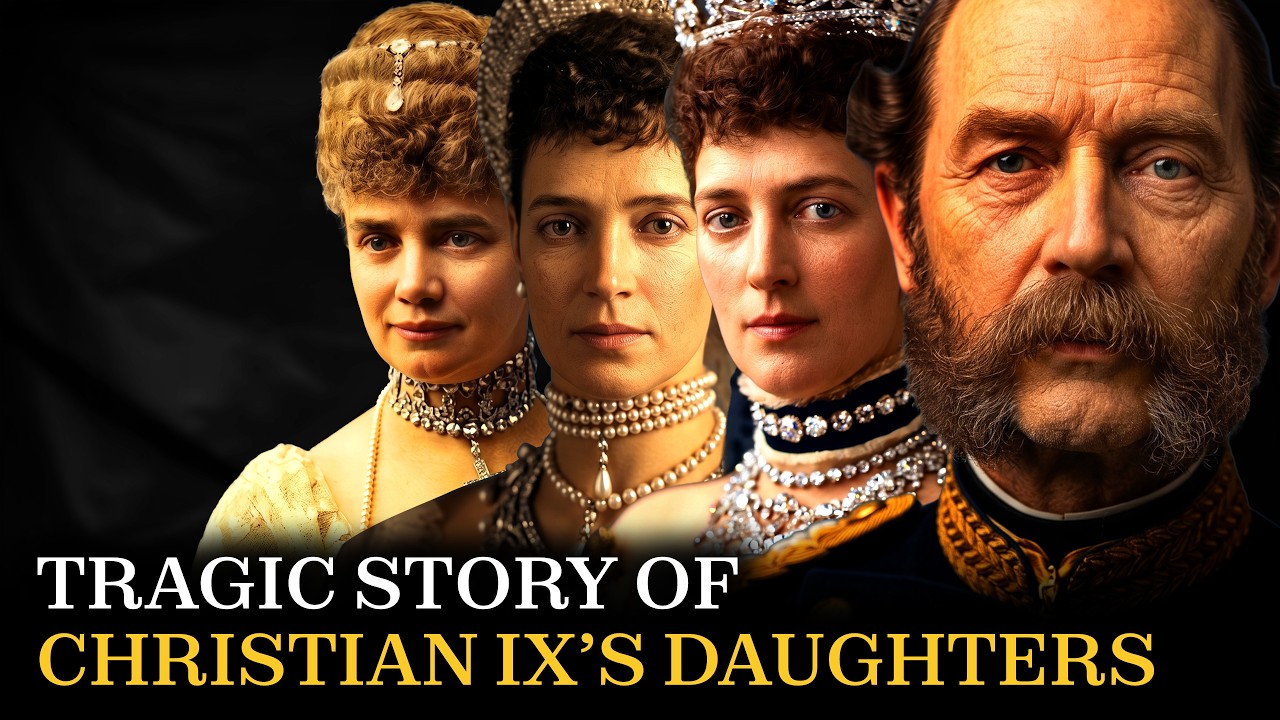
Alexandra, the eldest, sailed to Britain in 1863 to marry Bertie, the pleasure-loving Prince of Wales, and waited nearly four decades to be crowned queen. Dagmar was promised to the heir to the Russian throne, lost her fiancé to illness, and married his younger brother, swapping her Danish name for the long Orthodox name Maria Feodorovna. Thyra, the youngest, married the exiled heir to the throne of a Prussia that had been erased from existence. That throne existed only on paper.
Three sisters, three thrones, and a father in Copenhagen capable of gathering a British king, a Russian tsar, and a king of Hanover at the same Christmas table. None of it had been guaranteed. Christian was born a minor prince of the Glücksburg line, so far down the Danish succession that no one expected him to inherit anything greater than a title and a modest castle. When the main Danish royal line ran out of heirs, the great powers, casting about for a solution, settled on him almost by elimination. The London Protocol of 1852 quietly designated this obscure soldier as a future king. He took the throne in 1863, the same year Alexandra sailed to England, then spent the next four decades watching his children marry into every court that mattered.
His marriage network grew almost comically dense. His grandson George V of Britain and his grandson Nicholas II of Russia looked so alike that guests at family weddings confused the two cousins. Near-identical bearded twins, they would one day lead opposing alliances in the fiercest war the world had known. Another grandson was crowned king of Norway, another king of Greece. Through marriage, Christian IX achieved what generations of Danish diplomats had failed to achieve through treaties. And unintentionally, he planted his descendants on both sides of every fault line that would open in 1914.
Imagine what these sisters faced within twenty years of their father's funeral. One would give up her palace to a woman she did not trust, then watch her husband's mistress kneel at his deathbed and bless him. Another would lose her empire, survive a Bolshevik firing squad thanks to a stubborn sailor, and spend her final years insisting, against photographs and bone fragments, that her murdered sons might return. The third would find herself stuck on the losing side of the World War, stripped of her British titles by an act of Parliament, and cut off from her sisters for four years by the fire of war.
The same nursery, the same quiet father, and three utterly different endings.
Before the coffins and the revolutions, two of them tried to build a safe haven. In 1906, in fresh mourning, Alexandra and Dagmar pooled their money to buy Hvidøre, a coastal villa on the shore road north of Copenhagen. It was a place where two of the most powerful women in Europe could shed their titles and behave as Danish girls who had kept their essence. Notably, Thyra did not join the purchase. That small detail would become enormously important once the war broke out, because geography, not affection, decided which of Christian IX's daughters could still reach the others.
Alexandra and Dagmar were the closest of the three, so alike in features that portrait painters and even courtiers sometimes confused them. They wrote constantly, holidayed together, dressed their children in matching sailor suits, and maintained a private Danish world that owed nothing to the empires they ruled. Thyra remained on the margins of that intimacy, younger and quieter than her sisters. It was not only her marriage into a German family that separated her; the old king's death removed the last neutral ground. As long as Christian IX held court in Copenhagen, his daughters had a father to visit and a homeland belonging to none of the empires they had married into. With him gone, each woman belonged entirely to her adopted country, for better and, in two cases, for far worse.
Alexandra served 43 years as Princess of Wales, the longest apprenticeship to the throne in British history, before her husband was crowned Edward VII in 1901. Her time as queen consort lasted only about nine years, until Edward's health collapsed on May 6, 1910, after a series of heart attacks following decades of cigars and rich food. Alexandra did something that dismayed the royal court and still fascinates her biographers. She summoned Alice Keppel, the king's mistress of many years, and allowed her to help care for the dying man. Georgina Battiscombe, one of Alexandra's most careful historians, treats the moment as fact rather than legend. Queen and mistress stood together at the bedside of the man they had shared, one by law and one by desire. Understanding that gesture means understanding the woman.
Alexandra dominated London society for decades through a beauty that lasted into old age and a composure that never wavered in public, even as hereditary deafness gradually isolated her from the conversation around her. She adored her children, kept a varied collection of pets, and quietly forgave her husband his many affairs in a way some called saintly and others called denial. Bertie betrayed her throughout their marriage, and she mostly bore it with indifference and a deep grief she rarely showed anyone.
Widowhood turned the new queen mother into a logistical problem. Alexandra clung stubbornly to Buckingham Palace, infuriating her son, King George V, and his wife, Queen Mary, who could barely begin their reign while the former queen refused to hand over the reins. The months passed slowly. Alexandra eventually moved to Marlborough House, a residence she had known since her days as Princess of Wales, while keeping Sandringham in Norfolk, the country estate Edward had loved, where she intended to spend the rest of her life.
Popular history portrays the handover as a vicious struggle, a duel between the beautiful Danish queen and her dutiful German-born daughter-in-law over jewels and precedence and who entered which door first. The story does justice to neither the gossips nor their targets. Historians who examined the correspondence, including Jane Ridley and James Pope-Hennessy in his massive biography of Queen Mary, found something far less exciting than a war of queens. Mary, it turned out, did her utmost to please her mother-in-law, enduring Alexandra's stubbornness, her endless delays, and her refusal to surrender the family jewels with almost saintly patience. Alexandra kept what she wanted, and her daughter-in-law swallowed her pride and waited. If there was a lurking villain in the transfer of the crown jewels, he wore pearls, not the frown of the woman who ultimately inherited them.
To understand Alexandra's war, we must go back half a century to a wound that never healed. In 1864, Prussia and Austria seized the duchies of Schleswig and Holstein from Denmark, her father's kingdom, in a short and brutal campaign that left the Danes humiliated and their kingdom smaller on the map. The young Princess of Wales, barely settled in England, took the loss as a personal amputation. She never forgave the Germans, especially the Prussians who had engineered the war. For half a century she nursed that resentment in secret, a Danish patriotism that smiled through endless dinners with her German cousins. The guns of August 1914 gave her the bitter satisfaction of watching the rest of Britain finally reach the verdict she had formed in her twenties.
The war gave the old queen a role suited to her temperament. She strongly supported the Queen Alexandra's Imperial Military Nursing Service, which put her name on casualty hospitals in France, and she cheered when her son pulled off one of the cleverest image-management operations in royal history. In July 1917, with tens of thousands of British boys dead and popular anger rising against everything German, George V abandoned the family's Saxe-Coburg and Gotha name and renamed the house Windsor. Alexandra, the Dane who had loathed Prussia since girlhood, could not have dreamed of a sweeter vindication.
Charity allowed the childlike side of Alexandra's character its fullest expression. She lent her name to a London hospital, supported nurse training, and in 1912 launched Alexandra Rose Day, sending volunteers into the streets to sell small pink paper roses for the poor and sick, a fundraising ritual that still exists in Britain today. Her instincts were both generous and chaotic. She gave to anyone who asked, signed anything placed in front of her, and never reconciled her giving with the size of her purse. Even the roses outlived her by more than a century.
Money meant little to Alexandra. Richard Hough, documenting her spending, described her extravagance as legendary, and the records bear him out. She spent lavishly everywhere, with no accountant in sight. She tipped generously and treated her royal inheritance as a suggestion rather than a limit. George V, who inherited the throne and his mother's debts, quietly subsidized her household year after year because her expenses regularly exceeded her income.
Isolation closed in on her gradually, then suddenly. The deafness that had shadowed her for decades cut her off from dinner conversation, from the music she loved, and from the social gift that had once made her Europe's most sought-after hostess. Her children were absorbed in their own worlds and lives. Blindness crept in at the edges. Her once-famous memory faded into mild dementia. The dazzling Danish beauty who had turned heads in London ballrooms dissolved into a dim world of half-heard words and half-forgotten faces.
She died of a heart attack at Sandringham on November 20, 1925, at the age of 80. She was laid beside Edward VII in St George's Chapel at Windsor, reunited with the husband whose mistress she had welcomed at his deathbed, a gesture read either as the most Christian act in the whole story or as its most silently painful.
Of Christian IX's three daughters, Dagmar was the furthest from that quiet Danish nursery, in both distance and wealth. After marrying the future Tsar Alexander III, she reinvented herself as Maria Feodorovna, converted to Orthodoxy, learned to run a court of ten thousand people, and by 1906 was empress dowager of all Russia, mother of the reigning Tsar Nicholas II, and one of the few people on earth still capable of destabilizing him. She was small, iron-willed, and beloved by ordinary St Petersburg society, outshining her daughter-in-law, Empress Alexandra, in protocol and popularity, which strained relations between the two women for years. While the young empress withdrew from society, Maria handled it brilliantly. She raised money for charities, sponsored hospitals, and gathered women the way others gathered fans.
Fate had handed Dagmar her Russian destiny at a deathbed. After her first engagement to Nicholas Alexandrovich, eldest son of Tsar Alexander II and heir to the Russian throne, Maria watched her young fiancé contract meningitis and die in Nice in 1865. Legend says the dying prince joined her hand to his brother Alexander's at the bedside. She married Alexander. When he took the throne in 1881 after his father's assassination, the Danish girl became empress of a nation stretching from Poland to the Pacific. Grief had opened the door to her crown, and she never forgot the young man who gave his life to hand it to her.
For a quarter century, Maria shaped life at the Russian court. She shone at the great balls of the Winter Palace, wore the imperial jewels as if born to them, and built a reputation for warmth and intelligence that her withdrawn daughter-in-law could not match. Charitable institutions bearing her name multiplied, from schools and hospitals to the vast Empress Maria Office that administered social welfare across the empire.

When World War I broke out in 1914, the empress dowager refused to remain a mere symbol in a palace. She moved to Kiev, settled in the Mariinsky Palace, took direct command of the Russian Red Cross, and threw herself into hard field work, from bandaging wounds to hospital trains to caring for exhausted men, with the energy of a woman half her age. Kiev suited her spirit. Away from the polluted air of the capital and her disliked daughter-in-law, she ran her wartime charities like a military commander, privately furious at Rasputin's grip on her son's household. She saw the dynasty collapsing from within, but Nicholas did not listen to her.
The February Revolution of 1917 blew apart the world Maria had spent her life navigating. Within days, her son Nicholas abdicated, not only for himself but for his hemophiliac son, ending three centuries of Romanov rule in a railway car outside Pskov. Maria hurried south to the Crimean peninsula, that warm, sunlit land of vineyards and palaces where the imperial family kept summer homes, perhaps imagining the storm would pass. It did not. The Bolsheviks seized power that October, and the empress dowager soon found herself under house arrest, moved first to the Ai-Todor estate, then behind the high walls of Dulber Palace, a prisoner on the same coast where she had summered as empress.
Maria did not face Crimea alone. Her daughters Xenia and Olga had fled with her, along with a number of grand dukes, their in-laws, and the remnants of a shrinking court that had once filled ballrooms. They were all confined in confiscated villas, forbidden from seeing the sea lest they signal a rescue ship. Rumors of massacres reached them constantly. For months they lived on the edge of the abyss between rival Soviets. Two factions were eager to shoot them; another, for some murky reason, stood in the way. Every morning brought fresh news of relatives killed elsewhere in Russia. The old empress received each report with the same flat refusal to believe.
Here the story turns on one unexpected man. The Yalta Soviet, the peninsula's most radical Bolshevik stronghold, wanted the Romanov prisoners dead. By every rule of revolution, they should have prevailed. Maria and her relatives owed their survival to the same guard commander, a Bolshevik sailor named Filipp Zadorozhny, who took his orders from the rival Sevastopol Soviet and held his ground. Frances Welch, who reconstructed these months in detail, describes how Zadorozhny stalled, argued, and flatly refused to hand those under his charge to the Yalta men demanding a firing squad. When rescue finally came, it flew a British flag.
In April 1919, with the White armies collapsing and the Bolsheviks closing on Crimea, George V, who had lain awake worrying about the fate of his Romanov relatives after abandoning the tsar himself to his fate two years earlier, sent HMS Marlborough to save his aunt. Maria nearly refused the lifeline. She told astonished British officers she would not board unless they also evacuated all the anti-Bolshevik refugees gathered in Crimean ports, aristocrats, officers, and ordinary loyalists who would face Cheka bullets the moment she sailed. The Royal Navy gave way. It found ships, loaded the refugees, and only then did the empress dowager of Russia agree to leave the land of the empire she had entered as a teenage bride some 53 years earlier.
The departure had a strange dignity of its own. As HMS Marlborough left Yalta in the spring of 1919, Russian officers on other ships in the harbor, men sailing into permanent exile, stood at attention and sang the imperial anthem across the water to the last empress of Russia. Maria stood on deck watching the coast of the country she had served for more than half a century disappear below the horizon. She would never see it again. The empire she had raised abandoned her, and the nephew who saved her belonged to the family that would later falsely accuse her of coveting her diamonds.
The journey home passed through the ruins of the old order. Malta received her first, a British island crowded with Russian refugees swept up by the same catastrophe. Then came England, where Alexandra and George V sheltered her, and where the two Danish widows, one a former queen and one a former empress, sat together in London salons comparing their losses. Denmark waited at the end of the road. The empress who had once ruled a sixth of the planet's surface settled into the seaside villa she had bought with Alexandra for a summer holiday in 1906. Two widowed sisters now shared one house in Denmark. Both had lost the men who made them queen and empress. Both settled into a villa they had once considered merely a holiday place, aging quickly in their late years.
The arrangement might have seemed comfortable, except that one of them was steadily detaching from reality.
Grief took an unfamiliar shape in the mind of Maria Feodorovna, empress dowager of Russia. She refused, flatly and permanently, to accept death. In July 1918, in the cellar of a merchant's house in Yekaterinburg, Bolshevik executioners shot Nicholas, his wife, their five children, the family doctor, and their servants, then stabbed the bodies with bayonets, then burned them with acid and fire in a nearby forest. Around the same time, her other son, Grand Duke Michael, whom Nicholas had briefly named his successor, died in a wood outside Perm. The old empress absorbed none of it. To her, until the day she died, her sons and grandchildren were alive somewhere in the chaos of Russia, perhaps captive, perhaps hiding, perhaps simply beyond reach, waiting to be found.
Evidence knocked at her door, and she turned it away. Nikolai Sokolov, the White Russian investigator who searched the Yekaterinburg site inch by inch, assembled a grim collection of crime-scene material: a charred bone, a severed finger, fragments of the family's clothing, the doctor's spectacles. He traveled to show his findings to the mother of the murdered tsar. Maria refused to receive him. Julia Gelardi records this meeting, or rather non-meeting, in which the empress adamantly refused to look at the box of evidence that would confirm what she could not bear to have confirmed.
But denial had its limits, and Maria never surrendered to delusion. When the most famous royal impostor of the 1920s appeared, a young woman in a Berlin mental asylum claiming to be Grand Duchess Anastasia, miraculously escaped from the cellar, the empress dowager wanted nothing to do with her and refused to meet the woman the world would later call Anna Anderson. Instead of traveling to Berlin herself, Maria sent her daughter, Grand Duchess Olga Alexandrovna, accompanied by Alexei Volkov, a former family servant who knew the real Anastasia's face and manner precisely. Both returned home certain the claimant was a fraud, and that no amount of longing would turn a Berlin asylum patient into the granddaughter Maria had refused to bury. The Anna Anderson case would outlive everyone involved in it. Anderson pursued her suit in German courts for decades, gathered devoted followers, inspired films and books, and ultimately a full-blown legend, all while the surviving Romanovs and their Danish mother ignored her. Maria died without ever seeing the woman. In the 1990s, after all the main figures were gone, DNA testing settled the matter definitively and revealed Anderson to have been a Polish factory worker named Franziska Schanzkowska. The empress who refused to meet her had been right all along, though she did not live to hear the verdict.

Around this figure of widowhood and shrewdness, a small Russian family took shape on Danish soil. Her daughter Olga stayed close, raising her own family while managing the affairs of a mother who still expected the respect due an empress and a retiree's allowance. The servants who had accompanied the family out of Russia aged alongside her. Visitors found a short, polite, sharp old woman who would discuss anything except the one subject that had emptied her life of meaning. She presided over her shrinking court as if a messenger from Russia might arrive at any moment to tell her it had never happened.
The image of Maria as a destitute exile depending on charity and selling her last brooch belongs to melodrama, not history. William Clarke, who examined the numbers, corrects the picture. The empress dowager lived a cash-poor but asset-rich life, short on liquid funds yet holding a substantial fortune in jewels smuggled out of Russia. Her nephew, King Christian X of Denmark, did not fret over the electricity bill so much as argue with his formidable aunt about the cost of her house at Hvidøre, and was said to grumble about how many lamps she left burning. Family money always stirs disputes. She relied instead on an annual pension of 10,000 pounds from the more generous King George, and kept the jewels in a safe place. A vast fortune in diamonds and pearls, guarded as if it would one day fund a Romanov restoration.
A dark legend still clings to those jewels, the story that the grasping Windsors swooped in after Maria's death and stole her diamonds for a pittance. It is false. British royal records, as Clarke shows, prove that George paid a full 100,000 pounds in 1929, the fair market price set by the royal jeweler, Peter Hennell, not a lowball offer from a thief. Maria did not live to see the sale.
She died at Hvidøre on October 13, 1928, at the age of 80, in the same seaside villa she had bought with Alexandra in a happier century. The Danish people buried her in Roskilde Cathedral among the monarchs of her native land. Her story did not end with her burial. All her life Maria had wished to rest beside her husband, Tsar Alexander III, in the Romanov crypt at the Peter and Paul Fortress in St Petersburg. For 78 years, the fall of Russia and the Iron Curtain prevented that wish. Then history turned again. In September 2006, the Danish and post-Soviet Russian governments arranged to move her coffin from Roskilde to the east. On the 28th of that month, with an honor guard and Orthodox rites, and before the descendants of both peoples, the empress dowager was finally placed beside the tsar she had loved, more than a century after she sailed to Russia to marry him.
Thyra, the youngest of the three, had a strange story, though only a world war revealed it. She married Ernest Augustus, heir to a kingdom that no longer existed, and lived at Cumberland Palace in the Austrian town of Gmunden, where she managed the affairs of a family Prussia had humiliated in 1866 when it annexed the entire kingdom of Hanover. Bismarck seized the wealth of the deposed dynasty, known as the Guelph Fund, and used it for decades as a bargaining chip. Her husband harbored a grudge against the Hohenzollerns as bitter as Alexandra's, since the Guelphs and the Prussian crown were locked in a feud that had lasted generations. For long stretches, the two families refused to sit at the same table. Thyra raised her children in that hatred, which made her son's wedding all the more remarkable.
Tragedy struck first. On May 20, 1912, Thyra's elder son, Prince George William, died in a car accident while rushing to a family funeral, killed by the modern machine his class regarded as a toy. The loss shattered Thyra and, with cruel diplomatic irony, opened a door for her. Condolences flowing between European courts led her surviving son, Ernest Augustus the Younger, into correspondence and then into the company of Princess Victoria Louise, the only daughter of Kaiser Wilhelm II and the darling of his empire. Guelph met Hohenzollern, and against all expectations, the young pair fell in love. Their marriage on May 24, 1913, achieved what decades of diplomacy could not. The Berlin wedding drew the last great gathering of European royal families before the war, with Tsar Nicholas II and King George in attendance. Cousins smiling for cameras 11 months before ordering their armies to slaughter each other's subjects. For the Guelph and Hohenzollern families, the marriage ended a feud of nearly 50 years. Thyra watched her son marry the daughter of the very dynasty her husband had spent his life resenting.
The reconciliation lasted only as long as the peace, which lasted only 14 months. When war broke out in the summer of 1914, Thyra found herself stuck on the losing side. She lived in Austria by marriage, her adopted homeland tied to the Central Powers alongside the Germany her sisters loathed, but the war cut her off completely from Alexandra and Dagmar. For four years, two of Christian IX's daughters lived as strangers, unable to write, forbidden to visit, trapped behind front lines and censorship, confronting the fact that they now belonged to enemy nations. Her husband added to the family's troubles in Britain by openly siding with Germany. Ernest Augustus, who still held a British peerage as Duke of Cumberland, took up arms morally and legally against the country of his wife's sister.
Britain answered his open loyalty to Germany with harsh measures. In November 1917, the same year George V renamed his house Windsor, the British Parliament passed the Titles Deprivation Act, a law designed to strip hostile nobles of their British titles. Thyra's husband was a direct target. On March 28, 1919, with the war over and the reckoning begun, King George V signed the royal order formally canceling Ernest Augustus's British peerage, inflicting deep pain on the family through the loss of the Duchy of Cumberland. The title that had linked the House of Hanover to Britain vanished with a stroke of a royal pen. Thyra, guilty of no worse a crime than marrying the wrong man in the wrong country, watched her family demoted by the same cousin who had sent a warship to save her sister.
The war left scars deeper than a lost title. Thyra's family now lived on both sides of the destruction. Her son had married the kaiser's daughter while her sisters mourned with the victors. The Hohenzollern empire, which had finally embraced the Guelphs, collapsed in November 1918 along with every other German throne. Thyra, who had spent her childhood under the injustice of a lost kingdom, lived to see her son inherit the ashes of another.
When the guns finally fell silent, the sisters met again across the ruins. Thyra was able to write once more to Alexandra in England and to Dagmar, who had become a refugee. The three surviving daughters of Christian IX resumed the correspondence that four years of censorship had frozen. The reunion had a bitterness to it. Alexandra had grown into a deaf recluse, Dagmar into a woman clinging to illusions about her murdered sons, Thyra into the widow of a defeated family. The girls who had once holidayed together in Copenhagen greeted the 1920s as three exhausted old women on three torn continents.
Yet the ruin that swallowed Dagmar did not come to Thyra. Ernest Augustus died on November 14, 1923, leaving his widow among the Austrian lakes she had made her home for half her life. The collapse of the German and Austro-Hungarian empires destroyed many royal fortunes, but the Cumberland family kept its private wealth and properties in Austria and Germany, sparing Thyra the humiliations that trailed her Russian sister over begging for a pension. Thyra lived her last decade quietly in Gmunden, the last surviving daughter of Christian IX after Alexandra's death in 1925 and Dagmar's in 1928. She died at Cumberland Palace on February 26, 1933, at the age of 79, and was buried in the family mausoleum in the place where she had ruled as a widow for a decade.
Christian IX turned his daughters into instruments of European diplomacy, marrying them into Britain, Russia, and Hanover to weave his small kingdom into the fabric of the great powers. For a full generation, the strategy paid handsome returns. Then the empires his daughters had married into went to war against one another, and marriages that had once looked like guarantees became rigid geographical constraints, each sister trapped by the flag she had married. Alexandra was the winner. She ended her days as a beloved queen in a victorious nation, her German cousins defeated, her old grudge against Prussia confirmed by history, even by the changing of her family's name. Deaf, nearly blind, and forgotten in her final years, she nevertheless died safe, honored, and buried among monarchs at Windsor. Whatever sorrows she faced in her private life, the public verdict never wavered.
Dagmar's fate was the harshest. As the highest-ranking of the sisters and empress of the largest land empire on earth, she lost her throne, her sons, her grandchildren, and every certainty her life had been built on. Moved from house arrest to a British warship to a borrowed room in a Danish villa, she lived on her nephew's pension and a treasure of jewels, clinging to the illusion that her murdered family might one day return. Her position had raised her to the highest rank, and her fall was proportionate to the height.
Thyra's fate was strange, neither triumph nor catastrophe. Bound to the losing side by a marriage contracted before anyone imagined the war, she lost her family's British titles and four years of contact with her sisters, yet survived with her wealth and her lakeside home untouched. She outlived Alexandra and Dagmar. The quiet youngest sister, who had the least glittering marriage, in the end suffered the least devastating fate. History mentioned her little among them, and perhaps that suited her.