When Prince Felipe of Spain presented Letizia Ortiz to the nation as his future bride, the cameras captured something the palace had not planned for: the heir to the throne being interrupted. As Felipe attempted to move the conversation forward, Letizia stopped him with a phrase that would follow her for years: “Let me finish. ” The moment lasted seconds, but in those seconds, Spain saw the entire problem. This was not a princess raised behind palace gates.
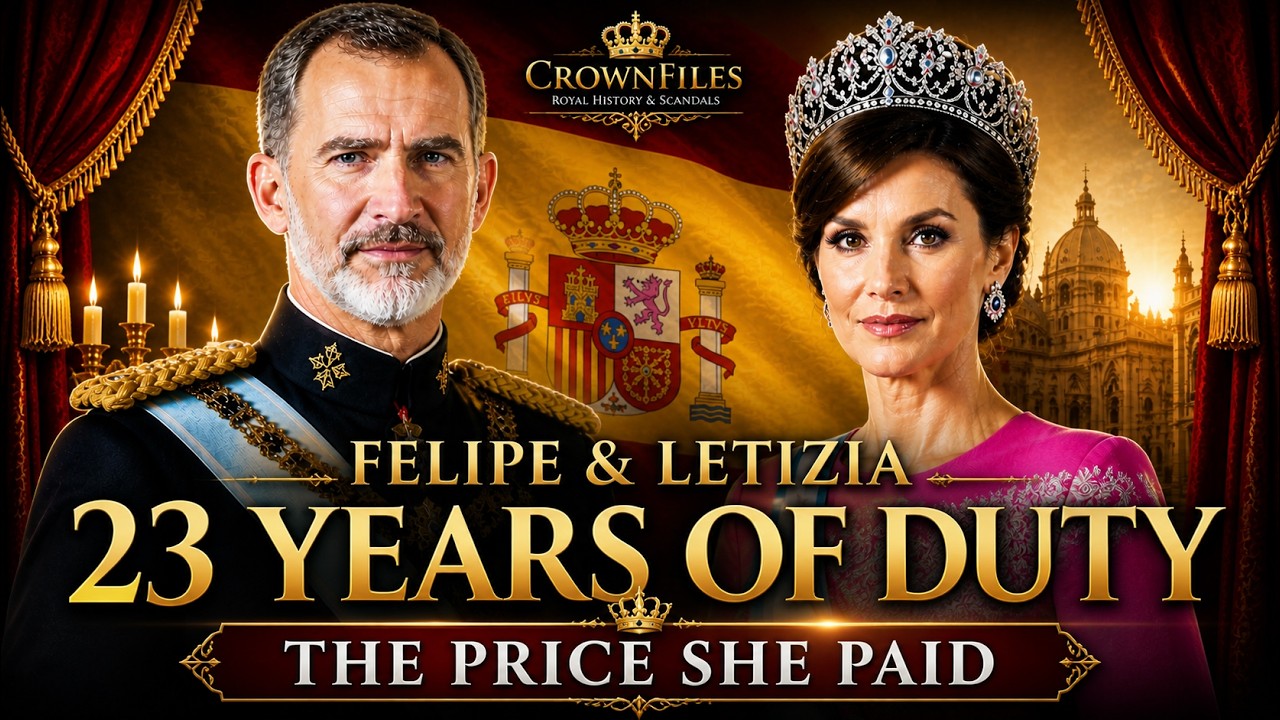
Letizia was a television journalist, a working woman, a divorced commoner, a person who had built her identity in front of cameras long before the crown ever opened its doors to her. For some, it was refreshing. For others, it was alarming. Was Felipe marrying a modern woman who could help renew the monarchy, or was he bringing into the royal house someone too independent for a system built on silence and ritual?
The official story was love. A prince had chosen the woman he wanted, and a journalist had stepped away from the newsroom toward history. But beneath that romance, another story was already underway. It was the story of a monarchy trying to modernize without losing control, a country trying to decide what kind of queen it could tolerate, and a woman who from her first public moment made clear that she would not enter the palace as a shadow.
Felipe was not just another European prince. He was the carefully prepared heir of a monarchy that had survived dictatorship, transition, democracy, and constant scrutiny. Every public appearance was measured, and every romantic choice was treated as a matter of national symbolism. Whoever married him would not simply become a wife; she would become part of Spain’s image of itself.
That was why Letizia was so unexpected. She did not arrive from an old royal house or a grand aristocratic family. She came from the world of newsrooms, live broadcasts, deadlines, and public speech. Spain already knew her face from television.
She had reported serious stories. She understood cameras not as decoration, but as a workplace. To supporters, Letizia looked like proof that the monarchy could move closer to ordinary Spain. The engagement gave the public a rare kind of royal fantasy.
Not a fairy tale of castles and ancient titles, but a story of recognition: a prince had seen a woman from the real world and decided she was worthy of the throne beside him. That felt intimate, almost democratic. Felipe, in those early days, seemed calm in that choice. He did not present Letizia as a mistake that needed explaining.
He presented her as the woman he loved. In a monarchy, love is never only private. It becomes a public message. His decision told Spain that the future king wanted his marriage to belong not only to tradition, but to the present.
For a brief moment, the story seemed to work. But what made the match feel so fresh was also what made it dangerous. Letizia had not been shaped by the palace before entering it. Felipe had spent his entire life being prepared as an institution in training.
His education, posture, words, and even his romantic future were watched through national expectation. Every choice became a signal, and every woman near him became a possible future queen. Letizia came from a very different world, but she also understood pressure. She had built her career in journalism, where emotion had to be controlled and words had to land cleanly.
She knew how to speak under lights and how to hold herself when people were watching. That experience did not make her royal, but it made her unusually prepared for public attention. She entered the relationship as someone who already had a professional identity, a previous life, and a voice of her own. To a prince surrounded by choreography, that must have mattered.
She was not made entirely out of protocol. And for Letizia, Felipe was not only a prince; he was also a man trapped inside a role. To marry him meant accepting that her private life would become part of a national institution. Their bond seemed believable because both understood performance, but neither was only performing.
Those same qualities would later make the palace uneasy. A woman who could stand beside Felipe without disappearing was also a woman who could not be easily absorbed. For a monarchy, a new bride is easier to manage when she arrives as a blank page. But Letizia had habits, opinions, a career, and experience surviving public judgment through competence rather than obedience.
From the outside, her adjustment could be sold as a modern success story. But inside that transformation was a quiet demand. Letizia had to keep enough of herself to make Felipe’s choice look modern, while surrendering enough of herself to make the palace feel safe. That balance was almost impossible.
If she appeared too independent, critics could say she was arrogant or too sharp for royal life. If she appeared too controlled, others could accuse her of being cold or artificial. The very qualities that made her impressive before the engagement became suspicious once she stood near the throne. Her voice became a symbol, her clothes became evidence, and her facial expressions became material for national interpretation.
A firm look could be called ambition. A serious face could be called distance. A correction, even a small one, could be turned into proof that she wanted control. Felipe’s position also began to change.
After the engagement, his choice became a test of judgment. If Letizia was accepted, he looked modern and courageous. If she was rejected, his decision could be read as reckless. The relationship no longer belonged to two people; it had become a public referendum on the future king’s instincts.
There was one detail that could never fully disappear: she had been married before. Because that marriage had been civil, it did not block a Catholic royal wedding. Officially, the path was clear. But public perception does not operate like a legal document.
For a conservative part of Spain, the fact itself mattered. A future queen was expected to symbolize continuity and an almost impossible personal neatness. The palace faced a strange contradiction. It needed Letizia to modernize the monarchy, but it also needed her to stop looking too modern.
It needed her confidence, but not her full force. It needed her intelligence, but only when that intelligence did not disturb the choreography. The breaking point did not arrive as one explosive revelation. It arrived as a slow public examination.
After the engagement was announced in November 2003, the story stopped being only about Felipe and Letizia. It became a national inspection of her life. Spain began asking whether her biography could be made royal, whether her past could be cleaned into ceremony, and whether a woman who had sat behind a news desk could stand beside the throne without changing the meaning of the crown. Certain facts were clear.
Letizia was a journalist, came from a middle-class background, not European nobility, and had been married before in a civil ceremony that had ended. Because it had not been a Catholic marriage, it did not create the religious barrier that a previous church marriage might have created. Officially, the wedding could go ahead. The confirmed facts were only the first layer.
The second layer was suspicion. Some critics wondered whether Felipe had chosen too far outside the traditional royal world. Others questioned whether Letizia had the temperament for a life of protocol. Her confidence, once successful on television, was recoded by some observers as hardness.
Her direct speech became a character study. Then came the third layer, amplification. The media took each detail and made it larger. A former marriage became a question about the future queen’s image.
A career in journalism became a question about whether she understood too much about the cameras now aimed at her. Letizia was not being judged only for what she had done, but for what people imagined those facts meant. In another family, her story might have seemed ordinary. But inside the Spanish monarchy, ordinary life became extraordinary material.
The palace could present the engagement as a modern love story, but it could not stop the public from treating every normal human detail as a possible threat to royal symbolism. Felipe stood at the center of that tension. He did not withdraw his choice or present Letizia as a temporary scandal to be survived. He moved toward marriage with her, and that gave the romance its strongest defense.
But it also raised the stakes. If Spain accepted Letizia, Felipe’s decision would look like renewal. If Spain rejected her, the engagement would become a wound at the beginning of his future reign. By the time the wedding arrived in May 2004, the event carried more weight than a royal celebration should have carried.
A wedding can transform controversy into pageantry. It can take a debated woman and place her in white, in music, in protocol, in history. But a ceremony cannot erase the questions that made it necessary. Letizia entered royal life as a problem to be solved, a symbol to be interpreted.
The engagement became the decisive turn. After it, every part of her identity was pulled into the royal machine. Her voice, her marriage history, her profession, her body language, and her family background were all rearranged around one question: could she become queen without making the crown look less royal? The official answer was yes.
The wedding happened, and the monarchy moved forward. But the emotional answer was never that simple. From that moment on, Letizia’s public life would carry a double reading. To some, she was proof that the monarchy had finally stepped into the present.
To others, she was the first sign that the old rules were being bent too far. After the wedding, the argument changed shape. Every public appearance seemed to ask the same hidden question: was she adapting to the monarchy, or was the monarchy adapting to her? For supporters, she represented competence and modernity.
For critics, those same qualities could be turned into accusations: too controlled, too ambitious, too severe, too unwilling to disappear. That was the trap. If she looked confident, some saw strength and others saw domination. If she looked serious, some saw duty and others saw coldness.
If she spoke clearly, some heard intelligence and others heard defiance. The same gesture could be used to defend her or condemn her depending on what people already wanted to believe. Felipe was protected in a different way. As the heir, his choice had created the debate, but the emotional cost fell much more visibly on Letizia.
He could be framed as the modern prince who followed his heart. She could be framed as the woman who forced the monarchy to change around her. In royal narratives, men are often allowed to choose, while women are often judged for being chosen. Letizia became more than a wife and more than a future queen.
She became the place where Spain argued with itself about whether the monarchy was supposed to remain a world apart or could survive by bringing in people who looked closer to modern citizens with careers, divorces, opinions, and complicated lives. Letizia’s scandal was never only that she had a past. It was that her past made the monarchy look human. And for an institution built on controlled symbolism, humanity is dangerous.
It invites empathy, but it also invites scrutiny. It makes the crown feel closer but also less untouchable. That is why the story kept returning, not because the engagement had failed, but because the questions underneath were never fully resolved. What remained after the wedding was not the scandal people had first expected.
There was no blocked marriage, no constitutional collapse, no public rejection strong enough to stop Felipe. The cathedral doors closed, the royal schedule continued, and Letizia began the long work of becoming part of an institution that had once seemed too distant from the life she had lived before. But something more subtle had been lost: the innocence of the story was gone. Every smile had to prove stability.
Every appearance had to prove legitimacy. Every adjustment in Letizia’s behavior could be read as either growth or surrender. What should have belonged to two people became evidence in a national argument. Letizia did not simply marry Felipe.
She entered a role where her past could never fully remain past. The palace could give her a title and a place in ceremony, but it could not give her back the freedom to be interpreted normally. Felipe also lost something. His choice of wife had been personal, but after the engagement, it became institutional.
The romance survived, but it could never again be only romance. Years later, the phrase from that early public moment still explains why the story mattered. “Let me finish” was not just a small interruption. It was the sound of a woman entering the royal frame with a voice already formed.
It was the warning that Letizia would not be easily reduced to a symbol, even as the monarchy needed her to become one. From the start, she represented both the crown’s modernization and its discomfort with modernization. The wedding made Letizia royal, but the engagement revealed the price.
She was accepted into the palace, yet never allowed to enter public memory as a blank page.