On a warm May morning in 1836, 34 people stood behind the timber walls of a small stockade on the Texas prairie. They believed the fort made them safe. Then the tree line moved.
What followed became one of the most famous captivity stories in Texas history. It was not a siege that lasted a week or a battle that lasted a day. The raid on Fort Parker was decided in minutes.
Among those inside the fort were Rachel Parker Plummer, 17 years old and already a mother, and her 9-year-old cousin, Cynthia Ann Parker. Rachel's son, James Pratt, was 14 months old.
The Parker family had come to Texas chasing land and a fresh start. They built the stockade with their own hands: timber walls, a blockhouse, cabins inside. The fort was meant to be the guarantee of safety.
Instead, it became a target.
The Comanche were not a random war band. They were the dominant military power of the Southern Plains and the finest light cavalry in the Western Hemisphere. They knew the fort was there and who was inside.
A Spanish document from those years quotes a Comanche voice: "They wage war on us because we do not want to make peace with them, and either they will destroy us or their race will disappear." That was not a tactical opinion. It was a people at the edge of a knife choosing violence as survival.
On paper, Fort Parker looked defensible. In reality, only a fraction of the 34 people inside were adult men capable of firing a rifle. The rest were women, children, and the elderly.
Their weapons were muzzle-loading long rifles, accurate but slow, taking about 30 seconds to reload with steady hands. Their strategy was to stay inside, shoot from the walls, and hold until help came. But there was no help. The nearest settlement was miles away across open prairie.
The Comanche were a professional light cavalry culture. A Comanche boy learned to ride before he learned to walk properly. By 10, he could shoot arrows from beneath the neck of a galloping horse. By 15, he was in raiding parties.
Their composite bows could fire 20 arrows in the time a settler reloaded a rifle once. They carried 14-foot lances, captured muskets, and rawhide-hardened shields that could stop a musket ball at distance.
A Comanche warrior on a good horse could cover 80 miles from morning until night. A Texas militia column on foot, dragging supplies, would be lucky to make 15. The settlers on this frontier were not actually being defended. They were being sacrificed to the space between forts.
The raid began with a parley. A small group of Comanche riders detached from the main body and approached the gate slowly, raising a hand in the sign language of the plains. They were asking to talk.
Inside the fort, the men had seconds to decide. Elder John Parker, the 68-year-old patriarch of the family, had spent his adult life on frontiers and believed he could read another man's face.
He made a calculation. If he rode out and talked, maybe the day would end without bloodshed. If he refused, the fort would certainly be attacked. He walked out through his own gate toward men he did not know. Behind him, the gate did not fully close.
As soon as he was in the open, he was cut down. In the moment his body hit the grass, the parley riders and the hundreds waiting in the timber became one single wave.
The fort's most experienced defender was dead. The gate was open. The distance between Elder John's body and the cabins where the women and children waited was 100 yards of prairie, and the Comanche were already crossing it.
The terrain made it worse. Fort Parker sat in gently rolling central Texas grassland with scattered timber. The prairie in May was high, and the tree lines were close. An approaching Comanche force could stage inside the timber, invisible, and cross the last 400 yards in under a minute at a full gallop.
A defender on the wall would have, at best, 20 seconds of warning between the trees moving and the riders arriving at the gate. Not enough to load a rifle. Barely enough time to shout a warning.
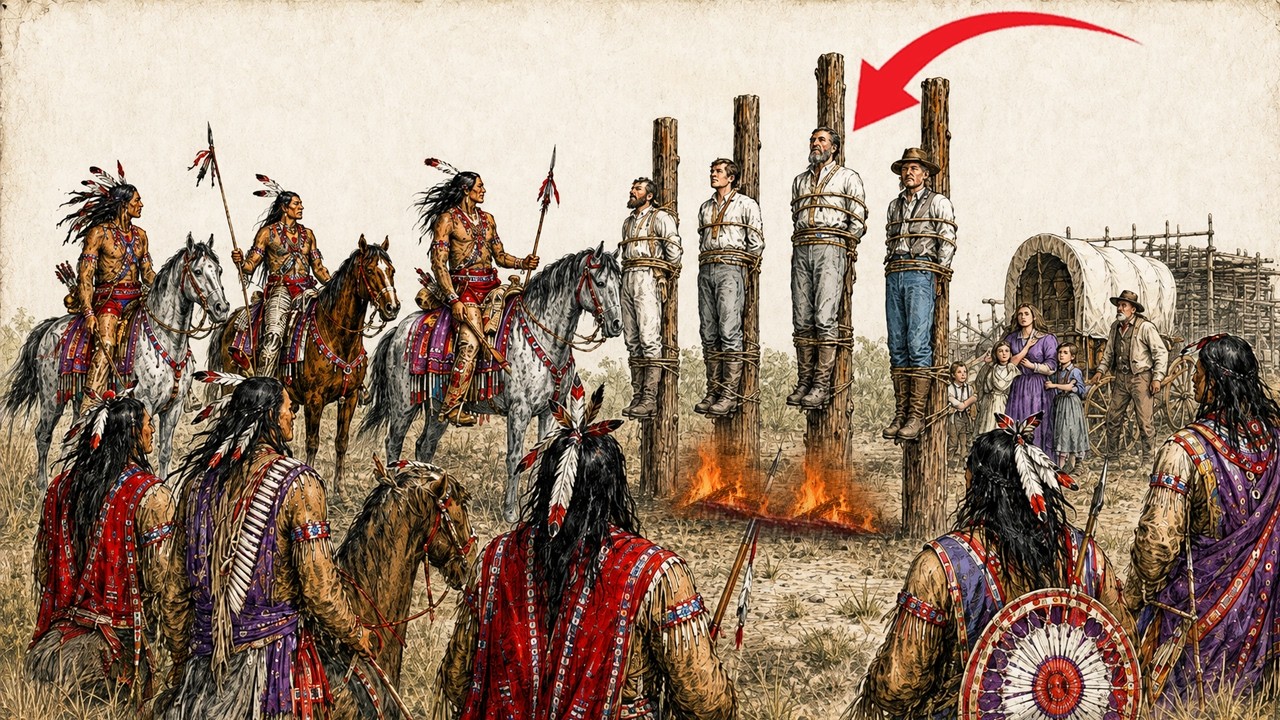
It was mid-morning when the Parker women noticed something in the timber. Not alarm at first, just a shape. A rider, then two. Then the shapes multiplied so fast that comprehension broke.
Rachel later described the moment in a single line: she saw "More Indians than I dreamed possible." It was not a count. It was a failure of counting, the mind hitting a number it could not process and giving up.
The first sensation of a Comanche raid was not fear but confusion. The world you were standing in a second ago had been replaced by a world you did not recognize, and your brain was still trying to catch up when the arrows began to fly.
From the moment Elder John Parker walked through the gate to the moment his family's world ended was less than five minutes. Everything that mattered, who lived, who died, who was taken, was decided in the first 300 seconds.
Rachel tried to run. In her captivity narrative, written three years later, she wrote: "I tried to make my escape, but alas, alas, it was too late as a party of the Indians had got ahead of me. Oh, how vain were my feeble efforts to try to run to save myself and little James Pratt."
She was seized, stripped, beaten with whips and bows, and dragged by her hair across the prairie while she was made to carry her son. The same was happening to other women in other doorways at the same instant.
To understand the other side, consider the account of Pay Kautah, son of the Kiowa chief Satanta, describing his part in a raid on the Hamilton home in northwest Tarrant County in April 1867. "Some of our men went up to the house and kicked in the door. I don't remember how many children there were in the house. We grabbed them and came out on the run."
There was no rage in that memory, no bloodlust, not even much detail. He did not remember how many children were in the house. He was describing a task the way a man might describe pulling in a fishing net. For the settlers, it was the end of their world. For the raiders, it was work.
By the time resistance inside the fort collapsed, the Comanche were already making decisions about who lived and who did not. Adult men who fought were killed. Some of the women were killed. But five people were kept alive by choice.
Those five were Rachel Parker Plummer, her son James Pratt, Rachel's 9-year-old cousin Cynthia Ann Parker, Cynthia Ann's 6-year-old brother John Richard Parker, and Rachel's aunt Elizabeth Kellogg.
About 23 people, over two-thirds of the original 34, escaped in the chaos, fleeing into the timber, hiding in creek bottoms, running for the nearest cabin. They would carry news of what happened to the outside world.
Rachel looked back as they took her. She saw her son on a different horse, held between two Comanche women. She tried to reach him. She was pulled away.
They rode hard all day. They did not stop for water except in brief snatches, did not stop for food, did not stop when a child cried. Rachel, half-naked and bleeding from where the whips and bows had opened her skin, was made to keep pace on horseback.
The pace was punishing on purpose. Comanche raiders knew they had a window, perhaps a day or two, before any pursuit could be organized, and they intended to be a hundred miles past it before it closed.
Somewhere on the second or third day, they crossed a line no map could show, a line beyond which no white American had ever traveled and returned. She was in the Comancheria now, the heart of Comanche territory, a country the size of France that no United States or Republic of Texas force controlled in any real sense.
The raiding party began to break apart. Some warriors peeled off with horses. Some went to different bands. Rachel, who had gone into captivity with an aunt, a cousin, a small nephew, and her own baby son within arm's reach, began to lose them one by one.
Cynthia Ann was taken by one band. John Richard by another. Elizabeth Kellogg was traded away. Rachel was left with James Pratt for a little while longer, and then eventually not even him.
It is not clear exactly when her son was taken from her permanently. What is clear is that he did not survive his captivity, and Rachel watched the beginning of that ending with her own eyes.
For weeks, on Sundays, she could see the little boy on the other horse, held between two Comanche women who were, in their own way, taking care of him. She could hear him cry. She could not go to him.

Once the raiding party dispersed, Rachel entered the second phase of a captive's life: slavery. Not the plantation slavery of the American South, but a different kind. She was assigned to a Comanche family.
She was made to gather firewood, dress hides, cook, carry water, tend fires, and pack and unpack the entire camp when the band moved, which was often. She was beaten for slowness and for defiance. She was subjected to sexual violence and to forced runs between rows of women and children armed with sticks and switches. She was starved.
And yet, not every Comanche in her life was cruel. There were older women who slipped her food. There were moments of small mercy. The Comanche were not a monolith. They were a people, and a people contain both the ones who will hurt you and the ones who will not.
What Rachel could not know in her first months was that she was inside a working society. Children played. Men laughed. Old people told stories at fires. Meat was shared. Horses were adored. The same warriors who had cut down her family were in this camp, kind fathers.
The frontier was full of captives. Some were traded between bands, moving hundreds of miles between hands in a single season. Some were adopted outright, especially children young enough to forget. Some were ransomed. Some were killed in raids on the raiders.
Consider the case of Nelson Lee, a middle-aged Texan cattle driver captured by Comanche in 1855, held for months, forced to witness raids, kept alive because he was useful. He eventually escaped, got a horse, and rode toward what he believed was safety.
When he finally came within sight of an American party, his own countrymen mistook him for an Indian and opened fire. He fell before he reached his friends. He survived, barely, and eventually wrote a memoir. A man escapes the Comanche, rides toward home, and is nearly killed by home.
Elizabeth Kellogg was ransomed relatively early, brought back within months in a trade brokered by Delaware Indians and paid for by General Sam Houston's people. John Richard Parker would eventually be ransomed too, but he came home half Comanche, restless, and eventually returned to the plains of his own accord.
Not every captive wanted to be rescued. That is the sentence that broke the frontier's easy story. Because if the raid was pure horror, why did some of the taken not want to come back?
In the summer of 1840, four years after Fort Parker, the Comanche launched the largest raid in Texas history. Four hundred to six hundred warriors, plus women and older children, rode from the plains all the way to the Gulf Coast.
They sacked the town of Victoria and took the port town of Linnville, with warehouses full of cloth, metal, hats, and mirrors, looting it to the walls. Eyewitnesses described Comanche warriors riding along the beach wearing top hats and stovepipe boots, dragging bolts of ribbon behind their horses.
That was the Great Raid of 1840, and it did not happen in a vacuum. It happened because of a 15-year-old girl named Matilda Lockhart. She had been captured by Comanche months earlier.
In March of 1840, Comanche negotiators brought her, and only her, to San Antonio to discuss the return of captives. She was expected to be one of many. She was, instead, alone. And what she looked like when they brought her in changed the war forever.
Mary Maverick, a San Antonio woman who was there, wrote the description down later: "Her head, face, and arms were full of bruises and sores. She had no nose, just two nostrils wide open like a skull surrounded by a large scab."
Maverick explained how it had been done. The girl's nose had been burnt off by Comanche women who took delight in waking her by shoving a burning piece of wood in her face. Historians debate how representative Matilda's treatment was. Some captives suffered like this, others did not. But on that day, no one was thinking about statistics.
Texas officials demanded the immediate return of all captives. The Comanche negotiators refused. Shots were fired. Twelve Comanche chiefs were killed on the spot. It became known as the Council House Fight. The Great Raid of 1840 was the Comanche answer.
Surviving a raid was not the same as surviving. The people who lived through the moment of violence did not walk out of that morning intact. They walked out changed.
They lived with a sound they could not unhear: hoofbeats, the high keening yell of a Comanche war cry, the wooden crack of a door being kicked in, the scream of a mother who has just seen her child on someone else's horse.
Some slept with a loaded rifle by the bed for the rest of their lives. Some drank. Some could not enter a room with more than one exit. Some walked away from the frontier entirely, moved east, and never spoke of what they had seen. And some, like Rachel, wrote it down.

Rachel Parker Plummer was in Comanche captivity for 21 months, from the morning at the fort to the day in February of 1838 when a party of Comancheros trading with the Comanches finally purchased her back for a small pile of goods and put her on a horse pointed east.
Twenty-one months. Long enough for her son to die. Long enough for her body to be broken. Long enough for the person who came home to no longer be the girl who left.
Thirty-four people had been inside Fort Parker on the morning of May 19, 1836. When the smoke cleared, five were killed outright. Another woman was wounded, an arrow driven into her breast, but alive. Five were taken captive. Roughly 23 escaped into the timber, hid in the creek beds, or fled to a neighbor's cabin miles away.
The horror of Fort Parker was never the body count. It was the taking. The five who were taken did not simply die. They went into a place from which their families could not follow, and the people they left behind spent the rest of their lives trying to get them back.
When Rachel Parker Plummer was returned to her husband Luther in the spring of 1838, she was described as emaciated, scarred, her hair thinned, her body carrying injuries that would never fully heal. She could barely eat. She had trouble sleeping.
She wrote her narrative in a fever of remembering, finishing it in early 1839. Within months of finishing it, she died. She was 20. Her return home was not a rescue. It was a slow ending.
Elizabeth Kellogg was ransomed within months, in late 1836, by Delaware Indians paid by Sam Houston. She returned to her family and lived out her life on the Texas frontier. John Richard Parker was returned years later, though restless, and eventually rode back to the plains on his own. Rachel's son, James Pratt, did not come back at all. He died in captivity, still a small child.
And then there was the 9-year-old girl on the horse. Cynthia Ann Parker was not ransomed, she was not traded, she was not found. She simply vanished from the perspective of her Anglo family.
Years passed, a decade, then two. She grew up Comanche, spoke Comanche, wore Comanche clothing, and took a Comanche name, Naduah. She married a Comanche war chief named Peta Nocona, one of the most feared raiders on the Southern Plains. She bore him three children. One of them, a son, was named Quanah.
In 1860, 24 years after the raid on Fort Parker, a company of Texas Rangers under Sul Ross attacked a Comanche camp on the Pease River. In the aftermath, they found a woman with blue eyes clutching a small daughter, trying to flee. They realized who she was, and they took her back.
Cynthia Ann Parker was returned to her Anglo relatives in Texas. She did not want to be there. She tried repeatedly to escape. She refused to speak English for long periods. She begged in Comanche to be returned to her husband and sons. She never was.
Her small daughter, Prairie Flower, died of a childhood illness within a few years. Cynthia Ann, broken by grief in the language of a life nobody around her spoke, died in 1870.
Her Comanche son, Quanah, the son she never saw again after 1860, would grow up to be the last free war chief of the Comanche people. He rode in raids as a young man. He fought United States Cavalry. He led one of the last hostile bands on the plains, the Quahadi Comanche.
In 1875, out of horses, out of buffalo, out of options, Quanah Parker rode into Fort Sill and surrendered. He would spend the rest of his life as a leader of his people in a very different sense: a rancher, a politician, a bridge between worlds. He is buried today in Oklahoma. His mother, taken from Fort Parker at nine, is buried beside him.
The Fort Parker massacre of popular memory, the dozens dead, the fort burned to ash, is largely mythology. The historical count is five people killed outright. Only five.
What made Fort Parker terrifying was not the death toll. It was the taking. It was the 24 years of Cynthia Ann's life spent as a Comanche woman, and the fact that when the Rangers found her, she did not want to come home.
That is the fact the schoolbooks avoided for a century, because it does not fit either side's easy story. The frontier's most famous massacre was actually five bodies and five kidnappings, and one of those kidnappings produced a marriage the raiders themselves respected, and a war chief the United States Army could not defeat.
For the young ones, the children under 10 especially, the Comanche did not merely hold them. The Comanche absorbed them, adopted them into families, gave them names, married them, loved them. When Cynthia Ann was pulled back to Anglo Texas in 1860, she was not being rescued. She was being kidnapped a second time from the only life she remembered as her own.
The Comanche world did not last. By the 1870s, the buffalo were gone, the horses were dying, the plains were fenced, and the Comanche bands were being driven onto reservations. What had been the finest light cavalry in North America was ended not primarily by defeat in battle, but by the destruction of the ecology that made it possible.
Go back to the young woman at the gate, Rachel, 17 years old, one baby on her hip, watching the timber move on a warm May morning. She did not know she was standing at the beginning of the most famous captivity story in Texas history. She did not know her cousin would become the mother of Quanah Parker.
She just knew what she saw. More Indians than I dreamed possible. Five words. That is what it was like to survive a Comanche raid. It was not surviving. It was being changed forever in the first three seconds by more than a person's mind was built to hold.