On the morning of November 9, 1971, John List drove his three children to school in Westfield, New Jersey, as he did every morning. He was an accountant, a Sunday school teacher, and a devoted father living in a 19-room mansion called Breeze Knoll. That morning seemed ordinary, except that on his way home, he stopped to buy two handguns. His wife was shot dead in the kitchen.
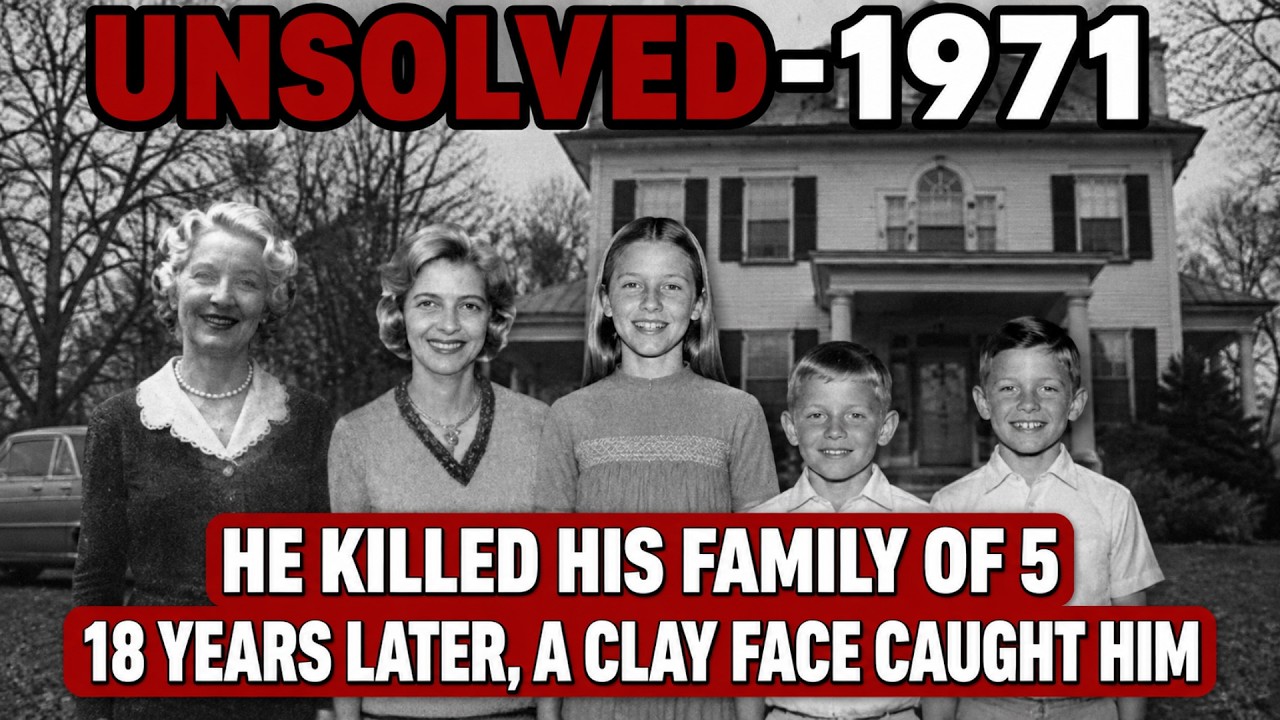
His 84-year-old mother was killed in her third-floor apartment. That afternoon, List watched his son play football, drove him home, and shot him dead. The two other children were killed as soon as they walked through the door. Five people in a single day.
List dragged the bodies into the ballroom, laid them on sleeping bags, cut his own face out of every family photo in the house, and left religious music playing over the intercom. He wrote a five-page confession letter to his pastor, explaining that he had sent his family to heaven. Then he locked the door and vanished. It was 1971, before the internet and before national databases.
List planned the disappearance so carefully that police did not find the bodies for nearly a month. By then, he was on the other side of the country living under a new name. The case went cold, and for 18 years no one knew where he was. What eventually unraveled the perfect disappearance was an unlikely combination: a self-taught forensic sculptor who built a clay bust based on old photos, a crime television show, and a phone call from a former neighbor.
To understand why John List killed his entire family, you have to understand who he was before he became a killer. Born on September 17, 1925, in Bay City, Michigan, he was the only son of a deeply religious German Lutheran family. His father taught him two things above all: discipline and appearance. Failure was not an option, and no matter what happened behind closed doors, the outside world had to see perfection.
In 1943, at age 18, List enlisted in the U. S. Army and served during World War II. He fought on the European front and was honorably discharged as a sergeant in 1945.
He used the G. I. Bill to attend the University of Michigan, earning a bachelor’s degree in business administration and a master’s degree in accounting. In 1951, he married Helen Morris Taylor, a widow whose first husband had been killed in the Korean War.
She brought a daughter, Brenda, into the marriage. The couple later had three children: Patricia in 1955, John Frederick Jr. in 1956, and Frederick Michael in 1958. On the surface, the List family was the ideal American family of the 1950s.
Behind closed doors, things were different. Helen began drinking heavily and showed increasing mental instability. Years later, medical records revealed she was suffering from late-stage syphilis, which was affecting her brain and behavior. List knew about her condition but told no one.
Appearance was everything. The family moved several times as List advanced his career. In 1965, he took a job as vice president and comptroller at a bank in Jersey City, New Jersey, and made a decision that, in hindsight, was the first step toward tragedy. He bought Breeze Knoll, a 19-room Victorian mansion on Hillside Avenue in Westfield, worth at least $100,000 at the time.
The house had a grand ballroom with a stained-glass ceiling, expansive grounds, servants’ quarters, and a large third floor that became a private apartment for his elderly mother, Alma, who moved in with them. The mansion was far too large for one family, and the costs of maintaining it were enormous. But List did not buy Breeze Knoll because he needed 19 rooms. He bought it because he wanted the world to see him living in 19 rooms.
In Westfield, List became a respected member of the community. He led a Boy Scout troop, taught Sunday school at Redeemer Lutheran Church, and imposed strict discipline on his children. Neighbors saw a model family. No one heard arguments or saw Helen drinking.
What no one knew was that by the end of the 1960s, List was drowning. He lost his job at the bank in 1970. According to a former colleague, the reason for his dismissal was simple: no one at the bank liked him. He applied for jobs everywhere but was hired nowhere.
He did not tell Helen. He did not tell his mother. He told no one. Every morning, he put on a suit, picked up his briefcase, and drove out of Breeze Knoll as if he were going to work.
Instead, he drove to the Westfield train station and sat alone for eight hours, sometimes reading the newspaper, sometimes just watching trains pass. Then he drove back home for dinner with his family as if nothing had happened. He secretly drained money from his mother’s savings account to pay the mortgage on Breeze Knoll. Alma had roughly $200,000 in lifetime savings.
By 1971, almost all of it was gone. Debts piled up, and the bank sent notices that foreclosure was imminent. For John List, a man who could never accept failure and who had been taught that receiving assistance was a disgrace, facing public ruin was worse than death. He did not ask anyone for help.
He prayed. In those prayers, he found what he called an answer. To understand the brutality of what he was about to do, you have to see the five people he decided to kill. Helen, 46, was once full of life but had become a shadow of herself, suffering from the effects of advanced syphilis, severe headaches, mood swings, and cognitive decline.
She drank to endure the pain and isolation. List knew of her illness but never got her proper treatment and told no one outside the family. Alma, 84, lived in the third-floor apartment, a devout, dignified woman who trusted her son completely. She did not know he was secretly depleting her life savings.
Patricia, 16, was beautiful, intelligent, and lively. She loved theater and was in the drama club at Westfield High School, where teachers believed she had a future in acting. She wore peace symbol shirts, had friends her father did not approve of, and sometimes talked back. For any ordinary father, this was normal teenage behavior.
For John List, it was proof that his daughter was drifting away from God. John Jr. , 15, was the quiet, obedient older son who played football. Frederick Michael, 13, was the youngest, a child who had not yet had the time to become someone remembered.
He had no passions yet, no dreams yet, and had never argued with his father. In his distorted reasoning, List looked at his family and saw five souls sliding toward damnation. Helen was drinking and falling. Patricia wanted to act.
The world of the 1970s, with its anti-war movement, drugs, and sexual freedom, was corrupting everything. His solution was horrifyingly simple: kill them now, while they were still Christians, to guarantee their place in heaven. In the letter he left for his pastor, he wrote that if he let the family live, he was not sure they would keep their faith. But if he killed them then, he knew they would be saved.
He did not see it as murder. He saw it as an act of love. Why did he not kill himself? Because suicide, under Lutheran doctrine as he interpreted it, was an unforgivable sin.
Suicide would send him to hell, and then he would never rejoin his family in heaven. He had to live, to kill his family, send them to heaven, and then continue living in hopes that God would eventually forgive him and allow them to reunite. In the days before November 9, List executed every step with precision. He canceled the newspaper, milk delivery, and mail.
He called the children’s school and said the family would be traveling to North Carolina to visit a sick relative. He calculated the temperature of the house, the lights, even the smell. If he lowered the temperature enough, decomposition would slow and no one outside would notice. On the morning of November 9, he dressed in his suit, had breakfast with his family, and drove his children to school.
On the way back, he retrieved two guns from the garage: a 9mm Steyr and a . 22 Colt. He entered the kitchen, where Helen was standing, and shot her once in the back of the head. She died instantly.
He dragged her body out of the kitchen, wiped up the blood, and climbed the stairs to the third floor. Alma was in her apartment, unsuspecting. He shot her once above the left eye. He left her body where it fell because she was too heavy to carry downstairs.
Then List made himself lunch and ate it in a house with two corpses. After lunch, he drove to the bank and closed his account, withdrawing whatever he could, including what remained of his mother’s savings. Then he drove to Westfield High School, where his son John Jr. was playing in an afternoon football game.
List stood and watched his son play the entire game, knowing it would be his last. After the game, he drove his son home. Inside Breeze Knoll, List shot him. But unlike Helen and Alma, John Jr.
did not die immediately. Forensic evidence showed the boy fought back, tried to run, perhaps tried to grab the gun. List shot his son multiple times in the chest and face before he stopped breathing. It was the only moment that day when his perfect plan met resistance.
Patricia, 16, arrived home after school. She walked through the door and was shot dead. Frederick, 13, the youngest, walked through the door and was shot dead. List left no detailed account of their final moments, recording only that he finished the task, as if completing a checklist.
So, five people in one day: the wife in the morning, the mother in the morning, the older son in the afternoon, the daughter in the afternoon, the youngest son in the afternoon. After the last death, List began the second phase of his plan. He dragged the bodies of Helen, Patricia, John Jr. , and Frederick into the ballroom on the first floor, and laid them neatly on sleeping bags as if they were sleeping.
Alma’s body remained on the third floor. He then went through all 19 rooms, found every family photo, and cut his own face out of each one with scissors, leaving the rest of the photograph intact. This act haunted investigators for decades. It served no practical purpose.
Psychologically, it meant everything. He was erasing himself from the family, separating himself from what he had just done. He lowered the temperature of the house to slow decomposition. He played religious music over the intercom so that anyone passing by would think someone was home.
He left the lights on throughout the house. From the outside, Breeze Knoll still looked lived in. Then List sat down at a desk and wrote a five-page letter to the Rev. Eugene A.
Rehwinkel. It began with a greeting, then moved directly to the confession. He explained that he had killed his wife, his mother, and his three children. He described the financial difficulties, the loss of his job, and the impending loss of the house.
He wrote that Patricia was determined to pursue acting and that this made him fear for her Christian faith. He gave funeral instructions and ended the letter with the sentence: “I commit myself to the justice and mercy of God, not the justice of man, but the justice of God. ”
He left the letter on the desk beside a note titled “To Whom It May Concern” directing whoever found it to important documents. Then John Emil List walked out of Breeze Knoll, locked the door, drove to John F.
Kennedy International Airport, and left his car in the parking lot. He took a bus, then a train headed for Denver, Colorado. He applied for a new Social Security card under the name Robert Peter Clark. John List no longer existed, and Breeze Knoll fell silent.
The lights stayed on. The music kept playing. Five bodies lay in the darkness. Day after day, week after week, no one came.
Because the List family was so insular and isolated, their absence raised no questions for nearly a month. But by early December, Patricia’s drama teacher at Westfield High School began to worry. Her best and most passionate student had been absent for too long, and no one answered the phone at home. Neighbors also noticed the lights in the mansion going out one by one as bulbs burned out and no one replaced them.
Police were called. On December 7, 1971, nearly a month after the murders, they entered Breeze Knoll. Religious music was still playing over the speakers. The air was cold and thick with the smell of death.
In the ballroom, there were four bodies lying on sleeping bags. On the third floor was Alma’s body. On the desk was the letter. The FBI quickly identified John List as the primary suspect.
They found his car at the airport parking lot, but then nothing. No plane ticket under his name, no bank transactions, no contact with anyone from his old life. The trail ended in the airport parking lot. While America was beginning to learn his name through crime news, John List was on a train heading west, carrying the last of the money withdrawn from his mother’s account and a brand-new identity.
He did not fly because plane tickets leave a trail. He did not drive because his car would still be found. He took a train, a mode of transportation where almost no one checked identification in 1971. In early 1972, Robert Peter Clark appeared in Denver, a courteous, quiet middle-aged man who rented a small trailer and briefly worked as a night cook at a nearby Holiday Inn.
No one asked where he came from. No one checked his past. In the 1970s, before the internet and before national databases, if you had a Social Security card and knew how to stay quiet, you could become anyone. John List knew how to stay quiet better than almost anyone.
What was most unsettling about his new life was its repetition. He rebuilt his old life exactly. He left the cooking job quickly and returned to accounting, the work he had done his whole life. He joined a Lutheran church, the same denomination, the same type of congregation he had attended every Sunday for decades.
He became an active member, arranging rides for elderly parishioners who could not drive. He lived quietly, politely, precisely, and dependably. No drinking, no smoking, no girlfriend, no close friends, no past. Robert Clark was John List minus the family, minus the mansion, minus the murders.
Everything else was identical. From 1979 to 1986, he worked as a controller at a paper box factory outside Denver, a mid-level accounting job with appropriate middle-class pay. He never sought attention, never lived extravagantly, never made a mistake that would make anyone ask questions. He simply lived day after day, year after year, as if the five people who died in the Westfield ballroom had never existed.
Meanwhile, the house where he had killed his family was also disappearing. After the bodies were found, the bank repossessed Breeze Knoll and put it up for sale. No one bought it. The mansion became a haunted site in the eyes of the whole town.
Kids climbed the fence at night, broke windows, and searched for macabre souvenirs. Eventually, the house was boarded up. Then, on August 30, 1972, less than a year after the murders, Breeze Knoll burned down. The fire was officially ruled arson, but no one was ever arrested.
The fire destroyed the 19-room mansion completely, including the stained-glass ceiling, claimed to be signed by Tiffany, that had been in the ballroom where four bodies lay on sleeping bags for a month. In 1974, a new house was built on the same property at 431 Hillside Avenue, but the town still called it the List house. Breeze Knoll was gone, but its ghost was not. What about the case?
The FBI placed John List on its national wanted list. They issued a federal arrest warrant and checked airports, stations, and border crossings. They contacted everyone who had ever known him. Nothing.
Not one lead, not one sighting, not one financial transaction. John List, or whoever he had become, disappeared from every system the 1970s could provide. This was the pre-internet era, before email, cell phones, and surveillance cameras on every corner. If a middle-aged white man with a valid Social Security card moved to a new city and caused no problems, he was almost invisible.
As one official described it, List had committed the perfect crime, not because the killings were perfect, but because the disappearance was. Local authorities in Westfield gradually gave up. The case files moved into the cold case drawer. The original investigators retired.
The town wanted to forget, and the system bet that time would bury the case. But in 1985, Robert Clark married again. He met Dolores Miller at a church event, the same kind of place where John List would have looked for a wife. Dolores was a gentle, religious woman who believed in family values.
She knew nothing about Bob Clark’s past. They married and lived together in Denver. In February 1987, their neighbor Wanda Flannery was reading a magazine with an article about the List family murders in New Jersey. The article included an old photo of John List from 1971.
Flannery looked at the picture and felt a chill. The man looked exactly like a younger version of her neighbor Bob Clark. She told Dolores, who dismissed the idea completely. Her husband went to church every Sunday and was the most upright man she had ever known.
Flannery did not insist, but she did not forget. In February 1988, the Clarks moved to Midlothian, Virginia, after Bob took a new accounting job in Richmond. Contact with Flannery was lost, and the case stayed cold. Then television entered the picture.
In 1988, Fox launched a new show called “America’s Most Wanted,” hosted by John Walsh. The show specialized in unsolved cases and asked viewers for help. The List case was proposed, but there was a problem. The most recent photo of John List was 18 years old.
In 1971, he was 46, dark-haired, and wearing a suit. Now he was 63. Eighteen years changes a face more than any surgery. The old photo was almost useless.
The producers needed a solution that had never been tried before. They turned to Frank Bender, a self-taught forensic sculptor living in Philadelphia. Bender had begun his career in 1976 while studying at the Pennsylvania Academy of Fine Arts. He asked an acquaintance to let him into the city morgue to study anatomy, and there he saw a badly decomposed body.
He said he knew what the woman had looked like alive. A criminal investigator challenged him to prove it. Bender sculpted the face in clay, and the bust helped identify the body as Anna Duval, 62, of Phoenix. Years later, a man was convicted of killing her.
Bender became one of America’s best forensic sculptors, specializing in rebuilding the faces of unknown victims and predicting the appearance of fugitives. The John List case was his greatest challenge. He had only old, faded front-facing photos, no profile shots, and no standard mug shot showing jaw structure. He needed more than photos.
He needed to understand John List from the inside. Bender worked with Richard Walter, a criminal psychologist, to build a complete psychological profile. They studied the confession letter, the daily habits, the obsessive need for control, and the insulated life. Walter concluded that List was the type of person who would never change.
He would still go to church, still work as an accountant, still wear a suit, and still live by the old patterns. Bender translated that profile into a clay bust. He predicted List would be balding, possibly with skin cancer due to age, and would wear old-fashioned round glasses rather than trendy frames. Bender went to an antique shop and bought a pair of thin-framed round glasses.
He placed them on the clay bust. Three months of work went into every line, wrinkle, and jaw angle. When the bust was finished, Bender believed he was looking directly at John List in 1989. Meanwhile, the FBI had created their own age-progression image using computer software.
But when told that “America’s Most Wanted” wanted to use Bender’s bust alongside it, the Bureau refused. Bender’s clay bust would appear alone in front of millions of TV viewers. Everything depended on whether a self-taught sculptor in Philadelphia had guessed correctly. On May 21, 1989, the bust appeared on television screens across America.
“America’s Most Wanted” aired the full story of the List family massacre and placed the bust beside the 1971 photo of List. John Walsh looked into the camera and told viewers that if they recognized the man, they should call. In Aurora, Colorado, Wanda Flannery was watching the show with her daughter Eva Mitchell. When the bust appeared, both women jumped out of their seats.
It was Bob Clark, not similar, not almost the same. It was him, the same receding hairline, the same long face, the same round thin-framed glasses, the same ordinary appearance Flannery had seen over the neighbor’s fence for years. Two years earlier, Flannery had told Dolores Clark her husband resembled the killer in a magazine. Dolores had dismissed it.
This time, Flannery did not tell Dolores. She called “America’s Most Wanted” directly. She was not alone. Within hours of the broadcast, about 20 calls came in from Richmond and surrounding areas where Bob Clark now lived and worked.
Former neighbors, coworkers, and church members all recognized the same face. Frank Bender, the self-taught sculptor in Philadelphia, had guessed correctly, so correctly it was chilling. When the FBI later compared the bust to photos of John List after his arrest, even veteran investigators shook their heads. From the receding hairline to the wrinkles around the eyes, from the jaw angle to the glasses Bender bought at an antique store, everything matched as if Bender had seen List in person before sculpting.
Eleven days passed from the broadcast to the arrest. On June 1, 1989, FBI agents arrived at Robert Clark’s home in Richmond, Virginia. Dolores answered the door. She said her husband was at his office.
The agents went to the accounting office where he worked. The man standing before them looked exactly like the clay bust: bald, wearing round glasses, average build, with a face too ordinary to attract attention on the street. An agent asked, “Are you Bob Clark? ” He said yes.
The agent asked again, “Are you John List? ” He said no. He claimed he did not know who John List was. He said it was a mistake.
He was just an accountant in Richmond. But fingerprints do not lie. The agents took Robert Clark’s fingerprints and sent them for comparison with the prints John List had left when he applied for a gun permit in New Jersey in 1971. Perfect match.
All ten fingers, with no room for error. Robert Peter Clark was John Emil List. After 17 years, 6 months, and 23 days since killing the five people he loved most and walking out the door of Breeze Knoll, John List was handcuffed in a Virginia accounting office, wearing a work suit, exactly as he had done every day for two decades of flight. Dolores Clark, his second wife, collapsed.
She had lived with him for four years, gone to church with him every Sunday, had dinner with him every night, and slept beside him every night, never knowing that her husband had shot his first wife, his mother, and his three children, and laid their bodies on sleeping bags in a ballroom. She was the sixth victim, not of a bullet, but of a lie that lasted four years of marriage. They divorced in 1989. List was extradited to Union County, New Jersey, and continued to deny his identity even after fingerprint matches and military record comparisons.
He clung to the name Robert Clark for months. Finally, on February 16, 1990, facing undeniable evidence, he admitted his true identity. Robert Clark disappeared for the last time. The trial began on April 2, 1990, at Union County Superior Court in Elizabeth, New Jersey, 18 and a half years after the murders.
The defense attorney, Elijah Miller, did not argue that John List had not killed five members of his family. That was impossible to deny. Instead, he argued that List suffered from obsessive-compulsive disorder, that his personality was fractured and unable to cope with accumulating hardships, and that he genuinely believed he was saving his family’s souls in a world he no longer understood. He asked the court to convict List of second-degree murder rather than first-degree.
The prosecutor, Eleanor Clark, dismantled that argument using the five-page letter List had left behind. She read it paragraph by paragraph before the jury: the plan to cancel newspaper delivery, the plan to call the school, the plan to close bank accounts, the funeral instructions, the escape route. She asked the jury whether this was the behavior of a man who had lost control, or the plan of a man who calculated every detail, from the temperature of the house to the music playing over the loudspeakers, and then calmly walked out the door and started a new life. She described List as cruel and calculated to the point of evil, saying he wanted a new life and simply closed all the old accounts, bank accounts, family accounts, and life accounts.
Court-appointed psychiatrist Dr. Steven Simring confirmed List had an obsessive personality but added that there was no evidence of genuine remorse. “He is a cold man,” Simring said. Judge William Wertheimer, who presided over the trial, later described List in six words quoted in all case documents: “No remorse, no honor.
”
The trial lasted seven days. The jury did not deliberate long. On April 12, 1990, John Emil List was convicted on all five counts of first-degree murder. Judge Wertheimer imposed five consecutive life sentences, one for each victim: Helen, Alma, Patricia, John Jr.
, and Frederick. Five names, five lives cut short, five stacked sentences ensuring List would never leave prison. He was 64 years old at sentencing. List appealed.
His lawyers made two arguments they believed were strong enough to overturn the conviction. First, they argued that post-traumatic stress disorder from his World War II service had impaired his judgment at the time of the crimes. Second, they argued that the five-page letter left at Breeze Knoll was confidential information directed to his pastor and protected by clergy-penitent privilege, and therefore should not have been used as evidence. The federal appellate court rejected both claims.
Regarding PTSD, the court found no clinical evidence that List lacked the ability to understand his actions at the time of the crime. On the contrary, the meticulous planning, from canceling the newspaper to lowering the temperature of the house, proved he was in full command of his faculties and in control of every detail. Regarding the letter, the court ruled that List had voluntarily left it at the crime scene with a note addressed to whoever found it, a deliberate act that negated any claim of confidentiality. He had not mailed the letter to his pastor.
He had left it on the desk beside five bodies for police to find. That was not confidential communication. That was a confession. The U.
S. Supreme Court declined to hear the case. All legal doors closed. John List would die in a New Jersey prison.
In prison, List lived the same pattern he had lived his whole life: disciplined, quiet, rule-following, causing no problems. He attended the prison church every Sunday, exactly as he had in Westfield, Denver, and Richmond. He prayed. He read the Bible.
And he waited, as he told a journalist, for the day he would be reunited with his family in heaven. In 2002, in the only interview he ever agreed to give publicly, reporter Connie Chung went to the New Jersey State Prison in Trenton to speak with John List. It was the first time since his 1989 arrest that he had spoken directly to the media about the murders. He was 76, white-haired, sitting in the visiting room in prison clothes.
He told Chung he wished he had never done what he did. “I have regretted my actions and prayed for forgiveness ever since,” he said. When Chung asked why he had not killed himself instead of his family, List gave the same twisted religious logic he had written in the letter 31 years earlier. He believed suicide would have prevented him from entering heaven, and if he could not go to heaven, he would never see his family again.
He had to live to have a chance of rejoining the people he had killed. Then he said something Chung later described as the most disturbing moment of her interviewing career: “I feel that when we get to heaven, we won’t be interested in these earthly matters. They will forgive me or they won’t realize what happened. They won’t realize what happened.
” He believed that in heaven, Helen would not remember the bullet in the back of her head. Patricia would not remember her father standing with a gun, waiting for her as she came home from school. John Jr. would not remember struggling against the bullets.
Frederick would not remember. Alma would not remember. If they did not remember, there was nothing to forgive. On March 21, 2008, John Emil List died at the New Jersey State Prison in Trenton from complications of pneumonia.
He was 82 years old. He spent 18 years in prison, almost exactly the same amount of time he had lived free as Robert Clark after killing his family. Eighteen years on the run, eighteen years in prison. He died without ever publicly admitting that what he did was morally wrong.
He only said he wished he had chosen a different path. Helen and the three children are buried in Fairview Cemetery in Westfield. Alma is buried separately. Five graves for five lives ended by the man they trusted most in the world.
The List case left behind several legacies. The first is forensic science. Frank Bender’s clay bust became a symbol of age progression technology, predicting how a fugitive’s face would change over time. Before the List case, the technique barely existed in law enforcement.
After it, it became a standard tool. The FBI and agencies around the world began using age progression in all long-term manhunts. The second legacy is crime media. The List case was one of the earliest and most prominent successes of “America’s Most Wanted,” which ran for 25 seasons and claimed the show helped capture more than 1,000 fugitives.
Many similar shows followed worldwide, and all owe part of their success to the List case. The third legacy is criminal psychology. John List became a classic case study in familicide, where a family member, usually the father, destroys the entire family and then disappears or takes his own life. List is the prototype of the ideal family killer: outwardly perfect, disciplined, religious, and respected in his community, but obsessed with control to the point that when he lost control, the only response was destruction.
The fourth legacy is popular culture. The case inspired books, documentaries, and podcasts, most notably Netflix’s “The Watcher,” in which the character John Graff was directly inspired by John List. The greatest legacy is the lesson. The List case revealed the dark side of the post-war American dream, the pressure to maintain a successful image at any cost.
The shame of financial failure was so profound that a man preferred to kill his entire family rather than admit he was broke. It also showed how extreme religion can be twisted into a weapon that justifies the most terrible act a human being can commit against the people he loves. John List was not a monster in the way movies usually present one. He was not mentally ill in the legal sense.
He did not hear voices. He was an accountant in a suit who went to work every morning, a Sunday school teacher who taught children about God, a father who drove his children to school and then came home to shoot them. That is what makes it so terrifying. Not the madness, but the ordinariness.
At 431 Hillside Avenue in Westfield, New Jersey, a new house now stands on the old property. New driveway, new lawn, new walls. But beneath the foundations, the ground is the same ground that once held Breeze Knoll, where religious music echoed through 19 empty rooms, and where five bodies lay on sleeping bags in the ballroom for nearly a month. Five people, one bullet each.
Eighteen years of flight, eighteen years in prison, and a clay bust that pulled justice from the darkness.