The Howard family was desperate to stay in the favor of King Henry VIII, and they devised a scheme that placed Mary Fitzroy at its center. But Mary refused to be a silent pawn in their game. She betrayed them in a way that would never be forgotten. Born into one of the most powerful noble families in sixteenth-century England, her prospects only brightened when she married the king’s illegitimate son.
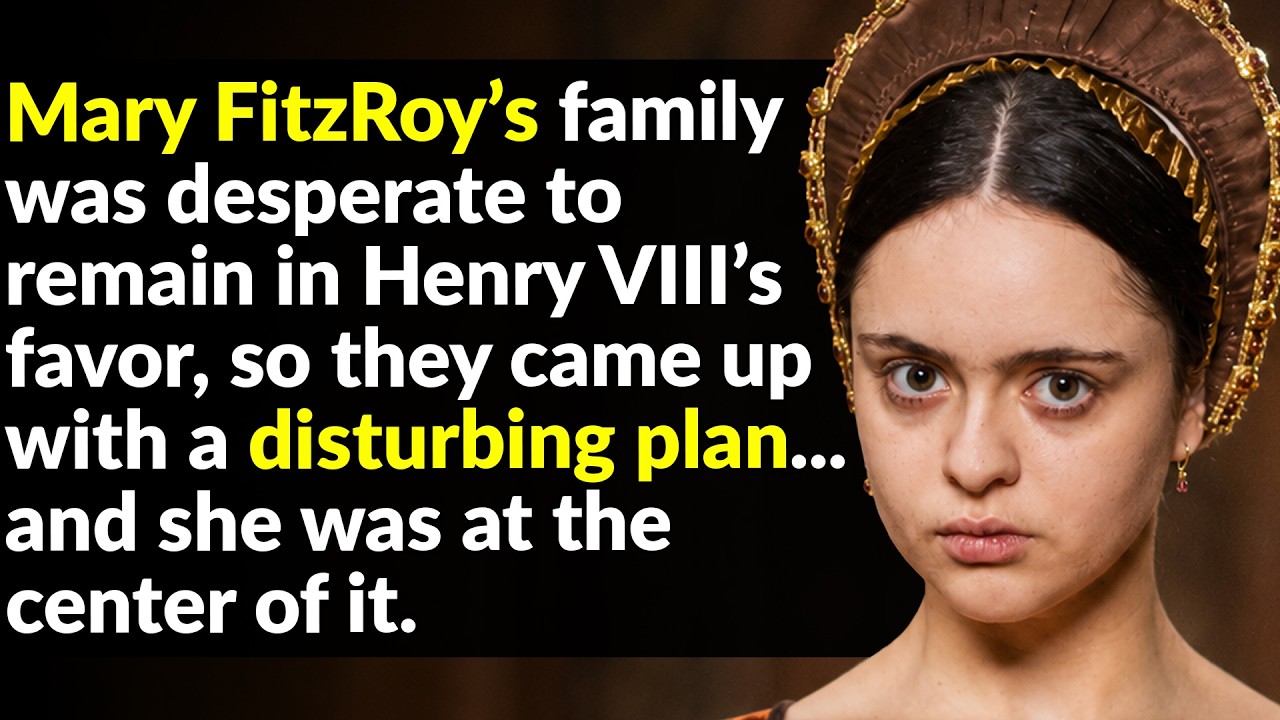
Yet the early loss of her husband sent the young duchess into a spiral of political risk, betrayal, and battles that would define her life. Mary Howard was born in 1519, the third of five children born to Lady Elizabeth Stafford and Thomas Howard, Earl of Surrey. At the time of her birth, her father was the third highest-ranking nobleman in England. He held influential court positions as Earl Marshal and Lord Treasurer of the King’s Household, which gave him considerable power in matters of great importance to the realm.
Her grandparents were the Duke and Duchess of Norfolk and the Duke and Duchess of Buckingham, which made her grandparents some of the most powerful nobles in the kingdom and her family a significant political force. The Howard family enjoyed enormous influence across England, both politically and militarily. Her father had led English forces to a decisive victory at the Battle of Flodden, crushing the Scottish opposition and cementing his place in the king’s favor, at least for a time. The family was an established dynasty with enormous ambitions for power, and they were not afraid to wield that influence, even if it sometimes meant risking their relationships with those in authority.
Throughout their history, the Howards were known for the fluctuating nature of their standing at court, a result of their constant scheming and factionalism. Mary’s powerful family tree did not stop with her parents and grandparents. Among her cousins were Anne Boleyn, Henry VIII’s second wife, Jane Seymour, his third wife, and Catherine Howard, his fifth wife. Each of those wives tried to exert influence over the king, and Mary’s family watched from the sidelines with bated breath, waiting for their next move.
Henry VIII’s reign was a significant period, with radical shifts in England’s religious landscape taking place during his rule. This was the Protestant Reformation, driven by his desire to annul his first marriage. However, Mary’s family maintained a conservative Catholic outlook and instilled those values in her from an early age. Though not all of her siblings necessarily followed that path.
While Mary’s sisters did not achieve much historical significance, her brothers were different. Her older brother Henry became a renowned poet and a founder of the English Renaissance poetry movement. Her younger brother Thomas became a politician who aligned more closely with the family’s values and was later at odds with his poet brother. But no one could say the Howard children experienced a harsh childhood.
Mary was raised primarily on the family’s many estates in the rural region of East Anglia. Not many details remain about her upbringing, but she likely had the best childhood possible at the time, with lavish parties, homes full of servants, and the finest food England could offer. In 1520, with Ireland under the weight of brutal English colonial rule, Mary’s father was appointed Lord Deputy of Ireland and made regular visits to carry out his authoritative duties. It is highly likely that Mary accompanied her father on at least some of these trips, perhaps learning a little about governance along the way.
Her parents were strictly devout in their conservative Catholicism. But, as with many religious zealots throughout history, her father was a great hypocrite. Family tensions reached a peak in 1527 when Mary’s father took a mistress, Elizabeth Holland, who moved into the family home after her parents’ marriage deteriorated. As she grew older, Mary proved herself to be a smart and capable young woman, receiving an education befitting her social class.
Alongside her intelligence, she was also beautiful, and she would use both qualities skillfully in her years of maturity. And with her family’s troubles escalating, she would need all of her wits. Mary’s maternal grandfather, the third Duke of Buckingham, was as ambitious as any Howard and maintained many high-level relationships with other nobles outside the king’s inner circle. The king eventually grew suspicious of this and ordered one of his cardinals to investigate.
Mary’s grandfather was ultimately tried and sentenced to death for treason. Oddly enough, this meant good news for her father’s side of the family. With Buckingham out of the picture, only two dukes remained in the kingdom of England: the Duke of Suffolk and Mary’s paternal grandfather, the Duke of Norfolk. The latter died in 1524, which led to Mary’s father being promoted to the position of Duke.
In 1525, the king appointed a new duke by promoting his illegitimate son, Henry Fitzroy, and giving him the title Duke of Richmond and Somerset. Mary’s father’s important position saw a slight decline, but the politically seasoned Duke of Norfolk seized another opportunity when it presented itself. The king placed his newly appointed son under the care of Cardinal Thomas Wolsey, but Henry VIII was a temperamental man. When Wolsey failed to secure the king’s annulment, the cardinal fell from favor and was imprisoned.
Mary’s father saw his chance. He volunteered to take over the care of Henry Fitzroy under his supervision, which the king approved. And with that, Mary became the perfect bargaining chip. The king was pleased with the progress his son made under Norfolk’s care and soon sought to merge his family with the Duke’s.
It was proposed, whether by the king himself or by Anne Boleyn, who was closely aligned with the Howard family, that the newly elevated Fitzroy should marry young Mary Howard. Her parents quickly completed the marriage negotiations, and in November 1533, Mary Howard married Henry Fitzroy, the king’s illegitimate son. It was a moment of triumph for both the Howard and Boleyn families. Their political ambitions were realized right before their eyes.
Of course, the young bride and groom had little say in the matter. At the time of their wedding, Mary and her new husband were very young, which was unfortunately common in arranged aristocratic marriages of that era. Henry was 14 years old on his wedding day, and Mary was only 13. Being in their early adolescence would play an important role in the drama that followed.
By marrying Henry, the new bride became Mary Fitzroy, Duchess of Richmond and Somerset. The Howard family now had a Duke and Duchess in the family, proving that their daughter was a profitable political bargaining chip. The new duchess was a former member of Queen Anne’s household, which meant the ambitious Boleyn family knew her well and could bend the young girl to their will. Mary also appeared open to religious reform, something the Boleyn family strongly advocated for.
But the young woman was not merely a pawn; the marriage also elevated her own status. At the time of Mary’s marriage, Henry VIII had no legitimate sons, meaning there was no male heir to the throne. As a Duke, Henry Fitzroy was seen as the most likely candidate to ascend to the throne. Mary was probably already dreaming of being crowned Queen of England.
But fate had other plans. Three years after their wedding, Mary’s husband contracted tuberculosis and died on July 23, 1536, just over a month after his seventeenth birthday. When Mary married Henry, the king had forbidden the couple from consummating their marriage, fearing that a marital relationship at such a young age would be unhealthy. After Henry Fitzroy’s death, that arrangement came back with real consequences.
Henry VIII insisted that the marriage was not valid because it had never been consummated. Under normal circumstances, aristocratic widows were granted the right to lands in the event of their husbands’ sudden deaths. Because of the king’s claim that the marriage was not legitimate, Mary was denied many of the lands she would otherwise have inherited. Despite the king’s stubbornness with his purse strings, he kept Mary in his favor, and the royal family allowed her to remain at court.
She settled into a quiet widow’s life among her fellow courtiers and continued to build her social circle. Mary Fitzroy was a cheerful and beloved figure at court, and she had some favorites among the nobility. She became especially close to Margaret Douglas, the cousin of her late husband. Away from politics, the two women collaborated on the Devonshire Manuscript, a remarkable collection of Tudor poetry featuring their own works and poems by court poets.
Mary seemed perfectly content to spend her days in creative pursuits, but a political scandal soon emerged. By 1542, Henry VIII had married his fifth wife, Catherine Howard, who was Mary’s cousin. But after hearing claims of Catherine’s infidelity, the king imprisoned her along with all of her extended family. Mary Fitzroy ended up in the Tower of London with the rest of the Howard family.
The Howards found themselves in a bind, and Mary’s father saw only one way out for his daughter: to marry her off again. The Earl pleaded with the king to marry Mary to Thomas Seymour, the brother of the king’s third wife, Jane Seymour. Surprisingly, the king granted his approval for Mary to marry his former brother-in-law. The Howards breathed a sigh of relief, seeing their dear daughter as a potential means of returning to the king’s favor.
But not all of the Howard family agreed, especially the person in question. Despite her predicament, Mary was not interested in marrying Thomas Seymour. She objected fiercely, and as a result, the marriage never took place. She was not alone in her protest.
Her brother Henry, Earl of Surrey, also objected to the match. It turned out he had an idea of his own. Mary’s brother was planning independently of his father to restore the Howard family to the king’s favor. And like his father, the Earl of Surrey had no hesitation in using his sister as a pawn.
Surrey suggested that Mary should seduce the king himself. This proposal enraged the young duchess, and she did not hide her feelings. Arguments broke out between the two stubborn siblings, and they completely stopped communicating with one another. This had dire consequences for Mary’s brother.
Shortly afterward, Mary’s father and brother were tried for treason, and Mary shocked everyone with her next move. She testified at the trial against her own family members. Whether driven by self-interest or genuine conviction, Mary’s dramatic testimony sealed the fate of two of the most powerful members of the Howard family and represented a complete severing of family bonds by this cunning duchess. Mary’s father and brother were convicted of treason, and both received death sentences.
Her brother, the Earl of Surrey, faced his inevitable fate on January 19, 1547. Her father was next on the execution list, but he escaped death by the stroke of the bells. Mary’s father was scheduled for execution on January 28, nine days after his son’s execution. However, a cosmic stroke of luck saved him from death.
In the early hours of that morning, Henry VIII died, throwing the kingdom into chaos. King Edward VI ascended the throne after his father’s death and never bothered to carry out the death sentence against a man accused of treason against his predecessor. Instead, Mary’s father was imprisoned in the Tower of London for the remainder of the new king’s reign. Mary had been raised as a Catholic.
In fact, her father was the foremost Catholic nobleman in England. Despite her devout upbringing, Mary was more sympathetic to reformist ideas than the rest of the Howard family. An oppositional stance that perhaps explains her willingness to turn on her family in their darkest hour. Although she never had children of her own, Mary took responsibility for her brother’s five children after their father’s execution.
Given the direction of religious currents at court, the duchess chose a wise path, employing the Protestant historian John Foxe to educate the children and ensure they remained in the good graces of the royal family. Interestingly, Mary never remarried after losing her husband. This is especially strange given her status, her young age when she became a widow, and the fact that she had not consummated her marriage in the first place. Perhaps this says more about the duchess’s independent nature.
Mary largely retreated into the background after Henry VIII’s death, becoming effectively a faceless courtier who never again exercised any real power or influence. She was probably more than happy with that. January 1556 saw the beginning of the reign of Queen Mary I, a period of unrest in the English monarchy. The queen attempted to undo many of the reforms implemented by her father, and although Mary Fitzroy had advocated for reform in the past, she was not worried about facing the queen’s wrath for being her brother’s wife.
Mary Fitzroy, Duchess of Richmond and Somerset, died on December 7, 1557, at the age of 37 or 38, possibly after a difficult bout of influenza. The duchess left behind a legacy of quiet independence and political intelligence wielded with careful judgment.