Archduke Ludwig Viktor of Austria was born on May 15, 1842, inside the Hofburg Palace in Vienna. He was the youngest son of Archduke Franz Karl and Princess Sophie of Bavaria, and a member of the House of Habsburg, a dynasty that had controlled thrones across Europe for 600 years.
His father, Franz Karl, is remembered mainly for stepping aside so that his son could become emperor. His mother, Sophie, was a formidable political operator who helped orchestrate the succession and ran much of the Habsburg political machine from behind the scenes.
Sophie had already lost a daughter, Maria Anna, in 1840, two years before Ludwig Viktor was born. That loss seems to have concentrated her attention on her youngest child with almost suffocating force.
From the moment he could walk, Ludwig Viktor occupied a strange position at court. He was the youngest surviving son, indulged by his mother, and mocked by the rest of the Hofburg. Sophie called him "booby little boy," and the court eventually adopted the nickname "Loosy Woosy."
That nickname followed him for life, a constant reminder that the family saw him as a child who never quite grew up. It was hardly a dignified label for a grown Archduke.
There was also a twelve-year age gap between Ludwig Viktor and his eldest brother, Emperor Franz Joseph I. In royal terms, that was not a sibling relationship but a generational divide.
Franz Joseph grew up during the revolutionary upheavals of 1848 and took the throne at eighteen during an existential crisis for the empire. By the time Ludwig Viktor understood the world around him, his brother was already emperor, already married to Empress Elizabeth, and already hardened into a rigid, duty-obsessed monarch.
The two brothers grew up in different eras of the same family. Franz Joseph breathed protocol and obligation. Ludwig Viktor gravitated toward art, theater, gossip, and elaborate parties.
Like every male Habsburg before him, Ludwig Viktor was pushed onto the military conveyor belt. He had no aptitude for drill formations, no interest in cavalry tactics, and no illusions about being a warrior.
He was eventually appointed general of the infantry, but the rank was entirely ceremonial. It came with a uniform and a title, but no battlefield responsibility and no expectation of real military competence.
The other duty the Habsburgs considered far more pressing was marriage. An Archduke existed to marry advantageously and produce heirs. Ludwig Viktor refused the job entirely, repeatedly, and with an obstinacy that baffled the court.
His mother first pushed him toward Duchess Sophie Charlotte in Bavaria, Empress Elizabeth's youngest sister. Ludwig Viktor declined without explanation. The woman he rejected later became engaged to King Ludwig II of Bavaria, another queer royal of the era, though that engagement also collapsed.
In 1863, Emperor Pedro II of Brazil sought European husbands for his daughters. Archduke Maximilian, Ludwig Viktor's own brother, tried to broker a match between Ludwig Viktor and Princess Isabel, the Brazilian heir presumptive. Ludwig Viktor refused again.
No reason ever satisfied the family, and no alternative bride was ever accepted. The court moved from confusion to irritation to a quiet, accumulating contempt for the youngest brother who would not play the game.
If Ludwig Viktor could not be a soldier or a husband, he decided to become the most interesting person in every room. By most contemporary accounts, he succeeded.
The Viennese court nicknamed him the gossip of the Hofburg because his tongue could ruin a reputation in a single perfectly aimed sentence. He made enemies as naturally as breathing and collected them almost as recreation.
At twenty-one, he commissioned the architect Heinrich von Ferstel to build the Palais Erzherzog Ludwig Viktor on Vienna's Schwarzenbergplatz. Completed in 1866, it became one of the most talked-about private residences in the city.
Art filled every room, chosen with his own eye and his own knowledge of European painting and decorative arts. His porcelain and silver collections would later fill entire auction catalogs.
His opulent soirées attracted Vienna's creative and aristocratic elite. Money flowed toward the theater and toward a cultivated circle of artists, writers, and performers.
In the language of the era, Ludwig Viktor was a dedicated bon vivant. He loved beautiful things, beautiful spaces, beautiful evenings, and the company of people who could keep up with his intellect and wit.
Whispers circulated about what else he loved, but for a while the whispers stayed whispers. Eventually, Viennese high society began calling him something far more dangerous than the gossip of the Hofburg. They called him the Archduke of the Bath Houses.
The legal context matters enormously here. Same-sex intimacy in the Austro-Hungarian Empire was not merely frowned upon. It was a crime.
Paragraph 129 of the 1852 Austrian Penal Code criminalized what the law called fornication against nature. The penalty was one to five years of hard labor.
For ordinary Austrians convicted under that statute, the punishment meant social annihilation, loss of employment, loss of family, and sometimes loss of life from brutal prison conditions. Ludwig Viktor was not an ordinary Austrian.
His homosexuality became what historians call an open secret among the Viennese elite. Everyone possessed the knowledge, but nobody could officially acknowledge it.
Because his brother sat on the imperial throne, a protective architecture existed around him that no commoner could access. Emperor Franz Joseph deployed state censorship to keep his brother's private life out of the Austrian press.
Newspapers that hinted at the Archduke's proclivities received warnings. Editors who persisted received visits from officials whose suggestions carried the weight of imperial displeasure.
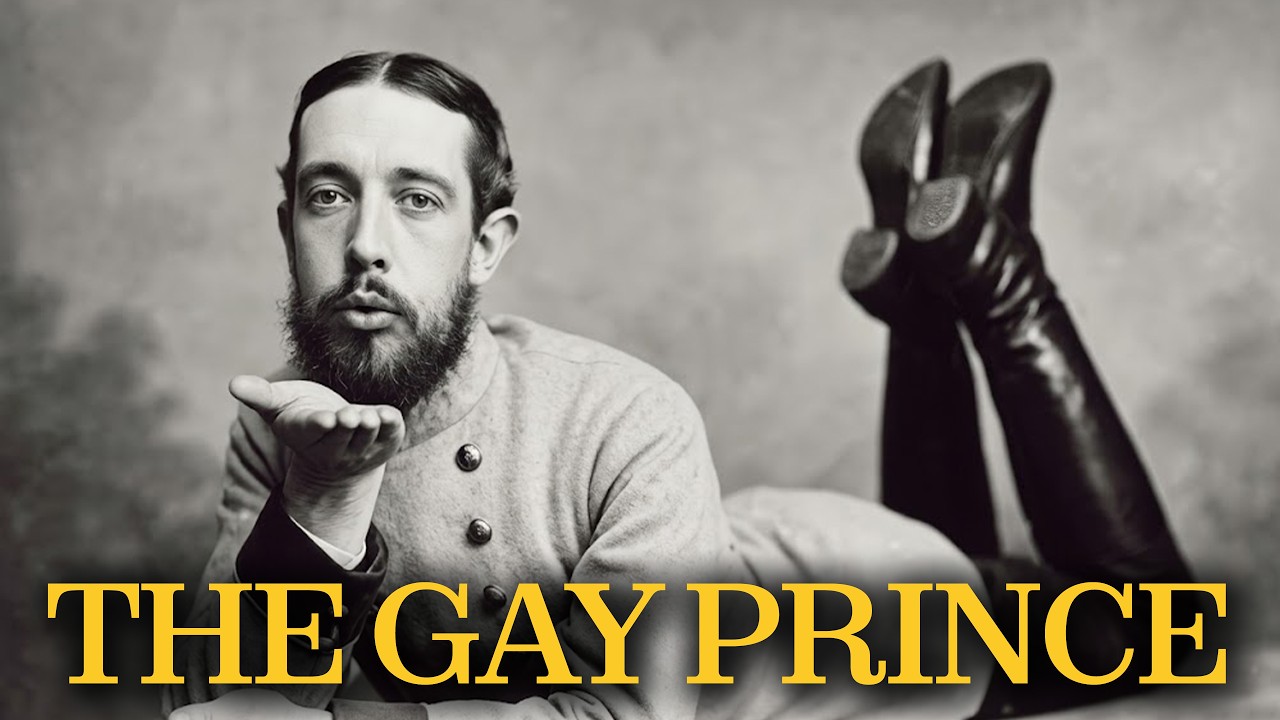
As long as Ludwig Viktor maintained a thin veneer of aristocratic propriety, the machinery of the state shielded him from the machinery of the law. Famous photographs exist showing him dressed in women's clothing, but context is everything.
Those photographs captured him wearing female theatrical costumes for court plays and tableau vivant, an acceptable form of aristocratic entertainment at the time. They are not evidence of public cross-dressing.
The real danger was never in the costumes. It was in a building on Vienna's inner ring, where steam and privacy created a space the law could not quite see into until suddenly it could.
For years, possibly decades, Ludwig Viktor frequented Vienna's exclusive Central Bad, a bathhouse known today as the Kaiserbründl. On its surface, it was a respectable high-society public bathhouse.
Beneath that surface, the Central Bad functioned as a known cruising ground. Men who desired men could find each other within a framework of plausible deniability that the police tacitly tolerated as long as nobody caused a scene.
Ludwig Viktor caused a scene. He arrived in his official Imperial carriage, the one with the Habsburg coat of arms on the door, driven by liveried servants and parked conspicuously outside the bathhouse.
Whether this was conscious defiance, sheer obliviousness born of lifelong privilege, or the recklessness of a man who had stopped caring about consequences, we will never know. But in 1904, when Ludwig Viktor was sixty-two, the consequences arrived.
The exact events at the Central Bad that year remain disputed because Franz Joseph's censors destroyed or suppressed the official police reports almost immediately. The broad strokes survived through memoirs, foreign press coverage, and high society gossip.
According to the most widely circulated account, Ludwig Viktor made an unwanted advance toward a younger man at the bathhouse. The advance was rejected violently, publicly, and humiliatingly.
Someone slapped the Archduke across the face in front of witnesses. Who delivered the slap is disputed. Some accounts name a young military officer, others a bathhouse attendant, and a third version claims it was the outraged father of a younger man Ludwig Viktor had approached.
The identity of the man who slapped him matters far less than the aftermath. Foreign newspapers in Britain, France, and Germany gleefully published detailed accounts of the Archduke's thrashing at the baths.
For a dynasty that treated its public reputation as a load-bearing wall of imperial legitimacy, the damage was catastrophic. Emperor Franz Joseph's reaction matched the catastrophe blow for blow.
Franz Joseph could not imprison his own brother, since the spectacle of a Habsburg Archduke behind bars would have generated even more damaging headlines. But within the closed world of Habsburg court protocol, he possessed tools of punishment more devastating than any prison sentence.
First came the banishment. Franz Joseph expelled Ludwig Viktor from Vienna permanently and ordered him to relocate to Schloss Klessheim, a baroque summer palace near Salzburg, two hundred miles from the court and everything he had built his life around.
Then came the symbolic kill shot. Franz Joseph stripped his brother of his military uniforms. In the Habsburg system, where military rank was woven into male royal identity, this was the equivalent of revoking his membership in the only institution that gave his existence official meaning.
According to a widely repeated anecdote from court memoirs, the emperor twisted the knife one final time. Franz Joseph reportedly joked that his brother should be assigned a ballerina as a military adjutant to keep him out of trouble.
Whether the emperor actually said it or the court invented the quip, the joke tells you everything about how the family processed Ludwig Viktor's disgrace. Not with empathy, not with bewilderment, but with contempt dressed up as humor.

Schloss Klessheim was gorgeous, a baroque palace built by Johann Bernhard Fischer von Erlach set among manicured gardens. Ludwig Viktor would spend the rest of his life there.
Calling it a prison feels almost insulting to people who actually experienced prisons. But a cage is still a cage, even when the bars are gilded and the views are spectacular.
At first, he tried to make the best of exile. The main palace was cold and drafty, so he commissioned the Cavalier House, a smaller, cozier building on the grounds designed for hosting guests.
Friends received invitations when friends still accepted them, and local philanthropy consumed much of his energy. He funded the Salzburg Red Cross, supported local artists and cultural organizations, and became a familiar and apparently well-liked figure in the community.
The people of Salzburg, unburdened by the poisonous gossip networks of Vienna, seem to have simply liked him. He was generous, interesting to talk to, and willing to spend money locally.
Yet the rumors followed him like hunting dogs tracking a scent. One persistent Salzburg legend claims that Ludwig Viktor invited soldiers from a nearby garrison to swim in his palace pool and intentionally neglected to provide bathing suits.
The story goes that military command eventually discovered the arrangement and quietly ordered officers to stop accepting the Archduke's hospitality. It is impossible to verify and impossible to forget.
Whether or not the pool story is true, the fact that it circulated tells you everything about how his sexuality colored every interaction, every gesture, and every act of generosity with an insinuation he could never escape.
Year by year, the world around him shrank. Fewer friends traveled to Salzburg. Fewer letters arrived from Vienna. The family that had banished him showed no interest in revisiting the sentence.
He rattled around Schloss Klessheim with his enormous collections of art, porcelain, and silver, objects he could admire endlessly but could no longer share with any audience that mattered. He became, in every sense that mattered, a man entombed alive.
The fracture between Franz Joseph and Ludwig Viktor is the wound at the center of this story. It never healed because neither brother possessed the tools, the vocabulary, or the willingness to attempt healing it.
Franz Joseph lived his entire adult life inside a framework where duty came before everything else. The woman he married, Empress Elizabeth, grew to despise the suffocating formality of the court and spent decades traveling Europe to escape it.
Then came the loss of his only son, Crown Prince Rudolph, to an apparent murder-suicide at Mayerling in 1889. In 1898, an Italian anarchist assassinated Empress Elizabeth in Geneva, stabbing her through the heart with a sharpened file.
Every major personal relationship in Franz Joseph's life ended in tragedy, estrangement, or violence. Through all of it, the old emperor kept working, kept processing state papers, kept waking at dawn to sit at his desk.
So when his youngest brother humiliated the dynasty with a bathhouse brawl that splashed across foreign newspapers, Franz Joseph reacted the only way his psychological architecture allowed. He treated it as a problem of institutional management.
No surviving record suggests that Franz Joseph ever agonized over the decision. No letters expressed doubt, no private conversations hinted at second thoughts, and no unofficial channels of reconciliation were opened.
Once Ludwig Viktor became a problem the censors could no longer contain, the emperor excised him from the family's operational structure with the same dispassionate efficiency he brought to dismissing a cabinet minister. The brothers remained estranged until death separated them.
Franz Joseph died in November 1916, eighty-six years old, in the middle of a world war that would annihilate the empire he had spent nearly seven decades trying to hold together. Whether he thought of Ludwig Viktor in his final hours, nobody recorded.
After Franz Joseph's death, the Austro-Hungarian Empire lurched toward its own destruction with terrifying speed. The First World War gutted the dynasty's armies, bankrupted the imperial treasury, and shattered the multinational patchwork of territories.
By November 1918, the empire ceased to exist. Emperor Karl I, Franz Joseph's grandnephew and the last Habsburg ruler, abdicated and fled into exile himself.
The successor states that emerged from the wreckage wanted nothing to do with the old regime or the family that had run it. Ludwig Viktor watched all of this unfold from Salzburg.
The empire that had defined his family for six centuries, that had constrained his life, criminalized his desires, punished his indiscretions, and exiled him from the only city he had ever loved, was gone.

By 1915, at seventy-three years old, Ludwig Viktor had already been placed under a conservatorship for what contemporary documents described as mental weakness. Historians generally interpret this as senile dementia.
He died at Schloss Klessheim on January 18, 1919, seventy-six years old. The empire he was born into had outlived him by only a few weeks, or perhaps he had outlived the empire by the same margin.
In his final act, the last decision attributed to him before dementia consumed the rest, came a quiet defiance. Despite a Habsburg tradition stretching back centuries, he refused burial in the Kapuzinergruft, the imperial crypt beneath the Capuchin Church in Vienna.
He requested burial in the local Walserfeld cemetery near Salzburg, not in Vienna, not among his ancestors, not in the crypt where his brother Franz Joseph had been laid to rest three years earlier. He chose, in death, to stay in exile.
He did not choose it because the empire forced him to, since the empire no longer existed, and not because someone forbade his return to the capital. He chose it because he wanted to.
After seventy-six years of being managed, controlled, exiled, and systematically forgotten by the family whose name he carried, the man they called Loosy Woosy decided he would rather sleep for eternity among strangers in a provincial graveyard than spend one more moment under the Habsburg roof.
His estate passed to the recently deposed Emperor Karl I, a man who no longer had a throne, a country, or a functioning empire to govern. Ludwig Viktor's magnificent art collection was auctioned off at the Dorotheum in Vienna between 1921 and 1922.
The porcelain, the silver, and the paintings he had spent decades selecting with his own discerning eye were dispersed to private buyers and museums across Europe. The last physical traces of a complex and deliberately erased human being scattered to the winds.
Ludwig Viktor's royal blood saved his life. That is not hyperbole but a literal, documentable fact. Under Paragraph 129 of the Austrian Penal Code, ordinary men convicted of same-sex intimacy faced up to five years of hard labor.
The prisons and labor camps of the Austro-Hungarian Empire were not the kind of places you walked out of unchanged. Disease, malnutrition, violence, and despair claimed lives with a regularity the state acknowledged only in dry statistical reports.
Ludwig Viktor never spent a single night behind bars, never faced a judge, and never endured the public trial and social annihilation the law inflicted on countless anonymous Austrians whose only crime was identical to his own.
His title shielded him, and his brother's censorship apparatus shielded him further still. The invisible architecture of aristocratic privilege wrapped around him like a suit of armor that ordinary citizens could see but never wear.
But that same title, that same family, and that same system of protection also trapped him in ways no ordinary person ever experienced. A commoner arrested under Paragraph 129 suffered terribly, but after serving his sentence, he could at least theoretically start over.
Ludwig Viktor could never disappear because an Archduke of the House of Habsburg lived under permanent observation. His face appeared in court photographs and society columns, and his movements were tracked by servants, secretaries, and informants who reported to the emperor's office.
His failures were treated as the dynasty's failures, and the dynasty possessed the power to punish him in ways no criminal court ever could. Not with prison, but with total social death, banishment from the capital, stripped uniforms, and decades of isolation in a building that gradually became a tomb with excellent views.
Too royal to be punished by the law, and too royal to escape the family. That contradiction defined every day of his adult life and consumed him by inches, year after year, until there was nothing left to consume.
The Habsburgs did their best to erase him, and for most of the twentieth century they mostly succeeded. Ludwig Viktor barely appears in mainstream histories of the dynasty.
When he does surface, it is usually as comic relief, the flamboyant uncle, the embarrassing eccentric. The bathhouse anecdote is trotted out for a cheap laugh before the narrative moves on to someone the historian considers more worthy of serious attention.
But in recent decades, as scholars and writers have begun excavating the hidden queer histories of European royalty, Ludwig Viktor has started to emerge from the footnotes and demand his own chapter.
He was not the only queer royal of his era. King Ludwig II of Bavaria, his near contemporary, endured a strikingly similar fate of institutional suppression, whispered scandal, and a mysterious death that historians still debate.
But Ludwig Viktor's story carries a particular sting because of how thoroughly and deliberately his family erased him, and how quietly, stubbornly, and finally he chose, in his last coherent act, to erase them right back.
That burial request, Walserfeld and not the Kapuzinergruft, was his last word in a conversation that had lasted seventy-six years. The Habsburgs spent decades telling him he was a disgrace, a liability, a stain on the dynasty's honor that had to be hidden from public view.
In the end, with nothing left to lose and nothing left to prove, the man they dismissed and demeaned as Loosy Woosy told them he did not want to spend eternity in their company. In one quiet, final gesture, he rejected the crypt, the tradition, and the family all at once.
After a lifetime of being managed, suppressed, exiled, and systematically forgotten, he got the last word after all.