The coroner’s report was stark: “Victim, male, 40 years old. ” That man was Chris Penn, found alone and motionless in his Santa Monica condo. The official cause of death was non-specific cardiomyopathy, a cold medical term that concealed a lethal combination of prescription drugs and a heart that had exhausted itself. Before that tragic end, Chris Penn was a force on screen.
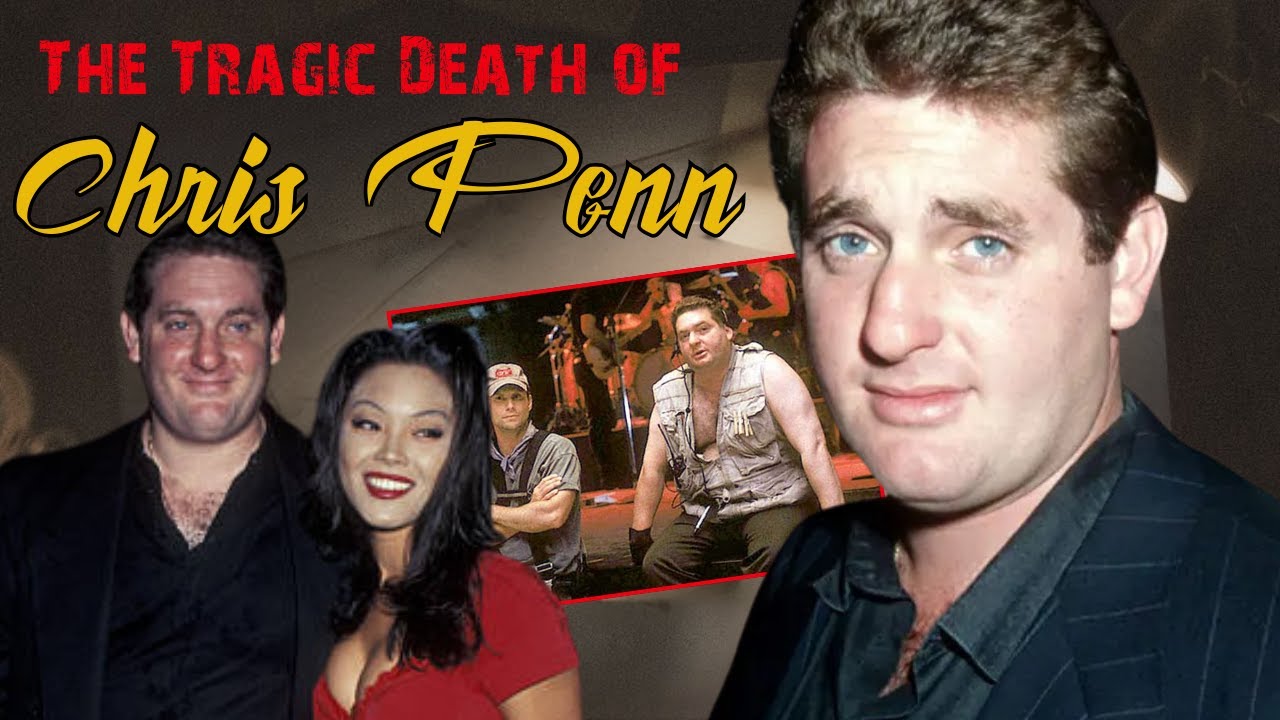
He was not just Sean Penn’s younger brother; he was a ruthless, unforgettable talent in his own right. Born into a Hollywood dynasty, he seemed destined for brilliance. Yet the red-carpeted path led him into a dead end. Christopher Penn was born on October 10, 1965, in Los Angeles, the youngest of three boys.
His father, Leo Penn, was a talented actor whose career was derailed by the McCarthy-era blacklist. Refusing to name names, he pivoted to become a successful television director. His mother, Eileen Ryan, was a versatile actress with a career spanning over six decades. The Penn household was built on craft, integrity, and resilience.
The three sons followed different paths. Michael, the eldest, found his voice in music. Sean, the intense middle child, was destined for superstardom. And Chris, the youngest, was the one with the easy smile.
Growing up, he was inevitably known as Sean’s little brother, a label that would challenge him throughout his life. Acting was the family trade, and Chris entered it almost immediately. At just 12 years old, he enrolled at the Loft Studio in Los Angeles, a serious professional training ground founded by renowned method acting coach Peggy Feury. His classmates included future stars like Johnny Depp and Nicolas Cage.
His best friends were other kids from acting families, including Rob Lowe, Emilio Estevez, and Charlie Sheen, long before they were dubbed the Brat Pack. Lowe later recalled Chris as the spirit of filmmaking for their group, more fascinated by the process and storytelling than by stardom. After just two years, Chris dropped out of high school, not as an act of rebellion but as a vocational choice. Acting was now his full-time profession.
His first screen appearance came in 1979 at age 14. But the real ignition point was 1983, when at 18 he landed three key roles. He appeared in Francis Ford Coppola’s experimental “Rumble Fish,” played the loyal best friend to Tom Cruise in “All the Right Moves,” and wrote, directed, produced, and starred in his own short film, “Nobody’s Heroes,” a war drama that revealed his deeper ambition to be a filmmaker. By the end of 1983, Chris Penn had proven his talent, pedigree, and ambition.
He was a 19-year-old craftsman ready for a serious career. But his next role would transform him from a respected young actor into a household name. In 1984, that next step came in the form of “Footloose. ” The project was one of the most anticipated films in Hollywood, with an $8.
2 million budget. The casting process for the lead role of Ren McCormack was intense, with the studio considering superstars like Tom Cruise and Rob Lowe. The character of Willard Huitt was written as a handsome jock football player, the quintessential all-American best friend. On paper, Chris Penn was the opposite of what was written.
But the film’s casting director, Marci Liroff, who had cast Penn in “All the Right Moves,” was captivated by his raw, authentic presence. She begged a skeptical director, Herbert Ross, to let Penn audition. Liroff said she didn’t even need to see Penn act to know he was the one. The moment he walked in the room, his chaotic, lovable energy was so magnetic that Ross and screenwriter Dean Pitchford saw the flaw in their own script.
In a move almost unheard of for a major studio production, they threw out the old character and rewrote the part entirely to fit Penn. The handsome jock was gone, replaced by a loyal, slightly backward, affable kid hiding a secret: he couldn’t dance. “Footloose” began filming in Utah, and Penn’s natural charm immediately created chemistry with co-star Kevin Bacon. Bacon later recalled Penn as a dude he loved playing around with who always made him laugh.
But Penn’s authenticity presented a major technical problem: he genuinely could not dance. When it came time to film the movie’s most iconic sequence, the training montage, choreographer Lynne Taylor-Corbett was brought in. Taylor-Corbett found Penn to be clumsy, embarrassed, and completely out of his element. Finally, she asked him what he was passionate about.
He lit up talking about wrestling and martial arts. She threw out the dance terminology and equated it to wrestling, choreographing the scene as a series of drills and athletic maneuvers. The result was pure cinematic magic. The scene was originally filmed to a slower song, but director Herbert Ross knew it was a disaster.
A new song had to be written, and fast. Dean Pitchford and his co-writer Tom Snow wrote an upbeat track built around the line, “Let’s Hear It for the Boy. ” Deniece Williams was flown in to record it, and the new track was slotted into the film. The sequence became the film’s standout moment.
Years later, Bacon himself stated that this montage was the best dance scene in the movie. “Footloose” was released on February 17, 1984, and it was a cultural earthquake. It grossed over $80 million on its $8. 2 million budget, making it the seventh biggest film of the year.
Its soundtrack spawned two number one hits, including “Let’s Hear It for the Boy,” which was nominated for an Academy Award. Overnight, Chris Penn became one of the most recognizable young actors in America. But the movie itself received mixed to negative reviews from top critics. Roger Ebert, in his scathing two-star review, called the film seriously confused and failed to mention Chris Penn or the Willard character even once.
This was the birth of the central paradox of Chris Penn’s career: he was a massive pop culture icon who was simultaneously invisible to the critical establishment. For Penn, who defined himself as a craftsman, this was a problem. He didn’t want to be a lovable sidekick. He wanted to be a respected artist.
His very next film, released just seven months after “Footloose,” was “The Wild Life. ” Written by Cameron Crowe, it was marketed as a spiritual sequel to “Fast Times at Ridgemont High. ” This was Chris’s chance to have his own “Fast Times. ”
Once again, the role was shaped by Penn’s real-life persona.
Crowe recalled struggling to find an actor for the lead role and decided to interview Penn just to understand the mentality. Penn walked in an hour late in fatigues with Jimi Hendrix blaring from his tape machine. Crowe was so taken by this raw chaotic energy that the interview helped him formulate the final character. The gamble failed.
“The Wild Life” was a critical and commercial bomb, panned as entirely plotless and a weak imitation of “Fast Times. ” One review bluntly stated that Chris Penn could not carry a lead actor spot. The film that was meant to be his star vehicle had crashed and burned. Undeterred, Penn pivoted again, this time even harder.
In 1985, he took a role in “Pale Rider,” a major western directed by and starring Clint Eastwood. Penn played Josh LaHood, the cruel, arrogant son of the film’s main antagonist. This time, the pivot worked. “Pale Rider” was a critical and box office hit, and critics finally took note of Penn’s range.
In 1986, he made the project that seemed inevitable: he worked with his family. “At Close Range” starred his brother Sean in a dark, gritty true crime story. Chris played Tommy, the brother to Sean’s lead, while their mother, Eileen Ryan, played their on-screen grandmother. The film was powerful and critically acclaimed, cementing a new specialty for Chris: the heavy, the gangster.
As his public career solidified, Chris was nurturing a private parallel life defined by intense discipline. While his brother Sean was famous for his brawls with paparazzi, Chris was channeling his physical energy into martial arts. He trained in kickboxing under legendary champion Don “The Dragon” Wilson and eventually earned a black belt in karate. This pursuit was the core contradiction of his life: a man born into artistic impulse and emotional volatility who was privately drawn to absolute physical and mental control.
Around this time in the late 1980s, Chris Penn’s personal life was struck by a tragedy so profound it would alter the course of his life. He and his girlfriend had a daughter. She was born prematurely, her lungs too weak. She lived for just two days before she passed away.
The grief was a trigger. The man who had trained his body to obey him now found himself in the grips of an impulse he could not control. He began a full-blown addiction to cocaine. In a remarkably candid 1996 interview with The Independent, long after he had gotten clean, he confronted his own choices head-on.
“It happened gradually,” he told the reporter. “I started to play around with it a little bit, and then I had a tragedy happen. I lost a daughter. I went kind of overboard.
I just used it as an excuse to do as many drugs as I could. ”
His career began to stall and then to nose dive. The late 1980s and early 1990s became a wilderness of forgettable roles in films far beneath his talent. He was gaining weight and drifting.
The industry that had celebrated his arrival now saw him as a risk. In 1989, he appeared in “Return from the River Kwai,” a box office disaster. That same year, he starred in the martial arts film “Best of the Best,” a modest B-movie action flick. Then in 1991 came a pair of films that marked the absolute nadir: “Future Kick,” a direct-to-video science fiction action movie, and “Mobsters,” a major studio picture that was savaged by critics as an embarrassing, shallow imitation of a superior genre.
Roger Ebert gave it one star. In the span of five years, Chris Penn had gone from starring in “Footloose,” the seventh highest grossing film of 1984, to co-starring in one of the most ridiculed films of 1991. He was in his late 20s, an addict, grieving, and his career was, for all intents and purposes, over. By 1991, following the critical disasters, Chris Penn was 26 years old and by all Hollywood metrics, finished.
He needed a resurrection. That resurrection came from the most unlikely of saviors: a 28-year-old video store clerk named Quentin Tarantino. The film was “Reservoir Dogs. ”
Penn knew this was his last shot.
He would later say, “I was at the bottom. I needed Reservoir Dogs. ” He went into that audition and poured every ounce of his frustration, craft, anger, and desperation into the room. The role he was reading for was Nice Guy Eddie Cabot, the boss’s son.
Penn’s raw, manic, endearing energy was precisely what Tarantino was looking for. From the very first scene, Penn is electric. The film opens in a diner with a now-legendary debate about the meaning of Madonna’s “Like a Virgin. ” Penn holds his own in a room of acting titans.
The iconic garish blue and orange tracksuit was Chris Penn’s own wardrobe, a choice that captured the character’s blend of suburban comfort and gangster entitlement. The film shot on a shoestring budget of $1. 5 million. On set, the atmosphere was a powder keg.
Veteran actor Lawrence Tierney, playing Penn’s father, was famously difficult and, according to Tarantino, a complete lunatic. Penn had to navigate this chaos while acting out a loving father-son relationship. In the climax, the final bloody Mexican standoff, Penn’s face is a novel of pure emotion. He sees his father is dead, his friend Mr.
Blonde is dead, and he executes the captured cop without a second thought. Then he turns to Tim Roth’s Mr. Orange and demands the truth. The look on his face was described by one critic as the most horrified stare in cinematic history.
“Reservoir Dogs,” released in 1992, was a cultural earthquake. It premiered at the Sundance Film Festival and became the definitive independent film of the 1990s. Just like that, Chris Penn was back. He was one of the most sought-after and respected character actors in Hollywood.
Tarantino immediately cast him again in 1993’s “True Romance. ” Penn played Detective Nicky Dimes, a cynical, wisecracking cop. His performance was so compelling that on the DVD commentary, Tarantino simply says, “I’m just going to watch for a minute as Penn’s scene plays out. ”
That same year, Penn secured a role in “Short Cuts,” directed by the legendary Robert Altman.
He played Jerry Kaiser, a troubled swimming pool cleaner disturbed by his wife’s work as a telephone sex operator. His performance was a masterpiece of quiet internalized rage. The entire cast was awarded the prestigious Volpi Cup for best ensemble at the Venice Film Festival. In 1996, he starred in “The Funeral,” a gritty independent crime drama from director Abel Ferrara.
Penn played the middle brother Chez Tempio, a terrifying, heartbreaking portrayal of a man drowning in his own violent impulses. For this role, Penn won the Volpi Cup for best supporting actor at the Venice Film Festival. It was one of the oldest and most prestigious acting awards on the planet. His brother Sean would win the Volpi Cup for best actor just one year later.
For one shining moment, Chris Penn was not the other Penn. He was standing right beside his brother as an equal. That same year, he landed a rare leading role in the Canadian independent film “The Boys Club. ” He was at the absolute undisputed peak of his craft.
The comeback was complete. But the peak was a lonely, precarious place. After a memorable supporting role in the 1998 blockbuster “Rush Hour,” the momentum of Chris’s career began to slow. He was now the go-to actor to play a cop or a criminal.
The nuanced, award-winning roles were replaced by serviceable, often clichéd parts in less ambitious films. The unresolved grief and his struggles with substance abuse returned with a vengeance. Combined with a lifestyle of excess, this led to significant and dangerous weight gain. In his 20s, he had been a disciplined athletic black belt.
In his late 30s, he was classified as morbidly obese. At 6 feet tall, he weighed an estimated 310 pounds. He expressed deep regret in his later years, acknowledging that his size was costing him roles. In 2001, he was cast in a major subplot for the blockbuster sequel “American Pie 2,” set to play the father of the iconic character Steve Stifler.
He filmed all of his scenes, but when the movie was shown to test audiences, the entire subplot was deemed ineffective. His entire performance was cut from the final film, relegated to the deleted scenes reel on the DVD. But the talent was still there, waiting for a new medium. In 2004, he found a new massive audience in a world he’d never explored.
He was cast as the voice of Officer Eddie Pulaski in the video game “Grand Theft Auto: San Andreas. ” Penn’s voice work was a revelation. He brought a slimy, snarling, terrifying life to the character. The game was a global phenomenon, selling tens of millions of copies.
A whole new generation knew Chris Penn not as Willard or Nice Guy Eddie, but as the most memorable cop in Los Santos. He continued to work, even as his health worsened. He never gave up on his true ambition. For years, he had been working on a new script, a feature-length film about the Vietnam War based on his 1983 short.
This was his passion project. Friends recalled that he was building the sets himself. He wanted to be a director. His friends were worried; he was working himself to the bone even as his health was visibly failing.
In late January 2006, a small independent film he had a role in, “The Darwin Awards,” was set to premiere at the Sundance Film Festival. At just 40 years old, Chris Penn was found dead in his Santa Monica condo. His dream of directing his Vietnam film was unrealized. The news hit Hollywood with a brutal shock.
The premiere of his new film at Sundance, which should have been a celebration, was suddenly a memorial. Immediately, the media narrative began to form: it must have been another Hollywood overdose. But the truth, as revealed by the coroner, was far more complex. The primary cause of death was not an overdose.
It was non-specific cardiomyopathy. His heart muscle was diseased and dangerously enlarged, weighing an estimated 700 grams, nearly double the size of an average healthy male heart. The death was ultimately ruled an accident, but it was a perfect storm of lethal contributing factors. His morbid obesity had put incredible constant strain on his already weak heart.
The toxicology report found a combination of painkillers and sedatives, including promethazine with codeine, Valium, morphine, and marijuana. The coroner concluded that this cocktail, combined with his diseased heart and extreme weight, was a stress his body simply could not take. His heart gave out. His brother Sean later spoke about the tragedy on “Larry King Live.
” He didn’t blame the drugs. He believed Chris died because of his weight. “It’s a piece of you, you know,” Sean said. “I intermittently have lost my right arm, my left, or the center.
”
The legacy Chris Penn leaves behind is not the simple legacy of a movie star. His is the legacy of a true character actor. With nearly 80 screen credits, he left behind a body of work demonstrating staggering range. He could be the sweetest, most lovable friend, or the most terrifying, ruthless monster.
Sometimes, as in “The Funeral,” he could be both at the exact same time. He was a man who won one of acting’s highest international honors, and a man who was unceremoniously cut out of a blockbuster teen comedy. He was a disciplined black belt and a man consumed by his addictions. What if his daughter had lived?
What if he had managed that unimaginable grief without the drugs? What if he had lived to direct his Vietnam film? We will never know.