James Stewart was flying a B-24 bomber over Germany in December 1943 when the sound of his voice carried a weight no movie audience could comprehend. The same hesitant, halting speech that had made him a Hollywood star was now the voice of a squadron commander whose decisions determined whether entire crews returned home. The men flying with him did not need the image the studios had built. They needed an officer who could judge weather, machinery, and fear before the margin for choice vanished.
That transformation did not begin in a studio. It began in a Pennsylvania hardware store, an architecture classroom, a summer theater, and eventually in the cockpit of a heavy bomber. The millions who knew his famous hesitation could not see what his crews had already learned. When a decision could no longer be postponed, James Stewart made it.
James Maitland Stewart was born on May 20, 1908, in Indiana, Pennsylvania, a small county seat east of Pittsburgh. His father, Alexander, ran the family hardware store, where farmers, tradesmen, and town officials brought their practical problems. James watched his father listen before offering solutions. The store taught a form of attention that would later appear in his acting.
A customer entered with a need. The first task was to notice it. Tall and thin long before that shape became a screen signature, Stewart built model airplanes, experimented with mechanical things, and played the accordion. His family assumed he would eventually return to the hardware store.
He attended local schools and then Mercersburg Academy before entering Princeton University in the fall of 1928. He initially imagined civil engineering, but mathematics made that plan painful. He later admitted that college algebra struck him like a death blow. A professor advised him to consider another path.
Stewart moved toward architecture, where drawing, structure, and practical imagination could work together. He did not suddenly become an effortless scholar. When Princeton later celebrated his record, he said, “It doesn’t mean I was smart. School was really difficult for me.
” His senior thesis proposed an airport terminal, joining architecture to his long fascination with flight. He graduated with honors and won a prize supporting graduate study. The country was deep in the Great Depression, and architecture graduates faced a landscape with too few buildings and too little money. But Princeton had given Stewart another education.
He drew cartoons for the campus humor magazine, sang with the Triangle Club, and joined the theater group. The work was experimental. He was learning what happened when his long body, dry timing, and apparently unprepared speech met an audience. Joshua Logan, a Princeton friend who would become a major director, invited him to join the University Players, a summer stock company in Massachusetts.
The pay was board and ten dollars a week. Stewart was approaching graduation with a scholarship and a family business waiting at home. He accepted anyway. The company gathered an extraordinary group of young performers before any of them were famous.
Henry Fonda was there. So was Margaret Sullavan. Stewart was not immediately commanding. He carried scenery, handled props, and accepted small parts while watching more experienced players.
He learned that a relaxed performance is made through listening, timing, repetition, and control. His gift was learning to make preparation disappear. Summer stock also taught him that the audience never sees the full machinery of a performance. That discipline stayed with him when film sets became larger and more divided.
The company moved toward Broadway, and Stewart faced a decision. He could return to Princeton for graduate architecture or remain with the troupe and become, as he put it, the skinniest actor on Broadway. He went home to Indiana and told his family. There followed what he called a moment of stunned Presbyterian silence.
Architecture seemed respectable. Acting still sounded uncertain. His parents rallied, and Alex kept the hardware store as a possible refuge. In New York, Stewart and Fonda became roommates.
Their temperaments differed but their friendship lasted more than half a century, despite political differences that might have divided less durable companions. They shared the instability of young actors waiting for calls, stretching money, and building model airplanes. They became close because each recognized the other’s seriousness about work and his right to remain partly unknowable. Stewart’s Broadway debut came in 1932 in a small role in Carry Nation.
More stage work followed. He was not an overnight sensation. He learned to occupy a stage without pushing, and that silence could be active. His pauses were not empty.
They allowed thought to appear. His repetition suggested a man trying to make language accurate before committing to it. Hollywood noticed. Fonda went west first.
Stewart followed in 1935 after a screen test and signed with Metro-Goldwyn-Mayer. He was 27, unusually thin for a leading man, with a voice that did not resemble the rounded assurance studios associated with romantic authority. His first film, The Murder Man, gave him a small role opposite Spencer Tracy. Casting departments were testing where this strange lanky presence belonged.
Margaret Sullavan helped answer the question. Their work together showed that his hesitation could carry romantic feeling without turning sentimental. Frank Capra recognized the possibilities. In You Can’t Take It With You, released in 1938, Stewart joined a comic ensemble built around the conflict between money and a household that refuses to organize life around it.
The next collaboration made him a national figure. In Mr. Smith Goes to Washington, he played Jefferson Smith, a young senator appointed because political operators assume he will be easy to control. The climactic filibuster demanded sustained physical and vocal deterioration.
Each broken phrase suggested the next might not arrive. The film fixed an image that would follow him for decades, that of the decent citizen who discovers goodness without courage is useless. But the image was not the whole man. He was ambitious, disciplined, politically conservative, and alert to business.
In Destry Rides Again, opposite Marlene Dietrich, he played a lawman who appears almost comically reluctant to use a gun. The role showed how effectively he could make an audience misread gentleness. In The Shop Around the Corner, he played a shop clerk who quarrels with a coworker while unknowingly falling in love with her through anonymous letters. The setting returned him in another form to the world of the hardware store.
Customers enter, clerks observe one another, and reputation is built through daily conduct rather than grand declarations. His gift for listening gave the shop a social life beyond the plot. By 1940, Stewart had reached the front rank of Hollywood actors. The Philadelphia Story paired him with Katharine Hepburn and Cary Grant.
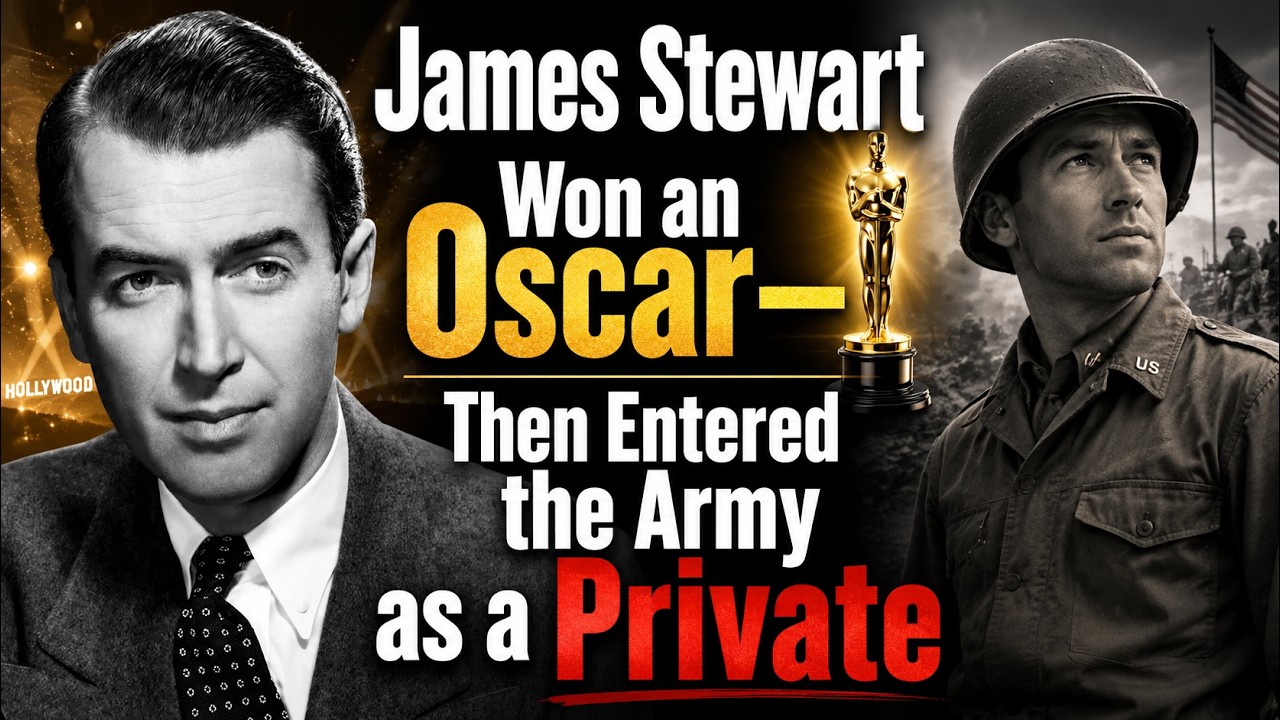
At the Academy Awards held in February 1941, he won Best Actor. He sent the statue home to Indiana, and his father placed it in the hardware store among practical goods and local conversation. The Oscar did not erase the store. It entered the store.
Within weeks, the question of usefulness changed completely. Stewart had been selected in the nation’s first peacetime draft. He had already learned to fly and accumulated hundreds of hours as a civilian pilot. When he reported for induction, however, he was under the required weight.
He returned after adding enough to qualify. On March 22, 1941, he entered the army as a private, months before the attack on Pearl Harbor. He left a career at its peak. The Army Air Corps could use a popular actor for recruitment and public appearances, but Stewart did not want celebrity to become a shield.
He studied for a commission, completed the required courses, and drew on more than 400 hours of civilian flight experience. He earned his pilot wings and became an instructor, but training frustrated him. He continued to press for an operational assignment. Eventually, the Army Air Forces sent him overseas as commanding officer of the 703rd Bomb Squadron.
In the fall of 1943, he arrived in England. The unit flew B-24 Liberators, heavy bombers designed to carry war deep into enemy territory. A squadron commander was responsible for readiness, discipline, planning, morale, and the terrible arithmetic of crews who left and did not return. His first combat mission came on December 13, 1943, against U-boat facilities at Kiel.
Stewart flew not as a visiting celebrity but as an officer responsible to the men around him. He flew 20 combat missions and received the Distinguished Flying Cross and other decorations. He advanced to operations responsibilities, including appointment as operations officer of the 453rd Bomb Group on March 31, 1944. Operations work expanded the burden.
Routes, formations, targets, weather, aircraft strength, and crew readiness had to be brought together before a mission could begin. Stewart’s architectural training and his habit of careful attention found a grave new use. His task was to gather incomplete information and decide before certainty became possible. By the end of the war in Europe, he had risen to colonel.
When he returned to civilian life, the question was whether he could act again. Hollywood had changed. So had he. The pre-war star had specialized in young men whose decency survived institutions and romantic confusion.
He returned in his late thirties, older in bearing, and uncertain whether the public still wanted him. Frank Capra and his partners had formed Liberty Films, and Stewart agreed to star in its first picture. The choice carried risk. He was returning not in a light comedy but as a man convinced his life had become a burden to everyone he loved.
The film was It’s a Wonderful Life. The title now sounds inseparable from holiday warmth, but the picture Capra released in 1946 is filled with frustration, debt, humiliation, sacrifice, and despair. George Bailey wants to travel, build, and see the world. Each departure is blocked by another person’s need.
His goodness is genuine, but it does not make sacrifice painless. When money disappears and ruin threatens, George does not remain noble. He lashes out, terrifies his family, and reaches the edge of self-destruction. Stewart’s familiar pauses no longer signal charming uncertainty.
They become fractures. The film received Academy Award nominations, but it was not the immediate commercial triumph later memory suggests. It gained much of its enormous cultural presence through television broadcasts years after its original release. For Stewart, the film marked a return, not a conclusion.
He could have spent the rest of his career repeating George Bailey. Instead, he tested the limits of the audience’s trust. He worked with Alfred Hitchcock in Rope, playing an intellectual whose ideas about superiority are taken literally by former students who commit murder. He also returned to the stage in Harvey, playing Elwood P.
Dowd, a gentleman whose closest companion is an invisible rabbit more than six feet tall. Stewart did not force an answer. Elwood listens. He remembers names.
The world tries to cure him because his calm exposes its own disorder. His private life was changing as well. He met Gloria Hatrick McLean, a former model and actress who had two sons from an earlier marriage. Gloria had driven an ambulance during the war.
Their courtship worked partly through humor. She later told columnist Hedda Hopper, “The first time we met, he told funny stories, and I laughed. That was how it all started. ” He proposed on his 41st birthday.
They married on August 9, 1949. Stewart became father to Gloria’s sons, Michael and Ronald. In 1951, twin daughters Judy and Kelly were born. On an adjacent lot, Gloria created a garden, removing a house so vegetables and plants could take its place.
She served on boards connected with the Los Angeles Zoo, the Natural History Museum, and the African Wildlife Foundation. Her work mattered because famous marriages are often narrated as if only one life contains action. At the same time, Stewart and his agent were reshaping the economics of his career. For Winchester 73, released in 1950, he accepted a profit-sharing arrangement rather than a conventional salary.
The decision helped weaken the old studio system’s control over major stars. It was practical rather than romantic. Stewart understood contracts, risk, and the value of his name. Anthony Mann’s direction was crucial because he did not ask Stewart to discard the audience’s affection.
He asked the actor to place violence inside it. In Winchester 73, the pursuit of a prized rifle becomes the pursuit of a brother. Stewart’s lean frame no longer appears merely awkward. It looks wired, tense, and capable of sudden force.
Mann recognized that audiences brought affection for Stewart into the theater and used that affection as dramatic pressure. In Bend of the River, The Naked Spur, The Far Country, and The Man from Laramie, Stewart played men whose goals were mixed with greed, revenge, suspicion, or shame. Decency had not disappeared. It had to fight for room.
This was not a simple transformation from innocence to darkness. The earlier Stewart had always contained anger. What changed after the war was the amount of conflict the films allowed to remain unresolved. No director explored that instability more deeply than Hitchcock.
Rear Window, released in 1954, confined him to an apartment in a wheelchair. His character, photographer L. B. Jeffries, watches his neighbors across a courtyard while recovering from a broken leg.
He believes one neighbor has murdered his wife. Yet Hitchcock also makes the investigation part of Jeff’s resistance to marriage. The man celebrated for attentive listening now plays someone who prefers observation without responsibility. Vertigo pushed the method into far more disturbing territory.
Stewart plays Scotty Ferguson, a former police detective whose fear of heights has contributed to a colleague’s death. He is hired to follow a woman apparently haunted by the past, loses her, and then tries to remake another woman into the image of the dead. The film depends on the audience’s history with Stewart. The hesitant man has become terrifyingly certain.
Vertigo was not embraced on its original release as the masterpiece later generations declared it to be. Its reputation grew through restoration, criticism, and renewed attention. It proved that Stewart’s screen identity could hold obsession without collapsing into villainy. In Anatomy of a Murder, released in 1959, Stewart plays Paul Biegler, a small-town lawyer defending an army lieutenant accused of murder.
Biegler appears relaxed, even lazy, but he studies people and builds a defense around legal possibility rather than moral certainty. The actor’s pauses now conceal calculation rather than reveal confusion. The role brought him his fifth competitive Academy Award nomination. Away from the courtroom sets and western landscapes, the family remained the fixed point to which Stewart returned.
His friendship with Fonda offered another durable structure shaped by difference. Their political views diverged sharply. According to later accounts, they learned not to make political argument the test of affection. The Man Who Shot Liberty Valance, directed by John Ford and released in 1962, turns that tension into national myth.
Stewart plays Ransom Stoddard, a lawyer and politician whose career rests on the belief that he killed the outlaw Liberty Valance. In fact, another man fired the fatal shot. The public story is false, yet it helps produce order and political legitimacy. The film delivers its famous judgment: when legend becomes fact, print the legend.
By the 1960s, Jimmy Stewart was larger than any single role. In Shenandoah, released in 1965 during the escalation of the Vietnam War, he plays a Virginia farmer trying to keep his family outside the Civil War. Neutrality fails. War enters the household.
The film shows the limits of a father’s control and the helplessness of waiting for sons to return. Away from the screen, Stewart continued his Air Force Reserve service. He was promoted to Brigadier General in July 1959 and retired on May 31, 1968. He had entered as a private and ended a long reserve career as a general officer.
The following year brought a loss that no public role could absorb. Gloria’s older son, Ronald Walsh McLean, had become a Marine officer. On June 8, 1969, he was killed in Quang Tri Province, South Vietnam. He was 24.
The father who had flown combat missions could not protect the son who went to another war. Stewart’s screen career was beginning to slow. He continued to work in films, television, and on stage, but the center of Hollywood had moved toward younger performers. He often chose age as part of the performance.
In The Flight of the Phoenix, released in 1965, he played a pilot whose experience is challenged after a plane crashes in the desert. The survivors must build a smaller aircraft from the wreckage. His film acting remained most effective when a character had something to solve, conceal, or endure. In The Shootist, released in 1976, he appeared with John Wayne as a doctor who tells an aging gunfighter he is dying.
Stewart does not decorate the diagnosis. He gives the other man the dignity of clarity. He returned to Harvey on stage in 1970 with Helen Hayes. The role changed as Stewart changed.
An older Stewart made Elwood’s detachment feel chosen. Stewart also wrote and recited poetry, often comic, domestic, and plain-spoken. One of his best-known poems concerned a dog named Bo. The performance moved from humor to grief with little warning, and his voice faltered as he reached the loss.
Recognition accumulated. The American Film Institute gave him its Life Achievement Award in 1980. In March 1985, the Academy presented him an honorary award for 50 years of memorable performances. Honors turned the long career into a sequence of tributes, but Stewart continued to protect large parts of himself from public inspection.
As the years passed, he reduced his work. His final movie role was a voice performance in An American Tail: Fievel Goes West, released in 1991. He played Wylie Burp, an old dog and former lawman whose name affectionately echoed Wyatt Earp. In animation, the body disappeared, and the voice carried everything: hesitation, authority, humor, fatigue, and one final call to courage.
Princeton remained part of his life. He served as a trustee, supported the university library, and donated screenplays from his films. In 1997, the university dedicated a theater in his name. Indiana, Pennsylvania also turned memory into a place.
The Jimmy Stewart Museum opened on his birthday, May 20, 1995, above the Indiana Public Library. By then, Gloria was gone. She died of lung cancer at their Beverly Hills home on February 16, 1994. She was 75.
The marriage had lasted more than 44 years. Her death altered Stewart’s remaining years. Friends described him as increasingly withdrawn. On July 2, 1997, James Stewart died of cardiac arrest at his home in Beverly Hills.
He was 89. Obituaries repeated the familiar words: everyman, hero, decency, small-town America. Those words were not false. They were incomplete.
After his death, the films continued to change. It’s a Wonderful Life remained a holiday ritual, but scholars and viewers increasingly emphasized its rage and economic anxiety. Vertigo rose in critical reputation until it was regularly placed among the greatest films ever made. The Anthony Mann westerns were studied as severe examinations of masculinity and violence.
The actor’s archive dispersed across institutions. Princeton held scripts and records. Military museums preserved service details. Indiana preserved objects and family history.
Each archive tells a different Stewart. None is sufficient by itself. Together, they prevent the easy legend from becoming the only available man. By the summer of 2026, his afterlife had taken another visible form.
The museum in Indiana displayed costumes, props, and production material from an upcoming feature film about his life made with the participation of his daughter, Kelly, as an executive producer. As of early August 2026, the new film had not yet opened. Its existence showed that the struggle over how to remember Stewart remained active. Jimmy was the name the public used for familiarity, warmth, and trust.
James was the man who studied structures, counted risks, guarded his private life, accepted command, made profitable contracts, loved imperfectly, grieved privately, and kept working after the image around him had become larger than any single performance.