Nancy Allen was 25 years old, broke, and ready to leave Los Angeles for good when a chance conversation in a health club steam room changed the course of her life. Within months, the shy daughter of a Bronx police lieutenant was on the set of one of the most influential horror films ever made. Within a few years, she became the wife and on-screen muse of a controversial director, starred in a thriller so incendiary that feminist activists spray-painted movie screens in protest, and anchored a science fiction franchise that became a cultural touchstone. Then she walked away from it all, quietly building a second life that had nothing to do with Hollywood.
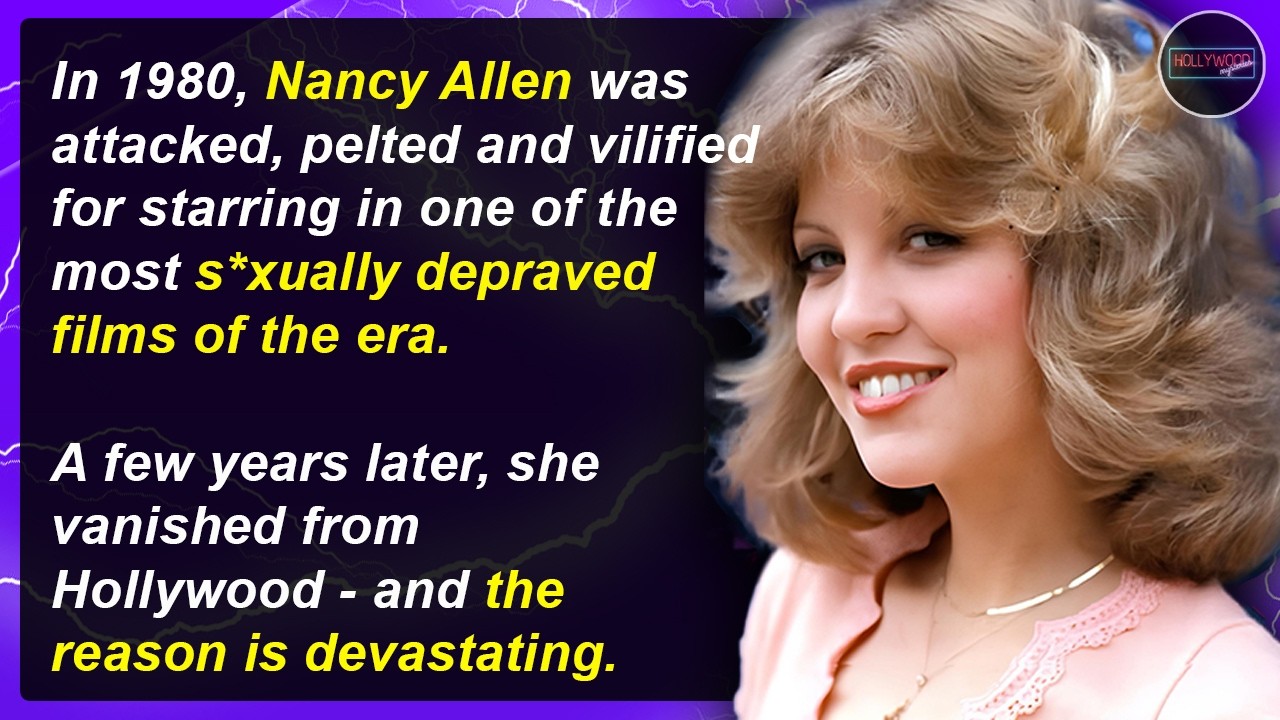
Born on June 24, 1950, in the Pelham Bay section of the Bronx, Allen was the youngest of three children. Her father, Eugene Allen, was a New York City police lieutenant, and her mother, Florence, noticed early on that her youngest daughter was cripplingly shy. The remedy was dance class, which Florence enrolled Nancy in at age four. It seemed to work.
Allen grew up on 196th Street, attended the Academy of Mount Saint Ursula, and carried the discipline of a household run by a police lieutenant. It was not a world that produced movie stars. When the family moved to Yonkers, Allen’s daily life shifted, but her watchful nature remained. She won admission to the High School of Performing Arts in Manhattan, a legendary institution humming with elite ambition.
But the atmosphere was relentlessly critical, and instead of liberating her, it took the joy out of performing. She lasted a year. She then enrolled at Jose Quintero’s School for Young Professionals, where a school connection led her to commercial auditions. By age 15, she was earning money in front of cameras.
The commercials were unglamorous but practical, teaching her how to hit a mark and make copy sound natural. She worked with a coach named Claudia Frank on voice and diction. Years later, Allen described this period with characteristic directness: “I didn’t struggle. I just started working and never really stopped.
” But by the mid-1970s, she was restless, approaching 25, and feeling like the real thing was happening elsewhere. She decided to go west. Her agents resisted, noting that commercial production in Los Angeles was sparse compared to New York. One agent delivered the kind of casual cruelty that passes for honesty in the entertainment business, telling her that at 25, she was too old to be worth the investment.
She went anyway. Her first widely documented film appearance had come in 1973, a small role in Hal Ashby’s “The Last Detail,” playing Jack Nicholson’s nervous date. It was three days of work, but they were transformative. Allen recalled that the set was loose and improvisatory, and Nicholson operated with a fluidity that astonished her.
“We didn’t really rehearse,” she said. “We just started shooting him talking to me, and people say, ‘Oh, you’re really good with the way you ignore him, and how bored you seem. ’ But really, the truth is that I think I was just paralyzed with fear. ” In between takes, Nicholson moved from casual conversation into character so seamlessly that Allen didn’t realize the camera had started rolling.
Those three days gave her the bug, setting the hinge on which everything turned. Los Angeles in 1975 was not kind to Nancy Allen. She arrived with commercial credits and one small film role, and found neither counted for much. Auditions were sparse, and the agent’s words about her age rang in her ears.
She was on the verge of packing up and returning to New York when fate intervened in the most improbable fashion. At a women’s health club, sitting in the steam room, she fell into conversation with a woman named Harriet Helberg, who turned out to be a casting director finalizing auditions for a horror film based on a Stephen King novel. The director was a young New Yorker named Brian De Palma. Allen was the last reader on the last day of auditions.
The role was Christine “Chris” Hargensen, the queen of mean girls, and she read with the desperate conviction of someone with nothing left to lose. What followed was a kind of emotional whiplash that Hollywood specializes in. A phone call suggested she had the part, then another warned that the search was continuing. After a protracted casting process, during which producers nearly recast the role, she was officially given the part in November 1975.
She was 25 years old, and everything was about to change. “Carrie,” released in 1976, was a phenomenon. De Palma’s adaptation of King’s novel about a telekinetic outcast terrorized by classmates and a fanatical mother was both a critical and commercial triumph. Allen’s performance as the coolly sadistic Chris Hargensen became one of the film’s defining elements.
She played the role with a serpentine pleasure that felt genuinely dangerous. “It was so much fun,” she said later, with something confessional in the admission, as though exploring her own capacity for cruelty had been a release. “I do like those bad girls,” she told the Hollywood Times decades later. Allen recalled that the young cast members attended dailies together and socialized constantly, creating a communal atmosphere rare on film sets.
The notable exception was Sissy Spacek, who kept her distance to preserve the isolation of the title character. Allen understood and admired it, but the dynamic had consequences: the other actors began treating Allen as though she actually were Chris Hargensen. In her telling, it was one of the first revelations about the power of committed performance—inhabit a character fully enough, and the world around you begins to reshape itself accordingly. She carried that lesson into every subsequent role, understanding acting not merely as pretending but as a kind of controlled possession, an invitation for the shadow side to walk in daylight.
“Carrie” was a commercial juggernaut, earning over $33 million against a modest budget, and it launched or solidified the careers of nearly everyone involved. For Allen, it was personal validation. The girl an agent had declared too old, and the dancer who had been critiqued out of performing arts school, had found her instrument. The “Carrie” set was also where Allen’s relationship with Brian De Palma began.
They met through the new Hollywood social ecosystem at its peak, a loose network of young filmmakers and actors who gathered at dinner parties and private screenings, debating scripts and dissecting films with the fervor of graduate students. “It was like being in film school,” Allen recalled. “To hear Steven and others discuss and take apart old films and current films and talk about directors. I learned a lot.
Everything was really magical, and it’s so different now. ”
When she casually mentioned names like Steven and Amy, she was referring to Steven Spielberg and Amy Irving, with whom she and De Palma socialized as couples. “Everybody was so young,” she told The A. V.
Club. “Steven was only a few years older than me and living in a very funky house in Laurel Canyon. And Brian’s apartment in New York, I think he had two dishes, a fork and a glass, and that was it. ” Allen was not merely an observer but a participant, absorbing the grammar of filmmaking through proximity to some of the era’s defining figures.
She married De Palma in January 1979. By then, their professional and personal lives were thoroughly intertwined. She had appeared in Robert Zemeckis’ debut feature, “I Wanna Hold Your Hand,” in 1978, a film she remembered with particular warmth. She had mistaken Zemeckis for a production assistant on the day they met.
“I bumped into this tall, young, geeky guy with glasses,” she recalled. “He said, ‘Oh, Nancy Allen, I loved you in Carrie. ’ I said, ‘Thank you so much. ’ He introduced himself as the director.
I said, ‘You’re the director? ’” The rehearsal process was meticulous, the shoot fast and collaborative, and the script, co-written with Bob Gale, was so tightly constructed that it moved, in Allen’s words, like a fast-moving train that didn’t stop. Then came Spielberg’s “1941,” a chaotic production that stretched from a 14-week hire to a six-month ordeal. The project demanded prolonged night shoots, constant rewrites, and a cast that eventually stopped reading the evolving script altogether.
“You had to wake up, say, ‘What are we doing today? ’ and then go for it. ” There were injuries, too. A freak accident involving flash bulbs and feathers ignited a fire near the mock-up cockpit where Allen was trapped.
She was pulled through the flames, her stockings burned off her legs. “I literally jumped out of the plane and a big grip caught me and flung me onto the wing. ” Despite it all, she distinguished between the experience, which she called disappointing at the box office, and the original script, which she insisted was funny before it was expanded into unwieldiness. The career apex of this early period is commonly anchored to two films, both directed by De Palma, both starring Allen, and both, in their very different ways, detonations.
“Dressed to Kill” arrived in the summer of 1980 and immediately became one of the most debated films of the decade. Allen played Liz Blake, a sharp-tongued sex worker who witnesses a brutal elevator murder and becomes both detective and target. The film was a Hitchcockian puzzle box, drenched in voyeuristic camera work and scored to Pino Donaggio’s lush, nerve-wracking strings, and it made Allen a star. Roger Ebert singled her out as wonderfully offbeat, noting the emotional accessibility she brought to a role that could easily have been mere genre furniture.
But the film was also a war zone. The MPAA initially slapped it with an X rating, forcing De Palma to trim roughly 30 seconds of material, including blood in the elevator sequence and more explicit dialogue from Allen’s character. An X rating in 1980 meant virtual exile from mainstream distribution, and the film’s commercial prospects hung on the willingness of a few seconds of footage to disappear. De Palma publicly accused the ratings board of censorship and repression.
The MPAA chair, Dr. Richard D. Heffner, countered by invoking his obligation to American parents. The battle was fought in trade papers and newspaper columns, leaving its mark on everyone involved.
The film opened on July 25, 1980, grossing $3. 4 million in its first weekend from 591 theaters. It would go on to earn over $31 million domestically, making it the 21st highest-grossing film of the year. David Denby, writing in New York magazine, proclaimed it “the first great American movie of the ’80s.
” But the praise was matched by outrage. Women’s groups rallied against the film with a fury that seems both of its moment and oddly prescient. The activist group Women Against Violence and Pornography in Media distributed leaflets arguing that the film’s depiction of a psychotic cross-dressing killer made all sexual minorities appear sick and dangerous. In Iowa City, NOW members picketed campus screenings.
Movie screens in some cinemas were attacked with red spray paint. The controversy engulfed Allen, Michael Caine, and De Palma alike, all three receiving nominations at the inaugural Golden Raspberry Awards. The film arrived amid a broader cultural panic about violence against women—in Britain, the Yorkshire Ripper was still at large, and women’s groups were already protesting outside sex shops and cinemas. Allen found herself at the center of the storm without having chosen it.
She was the woman in the black lingerie, the prostitute with the razor at her throat, the body on which the culture projected its anxieties about sex and violence. The legal fallout extended beyond protests. A lawsuit later alleged that distributor Orion had mishandled net profit calculations, a dispute settled amicably by late 1989. Allen, meanwhile, was nominated for a Golden Globe for new star of the year, an accolade that acknowledged what the protest sought to obscure: her performance was genuinely accomplished.
She existed for a brief, vertiginous moment in the space between acclaim and vilification. “I’ve been to hell and back on film,” she told the Washington Post in 1981. “A lot of people ask me if Brian has a lot of nightmares. Well, I’m the one who’s always waking up screaming in the middle of the night.
” She confessed that elevators terrified her after filming the murder sequence. “I’m claustrophobic anyway, but after the elevator sequence in Dressed to Kill, I do get a little freaked out if it stops on a floor I hadn’t planned on. ”
On the heels of “Dressed to Kill” came “Blow Out,” released in 1981, a neo-noir conspiracy thriller pairing Allen with John Travolta. She played Sally, a woman entangled in a political assassination, and the film required her to access a register of vulnerability quite different from the knowing wit of Liz Blake.
The part had not been written for her; the characters were originally conceived as much older. De Palma reworked them for Allen and Travolta, and the chemistry between the two actors became the film’s emotional foundation. Roger Ebert wrote, “We believe in the reality of the people played by John Travolta and Nancy Allen, and that belief was grounded in something genuine between the performers, an ease and trust that transmitted through the screen. ” Allen later praised Travolta: “He brought heart and soul to it, and a warmth that didn’t exist on page.
”
The film’s climax, in which Sally is murdered while Travolta’s character races helplessly through the streets of Philadelphia, remains one of the most devastating endings in American cinema. It refuses consolation, punishing the audience for believing that love and competence can overcome political corruption. Allen played the final moments with a terror that felt unfeigned, and her genuine claustrophobia gave her performance in the underwater car scene a raw, almost involuntary authenticity. “Blow Out” opened to what one retrospective essay described as pretty much disastrous box office returns, arriving in the summer of 1981 at the height of the blockbuster craze.
But its reputation underwent a radical transformation over the following decades, emerging as a touchstone of conspiracy cinema and, for many critics, De Palma’s masterpiece. The Criterion Blu-ray release brought it to a new audience, and Allen herself was surprised by its longevity. “Who knew that years later we would still be talking about these films? ” she reflected.
Working with De Palma was, by her account, both creatively rich and complicated by intimacy. “Maybe more so than the first time because we knew each other really well,” she told The A. V. Club.
“You develop a shorthand in terms of communicating. The more you work with anyone, the more comfortable and safe you feel. ” She said her own claustrophobia may have inspired De Palma’s next film after their divorce, “Body Double,” which centers on a claustrophobic actor. “Maybe he took that.
That was me, perfectly. ”
The divorce came in 1984, and Nancy has never spoken of the split with public bitterness. The mid-1980s were a period of recalibration. By some accounts, her film opportunities narrowed after the divorce; it was whispered that her association with De Palma had been both her making and her limitation.
She took roles in genre films, including Michael Laughlin’s “Strange Invaders” in 1983, written by Bill Condon, whose screenplay she adored. Her account of the production, however, was unusually blunt. “My fondest memory of Strange Invaders was reading the script, which was fantastic,” she said. “Bill Condon is an amazing writer and should have directed the movie.
I don’t have a lot of fun memories about making it. The shoot was very challenging because of the director. He really was awful. ”
The candor was characteristic.
Allen distinguished sharply between successful and dysfunctional sets. She starred alongside Michael Paré in “The Philadelphia Experiment” in 1984, earning a Saturn Award nomination for Best Actress, and briefly dated Paré after the production. She hosted the horror documentary “Terror in the Isles” with Donald Pleasence, and she worked with Abel Ferrara on “The Gladiator” in 1986, a television film she acknowledged was dreadful. Ferrara’s opening gambit on the first day of shooting was, by Allen’s telling, magnificent in its honesty.
“So, okay, this is a real piece of… What are we going to do with it? How do we make it work? ”
And then came the script that changed the second half of her career.
“I got the script and I called my agent and said, ‘They’re going to change the title, right? That’s a stupid, terrible title, and I’m sure it’s an awful movie,’” Allen recalled of “RoboCop. ” “But I turned to the first page and thought, ‘I’d read a few pages. ’ And then I couldn’t put it down.
It was very smart, very witty, and there’s a lot of political commentary in there. ” She met Paul Verhoeven, the Dutch director making his Hollywood debut, and read two scenes. He asked her to try a specific approach to one scene. She took a minute, left the room, came back, and did it differently.
She asked if that was what he had wanted. He said, “No, but it was very interesting. ” She laughed. Her father’s career as a police lieutenant gave her an immediate, almost visceral connection to Officer Anne Lewis, the tough, loyal partner who becomes the emotional center of “RoboCop’s” narrative.
“When I read the script, I felt like I knew the territory,” she said. “I felt pulled to it. My father died a few years later, so it was great that he got to see me in the film. Making RoboCop was a great way to honor him.
” On set, she insisted on a detail that her father confirmed, albeit not in the way she expected. During a scene in which Peter Weller suggested she hand over her gun, Nancy refused, declaring that a police officer never gives up their weapon. Weller told her to call her father and check. “I was absolutely certain I was right,” she recalled.
“But when I spoke to my father, it turned out I was absolutely wrong. ”
Verhoeven was, in Allen’s telling, a force of nature. “He’s like a mad genius,” she said. “He acts everything out and plays all the parts and then says, ‘But don’t copy me.
’” His energy was infectious, his methods chaotic and brilliant. “It was a delight to make this movie every day,” she told an audience at The Hollywood Show in 2024. The shoot had its own physical costs. For the climactic steel mill sequence, where Lewis lies wounded in a pool of filthy water, Allen was offered a wetsuit to wear beneath her costume.
“I’m not putting a wetsuit on. I will look like a whale in the movie,” she told the crew. They insisted. She refused.
When she entered the water without it, the freezing, contaminated reality hit instantly. She conceded afterwards, but by then the take was done. “RoboCop” was an enormous commercial and critical success, earning over $53 million domestically against a $13 million budget. Allen received a Saturn Award nomination for Best Actress, and the film spawned a franchise that would define her public identity for decades.
Verhoeven had created something that was simultaneously a brutal action film, a biting political satire, and an unexpectedly moving story about the persistence of human identity beneath layers of corporate machinery. Allen’s Lewis was the hinge on which the emotional story turned; it was she who recognized Murphy beneath the visor, she who insisted on treating the machine as a man. The role demanded an understated toughness that Allen drew directly from her upbringing. “There’s nothing more uncomfortable than wearing black lingerie,” she once quipped about the “Dressed to Kill” climax.
But Officer Lewis’s discomfort was a different order, the daily grind of a woman proving her competence in a world that doubted it, conveyed through body language and terseness rather than speeches. She reprised the role in “RoboCop 2” in 1990, training in martial arts and participating in police instruction to make Lewis more physically credible. “Swinging guns and throwing punches doesn’t come naturally to me,” she told the Los Angeles Times. But shooting the sequel under director Irvin Kershner was miserable.
“RoboCop 2 was the worst experience of my life,” she said flatly. “Irvin Kershner didn’t like me, and he made that apparent moment by moment, day by day. It was torture. He was awful.
In my opinion, we had a great script that he destroyed. Everything that was in the script that had humor or heart, he pulled out. ” She later referred to Kershner as a miserable human being. The venom was unusual for Allen, who generally parceled out criticism with surgical precision.
She said the only reason she returned for “RoboCop 3” was loyalty to the character and her fan base. “I really feel bad for Fred Dekker in a way because I came onto the film after such a terrible experience on the second film, and I was very guarded. ”
For the third installment, she worked to soften Lewis’s perpetual toughness. “You do your job, and you become more confident with yourself.
Therefore, you don’t have to prove yourself to anyone and basically deny your womanhood. It’s not a dirty word. It’s actually an asset. ” Her character was killed off early in the film, a decision she notably did not request herself, despite an enduring urban legend to the contrary.
Dekker later admitted publicly that killing Lewis had been a mistake. The film was rated PG-13, a dilution that Allen felt betrayed the franchise’s anarchic spirit. “You couldn’t make the original RoboCop today,” she observed. In 1992, Allen married comedian Craig Shoemaker, whom she met on the set of “Acting on Impulse” the previous year.
The marriage lasted barely two years before ending in divorce in 1994. She later married a contractor named Randy Bailey. Allen has never trafficked in public confession about her personal life, and the absence of tabloid drama is itself a statement in an industry that feeds on spectacle. Through the late 1990s, she took parts in films like Steven Soderbergh’s “Out of Sight” in 1998, which she described as a warm and welcoming set.
She came in at the end of filming, met George Clooney, worked with Albert Brooks and Isaiah Washington, and watched Soderbergh keep writing small moments for her and Brooks, most of which she suspected would never make the final cut, but it was fun to shoot it, she said. “It was a fabulous experience. ” Soderbergh was, in her taxonomy of directors, another member of a small fraternity who radiated competence and vision. “Whether you like their films or not, you can see them in the film,” she said, grouping him with Verhoeven and De Palma among directors whose personalities were inseparable from their work.
She also appeared in the French thriller “Le Patriot” in 1994, worked with Bill Condon again on the television movie “The Man Who Wouldn’t Die” opposite Roger Moore, and took roles in smaller films that kept her active without making much noise. Her final screen credit was a 2003 episode of “Law & Order: Special Victims Unit. ” And then, with a quietness that mirrored the shy girl from Pelham Bay, she stepped away. There was no valedictory interview, no long goodbye.
She simply picked up her hat and coat and quietly slipped out of the Hollywood door without anyone noticing she had left the party. The reason was not exhaustion or disillusionment. The reason was a friend named Wendy Jo Sperber. Sperber, a fellow actress who had appeared in “I Wanna Hold Your Hand” and “Back to the Future,” was diagnosed with breast cancer.
Out of that diagnosis grew a vision: a healing center where cancer patients, survivors, and their loved ones could access free programs and support in an environment that felt like a home rather than a hospital. Nancy joined the founding effort, initially as a helper. “I had no idea it was going to be life-transforming for me,” she said. The WeSpark Cancer Support Center opened in the autumn of 2001, a modest, house-like facility offering classes, support groups, yoga, Reiki, hypnotherapy, and other modalities.
The philosophy was radical in its simplicity: everything was free. The environment was designed to feel domestic rather than clinical, and the programs addressed the emotional and physical side effects of cancer rather than the disease itself. Allen taught yoga there herself in the early days, standing in front of small groups of patients and discovering, to her own surprise, that the creative satisfaction echoed something she had felt on the best film sets. The broader Hollywood community regarded the center with skepticism at first.
“We were known as that woo-woo organization,” Allen recalled with a laugh. But the skepticism gave way as the programs expanded and the tangible impact on patients’ lives became impossible to dismiss. Allen threw herself into every aspect of the operation: fundraising, program design, outreach, the daily logistics of keeping a nonprofit alive in a city where rents devour good intentions. When Sperber died of her illness in 2005, the loss was devastating.
It was also, for Allen, a clarification. This was the work now. This was where she belonged. In 2010, Allen was named executive director of WeSpark, formalizing a commitment that had been total for nearly a decade.
She described the creative satisfaction of the work in terms that deliberately echoed filmmaking: an internal feeling of building something, shaping an experience, reaching people. “I’m the vessel to tell someone else’s story,” she had once said of acting. At WeSpark, the stories were raw, the stakes infinitely higher, and the audience was not sitting in a darkened cinema but in a sunlit room looking for reasons to keep going. She has acknowledged missing the magical feeling of sets, the alchemy of a well-run production, but her priorities had shifted irrevocably.
Personal losses beyond Sperber, including family deaths, had accumulated, and the center became the place where grief and purpose converged. Acting satisfactions, however real, could not compete. Allen was never quite a leading lady in the traditional sense. She lacked the porcelain remoteness of a Meryl Streep or the combustible sexuality of a Kathleen Turner.
What she had instead was something harder to name: an offbeat naturalism, a sense of lived-in intelligence, a capacity to make the audience believe in women who existed at the margins of respectable society. Liz Blake was a sex worker. Sally was an escort with a murky past. Chris Hargensen was a teenage sociopath.
Ann Lewis was a cop in a man’s world. Each of these women could have been a cliché in lesser hands. Allen made them specific, human, and unforgettable. The great directors, the ones she returned to in memory—Verhoeven, De Palma, Zemeckis, Spielberg—all shared a quality she struggled to articulate but recognized instantly: a certainty about what they wanted, an energy that organized the chaos of production into something purposeful.
Allen knew how to deliver that certain something that visionary directors were looking for. “It’s just very exciting to work with people like that,” she said simply. And then she offered, almost as if in afterthought, a quotation she loved from “Chinatown”: “Most people never have to face the fact that at the right time and the right place, they’re capable of anything. ” It was a line about corruption and moral compromise, but Allen invoked it as a statement about human possibility in its fullest sense, the capacity for darkness and for grace.
Nancy Allen is alive and well as of this recording, still listed in the leadership of WeSpark, still occasionally surfacing at film events where the conversation inevitably turns to pig’s blood, razors, and the cold, filthy water of a fictional steel mill. She built a career on the tension between vulnerability and hardness, between that shy girl from the Bronx and the woman she became on screen. She survived the machinery of Hollywood not by bending to it, but by knowing when to refuse and when to walk away. “Never count on anything,” she once advised, “but be prepared.
” It is as good a summary as any of a life lived at the intersection of chance and will, art and endurance.