Ethel Kennedy, who died October 10 at 96, was canonized by a grieving nation in June 1968 and spent the next 56 years controlling every word written about her husband, her marriage, and her children — a feat of image management that a growing body of biographical evidence now shows was built on firings, unpaid bills, and an absolute prohibition on truth inside her own home.
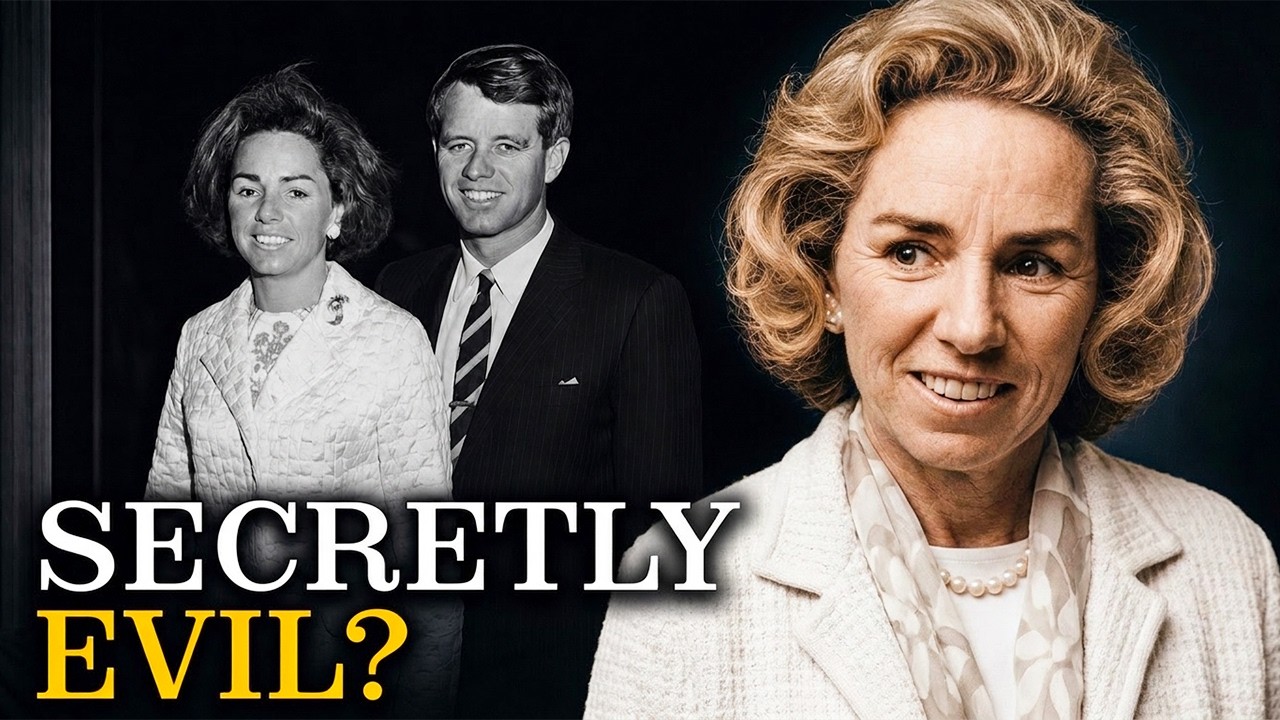
The photograph is fixed in American memory: St. Patrick’s Cathedral, the black veil, the pregnant widow behind her husband’s coffin. What the morning papers left out was already documented in the household she ran at Hickory Hill in Virginia and the family compound at Hyannis Port.
Domestic staff cycled through so fast that biographers interviewing them decades later struggled to assemble a coherent list. Nannies were dismissed abruptly, sometimes for things they had not done. Local merchants in McLean carried Kennedy accounts for months without payment.
Jerry Oppenheimer’s 1994 biography, denounced by the family, leaned on ex-employees with grievances. But Lawrence Leamer’s The Kennedy Women found the same pattern independently, and Evan Thomas, a sympathetic biographer with real archival access, describes a household run on adrenaline and enforced good cheer where weakness was not permitted.
When a hostile source, a neutral source, and a friendly source all describe the same temperature in the same house, that is not gossip. That is a management style. And it had a purpose: she was protecting something.
She was born Ethel Skakel in April 1928, the sixth of seven children, into a family with more cash than the Kennedys. Her father, George Skakel, a railroad clerk’s son from Chicago, founded Great Lakes Carbon Corporation and built it into one of America’s largest privately held companies.
Coke, carbon, petroleum byproducts — unglamorous industrial money, enormous amounts of it, and none of it under the control of a patriarch with political ambitions. That distinction matters more than anything else in this story.
Her mother, Anne Brannick Skakel, was the engine of the family’s Catholicism: devout, superstitious, capable of driving priests to distraction with demands and donations. George was a Protestant who converted late and drank hard.
The house they settled in, Rambling Brook Farm in Greenwich, Connecticut, was chaos by design. Dogs everywhere, children shooting at things, money treated as background noise. Nobody in that house was taught restraint.
What she was taught was this: God is real, the church is not negotiable, physical fear is contemptible, and loud is normal.
Then came the deaths, in a pattern that would have broken a different family. In October 1955, both parents were killed when their company plane exploded and crashed in Oklahoma. Ethel was 27 and already a mother several times over.
In 1966, her brother George Jr. died in a plane crash in Idaho. The following year, his widow choked to death at a dinner party.
A mother, a father, a brother, and a sister-in-law in 12 years. All sudden. All before her husband was shot.
The Skakels did not process grief. They absorbed it and moved. By the time she married into a family with its own catalog of catastrophe — a sister lobotomized, a brother killed over the English Channel, a sister killed in a 1948 plane crash — she had been trained in the same discipline the Kennedys practiced.
It began with a chase. Not his. Hers.
In 1945, at Manhattanville College of the Sacred Heart, Ethel’s older sister Pat roomed with Jean Kennedy, Bobby’s youngest sister. Bobby came into their lives on a Christmas ski trip to Mont Tremblant in Quebec.
He did not fall for Ethel. He fell for Pat. Bobby dated Ethel’s sister for the better part of two years while Ethel watched from inside her own family, at her own dinner table, on her own ski trips.
She was 17, aggressively pious, seriously considering becoming a nun.
She had also decided, and said out loud to classmates, that she was going to marry Bobby Kennedy. Several accounts of the Manhattanville years record her announcing it as a fact rather than a hope. Then Pat lost interest, and Ethel moved.
She pursued him for years through Harvard and the University of Virginia Law School. She wrote constantly. She showed up.
She converted his interest into obligation with the same relentlessness she brought to everything physical.
The courtship, by every surviving account, was not a mutual falling. It was one person deciding and the other eventually agreeing. He proposed in 1949 and by some accounts pulled back at least once before the engagement stuck.
Friends noticed the imbalance.
He was reserved to the point of coldness, capable of long silences and sudden withdrawal. She was in constant motion toward him. She entered the marriage as the pursuer, and she never stopped being the pursuer.
Fifty years later, she was still the one insisting on him.
But love was not the only ledger being kept. The Skakels brought a fortune outside politics, staunch Catholicism, and a huge fertile family. The Kennedys brought Joseph P.
Kennedy’s ambitions, a name climbing fast, and a need for wives who would produce grandchildren and never embarrass the operation.
Joe Kennedy liked Ethel immediately. Of all the daughters-in-law, she was the one who required no management. She was rich enough not to need his money, devout enough to accept the rules, and tough enough to run a house full of children while a man campaigned.
The wedding was held June 17, 1950, at St. Mary’s Church in Greenwich — roughly 1,700 guests, Jack Kennedy as best man, a reception at the Greenwich Country Club paid for by Skakel money. The bride’s family paid.
 The groom’s family set the terms.
And one thing she never surrendered: her own money. Great Lakes Carbon dividends came to her, not through Joe Kennedy’s trusts, not through a husband’s salary. Every other woman who married into that family lived inside an allowance system designed in Boston.
Ethel did not.
That independence is why she could later do things no other Kennedy wife could do. It is also uncomfortably part of why the tradesmen went unpaid. It was not poverty.
It was indifference — the specific indifference of someone raised in a house where money was weather.
In 1957, Jack and Jacqueline Kennedy sold Hickory Hill, their six-acre Georgian estate in McLean, Virginia, to Bobby and Ethel. Jackie had decorated a nursery there and then lost a baby, and she wanted out of the suburbs and back into Georgetown. For Ethel, the same house was a starting gun.
She filled it with children, animals, staff, politicians, reporters, priests, and an ever-expanding rotation of guests, and she ran it like a small nation with one government. Touch football on the lawn, scored, with adult guests expected to play and expected to be hit. Tennis, scored.
Sailing at Hyannis Port, scored, and the losing boat noticed.
Meals with 14 people at the table and a rule that you arrived with something to say. Weakness was the only unforgivable trait. Not incompetence.
Weakness. Guests who complained about a sprained ankle were remembered for it years later.
And the swimming pool. In November 1962, Ethel threw a party at Hickory Hill for a Justice Department crowd, and a table set up over the pool collapsed, dumping guests into the water. Arthur Schlesinger’s wife’s dress was ruined.
Columnist Art Buchwald made a career-length joke out of it.
The incident became a beloved Washington anecdote about the fun-loving Kennedys. Here is the part the anecdote depends on and never says: everyone already knew people went into that pool at Hickory Hill deliberately, at Ethel’s pleasure. Guests were pushed.
It was a house rule disguised as horseplay.
Through the late 1950s and all through the 1960s, Life and Look and the Sunday supplements ran spread after spread on Ethel Kennedy — the pregnant, laughing, athletic Catholic mother, the anti-Jackie, the wholesome one. Reporters loved her because she was quotable and warm and gave them access.
She was extremely good at this. She had been trained for public Catholic life since her thesis at Manhattanville, and she understood well before most political wives that friendly coverage is a currency you can spend later. She built press relationships for 20 years before she needed them.
Behind the coverage, the marriage had a structure that had nothing to do with romance. Bobby was gone constantly — counsel to the McClellan Committee, then his brother’s campaign manager, then attorney general of the United States at 35, then a senator from New York. He worked the hours of a man who believed he was running out of time.
When he was home, he was intensely present with the children. The record on that is overwhelming and sincere. He was also, by the same accounts, capable of treating his wife as household infrastructure rather than a companion.
She had 11 pregnancies in 17 years.
Kathleen in 1951, Joseph in 1952, Robert Jr. in 1954, David in 1955, Mary Courtney in 1956, Michael in 1958, Kerry in 1959, Christopher in 1963, Max in 1965, Douglas in 1967, and Rory, born in December 1968, six months after her father was killed.
She was pregnant during the 1960 campaign, pregnant during the Cuban Missile Crisis year, pregnant at Jack’s funeral in all but literal terms, and pregnant on the 1968 campaign trail. That is not a fun fact. That is the mechanism.
A woman with that many small children in that church in that decade had no exit any lawyer or priest could have drawn for her.
And she was not looking for one. But the absence of an exit changes how you interpret every choice she made afterward, including the ones that look like cruelty.
Robert Kennedy’s private life was not the private life the public believed in. The Marilyn Monroe story — RFK and Monroe as lovers, RFK involved in her death — is a legend that grew in the 1970s and 1980s out of interested witnesses and books with no archive behind them. Serious biographers, including Evan Thomas, examined it and found no credible evidence of an 𝒶𝒻𝒻𝒶𝒾𝓇.
What the record does support is more mundane and more corrosive. Multiple people in the Kennedy circle, including staff and friends who had nothing to sell, described a man surrounded by women, who took private company on trips, and who by the mid-1960s was operating with the same assumptions his brother and father had operated on.
What nobody who knew the household disputes is that Ethel governed the subject absolutely. You did not mention it. Not as gossip, not as concern, not as a joke.
Staff who brought messages or made comments about women around her husband found themselves gone. Friends learned the boundary by watching someone else cross it.
She did not confront. She did not complain. And she did not permit the information to exist inside her house.
That is where the nastier-than-you-thought thesis actually lives. Not in a pool prank, but in a woman systematically making reality unsayable in her own home.
She learned it from Rose. Rose Kennedy had spent decades with a husband whose infidelities were an open Boston fact, including the years he installed Gloria Swanson in the family’s social life. Rose’s response was mass, travel, and total silence.
She taught it as doctrine to her daughters and daughters-in-law.
 You do not discuss it. You do not acknowledge it. You outlast it.
Jackie found that instruction unbearable. Ethel did not. Ethel improved on it.
Rose endured the silence. Ethel imposed it. And the silence held.
Through the attorney general years, through the Bay of Pigs and Birmingham and the wiretaps, through the thing that broke everyone: November 22, 1963. Ethel was at Hickory Hill when Bobby got the call by the pool. She was with him in the hours after.
The record puts her closer to him that afternoon than almost anyone.
In the year that followed, Bobby Kennedy came apart in a way his family had no vocabulary for. He wore his brother’s overcoat. He lost weight.
He disappeared into books he had never read. Jackie, in her own grief, became the person he could talk to about it, and the two of them spent time together that year in a way that fed rumors for the next 60 years.
There is no reliable evidence of a romance. There is very reliable evidence of two people who understood the same loss, and a third person who watched them do it and said nothing about that either.
Ethel’s method during his collapse was the only one she had. Keep the house loud. Keep the schedule full.
Keep the children moving. Do not sit with it. Several people around them found it exactly wrong for him and exactly right for her.
That gap — his grief needing quiet, hers needing noise — is the closest thing to a documented rupture in that marriage.
He came back through politics as he always did. The Senate seat in 1964, the trips to South Africa and the Mississippi Delta and the Amazon, the slow construction of a man who was no longer his brother’s instrument. Then March 1968, the announcement, and the last 82 days.
That campaign was the best they ever were together. She was extraordinary on the road. She worked crowds in Indiana and Nebraska and California.
She drew reporters. She made him funnier and looser than he was alone. And she did it while pregnant with their 11th child.
On the night of June 4, she was with him at the Ambassador Hotel in Los Angeles. She was standing near the stage when he finished the speech and went out through the kitchen pantry. She got to him on the floor.
What happened in the next four days set the terms for the rest of her life. She sat with him at Good Samaritan Hospital. She flew back on the plane with the coffin.
She chose St. Patrick’s. She chose the train.
She chose to walk the cars, eight hours from Penn Station to Washington, thanking mourners, comforting the people who had come to comfort her.
A million people stood along the tracks in New Jersey and Maryland and Delaware. Two of them died when a northbound express hit the crowd in Elizabeth. She learned about that later.
She kept walking the cars.
Then she went home to Hickory Hill with 10 children and one on the way, at 40 years old, and made a decision she never publicly revisited. She would not remarry. She would not discuss him.
She would raise them and she would keep him.
The first two parts of that decision cost the children everything. The grief that had no language in 1963 had even less in 1968, and now it was permanent and it was hers. Nobody sat down with them.
There was no therapist, no conversation, no evening where their mother explained what had happened in that pantry.
Several of the children later said on the record, as adults, that their father’s death was simply not a subject in their own home. Robert Jr. wrote about the silence.
David, the most damaged of them, told a reporter in 1983 that he had watched the shooting live on a hotel television in Los Angeles at 12 years old, alone in the room, and that nobody in his family ever asked him about it.
The house got harder, not softer. The competition continued. The football continued.
Discipline was physical and immediate. Staff turnover accelerated. She had run a loud household to keep her husband from sinking.
Now she ran it to keep herself from sinking, and the children were inside it.
David Kennedy became addicted to heroin as a teenager and died of an overdose in a Palm Beach hotel room in April 1984 at 28, during a family holiday at his grandmother Rose’s house. He had been effectively estranged from his mother, who had at one point barred him from Hickory Hill.
Bobby Jr. was arrested for heroin possession on a plane in 1983 and has been publicly candid about the years that followed. Michael, accused in 1997 of a long 𝒶𝒻𝒻𝒶𝒾𝓇 with the family’s teenage babysitter — a case investigated by Massachusetts prosecutors and dropped when the young woman declined to cooperate — died on a ski slope in Aspen at the end of that same year.
He was playing a game of football on skis without a helmet at dusk, after being told to stop. That last detail is the family’s method condensed into one afternoon. Do not stop.
Do not be careful. Do not be the one who quits the game.
Her response to David’s death was a funeral and silence. Her response to Michael’s was a funeral and silence. When journalists went looking for a grieving matriarch’s reflections, they got nothing.
And the nothing was strategic. Every word she declined to say was a word that could not be quoted back at the family for 50 years.

She wrote no memoir. Almost every Kennedy woman of her generation and the next eventually published something. Rose did.
Eunice’s family did. Her own children did. Ethel published nothing.
She gave no substantial interview about her marriage for more than four decades.
She also had the papers. Robert Kennedy’s personal files went to the John F. Kennedy Presidential Library in Boston, and for decades access to the closed portions ran through his widow and the family’s designated gatekeepers.
Researchers who wanted the intimate material asked her, and the answer shaped the books.
Arthur Schlesinger got cooperation and produced a monumental, affectionate thousand-page authorized life in 1978 that treats the marriage as settled and happy. Evan Thomas, working in 2000 with more distance, got enough access to write something honest and still found the private terrain thin. That thinness is not an accident of history.
It is a policy.
When hostile books appeared, she deployed the machinery. Oppenheimer’s 1994 biography was met with family denunciation, coordinated statements, and friends going on the record to call it trash — exactly what you do to a book sourced from fired employees, because the sourcing lets you dismiss the contents.
The strategy worked. The nastier picture of Ethel Kennedy has been publicly available since 1994, and it never stuck, because the people who could have confirmed it had all been fired, and the woman it described was the mother of 11 and the widow of a martyr.
Meanwhile, she built the institution. In 1968, within months of the assassination, the Robert F. Kennedy Memorial was founded — later the RFK Center for Justice and Human Rights, now Robert F.
Kennedy Human Rights. She ran it, raised money for it, and used it to define what her husband had meant.
Every year it gave a human rights award and a journalism award, and every year the recipient stood next to Ethel Kennedy and accepted a prize named for a specific version of Robert Kennedy — the one who went to Delano and Soweto and the Delta, the moral one, the last good Kennedy. That version is real. It is also curated.
And she was the curator.
She was still the same person she had been at Manhattanville. Aggressive, profane, funny, indifferent to comfort, and a lunatic behind the wheel. She was cited more than once, and friends genuinely feared her driving into her 80s.
She kept the sailing, kept the dogs, kept the competition. In 2010, at 82, she was still hosting.
Then in 2012, she did the last thing anyone expected. She talked. Her youngest daughter, Rory — the child born six months after the assassination, the one who never met her father — made a documentary called Ethel for HBO.
It was Rory’s camera, Rory’s questions, Rory’s edit.
Ethel sat for extended interviews for the first time in her life, with her surviving children around her, and told stories about the courtship and the campaign and the White House years. She was charming and sharp and very funny. She also drew the line on film, and the moment is worth watching because it is the whole thesis in about 10 seconds.
When the subject moved toward her husband’s death and her own grief, she stopped. She said she did not want to talk about it. Her daughter did not push, and the film moved on.
Fifty years of silence, and when she finally broke it, she broke it inside a movie directed by her own child, produced by her own family, on subjects of her own choosing, with the one door still locked.
Two years later, in November 2014, President Obama put the Presidential Medal of Freedom around her neck. The citation praised her advocacy and her family. She was 86.
She had outlived her husband, all four of his brothers and sisters who died young, most of her own siblings, nearly every aide, nearly every reporter who had covered the marriage, and every servant who could have contradicted her.
She lived to 96 and died in Massachusetts on October 10, 2024 — the last adult witness to the inside of Robert Kennedy’s private life.
So what was the marriage? Not a fraud. That is the easy verdict and it is wrong.
She chased him for four years, married him at 22, gave him 11 children, campaigned for him brilliantly, and never wanted another husband in 56 years without him. Whatever that is, it is not 𝒻𝒶𝓀𝑒.
But it also was not the partnership of equals the magazines sold. It was closer to a family corporation with a religious charter, shared ambition, real affection, unlimited labor from her, and an absolute prohibition on any information that could damage the enterprise. She was not the passenger in that arrangement.
She was the compliance department.
And the price of compliance was paid by the housekeepers who got fired, the merchants who waited, the friends who learned not to speak, and most of all by the children who grew up in a home where the central fact of their lives was off limits.
Hickory Hill went on the market in 2003 and sold in 2009 for a fraction of what it had been asking. The lawn where cabinet officers were tackled belongs to somebody else. The pool is somebody else’s pool.
Now look at the photograph again. The veil at St. Patrick’s is not what we were told it was.
It was not the shield of a woman too shattered to be seen. She was seen all week — on the altar, on the train, in front of a million people — absolutely composed.
That black lace was the last thing in her life she let a photographer take without her permission. Everything after it, she chose. Which books were written.
Which files opened. Which stories died with the staff. Which daughter held the camera.
America thought it was watching a widow disappear behind a veil. It was watching an editor take control of the manuscript.