A surveyor named Creswell Purnell rode into the western edge of what is now Greenbrier County, West Virginia, in the spring of 1873 and never came out the same. He was working for a timber consortium out of Pittsburgh, tasked with mapping ridgelines and marking which slopes could be cut. In the back of his field journal, he kept a list of places he had refused to measure. Saegertown Hollow was the seventh entry on that list.
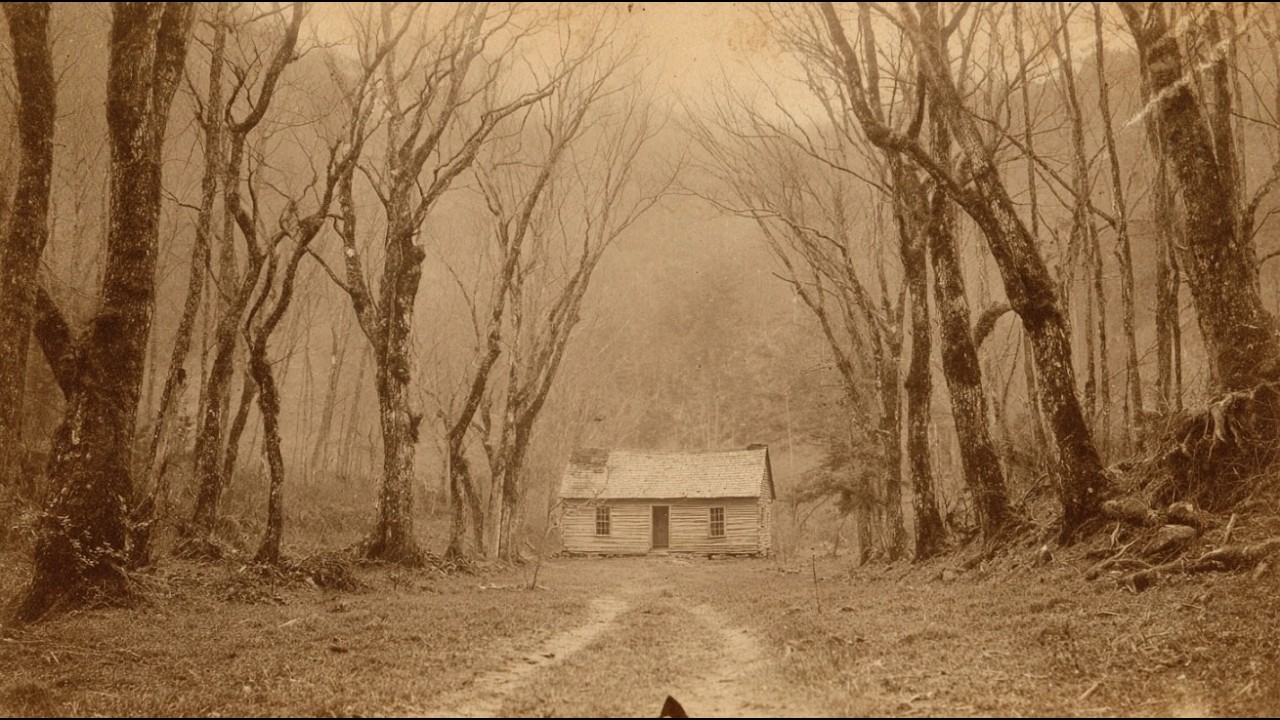
His notation included three lines. The first gave the coordinates, the second said the trees grew wrong, and the third said the silence had a weight to it, and that weight was watching him. He left the hollow on April 11, 1873, and rode forty miles north to send a six-word message to his employer: “Do not send another man here. ”
The consortium honored the request quietly.
They marked the hollow as unviable timber and turned their attention elsewhere. Purnell moved south to work along the Tennessee border and never spoke of the hollow again in any surviving letter. His widow donated his journals to a historical society in Pennsylvania in 1898. In the back of one journal, written in a different hand, was a note from his wife: “He never slept with the curtains open after that spring.
I do not know why. ”
Saegertown Hollow is still real and still exists, sitting in a fold where two ridges press together so closely that the sun reaches the floor only about forty minutes a day, near noon. The rest of the time it lies in a green twilight. Locals never logged it, and roads never went through it.
When a federal mapping survey came through in 1909, the surveyors approached the hollow, made camp on the eastern ridge, and broke camp the same day. The official reason given was “instrumentation difficulties. ” But a private letter from a junior surveyor on that team described a different problem: every man on the team began to dream the same dream on their first night, dreaming of a clearing where something tall and very still turned its head to look at them. They left at dawn.
It was only days later, back in Charleston, that one of the men, drunk in a tavern, said the word “clearing,” and three other men at the table flinched at the same moment. In the autumn of 1879, a widowed blacksmith named Obadiah Threlkeld bought four hundred acres at the head of the hollow, paying in silver. He arrived with his sister Sophronia, an older couple named Bartholomew and Henrietta Raithwood, and a wagon loaded with oxen, cows, nails, seed corn, and supplies for the winter. They began building a cabin on October 4.
By the evening of that same day, Bartholomew Raithwood had stopped speaking. He had been splitting cedar shakes near the creek when he stopped mid-swing and stood very still, staring up the slope toward the head of the hollow. After an hour, his wife led him back to the wagon. He lay down, pulled a blanket over his face, and did not come out for two days.
When he finally got up, he said only that they should not stay. He said the land had a tenant already. Then he went back to work as if nothing had happened and never mentioned it again. Sophronia Threlkeld kept a diary, and it survives.
That diary is the reason the story has come down through the years. She wrote about the trees in the hollow, noting they twisted slowly like a corkscrew, and that the bark, when cut into, smelled wrong, like meat left out, but with something sweet and floral underneath. She also recorded small occurrences. In early December, they woke to find every door in the cabin, including the hatch to the root cellar, standing open at exactly the same angle, with no tracks in the frost and nothing missing.
Obadiah laughed it off. Sophronia did not. Around four in the morning, she sat listening and heard heavy footsteps walking the perimeter of the cabin, pausing at each window and longest at the door, then moving away up the slope. She wrote in her diary that she made a private vow: whatever was in the hollow would only show itself to those who looked for it, and she would not look.
Through January and February of 1880, she recorded eleven separate incidents. Pots moved on the stove. A pair of stockings hung to dry was found neatly folded inside a closed flour barrel. A reflection in the dark window over the basin did not match her own, turning its head a fraction of a second later, and once not turning at all.
Henrietta Raithwood began speaking in her sleep in a voice that was not hers, deeper and older, and not in English. On February 22, she walked out of the cabin at three in the morning in her nightdress, barefoot in the snow, three-quarters of a mile up the hollow. Obadiah found her standing in front of a tree, looking up at the branches, smiling. He said her smile was the worst thing he had ever seen on the face of a person he loved.
He carried her back. She lost two toes from frostbite. When Sophronia asked her gently where she had been going, Henrietta said only, “It called me by the name my mother used. ”
By spring, three of the four people in the cabin were affected in ways medicine could not name.
Bartholomew was rapidly losing weight for no apparent reason. Henrietta could not be left alone after dark and tried to slip out four more times. Obadiah began nailing the door shut at sundown and pulling the nails out at dawn. Sophronia began having the same dream the survey crew had described years later.
She was standing in a clearing with something tall and very still. She understood in the dream that she must never close her eyes, and woke each morning with her jaw aching from being clenched. Obadiah seemed unaffected. He worked, hunted, and hauled water.
Then, in the early hours of May 2, 1880, Bartholomew Raithwood died in his sleep. His body had simply continued to lose weight and ran out. They buried him on a small rise near the cabin and marked the grave with a flat stone carved with his initials. That night, Henrietta did not sleep.
She sat by the door, dressed, and said gently that she was waiting for her husband, that he had told her he would come for her. She said it almost happily. Sophronia and Obadiah locked the door from the inside and took the key. In the morning, Henrietta was gone.
The door was still locked, the key still on Obadiah’s nightstand. They searched for three days and found a single shoe, Henrietta’s left shoe, sitting upright and neatly placed on the flat stone marking Bartholomew’s grave. There were no tracks leading to it. She was never found, and her body was never discovered.
The local sheriff came out from Lewisburg in June and stayed one night. His official report listed Henrietta as a presumed wandering elderly female. But in the margin, in his own hand, he wrote: “The hollow is a wound. Do not pull the bandage.
” He resigned six weeks later and moved to Ohio, never returning to Greenbrier County. Years later, in 1904, he wrote a letter to a folklorist describing what he had seen that night from the cabin window. In the moonlight, a figure walked back and forth just at the edge of the lantern light, wearing the clothes of his older brother, who had drowned in 1859. He wrote that for one brief moment, when the figure’s face was almost pressed to the glass, he had wanted to open the door.
He had had to grip the arms of the chair to keep himself in it, and for the rest of his life, he did not trust himself in the dark. Only Obadiah and Sophronia remained after Henrietta vanished. It was then that Obadiah, the man who had seemed unmovable, broke. He stopped hunting and working the field.
He took to sitting in the doorway looking up the hollow. He would hum the hymns he had always hummed, but the tune was wrong, the notes in a different order. Sophronia begged him to leave. She got word to a cousin in Pittsburgh and walked eight miles to ask a neighbor for help.
The old trapper came once, took one look, and left without crossing onto their property again. He later told her he had heard Obadiah sitting in the doorway having a conversation with somebody who wasn’t there, and the somebody was answering him in Obadiah’s own voice. By July and August of 1880, Sophronia was effectively alone. She kept writing in her diary.
She recorded that her reflection in the basin water carried a calm she did not feel, and that she heard Henrietta’s voice faintly humming a hymn from a direction that did not exist. On August 27, she found a small mother-of-pearl button sitting in the center of the kitchen table. It matched exactly the buttons on the dress Henrietta had been wearing the night she disappeared. Sophronia wrote that she understood the hollow was leaving her gifts, small reminders, the way a cat leaves a dead bird on the porch.
She put the button in the stove and watched it crack in the embers. It made a sound, she wrote, like a sigh. On September 1, 1880, she walked her brother out. She harnessed the mare, loaded the wagon, and tied Obadiah to the wagon seat with plow rope around his waist.
He did not resist. As the wagon turned and the head of the hollow disappeared from view, she wrote, he made a small, broken cry, like a man who had just realized he had left something important behind. She drove to Lewisburg and left her brother in the care of the Methodist Church, paying in silver. She asked them in writing never to return him to Greenbrier County under any circumstances.
She went back to Pittsburgh and lived with her cousin. Obadiah Threlkeld was committed to a state asylum in Weston, West Virginia, in the autumn of 1880. He lived there for nineteen years. Asylum records describe him as compliant, mild, and physically healthy.
He never spoke a complete sentence again. On the morning of October 3, 1899, an attendant found him sitting upright in his bed, in his nightclothes, with his hands folded in his lap. He was dead. There were no signs of distress or struggle.
The window was closed and locked from the inside. The door had been locked all night. On the floor next to his bed was a single shoe, a woman’s left shoe, sitting upright and very neatly placed. The description matched in every particular the shoe left on Bartholomew Raithwood’s grave nineteen years earlier, four hundred miles away.
The attendant who found him wrote to his wife that the room smelled of something sweet and floral with rot underneath. He resigned the following week and moved to Indiana. The cabin stood empty from 1880 to 1903. Hunters reported smoke from the chimney on at least four occasions during those years, although nobody was supposed to be living there.
A timber cruiser who passed within sight of the cabin in 1892 wrote that he saw a man and a woman sitting on the porch. When he looked back over his shoulder a few minutes later, the porch was empty and the cabin door was standing open. He never worked timber again. In the summer of 1886, a Methodist circuit preacher named Reverend Gantry Whitlock went into the hollow alone, believing any darkness could be met with prayer.
He came out two days later on foot, wearing only his trousers and his shirt, without his horse, his saddle bag, his Bible, or his shoes. He told the villagers the hollow had asked him a question and he had not been able to answer it. He never said what the question was. He preached for another eleven years but never again on the subject of the devil.
On his deathbed, he asked three times whether the door was closed. The third time, he said, “That’s good. Make sure it stays that way. ” Then he died.
In 1903, a logging concern purchased the land from the Threlkeld estate and sent a four-man crew in to assess the timber. The crew arrived on April 11, 1903, exactly thirty years to the day after Creswell Purnell had ridden out and refused to return. The foreman was a man named Werther Ashby Colestone, an unsuspicious man who had once said ghosts were a luxury for people who had time to imagine them. On the second night, Werther got up from his bedroll and walked out of camp.
They found him the next morning standing in a clearing about half a mile away, facing a tree, smiling. His eyes did not focus on the men who came for him. By evening, he had begun to speak in a voice that was not his own, addressing by name people who were not present, including people who had been dead for a long time. One of the crew refused to transcribe what Werther said, saying writing it down felt like agreeing to repeat it.
They tied Werther to a saddle and walked him out of the hollow. He did not survive the trip. He died on the eastern slope, about a mile from the head of the hollow, with his eyes open. The men buried him there.
A third man, a young axman who had stayed in camp, was struck mute. He never spoke another word for the rest of his life, enduring another fifty-one years before dying in a state care facility in Virginia. The logging concern wrote off the land, abandoned the lease, and never sent another crew into the hollow. In 1941, the federal government attempted to incorporate the hollow into the Monongahela National Forest.
Two men were sent in to walk the boundaries: a Forest Service ranger named Quentin Halberston Dune and a junior cartographer named Ovid Marshfield. They radioed normally for two nights. On the evening of November 9, a radio operator received an eleven-second transmission that contained no words, only the sound of a man humming a hymn. The operator later reported that the humming was being done by two men at once, in perfect unison, with no separation and no harmony.
She said it was the most disturbing thing she had ever heard come through a wire. The transmission ended without sign-off. There was no answer to any further calls. A search party found the camp intact.
The tent was up, the bedrolls laid out, the horses fed and watered, the radio operational. The two men were gone. There were no tracks leaving the camp except the incoming tracks from the eastern ridge, and those tracks simply stopped, as though the men had walked partway out and then walked back in. The only item found was a single man’s left shoe belonging to the ranger, sitting upright in the dirt in a small clearing three-quarters of a mile from camp.
His other shoe was still in his bedroll. The leader of the search party wrote that on the second night, he heard from somewhere up the hollow two voices in unison humming a hymn. He wrote that he sat by the fire with his rifle across his knees until dawn, and that whatever was making the sound did not approach the camp. It did not need to.
It was simply letting them know it was there. The Forest Service closed the file in 1942 and classified the disappearance as unresolved. They withdrew the petition to incorporate the hollow into the national forest and placed a single notation on the official map: “Restricted access, no surveys. ” That notation is still there today.
There is no road into the hollow, no trail, and no entry. The two men were never found. The ranger’s shoe remains the only physical trace recovered from their camp. The last diary entry from Sophronia Threlkeld was written on the night before she died in 1923, at the age of eighty-one.
Her handwriting had grown shaky. The entry is one line: “I have spent my whole life looking forward so it cannot find me from behind. ”
On the very last blank page at the back of the diary, after her death, there is a single line written in a different hand, in pencil, barely legible. It reads: “You forgot one.
” The pencil mark cannot be dated because graphite cannot be dated the way ink can. Conservators cannot say whether it was written a century ago or recently. No one currently living is known to have entered Saegertown Hollow. Locals will not direct visitors to it.
The Forest Service will not assist anyone in locating it. The maps show it as restricted, and the full record of what has happened there is held in private archives rather than official ones.