In September 1944, the Allied advance across Western Europe ground to a halt. After the breakout from Normandy, supply lines stretched hundreds of miles and front-line units ran out of fuel. In London and Washington, commanders clashed over how to deliver the final blow against Nazi Germany.
Field Marshal Bernard Montgomery proposed a bold, concentrated thrust northward through Belgium and the Netherlands. His goal was to seize the Ruhr industrial region. The plan required that all available fuel and supplies be diverted exclusively to his 21st Army Group, halting American forces under General Omar Bradley and General George S. Patton in the south.
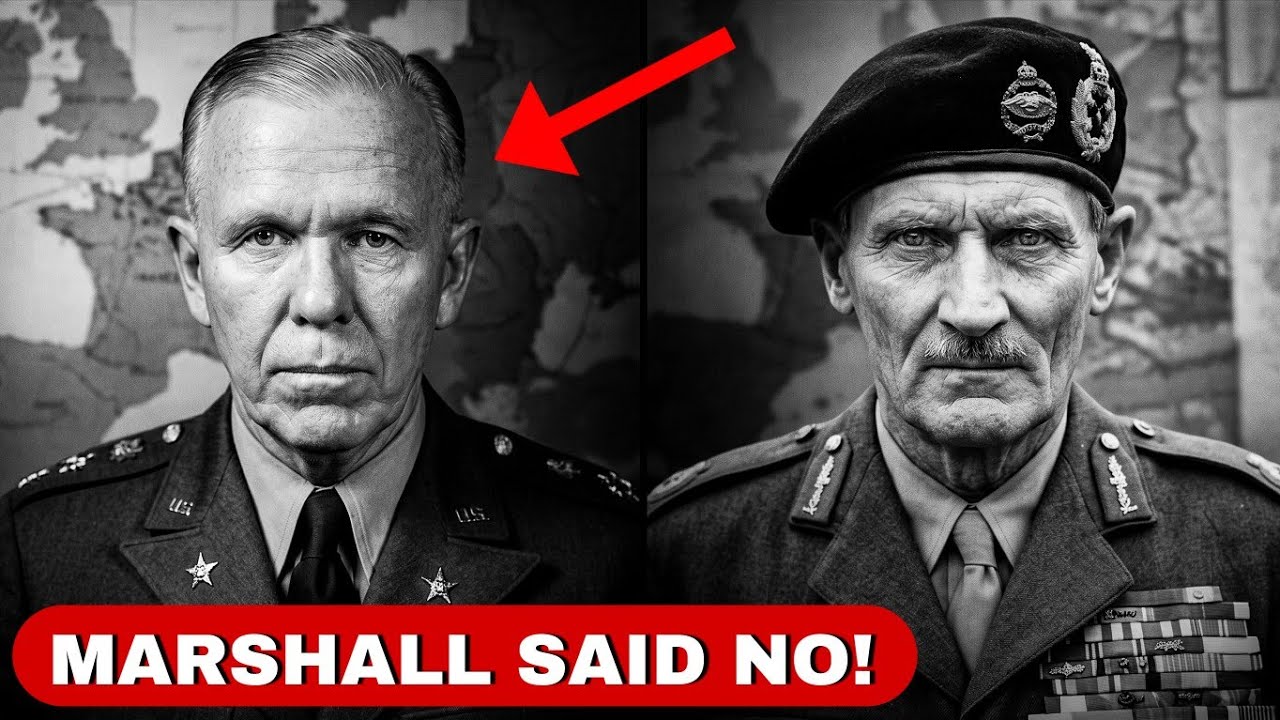
When the proposal reached Washington, General George C. Marshall examined it with deep skepticism. As Chief of Staff of the Army, Marshall managed operations in both Europe and the Pacific. He understood that a narrow spearhead pushed 40 miles into enemy territory would leave its flanks exposed to German counterattacks.
Marshall insisted on maintaining Supreme Commander Dwight D. Eisenhower's broad front strategy. Under that doctrine, Allied armies would advance simultaneously along a wide line, keeping pressure on all German defenses and securing deep-water ports along the Atlantic coast.
Montgomery argued that the broad front was far too cautious and would prolong the war into 1945. He believed a swift thrust north of the Rhine would bypass the Siegfried Line and force an immediate German surrender. He bypassed standard channels, writing urgent cables to Supreme Headquarters and demanding full operational control over all ground forces in Western Europe.
That demand directly threatened the authority of American commanders. Bradley and Patton were furious at the idea of handing their supplies and armies to Montgomery. Marshall backed Eisenhower completely in defending American operational autonomy and logistical balance.
Marshall recognized that American manpower and material production now dominated the Allied war effort. More than 60 percent of all ground troops in Western Europe were American soldiers. Halting American armies along the German border to feed a British-led offensive created severe political friction in Washington.
Marshall also knew that Montgomery's plan depended on the immediate capture of intact bridges over major European rivers. If German forces detonated those bridges, the offensive would collapse into a bottleneck. Allied intelligence had temporarily underestimated Germany's capacity to rebuild fractured divisions.
Field Marshal Walter Model had recently taken command of German forces on the Western Front, rapidly reorganizing armored units along the Dutch border. Marshall warned that driving a thin armored column into Model's regrouping Panzer divisions was an extraordinary risk. Montgomery remained convinced that German resistance was on the verge of collapse.
The logistical reality was harsh. The Allies were still supplying their armies from the Normandy beachheads and Cherbourg, hundreds of miles to the west. Until the Belgian port of Antwerp was cleared and operational, supplying a massive single thrust was mathematically impossible.
Marshall emphasized that securing Antwerp's shipping channels was the prerequisite for any major advance into Germany. Montgomery, however, prioritized Operation Market Garden and postponed the clearing of the Scheldt estuary.
Marshall conveyed his position directly to the Joint Chiefs of Staff. No single field commander, he stated, would receive exclusive priority at the expense of the entire front. The strategy had to remain balanced, cautious, and sustainable. If Montgomery's narrow spearhead failed, the Allies risked losing their momentum entirely.
In a tense conference, Eisenhower delivered Marshall's uncompromising directive to Montgomery. The broad front approach was non-negotiable. As a temporary compromise, Eisenhower granted Montgomery limited airborne assets for a restricted drop in the Netherlands. That compromise set the stage for Operation Market Garden.
Marshall monitored the situation closely, harboring deep reservations about airborne forces dropping deep behind enemy lines without immediate armored ground support. As British airborne troops prepared to drop at Arnhem, reports reached high command that two elite SS Panzer divisions were resting in the exact landing zones. Ultra intelligence intercepts flashed urgent warnings to Supreme Headquarters, but the operation could not be halted.
As paratroopers dropped into Arnhem and Nijmegen, tactical reality shattered Montgomery's assumptions. German armored units reacted with speed and violence. Field Marshal Model directed immediate armored counterattacks against the narrow Allied column. German infantry and artillery cut the single supply road, isolating forward units.
The single thrust strategy faced its nightmare scenario. Pushing along one narrow highway left the Allied spearhead vulnerable to total encirclement. Reports of heavy casualties and encircled airborne troops reached Marshall's office. The failure confirmed his core military doctrine: narrow offensives invited disaster against a resilient enemy, while a broad front protected advancing armies from deep flank cuts.

Had the Allies concentrated exclusively on Montgomery's thrust while halting all other fronts, a German counteroffensive could have destroyed the primary Allied striking force. Marshall moved to reinforce Eisenhower's authority. Eisenhower directed Allied forces to secure the approaches to Antwerp before launching any new offensive into Germany.
Montgomery's request for absolute operational priority over American armies was formally rejected. Bradley and Patton received orders to maintain pressure on their fronts, and supply allocations shifted back to a balanced distribution across all army groups. The broad front became the absolute doctrine of Allied Supreme Headquarters.
Montgomery accepted the correction with visible reluctance. He maintained that a single thrust, if fully supported, would have succeeded, and argued that divided supplies slowed every army group and gave Germany time to rebuild its defenses. Command tensions between British and American headquarters reached a historical high.
Marshall monitored these friction points closely, understanding that alliance cohesion was as critical as battlefield tactics. By late autumn 1944, American forces outnumbered British forces in the theater by a massive margin. Subordinating American armies to a British commander was politically unviable in Washington, and Marshall made clear that American theater leadership must reflect the actual operational contribution.
With Market Garden contained, Allied forces focused on clearing the Scheldt estuary. Canadian and British troops fought through flooded terrain to open Antwerp. Removing German defenses along the waterways proved costly and slow, but securing the port was essential for sustaining any future deep advance into Germany. Marshall's insistence on port logistics proved correct.
While the Allies resolved their supply bottlenecks, the German High Command prepared a massive counteroffensive. Hitler saw the strategic pause along the broad front as an opportunity. German forces secretly massed armored divisions in the Ardennes Forest, planning to strike thin American lines, cross the Meuse River, and recapture Antwerp.
Intelligence warnings surfaced along the American front, including reports of night transport movements and armored assembly behind the West Wall. Many senior officers dismissed them, believing Germany lacked the reserves for a major offensive. Allied focus remained fixed on planned advances toward the Rhine.
On December 16, 1944, the German army launched its surprise assault through the Ardennes. Dense fog grounded Allied air power as heavy German armor punched through weak American divisions. The Battle of the Bulge had begun.

As the German assault ripped through the American lines, Supreme Headquarters exploded into crisis. Montgomery saw the chaos as final proof that the broad front had failed. The command feud reached its most dangerous breaking point.
Eisenhower realized the northern flank of the American lines had lost direct communication with Bradley's headquarters. To maintain tactical control, he took two American armies away from Bradley and placed them under Montgomery's command. Bradley was stunned and deeply offended, arguing that handing American soldiers to a British field marshal would cause political outrage in Washington. Eisenhower insisted that military survival superseded national pride.
Montgomery's cold, methodical approach infuriated the American generals. He immediately ordered a tactical halt, refusing to counterattack until he reorganized his forces. Patton, executing a 90-degree wheeling maneuver with his Third Army in the south, was already driving toward the besieged town of Bastogne. He demanded that Montgomery attack simultaneously from the north to trap the German armor in a pincer. Montgomery refused, insisting on waiting for additional infantry reinforcements.
From Washington, Marshall watched the delay with mounting concern. Every day Montgomery waited allowed German armor to consolidate and inflict heavier casualties on American defenders. Marshall sent private communications to Eisenhower reaffirming that ultimate operational control rested with Supreme Headquarters. He warned that any attempt by Montgomery to permanently retain command over American forces would not be tolerated by the Joint Chiefs of Staff.
The crisis reached a public boiling point in early January 1945. After the German bulge was contained, Montgomery held a press conference and implied that his leadership had saved shattered American armies from destruction. The statements caused immediate fury across the American high command. Bradley and Patton informed Eisenhower they would resign rather than serve under Montgomery again.
Eisenhower drafted a confidential cable to the Combined Chiefs of Staff demanding a choice. Either Montgomery would be disciplined and forced to accept Supreme Headquarters policy, or Eisenhower would tender his own resignation. Marshall supported Eisenhower fully, preparing to back his commander against the British war cabinet.
Recognizing that the United States now supplied the vast majority of military power in Europe, British Prime Minister Winston Churchill intervened to save the alliance. He addressed Parliament publicly, praising the heroism of American soldiers in the Ardennes and restoring diplomatic balance. Montgomery, realizing how close he had come to dismissal, sent a personal letter of apology to Eisenhower.
Operational control of the American armies was promptly restored to Bradley. The strategic debates were settled once and for all. Eisenhower's broad front doctrine would guide the Allied coalition into the final invasion of Germany.
In the spring of 1945, Allied armies surged across the Rhine along a broad, unstoppable front. Patton's Third Army drove deep into central Germany while Montgomery's forces advanced in the north. By forcing Germany to defend every mile of its border, the Allies broke the enemy's strategic reserves completely.
Marshall's refusal of Montgomery's single thrust preserved both the operational integrity of the Allied forces and the delicate political balance of the Western Alliance. Had the Allies gambled their entire war effort on a narrow corridor in late 1944, a tactical failure could have prolonged the war indefinitely. The fierce command debates between Marshall, Eisenhower, and Montgomery remain among the most intense strategic conflicts of World War II.