In the autumn of 1959, in a hospital room in Tokyo’s Shinjuku district, an elderly man lay in a bed, unable to move. He had undergone surgery that opened his throat. The voice that had once sentenced thousands of people to slow, screaming deaths was gone forever.
Cancer was consuming him from within. Every swallow felt like broken glass grinding into an open wound. His family sat nearby. Nurses checked his vital signs in silence.
Yet, with a trembling hand, he wrote calm, precise clinical notes. He recorded his own deterioration with the same detached attention he had once applied to the living subjects strapped to his operating tables. He wrote no prayers. He offered no apologies.
His name was Shiro Ishii. He was not a general. He was a doctor. And he may have been the most dangerous man to ever wear a white coat in the twentieth century.
Ishii ran a program so brutal that even some Nazi scientists later expressed shock at its scale. His biological weapons killed more civilians than many battlefield commanders killed with entire armies. He was arrested, identified, and interrogated. Then, the United States government granted him full immunity. He was allowed to die a free man.
But the body keeps its own records. This is his story, and it does not end with justice.
Shiro Ishii was born on June 25, 1892, in the village of Shibayama, in Chiba Prefecture, Japan. His family were wealthy landowners, titled and deeply rooted in the local social order. From birth, Ishii was raised to believe he existed on a different level from the people around him.
Schoolmates remembered him as cold and calculating. He was not violent, but quieter than that. He was the type to wait until someone else cleaned the lab equipment, then deliberately contaminate it and walk away, knowing exactly who would be blamed. Small cruelties. Precise and deniable.
He graduated from Kyoto Imperial University’s medical school in 1920 and joined the Imperial Japanese Army as a surgeon. But treating patients did not interest him at all. What captivated Ishii was the weaponization of disease. The hidden war. The idea that a single infected flea, properly deployed, could achieve what an entire battalion of soldiers could not.
In 1925, the international community signed the Geneva Protocol, officially banning biological and chemical weapons. Most medical professionals felt relief. Ishii saw it differently.
His documented reasoning was chilling. If the great powers were banning these weapons, they must be devastatingly effective. The ban was not a moral boundary to him. It was a roadmap.
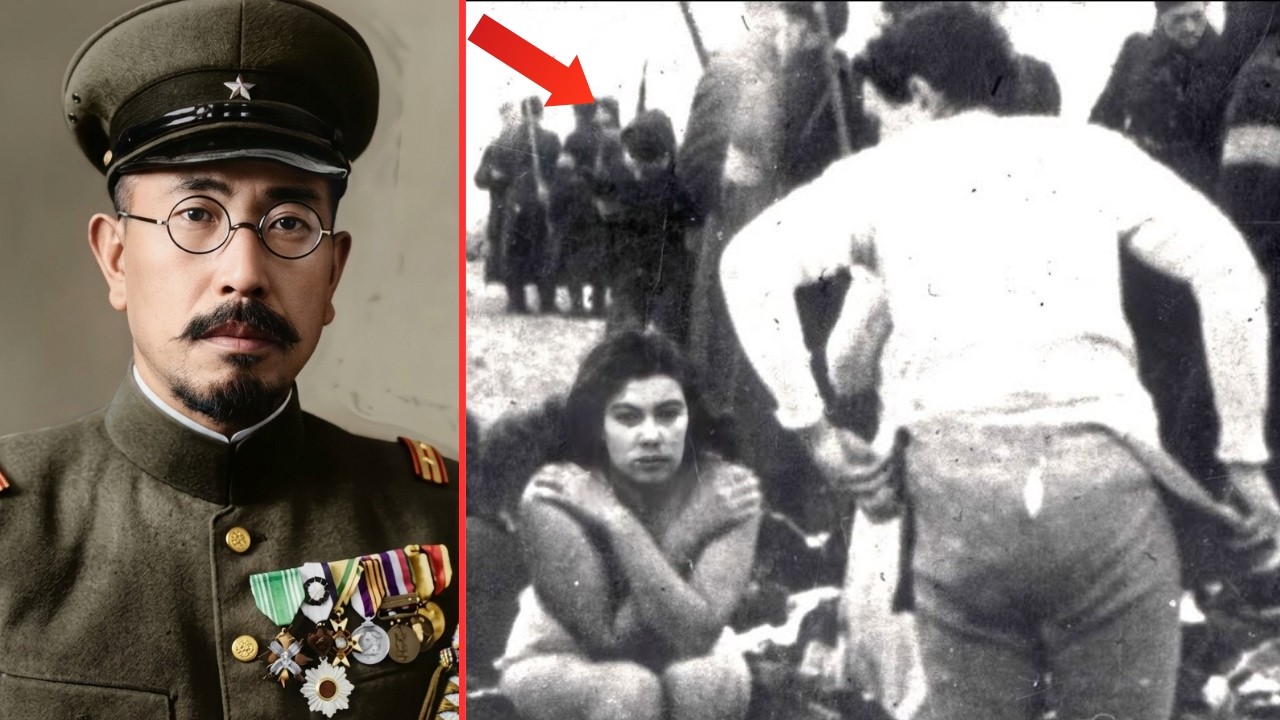
He spent the following years lobbying the upper ranks of the Imperial Japanese Army. He traveled through Europe and the United States, studying the remnants of chemical warfare programs. He returned with a proposal. Japan could build a biological weapons program that would surpass all rival nations. All he needed were resources, secrecy, and people no one would miss.
By 1932, the army agreed.
In occupied Manchuria, in the Chinese city of Harbin, Ishii took control of a sprawling complex of more than 150 buildings spread across six square kilometers. It was officially called the Epidemic Prevention and Water Purification Department. Local villagers described it as a lumber mill. Trains arrived regularly. They rarely left.
This was Unit 731.
Prisoners, mostly Chinese civilians, farmers, mothers, and teenagers, along with some Russian and Korean captives, were referred to in official documents as "maruta." The Japanese word for logs. Because to Ishii and his staff, these humans were not patients or prisoners. They were raw material.
What happened inside those walls remains among the most documented and most deliberately suppressed chapters of atrocity in modern history. Prisoners were infected with bubonic plague, cholera, anthrax, and typhoid. Then their bodies were opened surgically while they were still conscious. Anesthesia was never used because it was believed to affect the accuracy of the data.
Staff filed reports to the same medical unit used for recording weather conditions. The paperwork was meticulous. The cruelty was institutional.
People were locked in pressure chambers until their bodies ruptured. Others were frozen alive to study frostbite, then thawed and refrozen repeatedly. Some were placed in centrifuges. Others were hung upside down to record how long they took to suffocate. Air was injected directly into veins to determine how quickly death from embolism would occur.
Mothers were deliberately infected and kept with their infants to determine whether plague could be transmitted through breast milk. At staff dinner parties held inside the compound, officers ate and laughed. The screams were on the other side of the wall.
Then Ishii moved his program into the outside world. His teams loaded specially designed ceramic bombs, built to withstand impact without destroying the biological payload, with plague-infected fleas and dropped them over Chinese cities. Wells were contaminated. In one documented operation, his men distributed cholera-contaminated candy to children in rural Chinese villages.
In 1941, a mismanaged cholera operation near Nanjing killed an estimated 10,000 Chinese civilians and roughly 1,700 Imperial Japanese soldiers who fell victim to their own biological fallout. These details were buried in secret reports for decades. Conservative estimates place the total death toll from Unit 731 operations between 200,000 and 300,000 people.

Throughout this period, Shiro Ishii walked through his facility in his immaculate uniform. He was promoted. He received medals. In private military circles, he was described as a visionary. The more his victims suffered, the higher his status rose.
In August 1945, Japan was collapsing. American bombers had reduced Japanese cities to rubble. Soviet forces were sweeping through Manchuria. At Unit 731, Shiro Ishii issued his final order: destroy everything.
The remaining living experiment victims were executed. Some were shot. Some were given lethal injections. The buildings were blown up with dynamite. Twelve years of files, biological samples, and equipment were burned.
On August 12, 1945, days before Japan’s formal surrender, Ishii boarded a plane in Harbin and fled. He returned to Japan and faked his own death. A mock funeral was held in his village. Mourners paid respects to an empty coffin. He disappeared and waited.
American intelligence eventually confirmed he was alive. They found him. And here, the story shifts from war crime to something else entirely.
The Americans did not arrest Ishii. They did not hand him over to the international military tribunal prosecuting Japanese war criminals in Tokyo. Instead, in 1948, American military officials connected to what would become Fort Detrick, the U.S. biological warfare research center in Maryland, offered him a deal. Full immunity from all war crime prosecutions in exchange for every piece of Unit 731 research data.
Every experiment. Every result. Every piece of information extracted from every person who died in that facility.
Ishii accepted. A later declassified U.S. Army report noted that Unit 731 data provided information that could not have been obtained in American laboratories due to concerns about human experimentation. The Cold War had begun. America wanted what he knew, and they wanted it before the Soviets could claim it.
A 1993 review concluded that much of the data was of limited scientific value. The experiments had been conducted with total disregard for scientific controls, rendering many results unreliable. But the deal was made. Silence was purchased. The price was paid in full by the dead.
Ishii’s name was quietly removed from Tokyo war crimes tribunal records. Unit 731 was never mentioned in any public session. For more than four decades, the Japanese people remained ignorant of what had happened in Manchuria under their own army’s command.
After 1948, Ishii attempted to rebuild his life as an ordinary man. He reportedly opened a small private clinic in Japan, offering free checkups to poor patients. The same hands. The same medical eyes. Now dispensing prescriptions to the needy.

Those who knew him said he had become withdrawn and rarely spoke about the war. His private memoirs, reviewed by researchers after his death, contained no reference to Unit 731. He built a new inner life and closed every door that led back to the old one.
But in the late 1950s, something began to grow in his throat. He ignored the pain as long as he could. Then it became unbearable. Swallowing became a painful ordeal. His voice, that cold commanding voice, began to break mid-sentence.
In an act that seems pulled from a grim novel, Ishii took a scalpel, cut a tissue sample from his own throat, and carried it himself to the Tokyo University Medical School. He handed it to a former subordinate who had served under him at Unit 731, without revealing whose tissue it was. He simply asked for analysis.
The result was aggressive throat cancer. Shiro Ishii, the engineer of human vivisection experiments, had just diagnosed himself.
Surgeons operated, removing parts of his throat and larynx. He lost his voice permanently. The man whose orders had echoed through Unit 731, who had ordered the deaths of hundreds of thousands, could no longer speak a single audible word.
In his final months, he carried a small notebook everywhere. He recorded the progression of his disease. The swelling. The pain patterns. The rate of decline. Studying his dying body with the same absolute precision he had applied to everyone he had destroyed.
According to his daughter, in his final days, Ishii embraced Roman Catholicism and was baptized under the name Joseph. No living person can say whether it was sincere repentance or simply a frightened old man clinging to something solid in the dark.
He left no written apology. No confession. No list of the names he had erased.
On October 9, 1959, Shiro Ishii died in his bed at the Shinjuku hospital in Tokyo. He was 67 years old. His family was at his side. He died in a clean room, in a warm bed, surrounded by loved ones. Mercy that he had systematically denied to hundreds of thousands of people.
No court ever touched him. No jury ever convicted him. No prison ever held him for a single day.
But consider how his final chapter truly unfolded. Silent. Consumed by cancer. Forced to document his own body rotting from within. The only subject he had left. The same silence he had imposed on hundreds of thousands of victims finally swallowed him whole.
History did not punish Shiro Ishii. But time, and cancer, and perhaps the weight of what he had done, achieved what the world’s courts ignored.
The horror did not end with his death. Hundreds of Unit 731 officers were released alongside him. Many became university presidents, hospital directors, heads of national medical associations, and senior government officials. The evil of Unit 731 was never erased. It simply wore a uniform, held an office job, and started a family.
The question Ishii leaves behind is not about one man. It is about the systems that protected men like him. The deals made in back rooms. The sealed files. The victims whose names were never spoken in any courtroom. The least history owes them is the refusal to look away.