On the 10th of June 1921, in a villa called Monreo on the island of Corfu, a boy was born who would become Prince Philip, Duke of Edinburgh. He was the fifth child and only son of Prince Andrew of Greece and Denmark and Princess Alice of Battenburg.
Among the people who mattered to him in exile was a Greek French girl called Hélène Cordet, nearly four years his senior. What the record shows of that friendship is modest: a godfathership, a wedding in London, an absence on a coronation day. No document, letter, or statement by the people concerned has ever established a romance between them or a secret father for either of her children.
The friendship can be followed only as far as the evidence reaches, and it begins with a family that had very little time left in Greece. Greece had gone to war against Turkey in Asia Minor. When that campaign ended in defeat in the summer of 1922, the reckoning fell on those who had governed it. Prince Andrew, who had commanded troops in the field, was banished, and the family prepared to leave.
The British government sent a cruiser, HMS Calypso. By a story the family itself was said to have told, the baby was carried aboard in a fruit crate, a detail that rests on retelling rather than on any record. They went to France, which already held a large community of Greeks who had left or been driven out in the upheavals of those years.
The family had no house of its own. For a home they depended on a relative, Princess George of Greece, who lent them a house at Saint-Cloud on the western edge of Paris. It was a comfortable arrangement, and a temporary one, and it set the terms for the whole of Philip's childhood: a roof supplied by someone else's generosity, and an understanding that the arrangement could end.
The schooling that followed was scattered across three countries. Philip began in Paris and in 1930 he was sent to a preparatory school in England. In 1933, he moved again, this time to Salem in Germany, a school with a reputation for plain living and for the ideas of its founder, the educator Kurt Hahn. When Hahn left Germany and established a new school of his own, Gordonstoun, on a cold stretch of the Moray coast in Scotland, Philip followed him there.
While the boy was passing from school to school, the household he had left was coming apart. His four older sisters married German princes in the early 1930s, one after another, and went to live in Germany. In 1930, his mother, Alice, suffered a breakdown and was treated in a sanatorium in Switzerland. His father, meanwhile, settled on the Riviera.
The family that had boarded a cruiser together in 1922 had in a little under a decade become a set of people living in different countries. The one child still at school had in effect no single address to return to.
It was in France in those same years that another set of children was growing up among the Greek exiles. One of them was Hélène Cordet. By the most common account, she was born in Marseilles on the 3rd of July 1917 into a Greek family that had settled in France as royalists. The community she belonged to was small and close, held together by the shared loss of a homeland and by loyalty to the royal house that had left with them.
According to the accounts that mention it, her family helped the exiled Greek royals during these years. It was within that circle of obligation and acquaintance that she and the youngest of Prince Andrew's children came to know each other.
Where exactly the friendship took root is a matter on which the accounts differ. Some place it in Paris among the households of the exiled Greeks, while others place it at a villa on the channel coast at Le Touquet where families spent their holidays. Neither version is supported by a document.
What they agree on is the shape. The friendship dated from his early childhood in France, and it was a friendship between a boy and a girl who stood nearly four years apart. She was the older one, already a young girl when he was a small boy.
Taken together, the circumstances explain a good deal without needing anything further. Philip's own family in those years was a succession of departures. The Greek families around him formed a wider circle that did not leave. A boy who spent his term times among strangers, and who had no settled home to return to in the holidays, would naturally have valued a household where he was known.
The school years themselves did not bring the two of them into the record, and for a long stretch, the friendship leaves no trace at all. What emerges from that silence is a single event in London in 1938. Hélène married that year in London, a man named William Kirby. Of the ceremony itself, very little is recorded, not even the exact date. The one fact on which the accounts converge is that Philip, then 16 or 17 years old, was present and stood at the bride's side.
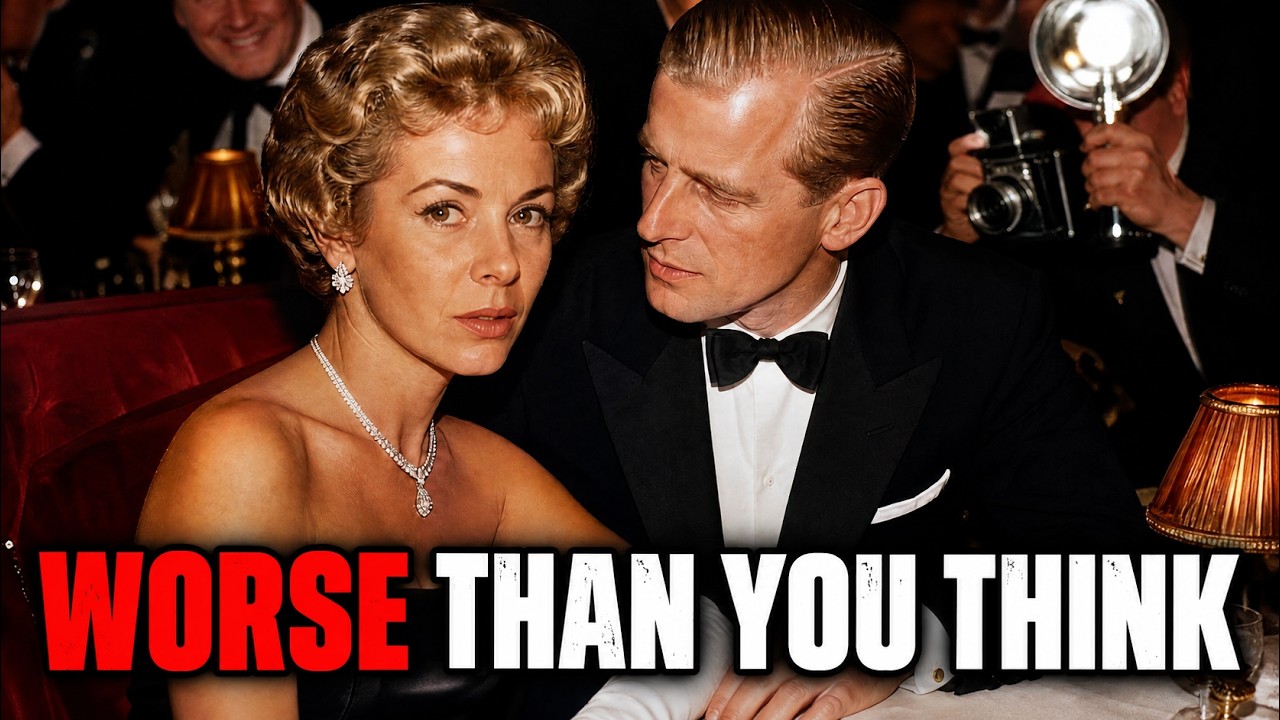
Beyond that, the versions part. In one telling, her father was dead and Philip stepped into his place and gave her away. In the other, the one given by the royal writer Christopher Wilson, he was the best man. Both place a schoolboy at the center of a wedding, and both show how far into the family circle of a Greek French bride he had by then been drawn.
Nothing is known from this record about how the marriage was arranged or what the guests said. The single scene that survives is that of a young man standing in a church or a register office in London beside a bride a few years older than himself. He was not a prince that day in any sense that mattered. He was a friend of the family, invited to stand at its side at a moment that counted.
Philip's own family had by then already suffered a loss that stands more plainly in the record than any wedding. In November 1937, his sister Cecile and her family died in an air crash at Ostend on their way to a wedding in London. Philip walked in the funeral procession in Germany, one of the mourners behind a coffin that belonged to the family he had been separated from for years.
Early in 1939, he left Gordonstoun for the naval college at Dartmouth. In July of that year, he met Princess Elizabeth, who was 13, while he was 18. He was a success as a cadet, and in 1940 he finished as the best of his course.
War did the rest of the work of making him a British officer. In March 1941 off Cape Matapan, he served on HMS Valiant during a night action in which his task was the searchlight. He was mentioned in dispatches. In 1942, at 21, he became first lieutenant of HMS Wallace, among the youngest officers in the service to hold such a post. In September 1945, he was in Tokyo Bay aboard HMS Whelp in the harbor where Japan's surrender was being formalized.
Hélène Cordet, meanwhile, was living through the same years in England. What is known of her war is bound up with a house in Berkshire and two births. Her first marriage to William Kirby ended. Her first child, a son named Max Boisot, was born at Maidenhead on the 11th of November, 1943. A daughter, Louise, followed on the 8th of February 1945, also in Berkshire.
The man whom the record gives as the father of both children was Marcel Boisot, a Frenchman who served with the Free French forces. Whether he served in the army or in the air force is a point on which the accounts differ. Hélène is reported to have married him in 1947, which would make him her second husband.
It was in these years that Philip became godfather to Hélène's daughter, Louise, a fact that is documented. Several accounts add that he was also godfather to her son, Max, though that rests on the accounts and not on a record. A godfather in that period was in the first place a person chosen for the confidence placed in him. For a young naval officer who had been given so little family himself, being asked to take on the role for the children of the woman he had known since boyhood was a recognition that he was in some sense still counted among her relations.
The rumor that later attached itself to these children, that one of them had a different father from the one the record names, existed. No document has ever supported it.
Early in 1947, Philip was naturalized as a British subject, took the surname Mountbatten, which belonged to his mother's family, and gave up his Greek and Danish titles. In July, the engagement to Princess Elizabeth was announced. The wedding took place at Westminster Abbey on the 20th of November, 1947. On the morning of the ceremony, the king created him Duke of Edinburgh.
One detail of that day has been told many times. His surviving sisters, the women who had married German princes, were not invited, an omission that the accounts attribute to postwar feeling about Germany. If the account is right, then the family that attended the wedding was largely a family that he had acquired by marriage, while the one he was born into stayed away.
That autumn in the same year, Hélène Cordet was married to Marcel Boisot in the accounts that give the date. The new duke had a wife, a rank, and a household, and she had a husband, two small children, and a place in a country that was not the one she had been born in.
What survives of her in the years that followed is a television schedule rather than a guest list. Hélène Cordet joined the BBC's television service, and from Alexandra Palace, she presented Café Continental, a variety program broadcast live. By the source's account, it went out on Saturday evenings at 8:00 and ran for 45 minutes. The studio was dressed as a continental café with small tables and the trappings of a Paris pavement.
The program drew performers from well beyond Britain. On the 26th of June 1948, the American-born singer and dancer Josephine Baker appeared on it. The format was live, which meant that nothing was recorded for later. Only a few episodes of Café Continental have survived, three of them from 1950 according to the source.

In the early 1950s, she took a few film roles. The source names two from 1953: The Limping Man and Three Steps in the Dark. They were small parts in British pictures of the period.
Philip's life in the same years had been turned into something he could not have designed. He was now the husband of the heir to the throne, and then, as the reign changed, the husband of the queen. There was one institution to which he returned in thought and in action more than to any other, and it was not a palace. Gordonstoun remained central to him.
In 1956, he and Hahn founded the Duke of Edinburgh's Award, a scheme that carried the same belief and challenge into the lives of young people across the country. When the time came, he sent his own sons to Gordonstoun. Max Boisot was educated there, too. It has been reported, though no record has been published and no sum has ever been named, that Philip paid the fees.
Then came the 2nd of June, 1953. The coronation was held at Westminster Abbey before about 8,000 people. It was also the first coronation ever to be televised. In Britain, about 27 million people watched it. Philip's own part in it was considerable. He had chaired the coronation commission, the body responsible for the planning of the ceremony, and in the abbey he was the first peer to kneel before the queen and do homage to her.
Hélène Cordet was not in the abbey. There are two accounts of why, and they have to be set down side by side. The royal writer Christopher Wilson says that courtiers kept her away, that someone in the household took care that she should not be among those present. She herself is reported to have said later that she had overslept. No document decides between the two.
What can be said is that her absence was noticed, that it came to be talked about afterwards, and that it is one of the three documented moments, with the wedding of 1938 and the godfathership, around which the whole later story gathered.
What was actually established by the spring of 1953? A woman had a television program and a few film credits, two children at school, and a husband, Marcel Boisot. A man had a naval career behind him, a dukedom, a wife who was now a queen, and a school he believed in. They had known each other for most of their lives, and he was godfather to at least one of her children.
The documented acts between them were these, and they were ordinary. A wedding attended, a christening, or its equivalent, an invitation that was or was not issued. Every other meaning that attached to them was supplied afterwards by readers who were not present.
That appetite had little to feed on until the autumn of 1956, when Philip set out on a voyage that kept him away from London for five months. He sailed in the royal yacht Britannia with a world tour ahead of him and at its center the opening of the Olympic Games at Melbourne. With him went his private secretary, Mike Parker, an Australian-born officer who had become one of the Duke's closest companions in the household.
The remark came on the 8th of February, 1957. On that day, the Baltimore Sun published a story by its London correspondent that dealt with rumors concerning the Duke and an unnamed woman. It did not name Hélène Cordet. It named no one at all. The identification of the woman in question with the friend of the Duke's boyhood was made later and elsewhere by people who had read the story and supplied a name of their own.
The consequences were more concrete than the story itself. Mike Parker's wife sued for divorce, and Parker resigned his post in the Duke's household. The palace then issued a statement, and the statement was a denial. It said that there was no rift between the queen and the Duke of Edinburgh. It answered a question about a marriage. It did not mention any woman, any friendship, any child, or any other person.
Mike Parker, for his part, spent the rest of his life insisting that the Duke had been faithful to his wife. That is his testimony, and it is stated here under his name, as it was by him. It should not be mistaken for the testimony of John Parker, who was a different man, a biographer of the Duke.
In the same years, another matter was occupying the Duke. When the queen came to the throne in 1952, the royal house had remained the House of Windsor, and the children of the marriage carried that name, not their father's. Biographers report that Philip complained that he was the only man in the country who was not allowed to give his name to his own children. In February 1960, an order in council established that the descendants of the marriage who needed a surname would bear the name Mountbatten-Windsor.
Hélène Cordet's course through the same decade was in some respects the mirror of his. By the middle of the 1950s, she had a nightclub that bore her own name, and she ran a French club in the West End as well. The largest of these ventures came in 1961 when she opened the Saddle Room in Park Lane in partnership with a major, Peter Davies. Later accounts describe the Saddle Room as London's first discothèque, and that is her own legend, attributed to her and repeated by those who liked it without a contemporary record that would settle the claim.

In the same year, she published a memoir, Born Bewildered. By the most repeated account, she did not name the father of her children in its pages. What she did say in the course of those years and in various places was that the stories attached to her were ridiculous, and she never confirmed any of them.
The book's reception has been summed up by John Parker, the Duke's biographer, in a sentence that is quoted almost wherever the memoir is discussed. "Her book," he wrote, "far from quelling innuendo, found it." The judgment is his, and it concerns the effect of the book on its readers and not the truth of anything the readers believed.
That is the sum of what is documented for the years between the coronation and 1961, and it is smaller than the volume of talk about it. A yacht sailed. A secretary resigned. A wife sued. A palace denied that a marriage was in difficulty. A surname was settled by an order in council, and a woman opened a club in Park Lane and wrote a book.
None of these events, taken alone or together, links the Duke and Hélène Cordet in any way other than the ways already known: a friendship from boyhood, a godfathership, a wedding in London, and an absence from an abbey.
Max Boisot's own path led away from the clubs and columns through the universities. He went from Gordonstoun to Cambridge where he read architecture, and then to the Massachusetts Institute of Technology where by the source's account he studied city planning, and afterwards to Imperial College in London which gave him a doctorate. His working life began in the building trade. He became a manager at Trafalgar House, and in 1972, according to the same source, he helped to found an architectural partnership. Between 1975 and 1978, he worked as a consultant in France and the Middle East.
His sister took a different road and a far louder one. Louise Cordet became a pop singer in the early 1960s, and her record "I'm Just a Baby" reached number 13 in the British charts in 1962. She toured with the Beatles and with other acts of the time, though by the accounts that mention it, she had stopped recording by 1965.
The rumor that had followed the family since the 1950s did not go away with the decade. It surfaced again with the force of a thing long stored in October 1986. The Queen and the Duke of Edinburgh traveled to China, the first journey there by a reigning British monarch. Max Boisot was by then in Beijing, where since 1983 he had served as dean of the China Europe Management Institute, a post he would hold until 1989. The royal writer Christopher Wilson says that the Duke called on him there.
Now, in a place where its subject could be reached by a reporter, Max Boisot is reported to have answered that the stories were ridiculous, and that his real father lived in Paris. The accounts differ on whether he said it in 1986 or two years later. The father he named was Marcel Boisot, the Frenchman who had served with the Free French forces.
Hélène Cordet died in Switzerland on the 30th of April 1996 at the age of 78. In all the years of the stories, she had called them ridiculous by the reports that give her words, and she had never confirmed them. She left behind a television program, of which only a few episodes survive, a handful of film credits, a memoir that did not name her children's father, and a name that had begun as a stage name.
In the year of her death, the matter received its most prominent treatment in print. Sarah Bradford in a biography published in 1996 wrote that the Duke had been unfaithful to the queen. Her claim was disputed. Giles Brandreth in a book of 2004 took a different line and described the Duke's women friends as companions, not lovers. Mike Parker insisted until the end that the Duke had been faithful. John Parker had already written his remark about the memoir and its innuendo.
The Duke himself, asked about such stories, is reported to have called them "absolutely cuckoo." That phrase is attributed to him with no date and no context that can be fixed, and it is the nearest he came on record to answering anything.
It is the whole of the evidence, and it can be stated once calmly. No document, letter, or statement by any of the people concerned has ever established a romance between Philip and Hélène Cordet, or a secret father for either of her children. She never confirmed what was said of her. Her son said that his father was Marcel Boisot, who lived in Paris. Philip never commented in public, and the palace never addressed the question, neither in 1957 when it spoke only of a marriage, nor at any time afterwards.
What the record does hold is very much smaller, and it has not changed in decades. A boy of 16 or 17 stood beside a bride in London in 1938, and nobody can now say whether he gave her away or stood as best man. There was a godfathership documented for Louise and reported for Max. There was an empty place in Westminster Abbey on the 2nd of June, 1953, for which two explanations were offered.
Max Boisot, meanwhile, had gone on to the work for which he is remembered. After Beijing, he became a professor at ESADE, the business school in Barcelona. He is credited by the accounts that mention it with co-developing the Cynefin framework with Dave Snowden, a way of sorting problems according to how well they can be understood. His books appeared in 1987, 1995, and 1998. He lived on the Catalan coast at Sitges in a house that by the source's account he had designed himself. He had been diagnosed with illness in July of 2011, and on the 7th of September that year he died there at the age of 67.
Philip outlived him by nearly 10 years. He died at Windsor Castle on the 9th of April 2021 at the age of 99. In all the decades between 1957 and that spring, he had never spoken in public about Hélène Cordet or her children, nor had his household done so on his behalf. The queen died in September of 2022, and with her the last person who could have said, if she had wished to, what had been said or not said across a breakfast table in the years when the stories were at their loudest. She never did.
Two questions are left standing, and the documents do not reach either of them. The first is what the friendship actually consisted of beyond the few public gestures that survive: the wedding, the christening, the abbey. Of the hours the two of them spent together over some 60 years, of the letters, if there were any, and of what was said at a table in Paris or Berkshire or London, nothing has been published. The second is whether a single word from Philip or from the palace spoken in any one of those years would have changed the way the friendship was read. It might have closed the subject, or it might have given it fresh life, as the denial of 1957 had in its way, and there is no evidence to show which.