On April 12, 1945, the war in Europe had roughly three weeks left to run. General George S. Patton, commander of the United States Third Army, stood in the German town of Ohrdruf in the Thuringian Hills. He was asking a question that would echo through history.
Before him stood an SS officer, pressed, composed, and rehearsed. The man had been asked to explain the bodies. There were stacked skeletal bodies, shallow graves, and evidence of industrial murder operating quietly in the German countryside. Ordinary German civilians had gone about their lives in houses and farms and market squares not half a mile from the wire.
The officer’s answer became one of the most infamous moral defections of the 20th century. He was following orders. His men were following orders. The machinery of death, he implied, had simply been running, and people had simply been feeding it.
Patton was unmoved. He had heard enough. What happened next is one of the most extraordinary moments of the entire liberation of Western Europe, not because of what Patton said, but because of what he did.
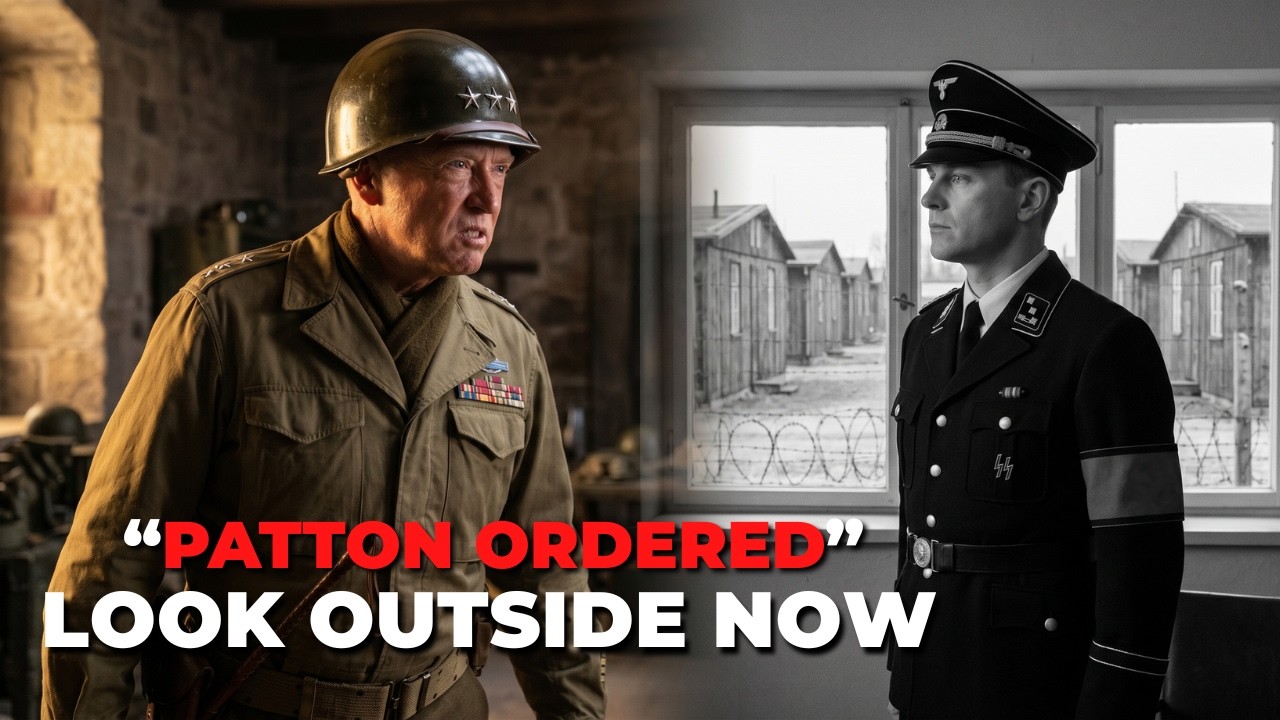
He looked at the German officer and pointed at the window. He told him to look out of it.
Beyond that window, walking through the gates of Ohrdruf, were the mayors and townspeople of the surrounding district. These were the men and women who had insisted, like so many others across Germany, that they had known nothing of what had been done in their name and in their neighborhood.
Patton had ordered them brought there. He ordered them to see it for themselves. He would not accept ignorance as a defense when the evidence of what had been done was visible from the windows of their own homes.
To understand why Patton reacted the way he did, you have to understand what the Third Army had encountered in the weeks and days leading up to Ohrdruf. These were not battle-hardened men who had become desensitized to suffering. Soldiers who had fought from Normandy to the Rhine had seen death in quantities that most people cannot imagine.
Yet almost universally, the accounts left behind by American soldiers who entered the camps in April of 1945 describe something qualitatively different. Something that did not fit the vocabulary of war. Something their training had not prepared them for.
Ohrdruf was a subcamp of Buchenwald. It was not even among the largest or most lethal of the thousands of camps constructed across German-controlled territories since 1933. By the time the Third Army arrived, the SS had already attempted to clear the evidence. Prisoners who could not be moved had been shot. Bodies had been partially burned.
But you cannot burn a place clean in a few days. The soil, the structures, and the remaining dead told the story plainly enough.
When Patton walked through the camp that April morning, accompanied by Generals Eisenhower and Bradley, he reportedly became physically ill. This was not a man of delicate constitution. This was a man who had spoken of war in terms of blood and aggression and professional violence for his entire adult life. The fact that what he witnessed at Ohrdruf made him sick is itself a piece of historical evidence about the scale of what had been done there.
Eisenhower’s instinct in the hours that followed was documentation. He understood with a clarity that would prove prophetic that there would come a time when people would attempt to deny that any of this had happened. He sent word to Washington requesting that members of Congress and senior journalists be brought to see the camps in person. He wrote in a cable that he wanted the evidence on record whilst it was still raw and visible and undeniable.
Patton’s instinct was different. Patton’s instinct was confrontation.
The townspeople of Ohrdruf and the surrounding communities had not, by and large, been members of the SS. They had not, most of them, personally administered violence within the wire. But the camp had been there, functioning, for years. The smoke had been visible. The sounds had carried. Prisoner work details had been marched through the streets.
The claim that the local population had known nothing was one that Patton, standing in that compound, was simply not prepared to accept. So he ordered them to come and see.
He ordered the mayor of Ohrdruf, along with his wife and civic leaders from the surrounding area, to walk through the camp and look at what had been done. The mayor and his wife went home that evening and hanged themselves. Whether from grief or guilt or the unbearable weight of public shame, they did not survive the night.
Other townspeople wept. Some claimed even then not to have known. Some said they had suspected but had been afraid. Patton, in his diary, recorded his contempt for all of them.
The moment with the SS officer carries a particular philosophical weight that goes beyond the fury of a general on a battlefield. The officer’s defense was not unique to him. It was the defense that would be offered in various forms by thousands of defendants at Nuremberg and in the trials that followed across occupied Germany.
We were following orders. The orders came from above. The system was larger than any individual. What could any one person have done?
The philosophical problem of this defense is not a simple one. It would occupy the minds of legal scholars, moral philosophers, and historians for decades afterward.
The political philosopher Hannah Arendt, who attended the trial of Adolf Eichmann in Jerusalem in 1961, gave this phenomenon its most famous name: the banality of evil. Eichmann, who had coordinated the logistics of the Holocaust with the efficiency of a mid-ranking bureaucrat, did not appear monstrous. He appeared ordinary. He claimed, as so many before him had claimed, that he had simply been doing his job.

Patton’s response, look out the window, is not a philosophical argument. It is something simpler and in many ways more powerful. It is a refusal to accept that proximity without responsibility is possible.
It is a statement that the world outside the window, the normalcy of the market square, and the church steeple, and the children playing in the street, does not excuse those who live within sight and smell and earshot of what was happening inside the wire.
There is a detail about Ohrdruf that is worth dwelling on. The camp was not hidden in a remote forest or concealed behind a mountain range. It was located approximately one kilometer from the town center of Ohrdruf itself.
In clear weather, from the upper floors of buildings in the town, the camp was visible. Prisoner columns had passed through the streets. The guards had shopped in local establishments. The infrastructure of the camp had required civilian contractors, civilian suppliers, and civilian administrators in the surrounding region.
The SS officer’s claim that his men had simply followed orders was, in the strictest legal sense, about to become moot. The Nuremberg principles developed in the months that followed would establish that following an unlawful order does not constitute a defense in international law.
Superior orders as a legal doctrine was effectively destroyed at Nuremberg. This was not uncontroversial. Militaries around the world had long operated on the assumption that a soldier was obliged to follow lawful commands. The boundary between a lawful and an unlawful command was not always as obvious as it was in the extreme cases of the Holocaust.
But the principle that was established, that individual moral responsibility cannot simply be transferred upward along a chain of command, would shape international law for the remainder of the 20th century and beyond.
What Patton understood in that room in Ohrdruf was not primarily a legal point. It was a moral one. The window was his argument. The view from the window was his evidence.
You knew. Or you could have known. Or you should have known. Any of those three conditions carries with it a weight of responsibility that cannot simply be dissolved by pointing to the orders you received.
The liberation of the Nazi camps in April and May of 1945 produced a body of testimony and photographic and documentary evidence that is, even now, almost impossible to absorb in its full dimensions. The camps varied enormously in their function and their population and their mortality rates.
Ohrdruf was a labor camp with a particularly brutal regime of work and punishment. Buchenwald, to which it was subordinate, held over 200,000 prisoners during its years of operation. Bergen-Belsen, liberated by British forces in mid-April, had become, in the final chaotic weeks of the war, a place of unimaginable overcrowding and disease, with corpses lying unburied in their thousands when the cameras arrived.

The SS men who ran these institutions came from a range of backgrounds and bore a range of degrees of personal culpability. Some were sadists who had sought out the work. Others were genuinely bureaucratic, focused on efficiency and paperwork, and not on the human meaning of what they were processing.
The camps required accountants and administrators and lorry drivers and cooks. Many of these people had convinced themselves that their role was sufficiently removed from the actual killing to preserve their conscience.
Patton had no patience for these gradations. He had seen the bodies. He had seen the faces of the survivors. He had, by all accounts, wept and then stopped weeping and turned the weeping into something harder and more useful.
The photographs taken at Ohrdruf that day show Eisenhower with his hands clasped behind his back, his face set in an expression of controlled horror. Bradley looks as though he might be ill at any moment. Patton is not looking at the camera. He is looking at what is in front of him.
The confrontation with the SS officer is not recorded in full. We do not have a verbatim transcript. What we have are accounts from officers and aides who were present. The general shape of the exchange is consistent across multiple sources.
The officer explained, or attempted to explain. Patton cut him off, or declined to engage with the explanation, or directed his attention to the window, to the town beyond, to the civilians who were already being assembled and brought to bear witness.
Look out the window. It is four words, or five, depending on the account. They contain within them an entire theory of moral responsibility.
They say: The world you claim not to have known about is visible from here. It has always been visible from here. The question of what you chose to see is a question only you can answer. But do not ask me to accept that you had no choice about whether to look.
Seventy-six years have passed since that April morning in Thuringia. The camps are now museums and memorial sites. The Nuremberg principles are embedded in international law. The phrase following orders has become shorthand for a kind of moral failure so complete that it requires no further explanation.
The lesson that Patton was teaching with that pointed finger and those four words has been taught and re-taught in courtrooms and classrooms and lecture halls for three quarters of a century. But it is worth remembering that it was not taught in the abstract.
It was taught in a room in a camp on a hill above a German market town, with the evidence still raw on the ground outside and the smoke still hanging in the April air. It was taught by a general who could have walked away from the SS officer’s explanation with a contemptuous silence and left history to deal with it.
He did not walk away. He pointed at the window. He made the man look.
The view from the window has not changed. The lesson has not become easier. And the question that Patton was really asking, not of the SS officer, but of everyone who would eventually hear this story, is one that each generation has to answer for itself.
What do you see when you look out the window? And what do you choose to do about it?