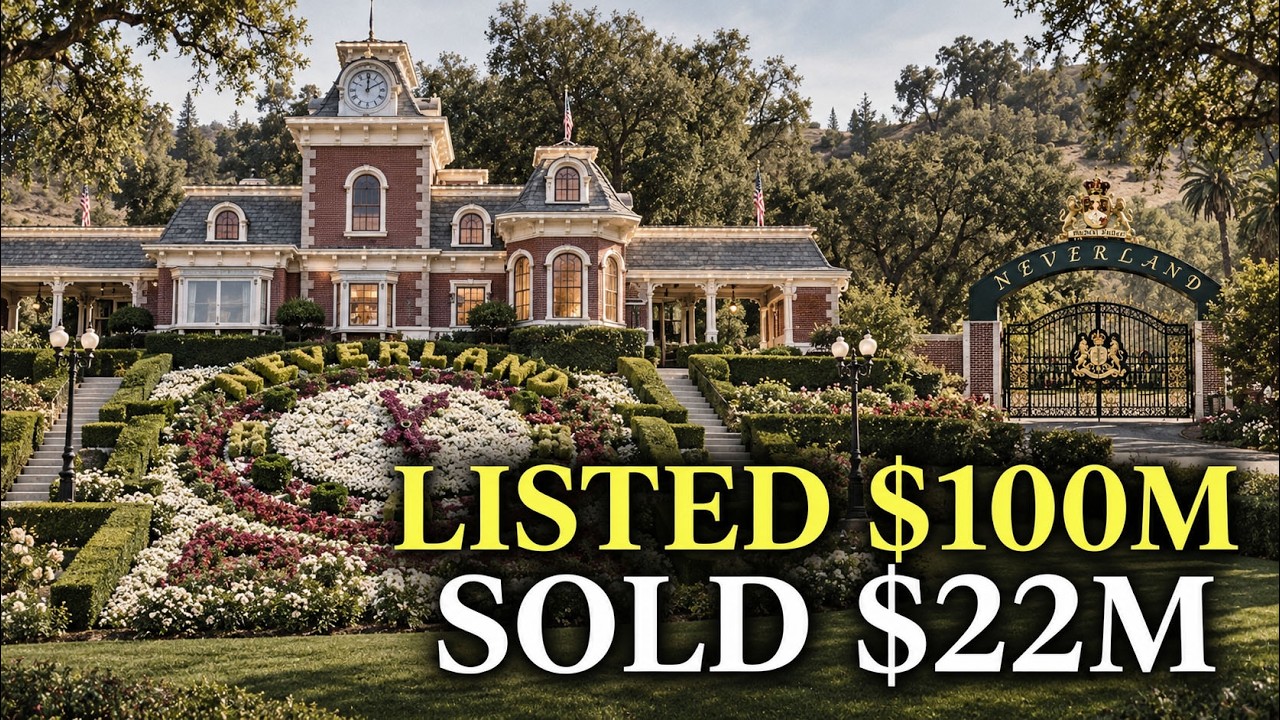
In 2015, a property in Santa Barbara County went on the market for $100 million. Five years later, it sold for $22 million. The 2,700-acre estate came with a zoo, a Ferris wheel, a railway station, a go-kart track, and its own fire department. The man who built it all walked away in 2005 and never returned.
He owned it for four more years without setting foot on it once. By the time it sold, the zoo was gone, the rides were gone, and the name had been taken off. Michael Jackson first saw the property in 1983 while visiting someone else. Paul McCartney was staying there while the two filmed the video for “Say Say Say.
” According to Jackson’s sister’s account, he said then that he wanted to own it one day. At the time, it was called Sycamore Valley Ranch, built in 1981 by property developer William Bone. Nobody outside Santa Barbara County had heard of it. Five years after that visit, in 1988, Jackson bought it.
He paid $19. 5 million for the 2,700 acres in Los Olivos, about 120 miles north of Los Angeles. He renamed it Neverland, after the island in Peter Pan where children do not grow up. Over the next 15 years, estimates put his spending on the property at around $35 million on top of the purchase price.
He built a zoo with elephants, giraffes, orangutans, and a chimpanzee. He built an amusement park with a Ferris wheel, a carousel, bumper cars, and a roller coaster. He added a railway with a working station, a go-kart track, a theater, and a fire department. For nearly 20 years, it was both his home and one of the most recognizable private properties in the world.
The zoo helps explain the running costs. This was not a few animals in a paddock. There were elephants, giraffes, orangutans, and a chimpanzee named Bubbles who became famous in his own right. An elephant eats around 150 kilograms of food a day, every day for decades.
A private zoo of that size requires licensed keepers, veterinary care, permits, and enclosures maintained to a legal standard. That payroll does not stop when the owner leaves. The animals stayed on the property for years after he did. Most were eventually moved to sanctuaries and other facilities across the country.
Some of the elephants went to a preserve in Northern California. The giraffes went to a private ranch. Bubbles is still alive at a primate sanctuary in Florida, now in his 40s, having outlived the man who owned him, the zoo he lived in, and the name of the property itself. In November 2003, the property was searched by police.
Around 70 sheriff’s deputies entered the grounds with a warrant as part of an investigation into Jackson’s conduct with a 13-year-old boy. He was charged the following month. The trial ran through the first half of 2005 in Santa Maria, about 40 minutes from the ranch. On June 13, 2005, he was acquitted on all counts.
The legal record should be stated plainly: he was tried and found not guilty of every charge. What happened to the house after that verdict is the central story. He left within weeks of the acquittal and did not return. His sister La Toya recorded what he said about it in her book, writing that he said he would never come back there.
He moved to Bahrain, then Ireland, then Las Vegas, then a rented house in Los Angeles. The ranch stayed in his name. From the middle of 2005, Neverland was a 2,700-acre property with a zoo on it, owned by a man who would not go near it. Two events put Neverland into every living room in America.
In October 1991, Elizabeth Taylor was married there. It was her eighth wedding, and Jackson gave her away. She was one of very few people who defended him publicly for the rest of her life. The photographs from that day were sold for a reported million dollars, and a helicopter carrying photographers circled the ceremony.
In February 1993, Oprah Winfrey interviewed him live from the property. Ninety million people watched it in the United States. She walked through the rooms with him, seeing the arcade, the cinema, and the bedroom he said he sometimes gave up to visiting children. That sentence, said on live television in 1993, followed him for the rest of his life.
Nobody has filmed inside it since. That broadcast is why the public had a picture of Neverland at all, and it is the last time most people ever saw inside it. An abandoned property of that size does not sit quietly. It costs money every single day.
There were animals to feed, grounds to maintain, and buildings to heat and secure across 2,700 acres. Staff had to stay on to do all of it on a property their employer refused to enter. By 2008, Jackson had defaulted on a loan of $24. 5 million secured against the ranch.
A foreclosure auction was scheduled for May 12, 2008. It was canceled at the last moment when an investment company called Colony Capital bought the loan. The rescue came with a condition nobody announced. In November of that year, he transferred the title to a joint venture.
Neighbors reported activity on the property almost immediately, with amusement rides seen being trucked out along the highway. Michael Jackson died on June 25, 2009, in Los Angeles. He was 50. He had owned Neverland for 21 years and had not seen it in four.
There was a proposal briefly to bury him there, but it did not happen. He was interred at Forest Lawn in Glendale. After his death, the property was emptied properly. Colony Capital removed the remaining assets: the petting zoo, the rides, the fairground pieces.
The things that had made it Neverland were taken off by a company with no reason to keep them. The property went on the open market in 2015, and what happened to the asking price is the clearest record of what the name was worth. The first listing in 2015 was $100 million. Nobody bought it.
Two years later, it was relisted at $67 million. Still, nobody bought it. In 2019, the price was cut again to $31 million. That is a 69 percent reduction in four years on a property that had not moved and had not changed.
It still did not sell for another 18 months. In 2017, they took the name. The estate reverted to Sycamore Valley Ranch, what it had been called before Jackson ever owned it. The Associated Press reported the same year that the property had been devalued.
The 2019 reduction came days before the release of a documentary containing allegations against Jackson made by two men who said they had been abused on that property as children. Those allegations have never been tested in a criminal court, and Jackson was dead by then. Whatever anybody makes of them, the effect on the property was immediate and measurable. The property sold in December 2020.
The buyer was billionaire investor Ron Burkle, who had been Jackson’s financial advisor in the mid-2000s. He paid $22 million, roughly what Jackson paid for the raw land in 1988 before adjusting for inflation and before the $35 million in additions. Burkle had not been looking for it. By his spokesman’s account, he spotted the estate from the air while looking at another location.
The property was not even on the market at the time. He did not describe it as a house. His spokesman said he saw the investment as a land banking opportunity. What is actually on those 2,700 acres today?
The main house is still there, along with the outbuildings, the guest quarters, and the lake. The floral clock at the entrance is still there and still works. The lake, the bridge over it, and the stone entrance with the eye gates remain. What is not there is anything that made it Neverland.
The zoo is not there. The amusement park is not there. The train station stands empty. The property is private, not open to the public, with no tours.
A film shoot was scheduled there in 2024 for a biographical picture about Jackson. When that film reached cinemas in 2026, the ranch was not in it. The numbers force a question, because $100 million to $22 million is not an ordinary correction. Part of it is simple: 2,700 acres in Santa Barbara County is worth something, but not $100 million.
The asking price was never really about the land. It was about the name attached to it, and the name was the problem. A buyer purchasing that property was buying a house with a permanent association in a valley where everybody knows what happened there. What made it a spectacle made it harder to sell.
The zoo enclosures, the amusement park foundations, the theater: none of that helps a private buyer. The sellers did the only thing available. They took the name off, removed the rides, and sold it as acreage, which is exactly what the man who bought it called it. Set this against other great houses, and the shape is familiar.
A man builds something enormous and specific to himself. It works while he is there. Then he leaves, and the thing that made it remarkable becomes the thing nobody else can use. Whitemarsh Hall was demolished.
Lynnewood Hall stood empty for decades. Idlewild burned. The more personal a great house is, the less anybody else can do with it. But Neverland did it faster than any of them.
It is the fastest version of that pattern: 32 years from purchase to a sale at a fifth of the asking price. Most of the houses in this series took 80 years to fall that far. Lynnewood Hall stood for a century before anybody talked about knocking it down. Neverland lost 80 percent of its value in five.
Much of this has an ordinary explanation. The purchase, because he saw it at 25 and wanted it. The additions, because a man with that much money built the place he wanted to live in. Why he left, because he was tried in a courthouse 40 minutes away and said afterwards that he never wanted to see the place again.
The price collapse, because the asking price was for a name and the name had become the obstacle. Two things do not have ordinary explanations. The four years do not: from the middle of 2005 until his death, he owned a property with a zoo, a railway, and staff on it, 40 minutes from where he had been acquitted, and he never went near it. He paid to maintain a place he could not stand to look at.
And the buyer does not. The man who eventually bought it had been his financial advisor. He spotted it from an airplane while looking at something else. It was not for sale.
He paid $22 million for it. And he called it land.