In September 1941, Lieutenant General Ben Lear stood in his Red Army headquarters near Shreveport, Louisiana, holding a formal protest. His opponent had broken the rules.
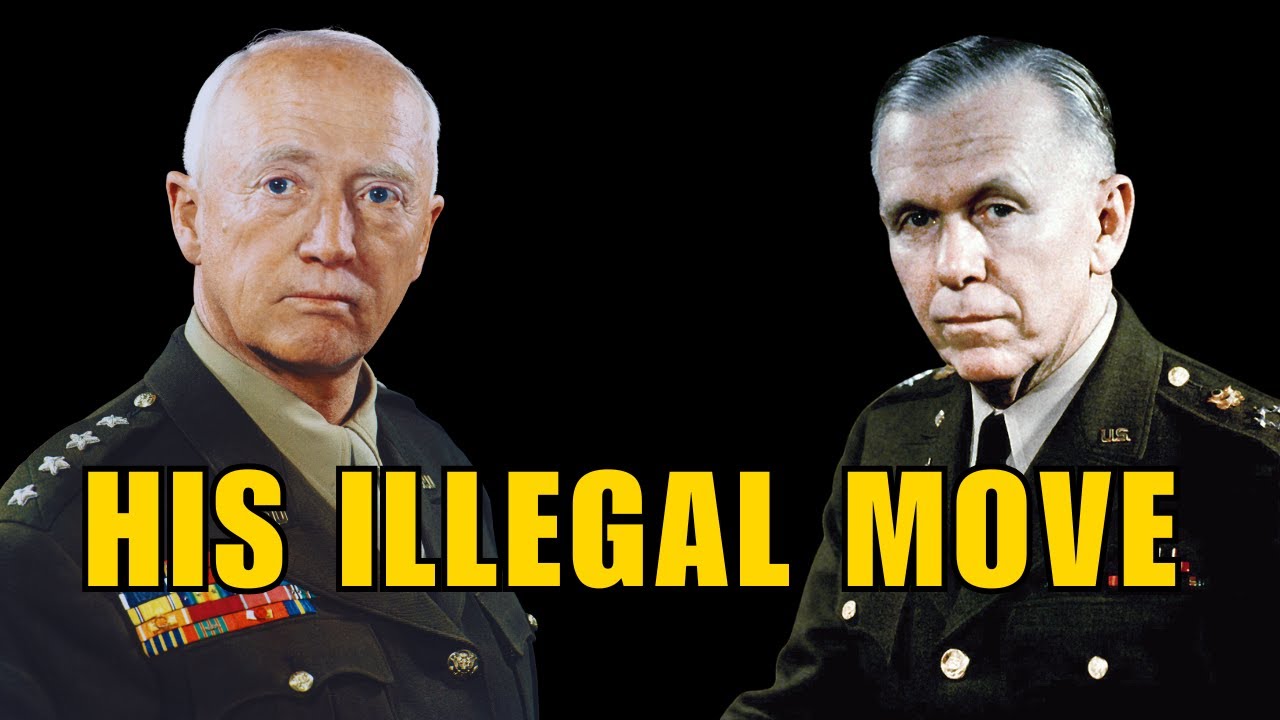
George Patton had taken the Second Armored Division completely outside the designated maneuver area. He crossed into Texas, bought gasoline from civilian service stations, and was threatening to decapitate Lear’s entire command from the north.
Lear wanted Patton disciplined. He wanted the maneuver voided. He wanted justice.
What Lear didn’t know was that in Washington, General George C. Marshall was watching this protest with great interest. Marshall didn’t care about rules. He cared about results.
Patton had just won the war game by treating it like an actual war. Lear had just lost by treating it like a game.
The decision Marshall made next would determine which type of officer would lead American forces into World War II.
On September 1st, 1939, the same day Hitler invaded Poland, Franklin Roosevelt made George C. Marshall the Army Chief of Staff. Marshall inherited a military ranked between 18th and 19th in the world.
Most officers had trained for static trench warfare since 1918. Equipment was obsolete. Some units conducted drills with broomsticks because real rifles were in short supply.
Marshall had spent World War I watching General Pershing relieve droves of unfit commanders. Men who had sustained reputations under less trying conditions proved too weak for the pressures of modern war.
Marshall never forgot. In October 1939, he told his staff that most general officers were too old to command troops under the terrific pressure of modern war. Their minds were set in outmoded patterns.
He needed aggressive leaders who understood mobile warfare. The problem was that the Army’s seniority system promoted officers based on time in service, not capability.
Marshall appointed a board of retired generals empowered to remove officers from line promotion. In the first six months, the panel removed 195 captains, majors, lieutenant colonels, and colonels. Ultimately, 500 colonels were forced into retirement.
But removing incompetence was only half the problem. Marshall needed to identify who deserved promotion. He needed to see officers command under pressure and adapt when plans collapsed.
In early 1941, Congress appropriated $21 million for the largest peacetime military exercise in American history. Camps were constructed across Louisiana, and the exercise covered 3,400 square miles.
By September 1941, 472,000 troops assembled. They divided into two fictitious nations, Red and Blue, fighting over Mississippi River navigation rights.
The maneuvers were unscripted. Commanders were given maximum freedom to achieve objectives however they saw fit.
Marshall was succinct before the exercise began. “I want the mistakes made down in Louisiana, not over in Europe.”
Lieutenant General Ben Lear commanded the Red Army. At 65, he was a rigid disciplinarian known for strict adherence to doctrine.
Lieutenant General Walter Krueger commanded the Blue Army. His chief of staff was a 51-year-old colonel named Dwight D. Eisenhower.
Major General George S. Patton commanded the Second Armored Division, nicknamed Hell on Wheels. At 55, Patton had spent decades studying armored warfare when most American officers dismissed tanks as infantry support.
Phase 1 began September 15th, 1941. Patton’s division was assigned to Lear’s Red Army.
His tanks moved so fast that by afternoon, advanced units had reached Fort Jessup near Many, Louisiana. A sharp battle erupted with mounted cavalry from the Blue 1st Cavalry Division.
But Lear refused to let Patton’s armor operate independently. He forced the Second Armored to move at infantry pace, using tanks as mobile artillery support.
Patton protested. “Tanks should lead breakthroughs, not follow foot soldiers.”
Lear overruled him. Within 24 hours, the division bogged down in swampland. Blue Army anti-tank units destroyed Patton’s tanks piecemeal because they were tied to slow infantry columns.
When Phase 1 ended, the Second Armored had been defeated. The failure wasn’t the equipment. It was the doctrine.
Between phases, the armies reorganized. Patton’s division switched sides. He now reported to Krueger’s Blue Army.
The mission changed completely. Blue Army would attack and seize Shreveport.
Eisenhower studied the terrain and designed a wide flanking maneuver. Patton would send his armor west across the Sabine River into Texas, then north through east Texas, then east back into Louisiana to attack Shreveport from the rear.
The plan pulled the main striking force away from the objective, extended supply lines dangerously, and required crossing terrain that wasn’t in the maneuver area. Krueger approved.
Patton received his orders on September 24th. Phase 2 began.
The Blue 1st Cavalry Division crossed the Sabine River to attack Shreveport from the south. This served as flank cover for Patton’s main thrust.
Meanwhile, Patton took the Second Armored Division on a completely different route. He crossed the Sabine River into Texas at Orange on the Gulf Coast.
From Orange, Patton drove to Beaumont, then turned north. His column included over 15,000 men, 390 tanks, and thousands of support vehicles.
Moving that much combat power nearly 400 miles in 3 days through unfamiliar terrain would be difficult under ideal conditions. Tropical storms had hit the region a week before. Roads were mud. Rivers were swollen.
Patton’s tanks rolled 24 hours straight. His ordnance teams performed miracles. Tanks that broke down were repaired in 30 minutes.
The biggest problem was fuel. Standard Army logistics relied on bulky 10-gallon drums and slow-filling blitz cans. The simulated supply line couldn’t keep pace with the 24-hour armor dash.
Patton sent officers with cash to every service station along his route through east Texas. They bought every gallon of gasoline.
Tank commanders pulled their vehicles up to rural gas pumps where farmers had been buying fuel minutes before. Startled attendants watched armored vehicles refuel like cars.
Receipts were collected. The Army would reimburse the stations later.
It violated procurement regulations. It bypassed the official supply chain. It worked.
From Henderson, Patton turned east and crossed back into Louisiana just north of Caddo Lake near Greenwood. By September 27th, the Second Armored Division was dashing northward in east Texas.

Red Army commanders scrambled. They lost track of Patton for 48 hours.
Reports came in of tanks in Texas, but Red intelligence assumed it was reconnaissance or a feint. Nobody believed an entire armored division would leave the maneuver area.
Lear’s defenses faced south toward Leesville, where he expected Krueger’s main attack. He never expected the old cavalryman to do something completely unexpected.
On the night of September 27th, Patton’s forces camped just west of Belcher, Louisiana. The next morning, they drove through Belcher and Dixie and attacked Shreveport from the north.
Red Army units scrambled to reorient. Orders contradicted each other. Commanders didn’t know which threat was real.
Patton’s reconnaissance battalions drove straight for Barksdale Field, the main air base and headquarters of Red Army’s Second Air Task Force. They overran the field and captured the entire staff.
Lear’s air support coordination collapsed. Red Army responded by launching bombers that attacked Patton’s columns and destroyed bridges, slowing him just enough to prevent complete encirclement.
But the damage was done. General Lesley J. McNair, who supervised the maneuvers, realized the Red Army was caught in a vise.
Blue First Cavalry was attacking from the south. Patton’s armor had decapitated command from the north.
McNair called a halt to the maneuvers on September 28th after only 4 days of Phase 2. Blue Army had won.
Lear filed his formal protest immediately. Patton had violated maneuver boundaries. He’d used civilian resources instead of military supply chains. The entire operation should be invalidated.
When umpires approached Patton about the protest, his response became legendary. “I am unaware of the existence of any rules in war.”
The umpires forwarded Lear’s protest to GHQ. Marshall read it personally.
Marshall sided with Patton. The reasoning was simple. War doesn’t have boundaries marked on maps. The enemy doesn’t respect maneuver areas. Supply chains break down.
Improvisation isn’t a violation of doctrine. It’s a requirement for victory.
Marshall used the 1941 maneuvers as his primary evaluation tool for senior leadership. Of the 42 generals who commanded divisions, corps, or armies during the exercises, only 11 would go on to command in actual combat.
Marshall relieved or pushed aside 31. They were too cautious, too rigid, too slow.
Patton emerged from Louisiana as one of the rising stars. Within months, Marshall would call him to Washington for promotion.
Eisenhower also caught Marshall’s attention. Eight days after Pearl Harbor, Marshall brought Eisenhower to Washington. By 1941, Eisenhower was a colonel. One year later, he was a three-star general and would become Supreme Allied Commander.
The tactics Patton demonstrated in Louisiana appeared again 3 years later.
December 1944, Battle of the Bulge. Germany launched its last major offensive through the Ardennes Forest. American forces were in retreat. The 101st Airborne Division was surrounded at Bastogne.

Eisenhower called an emergency meeting at Verdun. He asked his commanders how quickly they could counterattack.
Most generals talked about weeks of preparation. Moving armies was complicated. They needed time.
Patton said 48 hours. He could attack in two days with three divisions.
The other generals thought he was grandstanding. You couldn’t turn an entire army 90 degrees and attack on a completely different axis in 48 hours.
But Patton had already prepared. His intelligence officer had predicted the German attack when everyone else dismissed the possibility. Patton had quietly developed contingency plans.
Patton made one phone call. Within hours, Third Army began its pivot north. More than 250,000 men and tens of thousands of vehicles moved in winter conditions, across icy roads, in 48 hours.
The relief of Bastogne came on December 26th. Patton had done it again.
The same maneuver he’d executed in Louisiana in 1941. Turn the flank. Move faster than the enemy expects. Hit from an unexpected direction.
After the war, German generals were interrogated extensively. “Which Allied commanders did you fear most?”
The answers were remarkably consistent. Montgomery was predictable and methodical. Bradley was competent but cautious. Patton was different.
Field Marshal Gerd von Rundstedt said Patton was the Allied general they feared most. General Fritz Bayerlein said Patton was the only Allied commander who had the instincts of a German Panzer leader.
From the first day German forces encountered Patton in North Africa to the last day of the war, they underestimated how fast he could move. Every time, they paid for it.
German military doctrine emphasized speed, aggression, and exploitation of enemy weaknesses. Patton understood it, too.
German commanders could predict what most Allied generals would do. Patton didn’t follow the rules.
He attacked when doctrine said to defend. He advanced when logistics said to halt. He took risks that his superiors considered reckless and his enemies considered terrifying.
The Germans never knew what Patton would do next. They only knew it would be fast, it would be violent, and it would cost them.
September 1941, 3 months before Pearl Harbor, the Louisiana maneuvers ended. Soldiers went back to their bases. Equipment was inventoried. After-action reports were filed.
But the real result wasn’t measured in tanks or miles or maneuver scores. Marshall had his answer.
He knew which officers could lead American forces against the Wehrmacht. He knew who understood mobile warfare. He knew who would win.
George Patton bought gasoline at Texas service stations and became one of America’s most feared generals because he understood one thing Ben Lear never did.
Rules exist to create order in peacetime. War is chaos.
The officer who wins isn’t the one who follows the rules best. It’s the one who achieves the objective fastest.
Marshall made his choice. Three years later, Patton would command Third Army across France, destroying German divisions and proving that the Texas end run wasn’t luck.
It was the future of American warfare.